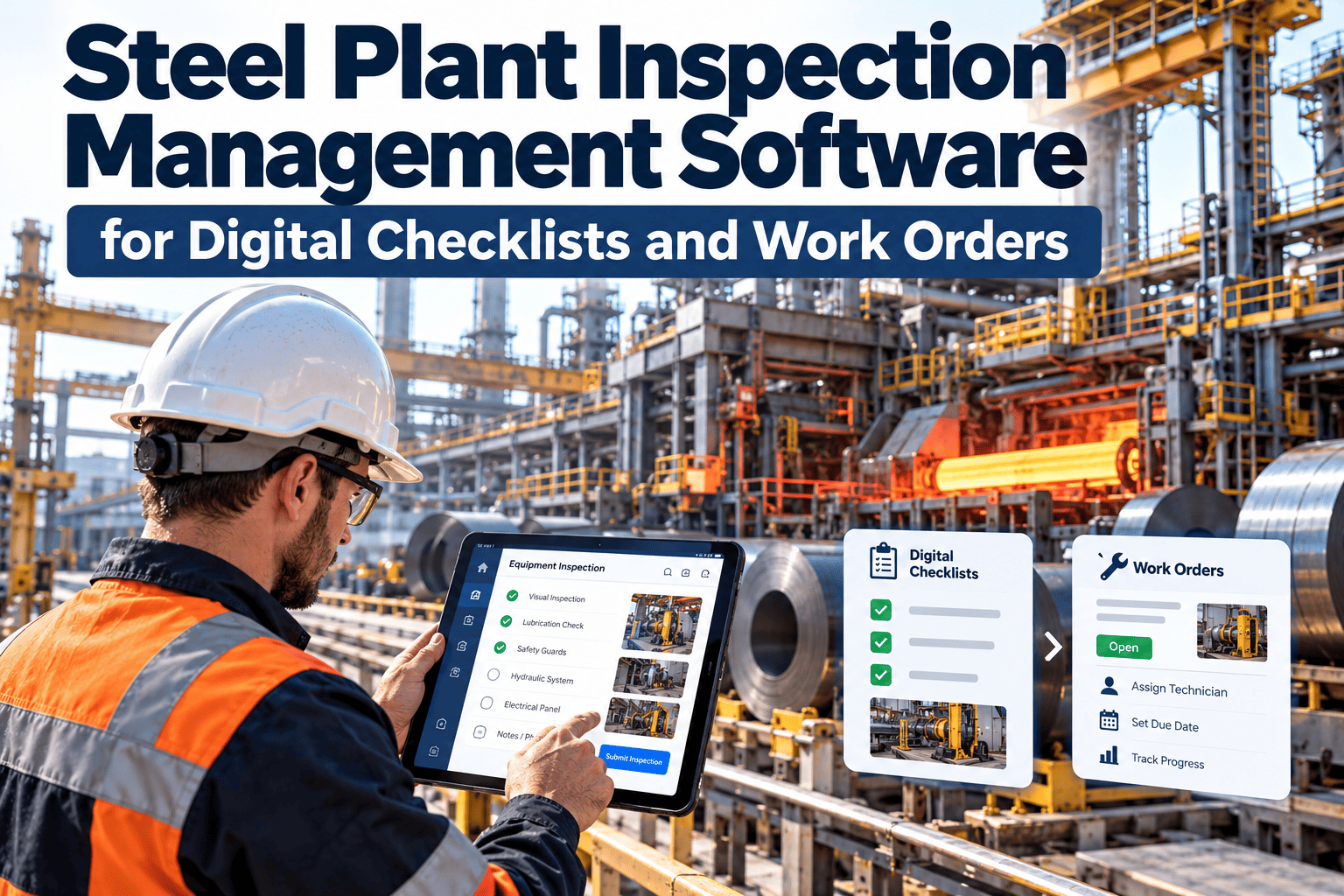
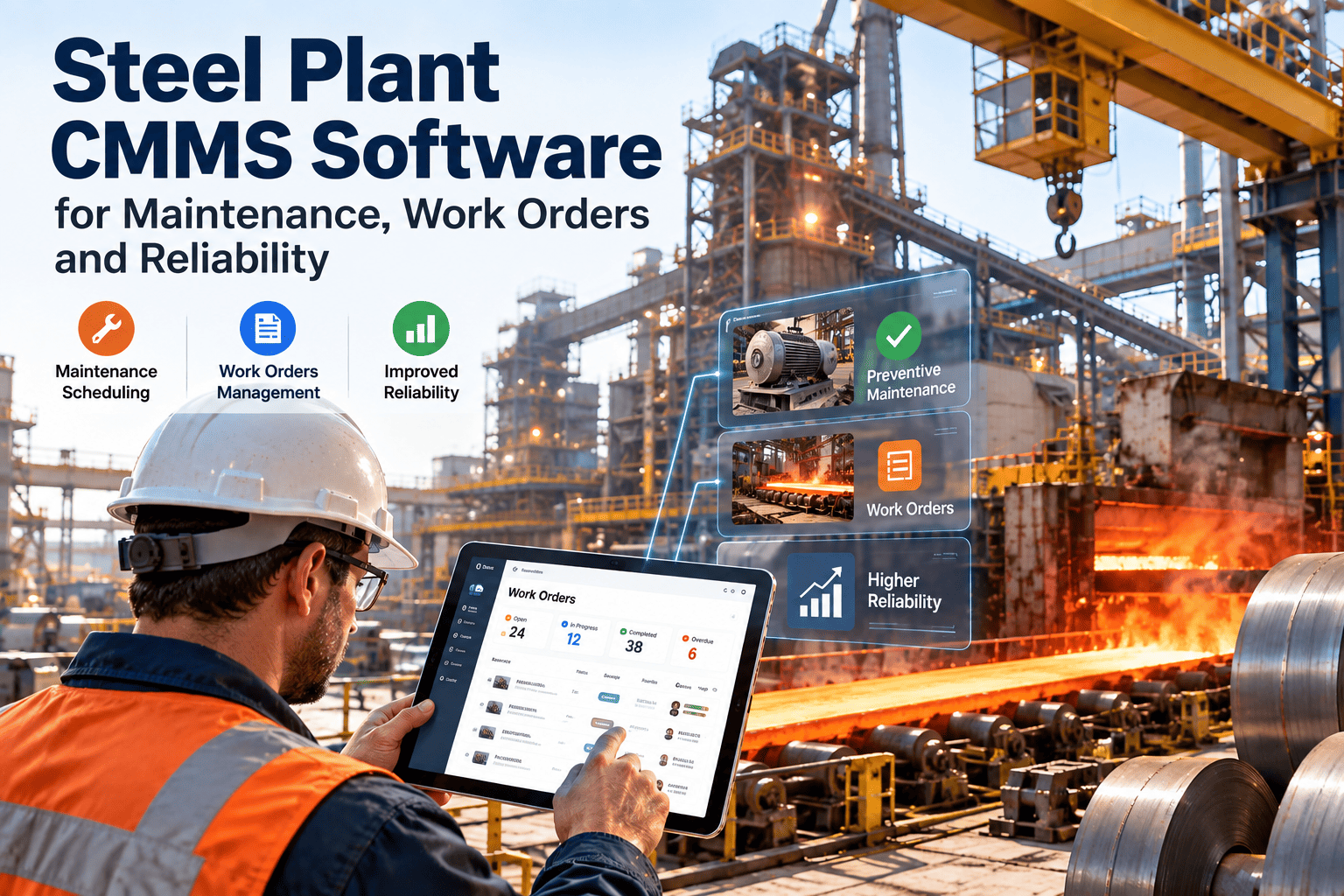
In a steel mill, every minute of unplanned downtime costs between $50,000 and $200,000—and the root cause is almost always the same: a maintenance task that was delayed, lost, or never assigned in the first place. When work orders live on whiteboards, radio calls, and paper clipboards, critical repairs fall through the cracks. Technicians waste hours tracking down parts. Supervisors can't see what's been done and what's overdue. The result is a maintenance operation running blind in one of the most demanding industrial environments on earth. Modern work order management software eliminates this chaos by digitizing every maintenance task from request to completion—giving steel mills real-time visibility, automated scheduling, and accountability across every shift, every crew, and every asset on the plant floor.
Why Steel Mills Need Dedicated Work Order Management
Steel production is a continuous, high-stakes process where every asset—from blast furnaces and casters to rolling mills and overhead cranes—must stay operational around the clock. Generic task management tools can't handle the complexity, urgency, and compliance demands of steel mill maintenance.
24/7 Multi-Shift Operations
Steel mills run three shifts with rotating crews. Work orders must transfer seamlessly between shifts with full context—photos, notes, parts used, and completion status—so nothing gets repeated or missed during handoff.
Emergency vs. Planned Priority
When a blast furnace cooling line fails, it's a $200K/hour emergency. Work order systems must instantly escalate critical tasks, auto-assign the nearest qualified technician, and push notifications to supervisors—all within seconds.
Complex Asset Dependencies
A single rolling mill work order might require coordination across electrical, mechanical, and hydraulic teams. The system must manage multi-trade assignments, prerequisite tasks, and lockout/tagout procedures in one unified workflow.
Compliance Documentation
Every completed work order becomes part of the audit trail. OSHA, EPA, and ISO standards require timestamped records of who performed what task, which parts were used, and what safety procedures were followed—automatically, not manually.
Harsh Environment Access
Technicians work in extreme heat, dust, and noise. Work order tools must function offline on rugged mobile devices, allowing task completion without Wi-Fi connectivity in blast furnace zones and rolling mill pits.
Spare Parts Coordination
Steel mill work orders often fail not because of labor—but because the right part wasn't available. Integrated inventory management links work orders to parts reservations, auto-triggers reorder points, and tracks consumption by asset.
How We Ranked: Evaluation Criteria
We evaluated each work order management platform across six critical dimensions that matter most for steel mill maintenance operations. Here is how each criterion was weighted.
Top 10 Work Order Management Solutions for Steel Mills
Oxmaint
Best Overall Work Order Management for Steel MillsPurpose-built for heavy industry, Oxmaint delivers end-to-end work order management designed around the realities of steel mill operations. From IoT-triggered emergency work orders to multi-shift handoff tracking, automated preventive maintenance scheduling, and real-time mobile access in offline zones—Oxmaint gives maintenance managers complete command over every task on the plant floor. Deploys in days with zero disruption to production.
IBM Maximo
Best for Enterprise-Scale Steel OperationsMaximo's work order module is deeply configurable with advanced workflow orchestration, job plan libraries, and multi-craft assignment. Ideal for multinational steel corporations with complex approval hierarchies. However, setup requires significant IT investment and 6–12 months of implementation time.
MaintainX
Best Mobile Work Order ExperienceAward-winning mobile-first platform with the most intuitive work order interface on the market. Technicians can create, complete, and document work orders with photos and comments in seconds. Excellent for digitizing paper processes. Less depth in heavy industrial IoT triggers and complex multi-trade workflows.
SAP Plant Maintenance
Best for SAP-Integrated MillsWork order management tightly integrated with SAP ERP for procurement, warehouse, and finance. Notification-to-order workflows support complex approval chains. The natural choice for mills already on SAP, but customization requires consultants and the mobile experience lags behind cloud-native competitors.
Fiix (by Rockwell Automation)
Best for AI-Prioritized Work OrdersCloud-based platform with AI-powered work order prioritization through Fiix Foresight. Automatically scores asset-failure risk and ranks work orders by criticality. Integration Hub connects to SCADA, ERP, and MES without custom middleware. Strong mid-market fit for steel plants modernizing maintenance operations.
LLumin CMMS+
Best for Sensor-Triggered Work OrdersExcels at automatically generating work orders from real-time PLC and SCADA data. When vibration, temperature, or pressure exceeds defined thresholds on a rolling mill motor, LLumin creates a prioritized work order instantly. Best for heavily automated steel plants wanting to eliminate manual work order creation for critical assets.
UpKeep
Best for Fast Digital AdoptionCloud-native platform that gets maintenance teams off paper and into digital work orders within days. Intuitive mobile interface, request portals for operators, and solid inventory management. Well-suited for smaller steel operations or secondary plants needing a quick upgrade without enterprise complexity.
Infor EAM
Best for Multi-Plant Work Order StandardizationEnterprise asset management with standardized work order templates across multiple steel plant locations. Deep integration with Infor's ERP, supply chain, and HR systems enables consistent task execution and reporting. Requires dedicated IT staff and longer deployment timelines.
Limble CMMS
Best for Custom Work Order TemplatesHighly customizable work order templates and workflow builder make Limble adaptable to steel-specific procedures. Drag-and-drop custom fields, conditional logic, and flexible approval chains. High user satisfaction scores but limited in real-time IoT-triggered work order generation.
Accruent Maintenance Connection
Best for Compliance-Driven Work OrdersEnterprise-grade platform with strong compliance-focused work order management. Every task captures timestamped audit data, safety checklist completion, and regulatory documentation automatically. Trusted by steel producers like SSAB for maintaining ISO and OSHA compliance records across multi-site operations.
Quick Comparison: Top 10 at a Glance
| Rank | Solution | Best For | Deployment | WO Automation | Pricing |
|---|---|---|---|---|---|
| #1 | Oxmaint | Overall steel mill WO management | Cloud / Days | Excellent | $$ |
| #2 | IBM Maximo | Enterprise-scale operations | Cloud or On-Prem / 6–12 mo | Excellent | $$$$ |
| #3 | MaintainX | Mobile work order experience | Cloud / 1–2 weeks | Good | $$ |
| #4 | SAP PM | SAP-integrated mills | On-Prem / 6–12 mo | Good | $$$$ |
| #5 | Fiix | AI-prioritized work orders | Cloud / 4–8 weeks | Good | $$$ |
| #6 | LLumin CMMS+ | Sensor-triggered work orders | Cloud / 4–8 weeks | Excellent | $$$ |
| #7 | UpKeep | Fast digital adoption | Cloud / 1–2 weeks | Moderate | $$ |
| #8 | Infor EAM | Multi-plant standardization | Cloud or On-Prem / 6–12 mo | Good | $$$$ |
| #9 | Limble | Custom WO templates | Cloud / 2–4 weeks | Moderate | $$ |
| #10 | Accruent MC | Compliance-driven work orders | Cloud or On-Prem / 4–8 wks | Good | $$$ |
The Work Order Lifecycle in a Steel Mill
Effective work order management follows a structured lifecycle that ensures every maintenance task—from initial request to final sign-off—is tracked, documented, and optimized. Here is how each stage should flow in a steel mill environment.
Request & Creation
Operators submit requests via mobile app, kiosk, or IoT sensors auto-generate work orders when equipment thresholds are breached.
Triage & Assignment
Supervisors prioritize by criticality, assign to qualified technicians by trade and availability, and link required spare parts.
Execution & Documentation
Technicians execute the repair, log labor hours, attach photos, record parts consumed, and complete safety checklists—all via mobile device.
Close & Analyze
Completed work orders feed dashboards with KPIs—MTTR, backlog, completion rate—driving continuous improvement and compliance reporting.
The ROI of Digital Work Order Management
Digitizing work order management delivers measurable results within weeks of deployment. Here is what steel mills typically see after moving from paper-based or spreadsheet systems to a modern platform.
Frequently Asked Questions
What is work order management in a steel mill context?
Work order management is the systematic process of creating, assigning, tracking, and completing maintenance tasks across all assets in a steel mill. In the steel industry context, this includes everything from routine preventive maintenance on rolling mills and overhead cranes to emergency repairs on blast furnace cooling systems. A digital work order system replaces paper-based processes with automated workflows that ensure every task is properly documented, assigned to qualified personnel, and completed with full audit trail compliance.
How does automated work order generation work with IoT sensors?
IoT sensors attached to critical steel mill equipment continuously monitor parameters like vibration, temperature, pressure, and current draw. When readings exceed predefined thresholds—for example, a rolling mill bearing vibration exceeding 7.1 mm/s—the system automatically creates a prioritized work order, assigns it to the nearest qualified technician, reserves the required spare parts, and sends push notifications to maintenance supervisors. This eliminates the delay between fault detection and repair initiation, which is critical in steel operations where every hour of downtime costs $50K–$200K.
Can work order software handle multi-shift handoffs in steel mills?
Yes—this is one of the most critical capabilities for steel mill operations. Modern work order platforms maintain a living record of every task including current status, work completed so far, photos and notes from the outgoing shift, parts consumed, and remaining steps. When a new shift begins, incoming technicians see exactly where every open work order stands without relying on verbal handoffs or whiteboard summaries. Some platforms like Oxmaint include dedicated shift handoff reports that supervisors can review at the start of each rotation.
How does work order software ensure regulatory compliance?
Every completed work order automatically captures timestamped data including who performed the task, when it was started and completed, which safety procedures were followed (lockout/tagout, confined space entry), what parts were used, and any photos or inspection results. This creates a tamper-proof digital audit trail that satisfies OSHA, EPA, ISO 14001, and ISO 45001 requirements. During audits, maintenance managers can instantly pull compliance reports filtered by asset, date range, or regulation type—eliminating the days of manual record assembly required with paper-based systems.
What is the typical cost of work order management software for a steel mill?
Cloud-based work order platforms range from $30–50 per user per month (Oxmaint, MaintainX, UpKeep) to $100,000–500,000+ annually for enterprise solutions (IBM Maximo, SAP PM, Infor EAM) including licensing, customization, and support. For a mid-size steel mill with 50–100 maintenance users, expect $50,000–150,000 annually. The ROI calculation is straightforward: if the system prevents even one hour of unplanned blast furnace downtime per quarter, it pays for itself within weeks.
How quickly can a steel mill implement work order management software?
Cloud-native platforms like Oxmaint can be deployed in days to 2 weeks with phased rollouts starting from a single department. Mid-tier solutions like Fiix or MaintainX typically take 4–8 weeks. Enterprise systems like IBM Maximo or SAP PM require 6–12 months including data migration, workflow customization, ERP integration, and multi-site training. The fastest path for steel mills is to start with a cloud-based platform on critical assets, prove ROI, then expand across the full operation.
Stop Losing Tasks Between Shifts and Crews
Oxmaint gives your steel mill digital work order management with automated task routing, real-time mobile access, IoT-triggered work orders, and complete compliance documentation—all in a platform that deploys in days. Join the steel mills that have cut work order completion time by up to 60%.