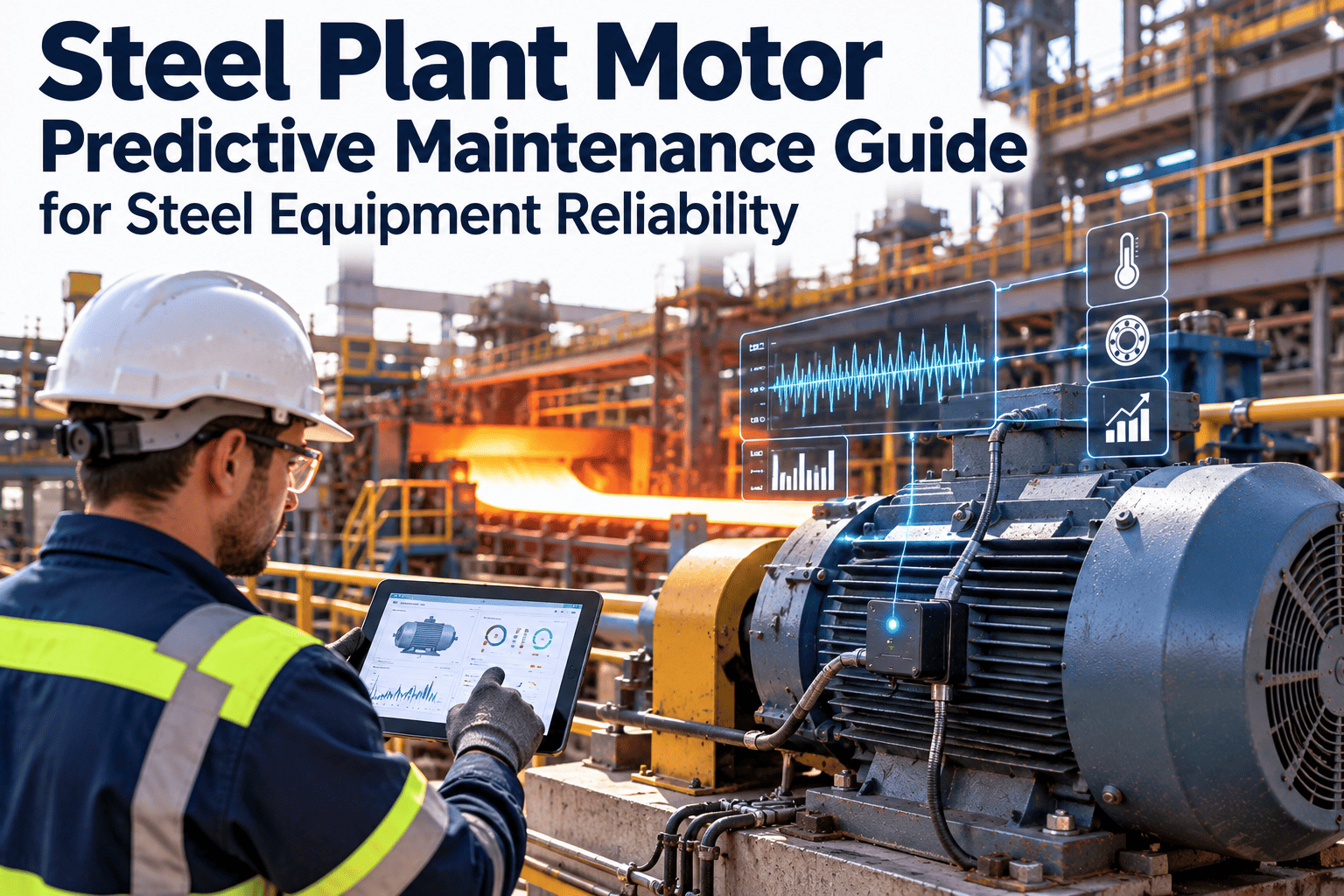
The 4,500 HP main drive motor on a hot strip mill finishing stand seized without warning at 2:23 AM. The catastrophic bearing failure did not just destroy a $380,000 motor — it triggered a cascade that halted 2.4 million tonnes of annual rolling capacity for 9 days, cost $14.2 million in lost production, $2.1 million in emergency repair costs, and expedited freight charges that exceeded the motor's original purchase price. The root cause analysis revealed that vibration signatures had been trending toward failure for 11 weeks. The data existed in a standalone analyser. It never reached the maintenance planning system. The bearing announced its death for months. Nobody heard it. OxMaint's motor health AI ensures every vibration trend, thermal deviation, and motor current anomaly converts automatically into a prioritised work order — before the 11-week window closes.
Predictive Maintenance · Steel Industry
Industrial Motor Health Monitoring System
Continuous vibration · MCSA · thermal · multi-sensor fusion · auto work orders
83% of rotating equipment failures exhibit detectable vibration, thermal, or electrical degradation signatures 2–12 weeks before functional failure. The challenge is not detection — it is converting detection into maintenance action before the window closes.
83%
of motor failures have detectable signatures 2–12 weeks before functional breakdown
70%
breakdown reduction reported by Deloitte across condition-monitoring adopters
94%
failure type accuracy with multi-sensor fusion models vs. 65% with vibration alone
$14.2M
production loss from a single undetected motor failure on a hot strip mill stand
4 Monitoring Techniques — What Each Detects, What It Misses Alone
Vibration Analysis
Detects
Bearing BPFO/BPFI/BSF/FTF defects · Shaft imbalance (1× RPM) · Misalignment (2× RPM) · Mechanical looseness · Gear mesh anomalies
Lead time: 3–8 weeks
Limitation: Load variation on rolling mill drives causes false alarms in threshold-only systems — requires load-normalised AI models
Motor Current Signature Analysis (MCSA)
Detects
Rotor bar cracks · Winding asymmetry · Eccentricity · Load-related mechanical faults invisible in vibration · Electrical supply imbalance
Lead time: Weeks–months
Advantage: Non-contact detection from MCC — no sensor mounting on motor body required. Ideal for high-temperature and inaccessible locations
Thermal Imaging
Detects
Winding hot spots from insulation breakdown · Bearing housing temperature rise · Coupling misalignment heat · Cooling system blockage
Lead time: Days–weeks
Application: Periodic route-based thermal surveys on scheduled routes; continuous thermal monitoring on critical motors in accessible locations
Multi-Sensor Fusion
Combined Score
Vibration + MCSA + thermal + oil analysis weighted into a composite health score. Fires only when multiple signals confirm — reduces false positive rate from 35% to below 8%
Accuracy: 94% fault type
POSCO: 180 rolling mill assets on edge AI fusion models in 2024 — false positives below 8%, maintenance cost per asset down 25%
The Failure That AI Would Have Prevented — Reconstructed
Week −11
BPFO frequency amplitude begins rising
AI: Advisory alert generated. Work order WO-XXXX created — replace F3 NDE bearing within 6 weeks. Parts check: 2 of 2 in stock. Estimated window: next planned maintenance stop.
Paper system: Reading archived in standalone analyser. Not reviewed.
Week −6
BPFO harmonics appear. Temperature trending +0.4°C/week
AI: Work order escalated to P2 Urgent. Bearing replacement within 3 weeks recommended. Maintenance window booked — 8-hour planned stop scheduled.
Paper system: Quarterly technician route not yet due. No action.
Week −2
Stage 3 bearing signature. Audible to experienced mechanic
AI: Scenario avoided — bearing replaced 4 weeks earlier during planned stop. 8 hours downtime. $85,000 cost.
Paper system: Technician reports "bearing sounds bad." Emergency repair initiated. Parts not in stock — order placed.
Week 0
Catastrophic bearing failure — 2:23 AM
AI path: $85K planned repair, 8 hours planned downtime. Stand running.
Paper path: $14.2M production loss. $2.1M emergency repair. 9-day mill stop. Motor destroyed.
The Bearing Announced Its Failure for 11 Weeks. The Only Question Is Whether Anyone Was Listening.
OxMaint converts continuous sensor data into timestamped work orders before the detection window closes — connected to your existing instrumentation infrastructure.
Motor Health Coverage — Steel Plant Asset Classes
Rolling Mill Main Drives
Power range500–10,000 HP per stand
Primary monitoringVibration (triaxial) + MCSA + winding temperature
Key faultsRotor imbalance, bearing defects, rotor bar cracks, misalignment post-roll-change
Special challengeLoad variation during rolling requires AI load-normalised baseline — not static thresholds
Blast Furnace Blowers
Power range5,000–30,000 HP
Primary monitoringVibration + thermal + MCSA from MCC (inaccessible motor location)
Key faultsBearing degradation, winding insulation failure, rotor eccentricity from dust buildup
Special challengeHigh-dust environment accelerates bearing wear — conservative P–F interval of 3–5 weeks
Caster Withdrawal Motors
Power range100–500 HP per strand
Primary monitoringMCSA (load profile monitoring) + vibration at gearbox
Key faultsLoad variation from strand bulging detectable in current draw before quality impact
Special challengeThermal environment near liquid steel limits direct sensor mounting — MCSA is primary method
ID/FD Fans & Pumps
Power range50–2,000 HP
Primary monitoringVibration + temperature + current draw trending
Key faultsImbalance from dust buildup, cavitation (pumps), bearing degradation, belt/coupling wear
Special challengeLarge fleet — route-based monitoring on non-critical; continuous on process-critical fans
"
The gap I encounter repeatedly is not in the sensor technology or the diagnostic algorithms — both are mature and reliable. The gap is between the analyser and the maintenance planner. When condition monitoring data lives in a standalone system that requires a specialist to interpret and manually raise a work order, the detection happens and nothing changes. I have worked with plants where the vibration analysis programme was technically excellent — 90%+ early detection rate — but the maintenance backlog was not reducing because the insights were not reaching the people who schedule work. MCSA and vibration data connected directly to the CMMS work order creation is the integration that closes the loop. Not a recommendation in a report. A work order with a due date, a priority, and the parts already checked against storeroom stock.
Olusegun Adeyemi, MSc Energy Systems, CEng MIChemE
Senior Reliability Manager — ArcelorMittal Flat Carbon Europe · 19 Years Steel Plant Maintenance and Reliability · Chartered Engineer (IChemE) · Specialist in condition monitoring programme deployment, MCSA-to-CMMS integration, and motor reliability improvement for hot strip mills and EAF melt shops
Frequently Asked Questions
How does OxMaint handle the high false-positive rate that makes vibration alarms get ignored on rolling mills?
False positives from load variation are the primary reason rolling mill operators stop trusting vibration alarms. OxMaint's AI baseline correlates every vibration reading against concurrent rolling force, speed, and temperature from the Level 2 process system — comparing against what the model predicts for those exact conditions rather than against a static threshold. The alarm fires only when the signature deviates from the load-adjusted prediction. Single-sensor systems produce false-positive rates of 35–40%. Multi-sensor AI fusion models running load-normalised analysis reduce false positives below 8% — and operator trust in the alarms that do fire rises to the level that drives action.
Book a demo to see load-normalised motor monitoring for your mill configuration.
Can OxMaint monitor motors using MCSA without mounting sensors directly on the motor body?
Yes. Motor Current Signature Analysis (MCSA) works from the motor control centre — monitoring current draw through existing CT sensors or dedicated MCSA probes at the MCC without any hardware mounted on the motor itself. This is the primary monitoring method for blast furnace blower motors, caster withdrawal drives, and any motor operating in high-temperature or physically inaccessible locations where accelerometers cannot be safely mounted or reliably maintained. OxMaint connects to existing MCC current measurement infrastructure via OPC-UA or Modbus TCP and performs MCSA spectral analysis in the analytics layer — detecting rotor bar defects, winding asymmetry, and eccentricity without touching the motor.
Start your free trial to assess MCSA connectivity for your existing motor control infrastructure.
What is the typical lead time between first AI detection and motor failure — and is it enough to schedule a planned repair?
Bearing defects in industrial motors typically progress through four stages over 3–12 weeks from first detectable signal to functional failure — the P–F interval. OxMaint detects at Stage 1–2 (subsurface micro-cracking through early surface pitting), giving 3–8 weeks of lead time for most industrial bearing sizes. This is sufficient for ordering replacement bearings, scheduling a planned maintenance window, and staging the repair. The specific P–F interval varies by bearing size, load, speed, and lubrication condition — OxMaint calibrates per-asset P–F estimates from historical failure data as campaign history accumulates, improving the accuracy of the remaining useful life estimate over time.
Motor Health Monitoring AI — OxMaint
Every Motor Failure Sends a Warning. OxMaint Ensures It Becomes a Work Order — Not a Shutdown.
Continuous vibration analysis, MCSA from the MCC, thermal monitoring, and multi-sensor fusion — all converting automatically into prioritised work orders before the P–F interval closes. Connected to your existing sensor and control infrastructure without replacing it.