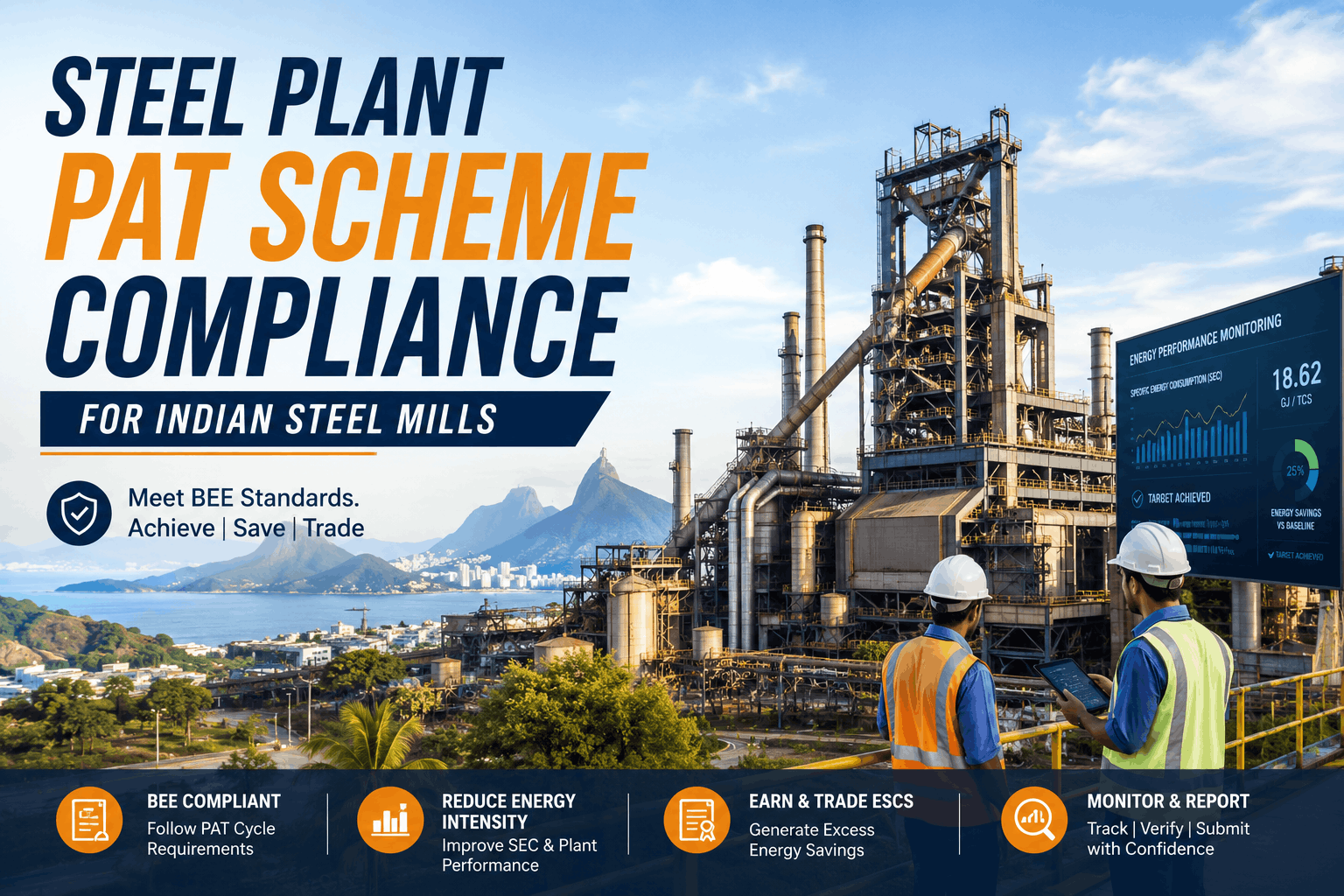
India's steel industry consumes over 20,000 TOE per year per plant — and every one of those plants classified as a Designated Consumer (DC) under BEE's PAT scheme is legally required to hit SEC reduction targets, file annual energy returns, and clear mandatory audits every three years. Yet with PAT Cycle VII already active through 2025 and the Carbon Credit Trading Scheme (CCTS) set to follow from FY 2025-26, steel plant energy managers are now running two compliance clocks simultaneously — and the cost of missing either is not just financial penalties, it is mandatory ESCert purchases at market price. Start tracking SEC and PAT compliance in Oxmaint free and get your first live energy dashboard from your first work order — or book a 15-minute demo to see how Oxmaint automates energy data capture, SEC calculation, and audit-ready reporting for steel plants.
PAT Scheme Compliance for Steel Plants: SEC Targets & Energy Reporting
163 steel units are Designated Consumers under India's PAT scheme. Here is everything your energy team needs to track SEC, clear BEE audits, manage ESCerts, and stay ahead of CCTS — with data that updates every shift, not every quarter.
What the PAT Scheme Actually Requires from Steel Plants
The Perform, Achieve and Trade (PAT) scheme — run by the Bureau of Energy Efficiency (BEE) under India's Ministry of Power — is not a voluntary program. It is a legally binding regulatory instrument under the Energy Conservation Act. Steel plants that cross the 20,000 TOE annual consumption threshold become Designated Consumers and inherit four non-negotiable obligations that repeat every three-year cycle.
A certified Energy Manager must be formally designated and notified to BEE. This person is the compliance owner for all PAT filings, audit coordination, and SEC target tracking.
Energy consumption data must be reported to BEE every year. Incomplete or inaccurate filings trigger scrutiny and delay ESCert issuance — or mandate purchase obligations.
The first mandatory audit must be completed within 18 months of DC notification. Subsequent audits are required every three years by BEE-accredited auditors.
Each DC receives a plant-specific SEC reduction target. Overachievers earn tradable ESCerts. Underachievers must purchase ESCerts or face financial penalties under the EC Act.
Specific Energy Consumption (SEC): The Number That Decides Your Compliance
SEC is not just a KPI — it is the compliance metric BEE uses to determine whether your plant earns ESCerts or owes them. Getting your SEC calculation right, with audit-verifiable data, is the foundation of everything else in PAT compliance.
The gap between India's average SEC and international Best Available Technology (BAT) represents the PAT scheme's core opportunity — and your plant's risk if SEC data is not tracked accurately and continuously.
Your SEC Data Is Already Inside Your Work Orders. Oxmaint Surfaces It.
Every maintenance activity, equipment runtime, and energy consumption event creates data that belongs in your SEC calculation. Oxmaint connects operational work orders to energy tracking so your SEC updates in real time — not at audit time when it's too late to correct course.
PAT Cycles Explained: Where Your Plant Stands Right Now
PAT operates on a rolling cycle basis. Each 3-year cycle has its own set of Designated Consumers and SEC targets. Steel plants often participate across multiple concurrent cycles — which means your compliance obligations compound over time.
| PAT Cycle | Period | Steel DCs | Key Outcome | Status |
|---|---|---|---|---|
| Cycle I | 2012–2015 | Part of 478 DCs | 8.67 MTOE saved — 30% over target | Completed |
| Cycle II | 2016–2019 | Expanded coverage | 14.08 MTOE saved, 68 MT CO₂ avoided | Completed |
| Cycle III | 2017–2020 | 116 DCs (6 sectors) | 1.594 MTOE saved; ESCert trading Apr 2024 | Completed |
| Cycle IV–VI | 2018–2022 | Multiple steel units | M&V completed; under BEE scrutiny | Under Review |
| Cycle VII | 2022–2025 | 509 DCs across sectors | 6.627 MTOE total target — active now | Active |
| CCTS (Successor) | FY 2025-26 onward | Iron & Steel included | Shifts from SEC to emissions intensity targets | Upcoming |
Scroll horizontally to view full table on smaller screens
ESCerts: How Compliance Converts Into Certificates or Costs
Energy Saving Certificates are the financial heartbeat of the PAT mechanism. Overachieve your SEC target and you earn tradable certificates. Underachieve and you must buy them — at market price, on India Energy Exchange (IEX) or PXIL. Understanding this flow is essential for any steel plant energy manager.
Non-compliance in PAT Cycle I was 9%. By PAT Cycle II, it rose to 56%. The pattern is clear: plants that lack real-time SEC monitoring consistently miss targets they could have corrected mid-cycle. Data visibility is not a reporting convenience — it is the difference between earning ESCerts and buying them.
PAT to CCTS: What Steel Plants Must Prepare for Before FY 2025-26
India's Carbon Credit Trading Scheme (CCTS) — active from FY 2025-26 — is not a replacement for PAT in name only. It is a fundamental shift in what gets measured, how targets are set, and what non-compliance costs. Iron and steel is among the first four sectors mandated under CCTS.
The shift to annual compliance cycles under CCTS means data gaps that were manageable under a 3-year PAT window will become compliance failures within a single financial year. Steel plants that are still relying on spreadsheet-based energy tracking are running out of time to build the data infrastructure CCTS demands.
Track PAT + CCTS Compliance in One Dashboard — Not Two Spreadsheets.
Oxmaint is built for exactly this transition. Whether you are in PAT Cycle VII today or preparing for CCTS annual reporting from FY 2025-26, Oxmaint captures energy consumption data from your work orders and operations automatically — so you have audit-ready SEC and emissions records every single day.
How Oxmaint Turns Daily Operations into PAT Compliance Records
Compliance data lives in your plant every day — inside equipment runtimes, maintenance work orders, shutdown logs, and energy meter readings. The problem is that most steel plants collect this data in three different systems that never talk to each other. Oxmaint unifies it.
Track SEC for blast furnace, BOF, rolling mill, and auxiliary units separately — not just plant-wide. Spot which process is pulling your aggregate SEC above target before BEE's auditor does.
The data BEE requires in annual energy returns — production volumes, energy input by type, normalization factors — is captured automatically from work orders and shift logs. Export-ready for Form-A filing.
Every energy reading, equipment shutdown, and maintenance event is timestamped and linked to a work order. Accredited Energy Auditors get a verifiable data trail — not a spreadsheet reconstructed three years after the fact.
Unplanned shutdowns inflate your SEC by reducing output while fixed energy loads continue. Oxmaint tracks planned maintenance percentage so your energy team can see which downtime events are costing you the most SEC points.
Based on current SEC trajectory vs. your assigned target, Oxmaint projects whether your plant is on track to earn, break even, or need to purchase ESCerts — with enough lead time to act.
As CCTS begins annual compliance from FY 2025-26, Oxmaint's energy tracking foundation extends to emissions intensity monitoring — so the same system that runs PAT compliance today powers CCTS compliance tomorrow.
Frequently Asked Questions on PAT Compliance for Steel Plants
Which steel plants qualify as Designated Consumers under PAT?
Any iron and steel unit with annual energy consumption of 20,000 tonnes of oil equivalent (TOE) or more is classified as a Designated Consumer under BEE's PAT scheme. As of the latest cycles, 163 steel units across India have been notified as DCs. If your plant is near this threshold or has expanded capacity recently, you should verify your DC status directly with BEE or your State Designated Agency (SDA). Start tracking energy consumption in Oxmaint to maintain verifiable annual consumption records for DC status purposes.
What happens if a steel plant misses its PAT SEC target?
A plant that fails to achieve its assigned SEC target is directed by BEE to purchase ESCerts equivalent to the energy savings shortfall. ESCerts are traded on power exchanges at a floor price set by the Ministry of Power. If the purchase obligation is not fulfilled, the plant faces financial penalties under the Energy Conservation Act enforced by State Designated Agencies. Non-compliance rose to 56% in PAT Cycle II — mostly among plants without real-time SEC tracking. Book a demo to see how Oxmaint gives your team mid-cycle visibility to correct course before it becomes a purchase obligation.
How does the mandatory energy audit process work under PAT?
Every Designated Consumer must complete a Mandatory Energy Audit (MEA) within 18 months of being notified as a DC, and then repeat it every three years. Audits are conducted by BEE-empaneled Accredited Energy Auditors who verify your baseline SEC, validate your energy consumption data, and submit findings to the SDA and BEE. Gaps in operational data — missing shift logs, unlinked equipment runtimes, or estimated energy figures — directly weaken your audit position. Oxmaint captures audit-ready data automatically so you are never scrambling to reconstruct records before an auditor arrives.
How does CCTS differ from PAT and what should steel plants do now to prepare?
PAT measured Specific Energy Consumption (SEC) over 3-year cycles. CCTS, starting FY 2025-26, measures greenhouse gas emissions intensity annually and covers both Scope 1 and Scope 2 emissions. This means compliance is no longer a three-year sprint — it is a continuous, year-round obligation. Steel plants that have been relying on year-end data consolidation for PAT reporting need to build real-time energy and emissions monitoring infrastructure before CCTS kicks in. Book a demo to see how Oxmaint bridges PAT and CCTS compliance in a single operational platform.
PAT Cycle VII Is Active. CCTS Starts in FY 2025-26. Your SEC Data Should Be Live Today.
Steel plants that wait until audit season to calculate SEC miss the chance to course-correct mid-cycle. Oxmaint gives your energy manager, compliance team, and plant director a single live dashboard — showing SEC by process area, PAT target gap, and ESCert position in real time, calculated automatically from operational data. No data entry. No end-of-cycle surprises.