Steel Plant PAT Scheme Compliance for Indian Steel Mills
By Alex Jordan on June 25, 2026
India's Perform Achieve Trade (PAT) scheme, administered by the Bureau of Energy Efficiency (BEE), mandates that large steel plants achieve specific specific energy consumption (SEC) reduction targets over five-year cycles. PAT Cycle 2 (2016–2020) and Cycle 3 (2021–2025) require integrated steel mills to reduce SEC by 3–5% cumulatively, with penalties of ₹10 lakhs per tonne of excess CO2 equivalent for non-compliance. Steel plants failing to meet SEC targets must purchase Energy Saving Certificates (ESCerts) from the ESCERT trading platform — a costly and unpredictable expense that can range from ₹200–500 per tonne. OxMaint's PAT Compliance Engine automates SEC monitoring, target tracking, and energy audit documentation — integrating equipment-level energy consumption data, baseline calculations, and monthly progress dashboards to flag shortfalls before they occur and identify cost-effective reduction opportunities across your production lines.
Indian Steel Industry · PAT Compliance · 2026
PAT Scheme Compliance for Indian Steel Mills: SEC Target Tracking and Energy Audit Documentation
Meet BEE SEC reduction targets, avoid ESCert purchases and penalties, prepare energy audits with equipment-level data, and unlock cost-free reduction opportunities across blast furnaces, steel furnaces, and rolling mills — real-time progress tracking against your assigned target.
3–5%Cumulative SEC reduction required per PAT cycle
₹10LDaily penalty per tonne CO2 non-compliance
₹200–500ESCert trading price per tonne saved energy
6–8 weeksTime required for BEE energy audit submission
Six PAT Scheme Components — How SEC Targets, Baselines, and Monitoring Work
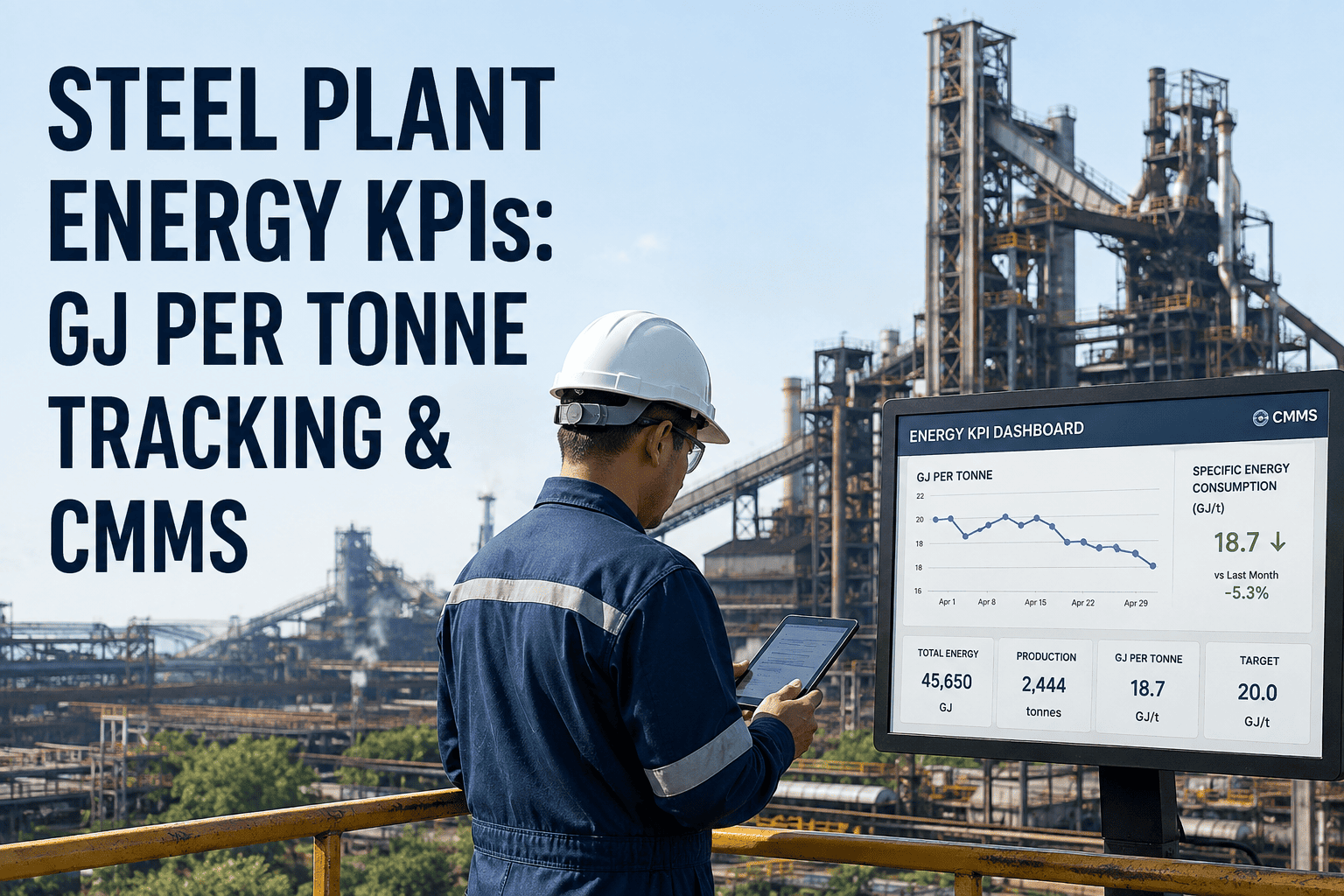
The PAT scheme operates through a five-year cycle where the Bureau of Energy Efficiency assigns each steel mill a Specific Energy Consumption (SEC) reduction target based on its production capacity and baseline energy data. SEC is measured in kWh per tonne of crude steel produced — the lower the SEC, the more energy-efficient the plant. A plant's baseline is its average energy consumption over three prior years; if baseline SEC is 5.5 MWh/tonne, and the target is 3% reduction, the plant must achieve 5.34 MWh/tonne by cycle end. OxMaint integrates plant-wide energy metering and production data to calculate actual monthly SEC, compare against target, and forecast year-end compliance with granular visibility into which production areas are over or under target.
Baseline Calculation & Registration
Plants submit three-year average SEC data to BEE; baseline becomes the reference point for all target calculations during the PAT cycle. BEE assigns individual reduction targets at Cycle start. OxMaint maintains baseline records and flags deviations from submitted baseline automatically.
Real-Time SEC Monitoring
Monthly energy consumption (from meters) divided by monthly steel production (from MES) yields monthly SEC. Continuous monitoring reveals when a plant is tracking ahead or behind cumulative target — allowing corrective actions before year-end.
ESCert Purchase or Sale
If a plant beats its SEC target, it generates Energy Saving Certificates (ESCerts) — one certificate per tonne of energy saved below target. These can be sold on ESCERT trading platform. Plants exceeding target must purchase ESCerts to meet compliance.
Energy Audit & Compliance Documentation
Designated Energy Auditors conduct annual or bi-annual audits, measuring equipment-level energy consumption, identifying inefficiencies, and recommending conservation measures. OxMaint prepares audit-ready data reports with all required equipment schedules and energy balances.
Mid-Cycle Progress Reporting to BEE
BEE requires interim progress reports at year 2 and year 4 of each five-year cycle. Plants must demonstrate cumulative SEC reduction progress; missed milestones trigger intensified monitoring and potential penalty discussions.
Cycle-End Compliance Verification
At five-year cycle end, BEE verifies final SEC against assigned target. Compliant plants avoid penalties and ESCert purchase costs; non-compliant plants incur ₹10L daily penalties per tonne shortfall until ESCerts are purchased and retired.
Understanding SEC (Specific Energy Consumption) — Calculation and Benchmarking
Specific Energy Consumption is the foundation of PAT compliance. SEC = Total Energy Consumed (MWh) / Production Volume (tonnes steel). Energy includes all electricity, fuel combustion in furnaces, and steam from external sources, expressed in energy units. SEC benchmarks vary by plant type: integrated BF-BOF plants typically report 5.0–5.8 MWh/tonne, EAF scrap-based plants 0.4–0.7 MWh/tonne. Within a plant, SEC varies by product — rail and rods require different energy than plates and coils. BEE allows plants to normalize SEC for product mix shifts; if a plant shifts production toward lower-energy-intensity products, SEC naturally improves without energy efficiency investment. OxMaint calculates product-specific SEC and normalized SEC, helping plants distinguish between true efficiency gains and product-mix effects. This separation is critical for energy audit credibility — auditors must verify that SEC improvements come from documented equipment upgrades, not production shifts.
Plant Type / Product Category
Typical SEC Range (MWh/tonne)
PAT Baseline Assumption
3% Reduction Target
Integrated BF-BOF (hot metal → crude steel)
5.2–5.8
5.5 MWh/tonne
5.34 MWh/tonne by cycle end
EAF (scrap melting)
0.45–0.65
0.55 MWh/tonne
0.534 MWh/tonne by cycle end
Long products (rails, rods, wire)
4.8–5.5
5.1 MWh/tonne
4.95 MWh/tonne by cycle end
Flat products (plates, coils, sheets)
5.1–6.2
5.6 MWh/tonne
5.43 MWh/tonne by cycle end
DRI-based (Direct Reduced Iron)
2.8–3.5
3.15 MWh/tonne
3.05 MWh/tonne by cycle end
Five Cost-Free and Low-Cost SEC Reduction Opportunities Across Steel Plants
Meeting SEC targets doesn't always require capital investment. Energy audits frequently identify no-cost and low-cost conservation measures that yield 2–4% SEC reductions within a year. Optimizing compressed air systems — repairing leaks, reducing pressure settings from 8 bar to 7 bar where feasible, and scheduling compressor maintenance — can cut compressed air energy by 10–15%. Improving motor efficiency through variable frequency drives (VFDs) on rolling mill drives, cooling tower fans, and pump motors reduces energy by 15–25% with payback periods of 2–3 years. Insulation upgrades on furnaces, hot-water lines, and steam pipes reduce heat loss and can contribute 1–2% SEC improvement. Optimizing reheating furnace temperatures and schedules, dwell times, and burner tuning can cut fuel consumption by 5–8%. Finally, production scheduling optimization — batching similar products to minimize reheating cycles and furnace idle time — often yields 1–3% energy savings at zero capital cost, requiring only process discipline and real-time data visibility. OxMaint identifies these opportunities through energy balance analysis and equipment-level benchmarking against peer plants and OEM specifications.
1. Compressed Air System Optimization
Opportunity: Leak detection and repair, pressure optimization, compressor sequencing
Potential Saving: 8–12% of compressed air energy (~0.5–1% plant SEC)
Investment: ₹5–10 lakhs for leak detection tools and repairs
PAT Energy Audit Preparation — Documentation, Equipment Schedules, and BEE Compliance
The Bureau of Energy Efficiency requires periodic energy audits by Designated Energy Auditors — professionals certified to measure and verify energy consumption across all plant equipment. Energy audits produce comprehensive reports detailing major equipment (boilers, furnaces, compressors, motors), actual energy consumption per equipment category, efficiency measurements, and recommended conservation measures with estimated payback periods. For PAT compliance, audit documentation must include equipment schedules (listing all major energy-consuming equipment with nameplate power ratings and operating hours), energy balances (input energy vs. productive output), and calculation support for SEC determination. OxMaint generates audit-ready equipment schedules and energy consumption reports — consolidating data from EMS, process control systems, and maintenance records — reducing the auditor's field measurement time from weeks to days and improving data accuracy through continuous monitoring versus periodic spot checks.
Equipment Schedule & Nameplate Data
Comprehensive listing of all motors, boilers, furnaces, compressors, transformers, and other major equipment with ratings, vintage, and estimated operating hours — critical for auditor verification and baseline SEC confirmation.
Energy Flow & Balance Diagram
Visual representation of energy inputs (fuels purchased, electricity from grid, waste heat recovery) and outputs (productive work, heat losses, steam generation) — enables auditor to identify efficiency gaps and missing measurements.
Monthly Energy Consumption Records
12-month history of electricity purchases, fuel consumption (coke, natural gas, heavy fuel oil), steam generated, and production volumes — proof of baseline accuracy and SEC trend documentation.
Equipment-Level Energy Distribution
Breakdown of total plant energy into categories: blast furnace, steelmaking furnace, rolling mill, compressors, HVAC, lighting — identifies which areas consume the most energy and should be audited in detail.
Maintenance & Repair Records Linked to Energy Performance
History of equipment maintenance, efficiency improvements, and repairs that may have impacted energy consumption — provides audit trail for SEC changes and justifies variance from prior years.
Frequently Asked Questions on PAT Scheme Compliance
What if our plant fails to meet the SEC target by cycle end?
Your plant must purchase Energy Saving Certificates (ESCerts) on the ESCERT trading platform to cover the shortfall — the cost depends on market price (typically ₹200–500/tonne). Additionally, BEE may impose penalties. Most plants view ESCert purchase as expensive insurance; continuous monitoring prevents this outcome.
Can we generate ESCerts if we beat the SEC target?
Yes — beating target generates ESCerts that can be sold on the ESCERT trading platform, creating a revenue stream. OxMaint forecasts ESCert generation early so you can plan sales strategy and optimize market timing.
How are baseline SEC values determined if our plant is new?
New plants submit three years of operational energy data before entering PAT Cycle; baseline becomes the average of those three years. BEE then calculates reduction targets from that baseline. If production mix shifts significantly, normalized SEC adjustments may apply.
How often does BEE conduct energy audits, and what is our audit preparation timeline?
Designated Energy Auditors typically audit annually or bi-annually; the audit takes 2–4 weeks depending on plant size. Most plants allocate 6–8 weeks for complete data compilation and auditor engagement. OxMaint audit-ready reports reduce auditor fieldwork by 50%, accelerating the audit process.
Can production mix changes affect our SEC target?
Yes — if production shifts toward lower-energy-intensity products, SEC naturally improves. BEE allows normalized SEC adjustments where documented. This separation is critical: auditors verify that SEC gains come from efficiency, not just product shift.
When is the next PAT Cycle, and when should we start compliance planning?
PAT Cycle 3 runs through 2025; Cycle 4 begins 2026. Begin baseline and target discussions with BEE 12 months before cycle start. Schedule a consultation with our compliance team to understand your assigned target early.
Are there penalties for missing BEE mid-cycle progress reports?
Yes — BEE requires interim progress reports at year 2 and year 4 of each cycle. Missing deadlines can trigger penalties and intensified monitoring. OxMaint auto-generates progress reports with automated BEE submission workflows.
"
We were tracking PAT compliance manually across emails and spreadsheets — no real-time visibility into whether we would meet year-end target. In year 3 of Cycle 2, we realized we were 2% behind. We implemented OxMaint's SEC monitoring dashboard and discovered three no-cost efficiency opportunities (compressed air leaks, furnace scheduling) that got us to target. In Cycle 3, we're ahead of target and generating ESCerts for sale. Real-time visibility changed everything — compliance went from panic to opportunity.
Head of Energy Management — Integrated Steel Plant, Maharashtra, India
Start Your PAT Compliance Journey With Real-Time SEC Tracking.
OxMaint connects your energy metering, production systems, and equipment data into a single SEC compliance dashboard — monthly progress tracking, target forecasting, energy audit preparation, and ESCert opportunity identification. No spreadsheets. No surprises. Begin your free trial or schedule a compliance consultation with our BEE-familiar team.
Meet Your SEC Target, Avoid ESCert Costs, Generate Revenue.
Real-time SEC monitoring, monthly progress tracking, energy audit readiness, and ESCert generation forecasting — PAT compliance simplified.