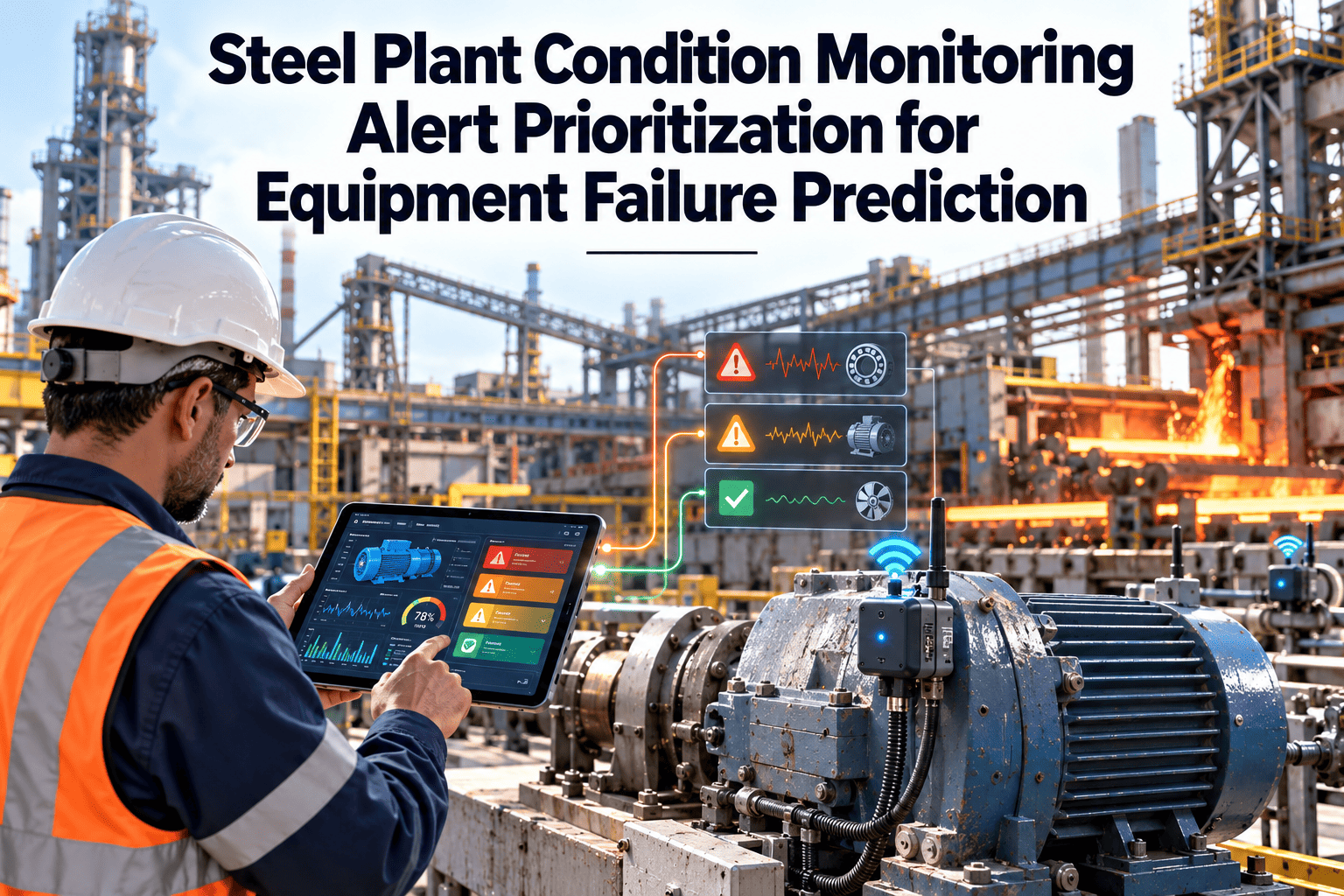
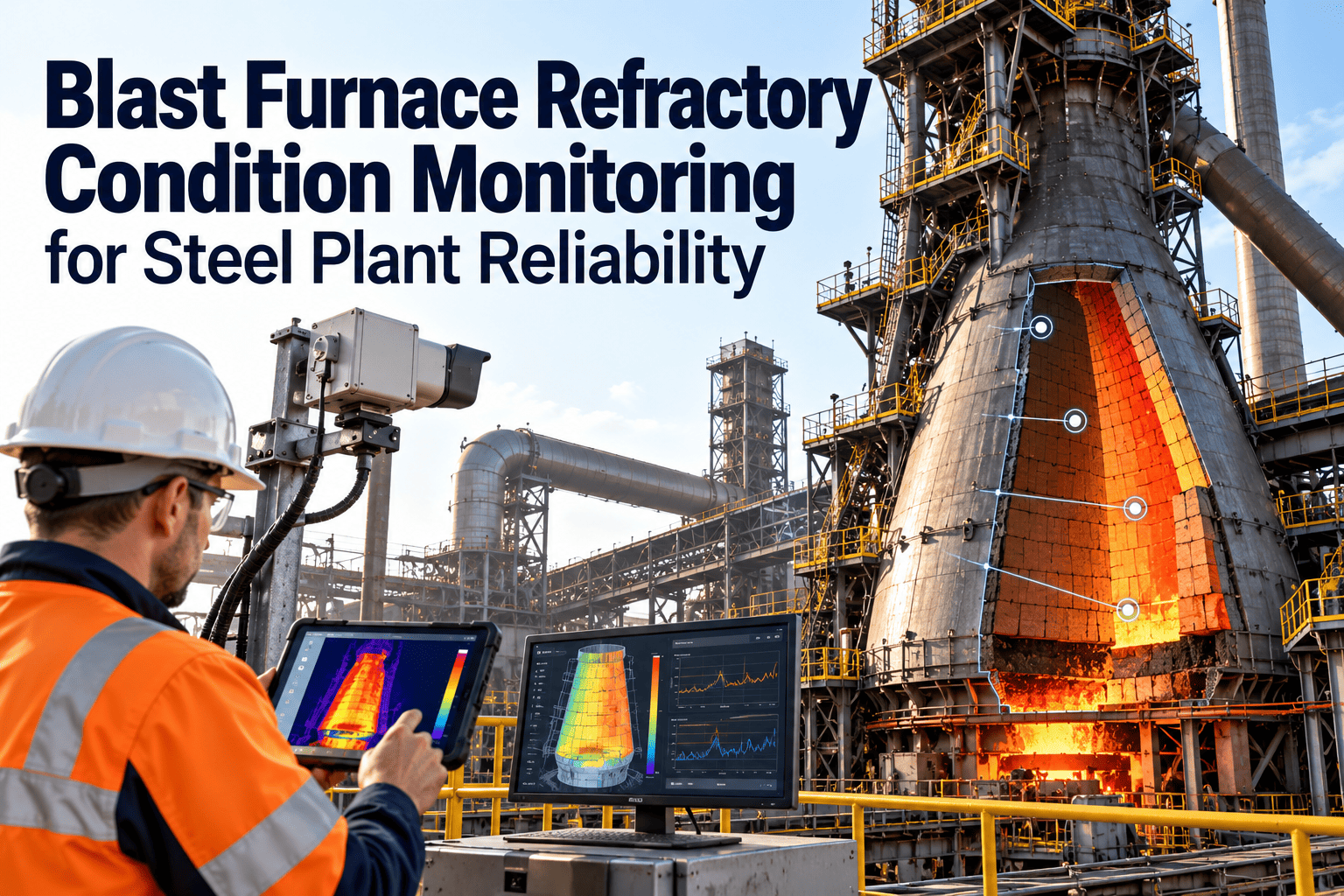
A blast furnace hearth breach is not a maintenance event — it is a $50–150 million emergency reline, six to twelve months of lost hot metal production, and a forensic investigation asking why the thermocouple data that predicted it was never acted on. That data exists in every instrumented blast furnace. Embedded thermocouples at five depth levels, cooling water differential sensors across 30+ circuits, and shell temperature arrays generate thousands of readings per shift — and in most plants, none of it is connected to a system that converts raw temperature gradients into a living refractory wear model. The gap between the sensor and the decision is where campaigns end years early. OxMaint's refractory monitoring AI closes that gap: continuous isotherm tracking, zone-by-zone wear rate calculation, three-tier alert escalation, and automatic work order generation — weeks before the thermocouple reading that everyone will later say they should have acted on.
Predictive Maintenance · Steel Industry
Steel Plant Refractory Condition Monitoring AI
Predict Wear. Prevent Breakouts. Extend Campaign Life.
AI-powered continuous monitoring of blast furnace and BOF refractory linings — converting thermocouple arrays, cooling stave heat flux, and shell temperature surveys into zone-by-zone remaining life predictions with 95%+ accuracy.
Blast Furnace · Refractory Health Map
ThroatOK
Upper StackOK
BellyWatch
Bosh ◀ Alert14mm/yr ↑
Hearth · NW SectorCritical
$50–150M
cost of an unplanned hearth breach including emergency reline and lost production
95%+
remaining life prediction accuracy with AI isotherm models at 6-week forecast horizon
2–4 yrs
additional campaign life achieved through AI-optimised refractory management
30%
longer lining life through targeted hot repairs vs. full unplanned relines
What Refractory Monitoring AI Actually Does — System by System
01
Thermocouple Array Analysis
Embedded thermocouples at 4–5 depth levels through the refractory wall measure thermal gradients continuously. As refractory erodes, the temperature gradient shifts — outer thermocouple readings rise as the insulating mass thins. OxMaint tracks the rate of gradient shift per zone and calculates the remaining wall thickness from the temperature profile, building an isotherm model that maps erosion across every instrumented zone simultaneously.
Detection lead time60–90 days before critical threshold
02
Cooling Stave Heat Flux Trending
Cooling staves in the lower stack and bosh zones must maintain sufficient heat extraction to stabilise the accretion layer that protects the carbon lining. OxMaint calculates heat flux per stave from the inlet/outlet temperature differential and measured flow rate. Individual stave heat flux is trended against both its own historical baseline and adjacent staves in the same panel — the statistical comparison that identifies a single failing stave before it produces visible refractory deterioration. Stave failures are predictable through heat flux trending weeks before any observable effect on the lining.
Stave failure detection3–5 weeks before lining impact
03
Hearth Erosion Modelling
The hearth is the highest-consequence refractory zone — a breach here is the catastrophic event. OxMaint tracks carbon brick dissolution by liquid iron (wear rate: 5–15 mm/year), elephant foot erosion from iron flow patterns, and hotspot development from circumferential temperature array data. Continuous isothermal mapping triggers automated TiO₂ injection alerts and identifies hearth sectors requiring protective operational changes — with trend alerts at configurable thresholds before the emergency threshold is reached.
Carbon block hotspot detection60–90 days before emergency
04
Operational Parameter Correlation
Elevated alkali input that is not offset by increased slag basicity correlates with accelerated bosh erosion 4–8 weeks later. OxMaint flags these operational events and links them to the subsequent thermocouple responses — building the operational intelligence that enables burden management decisions to protect campaign life. Accretion stability from heat flux trending, alkali and zinc load calculation per period, and burden distribution correlation to wear patterns are all tracked and connected to the refractory condition record.
Alkali event to erosion response4–8 week lag window tracked
Three-Tier Alert System — From Watch to Emergency Response
System Action
Watch zone flagged on health map. Trend monitoring interval increased. Affected zone highlighted in daily condition report.
CMMS Action
Advisory work order created — inspection and measurement scheduled within 14 days. Parts for targeted hot repair added to watch list.
Typical Lead Time
8–16 weeks before minimum safe thickness reached at current wear rate.
System Action
Zone elevated to Warning status. AI calculates projected date of minimum safe thickness based on current wear rate. Reline schedule recommendation generated.
CMMS Action
Reline planning work order created. Refractory material procurement triggered. Shutdown window evaluation initiated against production schedule.
Typical Lead Time
4–8 weeks before minimum safe thickness — sufficient window for planned reline at 5–10% of emergency repair cost.
System Action
Critical alert to all plant management. Heat load reduction recommendation issued. Emergency response protocol triggered automatically.
CMMS Action
Emergency work order with P1 priority. Blast furnace cast rate reduction work order. Emergency reline contractor contacts flagged from asset record.
Prevention Note
With Advisory and Warning tiers functioning correctly, the Critical tier should never be reached. It exists as a final safety net.
Your Blast Furnace Already Generates the Data. It Needs a System That Converts It Into Action.
OxMaint connects to your existing thermocouple arrays, cooling water sensors, and process historians without new hardware — and is delivering refractory health maps within weeks of deployment.
Monitoring Coverage — Blast Furnace Zone by Zone
| Zone |
Primary Failure Mode |
Sensors Used |
AI Detection Method |
Lead Time |
| Hearth |
Carbon brick dissolution, elephant foot erosion |
Carbon block thermocouples, shell arrays |
Isothermal model, circumferential anomaly detection |
60–90 days |
| Bosh |
Chemical attack from slag, alkali-accelerated erosion |
Stave heat flux, thermocouple arrays |
Wear rate trending, alkali correlation model |
4–8 weeks |
| Belly |
Accretion instability, localised erosion from gas channeling |
Wall thermocouples, gas temperature probes |
Temperature gradient shift, accretion stability index |
3–6 weeks |
| Stack |
Alkali and zinc attack, abrasion from burden descent |
Shell temperature surveys, burden probes |
Burden distribution correlation, thermal deviation scanning |
4–10 weeks |
| Cooling Staves |
Water circuit blockage, stave cracking, scale deposition |
Flow meters, ΔT sensors per circuit |
Per-stave heat flux vs. baseline and adjacent panel comparison |
3–5 weeks |
| Main Runner |
Hot metal erosion at slag line, thermal cycling fatigue |
Embedded thermocouples, scanner measurements |
RHI predictive model — campaign vs. measured thickness |
Campaign-level |
The Economics of Refractory Monitoring — Planned vs. Unplanned
Unplanned Emergency Reline
Emergency reline cost$45–80M
Lost production (avg 90 days)$108–250M
Emergency contractor premium3–5× planned rate
Average time to restart3–6 months
Total event cost$150–330M
vs
AI-Planned Reline
Planned reline cost$45–80M
Lost production (avg 30 days)$36–80M
Contractor at scheduled rateStandard rate
Time to restart25–35 days
Additional campaign extension+2–4 years
Each additional year of campaign life defers the $45–80M reline cost. Plants using AI lining management average 2–5 years longer campaigns. The refractory monitoring investment typically costs less than one additional week of planned downtime savings.
"
Blast furnaces running 24/7 with a single unexpected failure trigger catastrophic losses. Yet most plants still operate on reactive maintenance strategies developed decades ago. Every blast furnace I have assessed in the last five years had the thermocouple data that would have predicted the problem that cost them — in one case, the data was archived and accessible. Nobody had built the model that converted it into an actionable signal. The difference between struggling plants and profitable ones is not luck and it is not the sensor hardware — those exist everywhere. It is the platform that converts continuous sensor data into a living erosion model, and the workflow that converts that model into a maintenance decision before the window for a planned repair closes. Once that window closes, you are in emergency territory, and emergency territory in blast furnace operations means nine figures of exposure.
Kenji Watanabe, Dr.Eng
Senior Furnace Process Engineer — POSCO Technical Research Institute · 24 Years Blast Furnace Campaign Management and Refractory Technology · Specialist in AI-based hearth erosion modelling, thermocouple array analysis, and campaign life extension for integrated steelworks
Frequently Asked Questions
Does OxMaint require new sensor hardware to deploy refractory monitoring AI?
No. OxMaint connects to existing instrumentation — thermocouple arrays, cooling water differential sensors, shell temperature monitors, and flow meters — via OPC-UA, Modbus TCP, and process historian connections. In most cases, a blast furnace already has 80–90% of the sensor coverage needed for AI-powered refractory monitoring. OxMaint adds the analytics layer that converts existing data into zone-by-zone wear models. Deployment typically takes 4–6 weeks from first data connection to live health maps, and requires no modification to process control infrastructure.
Book a demo to review your current sensor coverage against OxMaint's connection requirements.
How accurate is OxMaint's remaining refractory life prediction, and what is the forecast horizon?
OxMaint's AI isotherm model achieves 95%+ remaining life prediction accuracy at a 6-week forecast horizon when the furnace has at least 90 days of historical thermocouple and heat flux data in the system. The model uses ensemble methods — combining physics-based thermal gradient calculation with machine learning trained on the furnace's own historical wear patterns — to produce zone-specific wear rate estimates. Forecast accuracy increases progressively as campaign history accumulates. RHI Magnesita's published research on predictive modelling for blast furnace main runners demonstrates sub-millimetre accuracy in remaining thickness prediction when operational data is correctly integrated.
Start your free trial to begin building the data history that trains your refractory AI model.
What is the difference between OxMaint's refractory monitoring and standard thermocouple alarm systems?
Standard thermocouple alarm systems trigger when a temperature reading exceeds a fixed threshold — by which point the refractory condition has already reached an advanced state. OxMaint's AI operates on the rate of change and the gradient shift across multiple thermocouple depths, not on the absolute reading. A thermocouple that was reading 280°C six months ago and is now reading 295°C at a consistent rate of increase tells a completely different story than one that jumped 15°C in 48 hours — even though both would trigger the same fixed-threshold alarm. OxMaint's trend-based models generate Advisory alerts 60–90 days before any fixed threshold is approached, giving operations the window to plan a response rather than react to one.
Does OxMaint cover refractory monitoring for EAF and BOF vessels as well as blast furnaces?
Yes. OxMaint's refractory monitoring covers blast furnace hearth and lining, BOF vessel lining wear from thermal cycling and chemical attack, EAF sidewall panel and roof conditions, ladle and torpedo car refractory life tracking by heat count, and main runner campaign management. Each vessel type has a different wear mechanism and sensor profile — OxMaint configures separate monitoring models per vessel class. BOF and EAF vessels typically use heat count-based wear models correlated with lance height, oxygen blow rate, and slag composition, while ladle refractory is tracked by heat count against OEM life specifications with inspection triggers at configurable intervals.
Refractory Monitoring AI — OxMaint
Convert 20 Years of Thermocouple Data Into a Living Refractory Model. Know What's Happening Inside the Lining Before the Lining Tells You.
OxMaint connects to your existing furnace instrumentation, builds zone-by-zone wear models from thermocouple arrays and cooling stave heat flux, and delivers three-tier alerts with automatic CMMS work orders — weeks before the Advisory threshold becomes a Critical event.