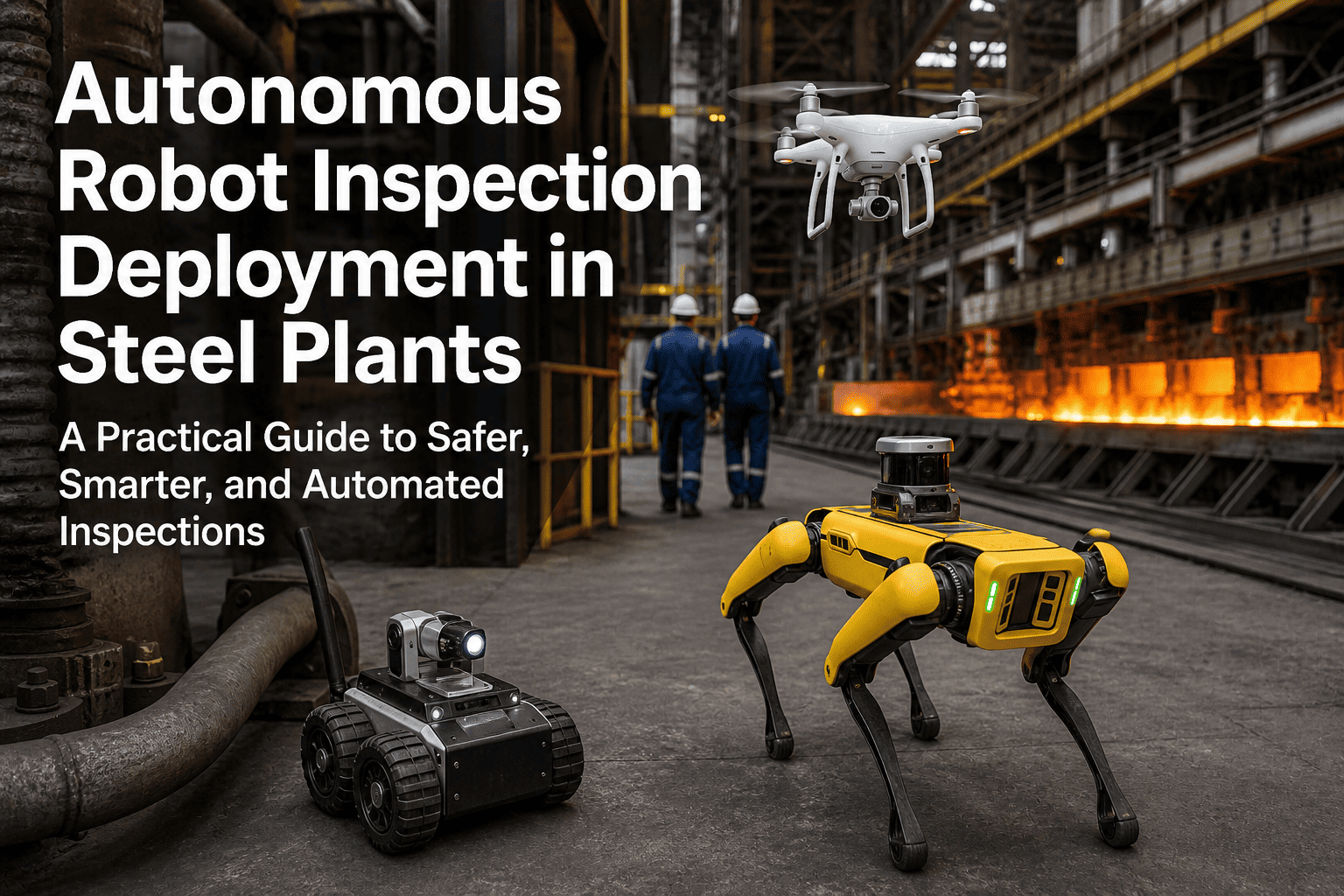
At Outokumpu's Krefeld facility in Germany, a four-legged robot now covers 270 inspection checkpoints per day across blast furnace perimeters, coke battery corridors, and acid processing zones — areas where human inspectors were limited to short, infrequent visits due to heat exposure and chemical hazards. The robot does not get tired. It does not skip checkpoints on night shifts. It detects thermal anomalies at 0.1°C resolution and pushes every finding directly into the plant's maintenance management system within seconds of detection. This is not a pilot project. This is how steel plant inspection is changing — and the plants adopting robotic systems are building a measurable safety and maintenance advantage that manual-inspection competitors cannot match. See how Oxmaint connects robotic inspection data to automated work orders.
Robotic Inspection for Steel Plants: Drones, Quadrupeds & AI Crawlers
A practical guide to deploying inspection robots across steel plant environments — covering which robot type works where, what sensors matter, how AI anomaly detection transforms raw data into maintenance actions, and how each system connects to your CMMS.
Why Manual Inspection Fails in Steel Plant Environments
Steel manufacturing creates conditions that systematically degrade manual inspection quality. Blast furnace perimeters sustain ambient temperatures above 60°C, forcing inspectors to limit exposure to 10–15 minute windows. Coke oven corridors emit benzene, carbon monoxide, and hydrogen sulfide at concentrations that require full SCBA equipment, slowing movement and limiting observation quality. Rolling mill floors combine 100+ decibel noise levels with moving machinery and overhead crane activity that demand constant situational awareness — leaving little cognitive capacity for systematic defect detection.
The result is that even well-managed steel plants conducting regular manual inspections miss early failure indicators — not through negligence, but because the physical environment makes sustained, consistent, close-range observation of critical equipment genuinely impossible for human inspectors. Sign into Oxmaint to see how robotic inspection findings feed your maintenance workflows automatically.
| Zone | Manual Inspection Limit | Robot Capability |
|---|---|---|
| Blast Furnace Perimeter | 10–15 min max per visit due to heat; 1–2 visits per shift | Continuous patrol every 2–4 hours; 0.1°C thermal resolution at full standoff distance |
| Coke Oven Corridors | SCBA required; limited to essential checks only, infrequent | Full route coverage every shift; gas, thermal, and structural monitoring without PPE constraint |
| Rolling Mill Underdeck | Production must stop for safe inspection access | Crawler systems operate during live production; no production interruption required |
| High-Structure & Roofwork | Fall risk limits frequency; rope access requires 2-person team | Drone coverage on demand; no fall risk; single operator deploys in under 5 minutes |
| Flue Gas Ductwork | Requires cooling, purging, and confined space permits before entry | In-service crawler inspection at operating temperature; no shutdown required |
The Three Robot Types and Where Each Fits in a Steel Plant
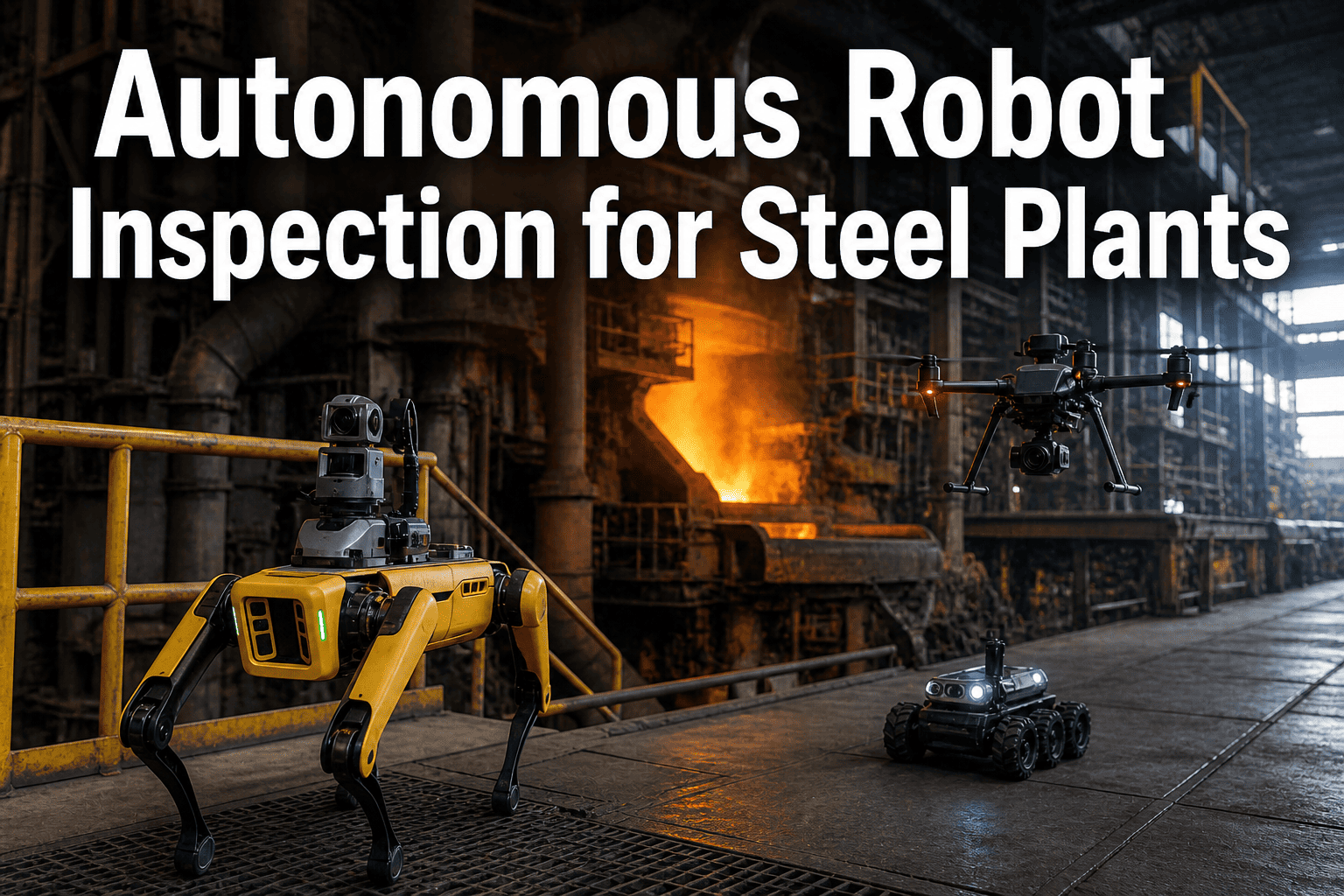
No single robot platform covers every inspection requirement in a steel facility. Drones, quadrupeds, and crawlers each have distinct capability profiles and deployment envelopes — the right selection depends on the specific asset, access geometry, and inspection objective.
Industrial drones cover large vertical and horizontal areas at speed — roof structures, stack exteriors, storage tanks, high-bay structures, and overhead conveyor systems. Equipped with thermal imaging, RGB 4K cameras, and LiDAR payloads, they complete inspection passes in minutes that would require rope access teams working for hours. Autonomous dock-and-fly systems like Percepto Arc operate without a pilot on site, launching scheduled inspections at pre-programmed intervals and returning to charge automatically.
Quadruped robots are the most versatile ground platform for complex industrial environments. Unlike wheeled robots, they climb stairs, traverse grated walkways, step over obstacles, and navigate the multi-level terrain that characterizes steel plant layouts. ANYmal at Outokumpu covers acid processing zones, furnace perimeters, and electrical rooms on a fully autonomous patrol schedule — collecting thermal, acoustic, and visual data at pre-mapped checkpoints without human guidance on site.
Crawler robots use magnetic adhesion, vacuum grip, or tracked traction to access surfaces that drones cannot reach and quadrupeds cannot fit — blast furnace shells, hot metal ladles, pipe interiors, tank floors, and pressure vessel walls. They perform contact ultrasonic thickness measurements, cathodic protection surveys, and corrosion mapping in real time while the asset remains in service. Gecko Robotics' Toka system, deployed at multiple steel and energy facilities, completes furnace shell inspections at 1mm thickness resolution without plant shutdown.
AI Anomaly Detection: How Robots Turn Sensor Data into Maintenance Decisions
Raw sensor data from an inspection robot — thermal images, ultrasonic waveforms, vibration spectra — has no operational value until it is interpreted and acted upon. The AI anomaly detection layer is what converts a 640×480 thermal image of a bearing housing into a prioritized maintenance work order with a predicted failure date. This is where the real intelligence in robotic inspection systems lives. Book a demo to see how Oxmaint's AI layer processes robotic inspection outputs for your specific asset types.
Thermal images, acoustic spectrograms, UT thickness maps, and visual frames are ingested via the robot's API in real time during the patrol. Each data point is timestamped and geo-tagged to its inspection checkpoint location in the CMMS asset registry.
The AI compares each new reading against the historical baseline for that specific checkpoint — not against a generic industry threshold. A bearing that normally runs at 48°C triggers an alert when it reaches 54°C. A bearing that normally runs at 62°C does not.
Anomaly confidence increases when multiple sensor types confirm the same degradation signature. A temperature rise combined with a simultaneous acoustic frequency shift at a bearing is a far stronger failure signal than either reading alone — the AI fusion layer computes this combined confidence score automatically.
Each anomaly is placed on a degradation trend curve built from previous readings at the same checkpoint. The AI projects when the degradation will reach the intervention threshold — giving maintenance planners a predicted failure window rather than just a current alert.
When confidence and trend projection cross configured thresholds, Oxmaint auto-generates a prioritized work order with the inspection evidence attached — thermal image, acoustic data, trend chart — assigned to the correct technician based on asset ownership and shift schedule. Start your free trial to configure anomaly thresholds for your first robotic inspection integration.
Deployment Zone Matrix: Which Robot for Which Steel Plant Area
This matrix maps the three robot types against the primary inspection zones in a steel facility. Use it to plan your first deployment — prioritize zones where current manual inspection is most constrained and failure consequences are highest.
| Inspection Zone | Aerial Drone | Quadruped | Crawler | Priority |
|---|---|---|---|---|
| Blast Furnace Shell | Perimeter only | Perimeter patrol | UT thickness mapping | Critical |
| Coke Oven Battery | Not suitable | Full corridor patrol | Not applicable | Critical |
| Stack / Chimney | Full exterior survey | Not suitable | Internal liner inspection | High |
| Rolling Mill Underdeck | Not suitable | Perimeter + bearing check | In-service roll inspection | High |
| Storage Tanks | Roof and shell survey | Not suitable | Floor and wall UT | High |
| Continuous Caster | Not suitable | Mold area thermal scan | Strand guide roll UT | High |
| Electrical Rooms | Not suitable | Thermal hotspot patrol | Not applicable | Medium |
| High-Bay Structure | Full structural survey | Ground-level only | Not applicable | Medium |
The Outokumpu Case: What Real Deployment Looks Like
Outokumpu — one of Europe's largest stainless steel producers — deployed ANYmal robots across three production facilities in Germany, Sweden, and Finland starting in 2023. Their deployment is the most documented real-world example of quadruped inspection in active steel production, and the results benchmark what facilities should expect from first-generation robotic inspection programs.
Use of AI and robotics for safety management is one of the cornerstones of our safety strategy. The robot technology helps us increase safety by reducing employee exposure to hazardous substances and environments, optimize production through preventive maintenance, and decrease environmental impacts.
How Oxmaint Integrates with Your Robotic Inspection Program
Collecting robotic inspection data solves half the problem. The other half — turning that data into scheduled maintenance actions, compliance records, and trend history — requires a CMMS that can receive, process, and act on robotic inputs automatically. Oxmaint is built for this integration from the ground up. Start your free trial to configure your first robot integration.
Connect Your Inspection Robots to Oxmaint and Close the Loop
Every thermal anomaly, UT reading, and acoustic flag your robots detect becomes an automatic work order in Oxmaint — with evidence attached, technician assigned, and compliance record created. No manual entry. No data gaps.