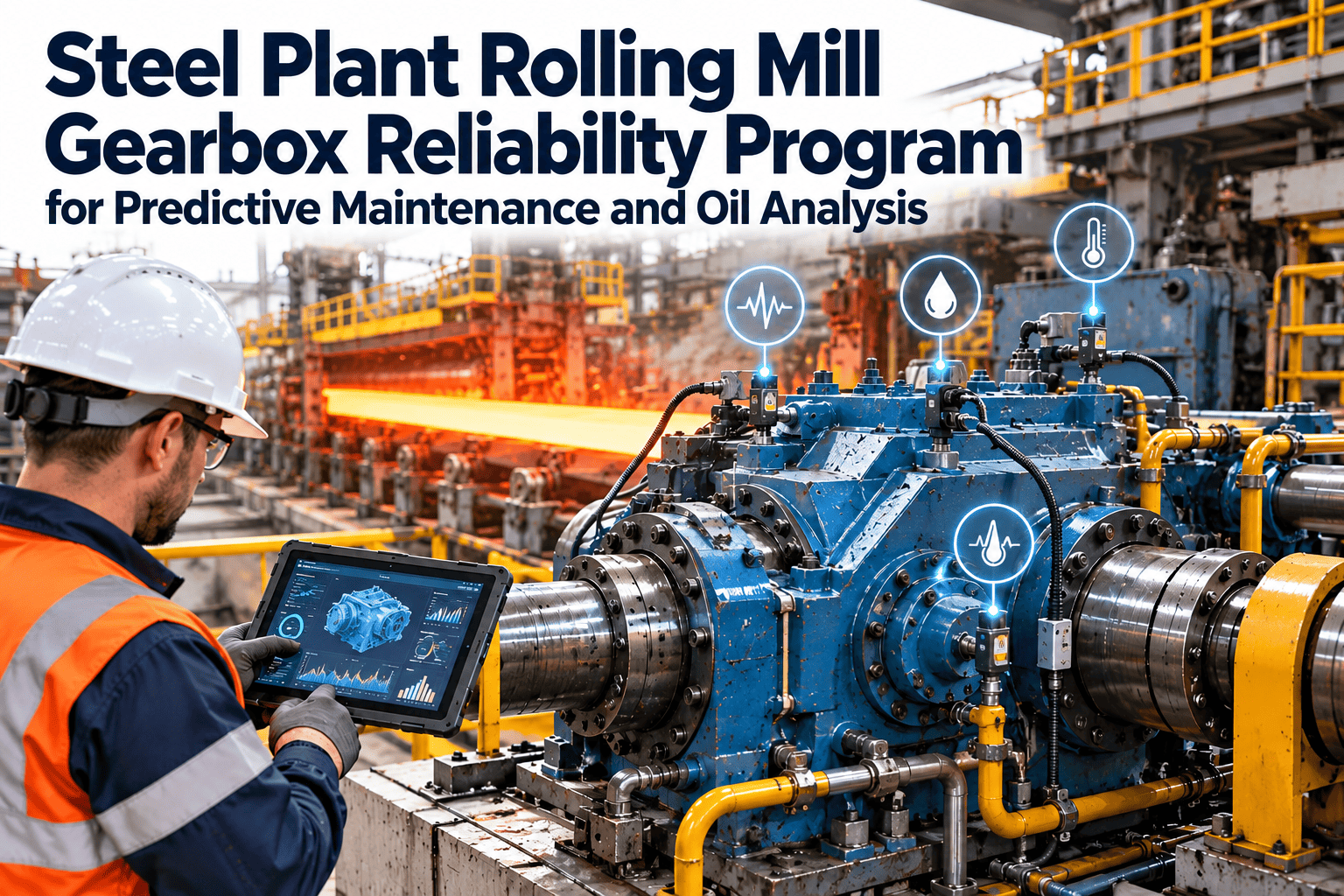
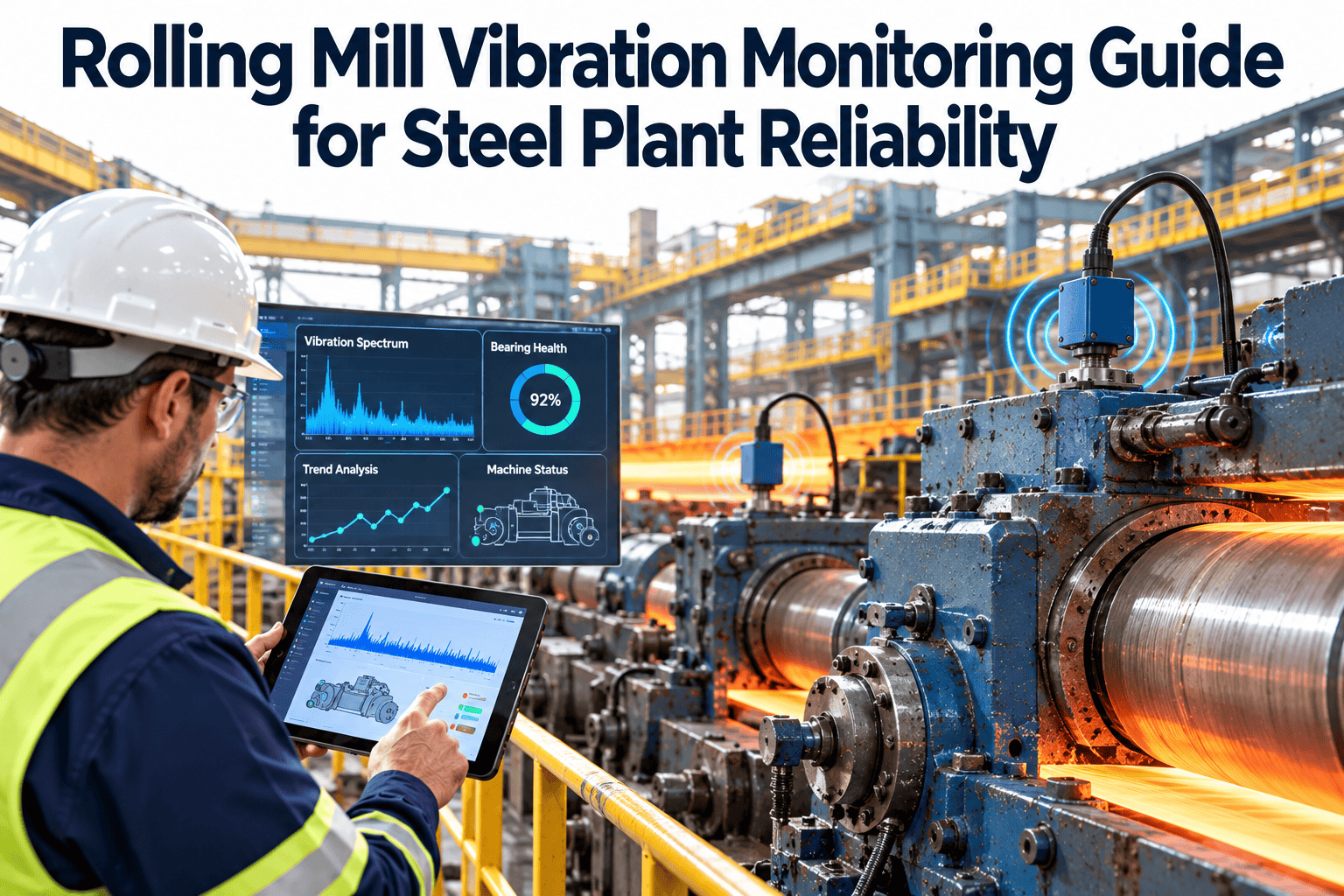
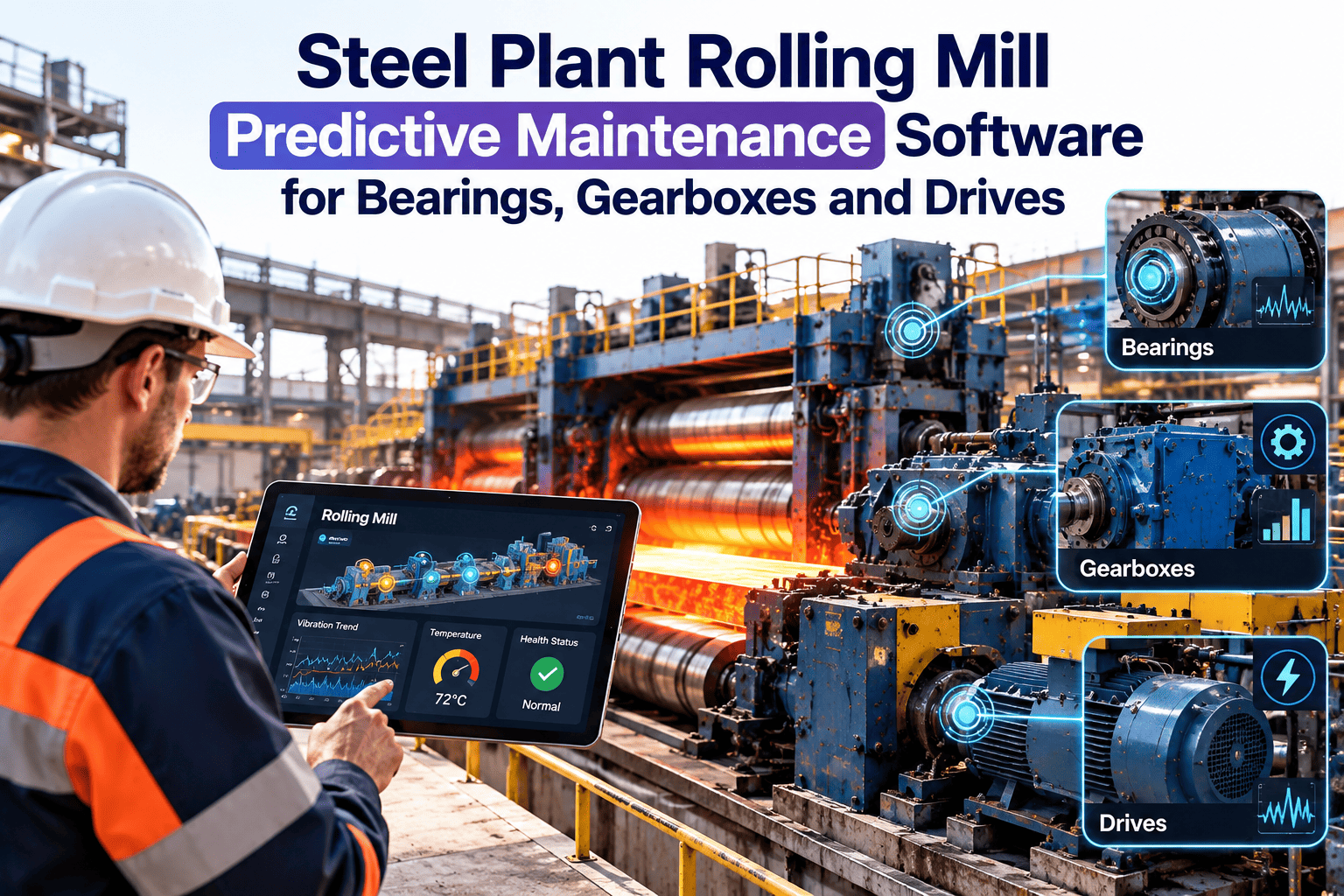
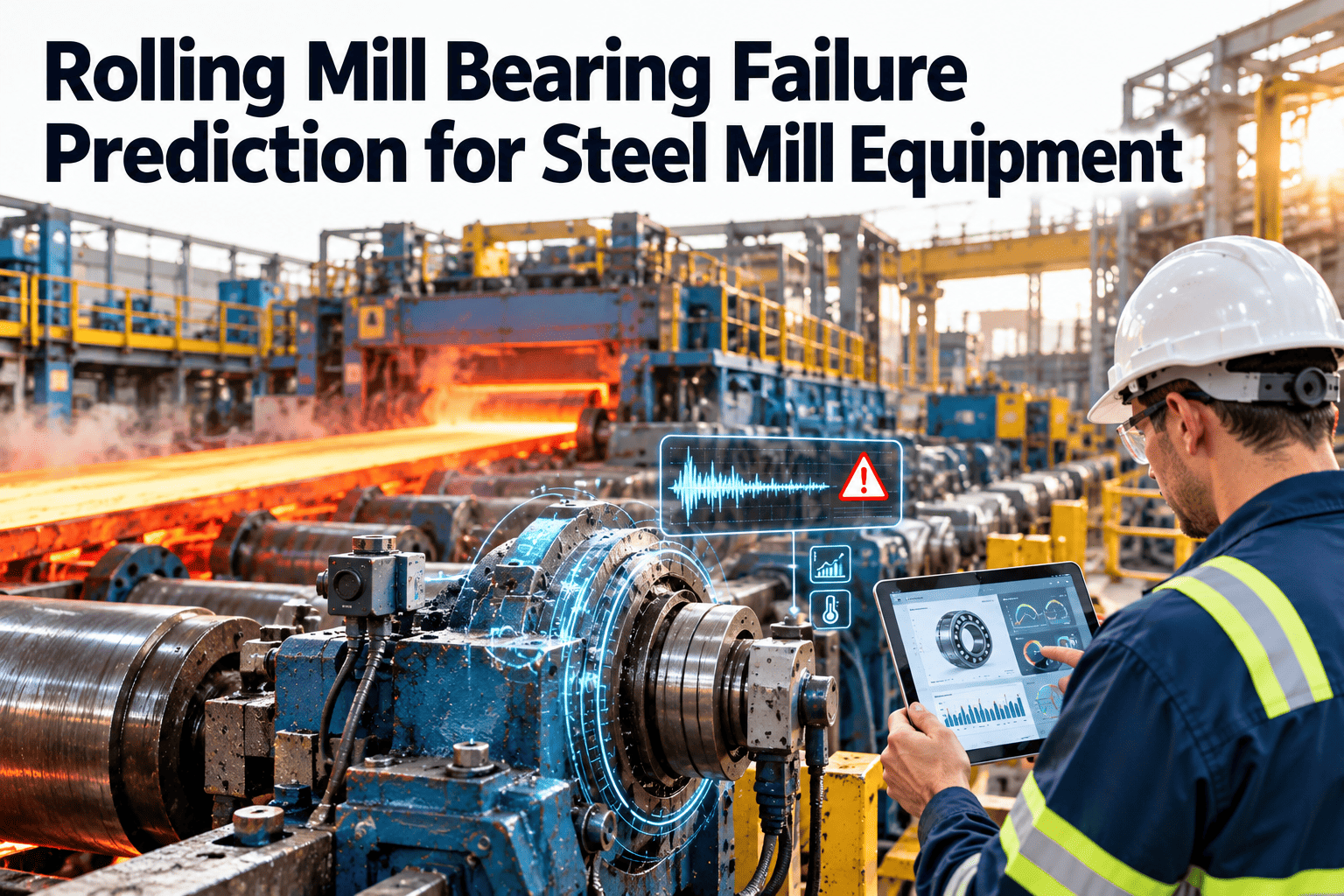
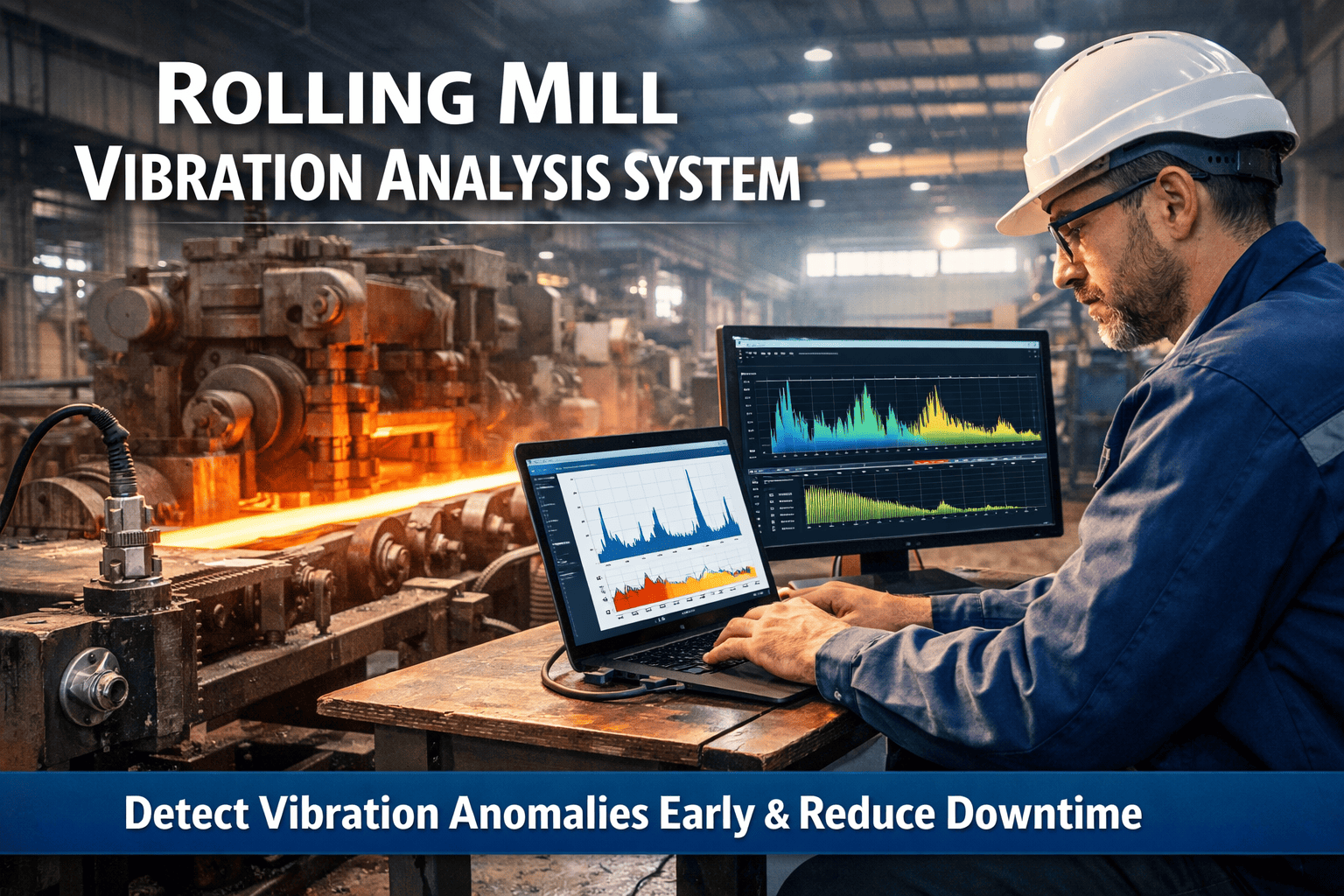
Rolling mill bearing failures, gearbox deterioration, and shaft misalignment share one characteristic that makes them preventable: they announce themselves in vibration data weeks before they cause an unplanned stop. OxMaint's AI vibration monitoring system captures that signal from every critical rotating asset in the mill, identifies the specific failure pattern developing, and triggers a maintenance work order timed to the next available roll change window — not to the moment the bearing seizes mid-campaign. Book a demo to see AI vibration analysis configured for your rolling mill asset register.
Case Study · Rolling Mill Reliability · Predictive AI
Rolling Mill Vibration Analysis
AI System
How OxMaint's AI detects bearing, gearbox, and alignment failures weeks in advance — and converts vibration anomalies into scheduled maintenance actions before the mill stops.
4–6 wk
Advance warning window for rolling mill bearing failure via vibration trending
$150K
Per-hour production loss at integrated mills during unplanned rolling stops
45%
Reduction in unplanned downtime at plants with AI predictive monitoring active
92%
Prediction accuracy of AI models for rotating asset failures 30–90 days out
How It Works
From Vibration Signal to Scheduled Repair
V
Continuous Vibration Capture
Wireless sensors on bearings, gearboxes, and drive spindles capture vibration at characteristic fault frequencies — BPFO, BPFI, BSF, FTF — during normal rolling operation. No production interruption required.
→
AI
AI Pattern Recognition
OxMaint's AI compares live frequency signatures against baseline profiles and known fault patterns. Amplitude trending identifies which failure mode is developing and calculates remaining useful life estimate.
→
WO
Automated Work Order
When amplitude exceeds the threshold — typically 15% above baseline over three consecutive readings — OxMaint auto-generates a work order for the next planned roll change, with asset ID, fault type, and specification attached.
Asset Coverage
Rolling Mill Components Monitored by AI
BRG
Work Roll & Back-Up Roll Bearings
BPFO and BPFI frequency monitoring detects inner and outer race defects weeks before seizure. Amplitude trending across roll changes builds a deterioration curve that predicts replacement timing with high accuracy.
BPFO / BPFI detection
Per-roll-change trending
4–6 week warning
GBX
Main Drive Gearboxes
Gear mesh frequency monitoring identifies tooth wear and pitch error developing from misalignment or lubrication starvation. Oil particle count trending in the CMMS provides a secondary confirmation signal.
Gear mesh frequency
Oil analysis log
High priority
SPN
Drive Spindles & Couplings
Spindle coupling backlash produces a characteristic amplitude step increase visible in vibration trending 4–6 weeks before failure. Motor current trending provides a complementary signal when vibration amplitude change is gradual.
Backlash trending
Motor current correlation
Critical failure risk
ALN
Shaft Alignment
1× and 2× running speed amplitude increase is the primary indicator of shaft misalignment developing from thermal growth, bearing wear, or base frame movement. Detected before it accelerates bearing and coupling degradation.
1× / 2× amplitude
Thermal growth tracking
Surface and shape risk
Verified Results
Steel Plant Outcomes — OxMaint AI Vibration Deployment
$2.1M
Annual savings verified at an integrated steel plant — 2.4M ton annual output — after AI predictive monitoring deployment
67%
Reduction in critical equipment failures including rolling mill bearing and drive events
6 mo
Full investment payback timeline — verified, not projected
Incident Prevented
Caster Roller Bearing — Detected 18 Days in Advance
Vibration trending on a caster segment roller bearing showed progressive amplitude increase over three consecutive measurement cycles. OxMaint generated a replacement work order scheduled for the next planned roll change. The bearing was replaced during the planned window. Avoided loss: $80,400 in production plus emergency labour and expedited parts — and the associated breakout safety exposure.
$80,400 Avoided Loss
Put AI Vibration Analysis to Work in Your Mill
OxMaint deploys wireless sensors, AI baselines, and automated work orders across rolling mill rotating assets — with first anomaly alerts within 30 days of deployment.
Expert Review
"For a steel plant where a bearing failure on a continuous caster or rolling mill can cascade into a $500,000 production loss in under 60 seconds, the difference between a 200-millisecond edge alert and a delayed response isn't academic — it's the difference between a planned bearing swap and a catastrophic shutdown. Plants still operating on calendar-based PM intervals are not just inefficient; they are structurally disadvantaged against competitors whose maintenance cost per tonne is falling while theirs holds flat."
— Steel Plant Maintenance Management Analysis, OxMaint Industry Review, 2026
Common Questions
Frequently Asked Questions
How does OxMaint's AI distinguish between different bearing failure modes in rolling mill vibration data?
OxMaint's AI monitors vibration at the specific characteristic fault frequencies for each bearing type: Ball Pass Frequency Outer Race (BPFO), Ball Pass Frequency Inner Race (BPFI), Ball Spin Frequency (BSF), and Fundamental Train Frequency (FTF). Each fault mode produces a distinct frequency signature. When amplitude at a specific fault frequency increases beyond the baseline by a configurable threshold — typically 15% over three consecutive readings — the AI identifies which race or rolling element is developing a defect and generates a targeted work order for that specific component. This eliminates the false alarms that generic amplitude thresholds produce, and ensures the right repair is specified before the asset reaches the maintenance bay.
Sign up free to configure bearing fault monitoring.
What is the recommended sensor placement strategy for a rolling mill AI vibration programme?
OxMaint's deployment framework prioritises sensor placement on the highest-consequence assets first: work roll bearing housings (both operator and drive side), main drive gearbox input and output bearings, and drive spindle coupling housings. Secondary priority covers back-up roll bearings, motor bearings, and pinch roll assemblies. At an integrated mill, 20–30 sensors on these tier-1 assets deliver the highest-impact anomaly detection. Baseline models establish in 2–4 weeks of normal operation. OxMaint deployment specialists configure alert thresholds and fault libraries specific to your mill's rolling schedule and bearing specifications during the setup process.
Book a demo to discuss sensor placement for your mill configuration.
How does motor current trending complement vibration monitoring for rolling mill drives?
Motor current trending provides an independent confirmation signal for mechanical degradation in the drive train. When coupling wear, spindle imbalance, or bearing friction begins to increase, the motor draws 5–8% more current at equivalent rolling load to maintain the required torque. Current trending in OxMaint often catches drive train deterioration before vibration amplitude rises sufficiently to cross the vibration-based alert threshold — providing an additional early warning layer. The two signals together reduce false negatives and allow earlier intervention scheduling. Current data is typically available from existing motor control infrastructure without additional sensor hardware.
What ROI timeline should a rolling mill expect from AI vibration monitoring deployment?
OxMaint customers at rolling mill operations typically report full platform payback within 3–6 months. A single avoided mid-campaign bearing seizure — which costs 4–8 hours of production at $50,000–$150,000 per hour, plus emergency labour and expedited parts at 3–5× planned cost — commonly exceeds the annual platform subscription. The compounding value from gearbox wear detection, spindle life extension, and eliminated emergency callouts accelerates payback further. The US Department of Energy has documented 10× returns on predictive maintenance investments across industrial operations.
Start your free account and begin deployment planning.