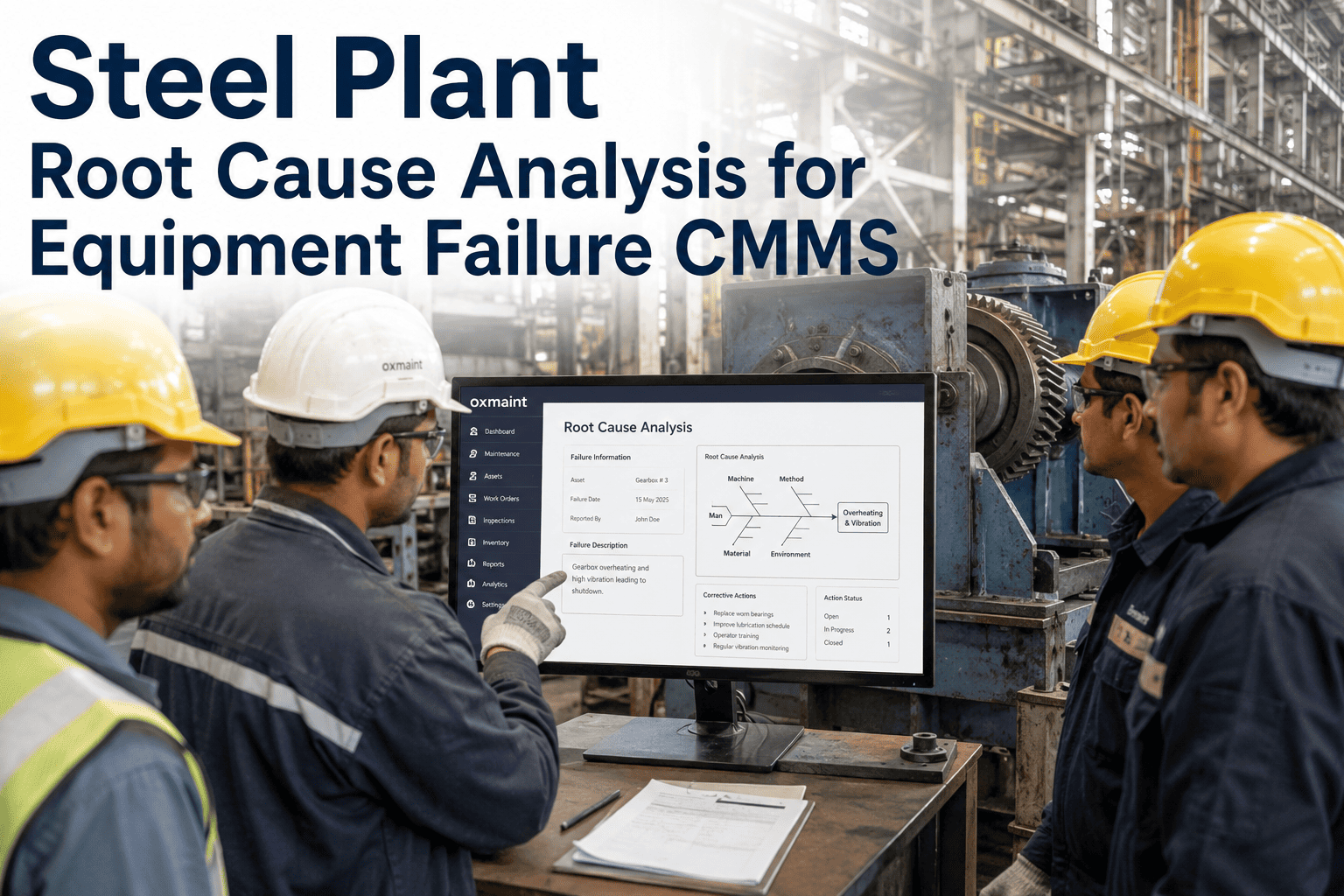
A steel plant that fixes the same rolling mill gearbox failure every 90 days is not running a maintenance program — it is running an expensive cycle of symptom suppression. Root cause analysis exists to break that cycle, yet fewer than 12% of failure events in most steel plants receive any structured RCA documentation. The reason is not that engineers do not understand RCA — it is that the traditional process takes 2–4 hours per event, requires data that is scattered across three systems, and competes with the next breakdown already queued in the work order backlog. AI-assisted RCA in the Oxmaint platform changes this by generating a structured analysis draft at work order closure — from failure data, sensor readings, and asset history that the CMMS already holds. Start a free trial or book a demo to see AI-assisted RCA in a live steel plant workflow.
Article · AI Copilot · Reliability Engineering
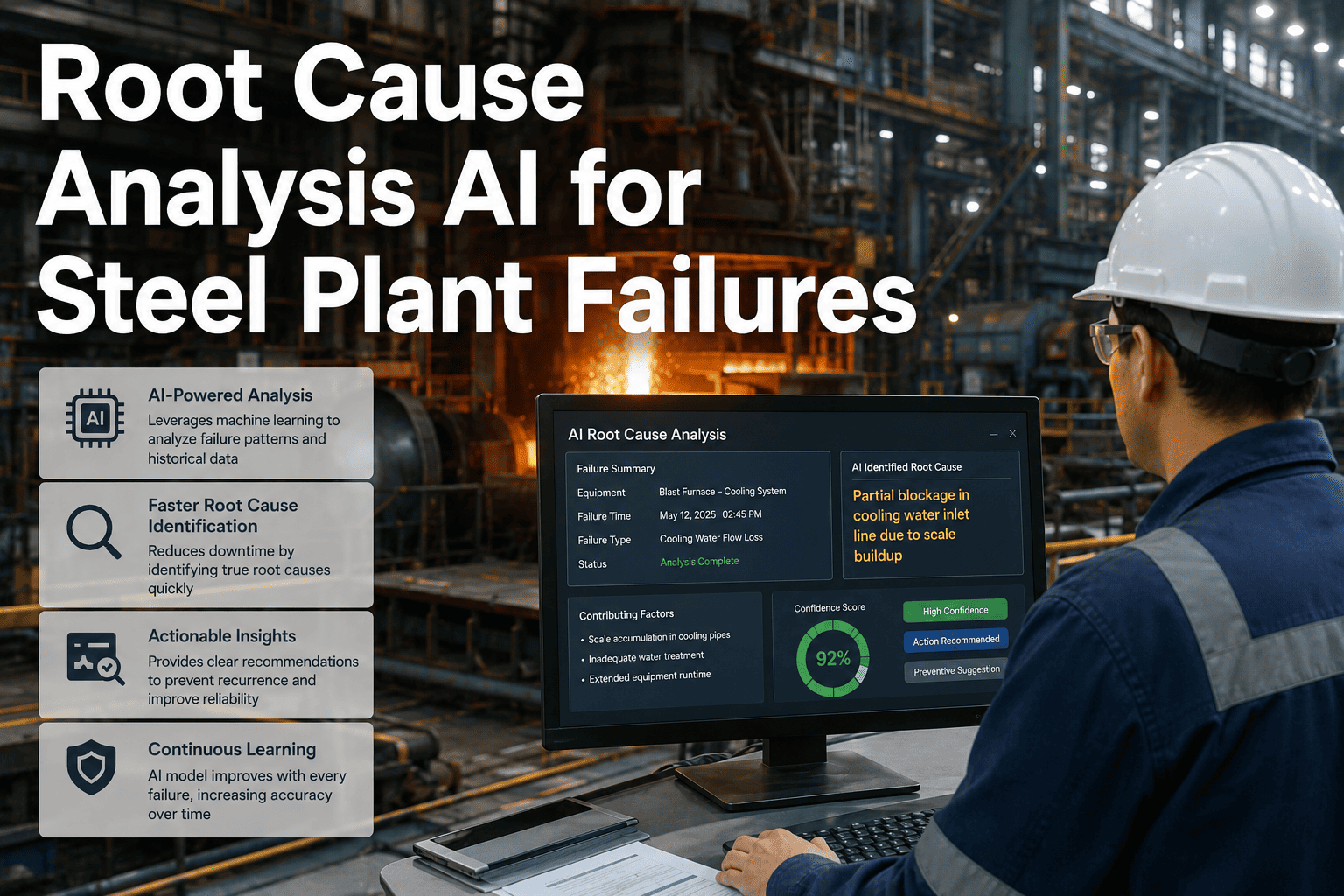
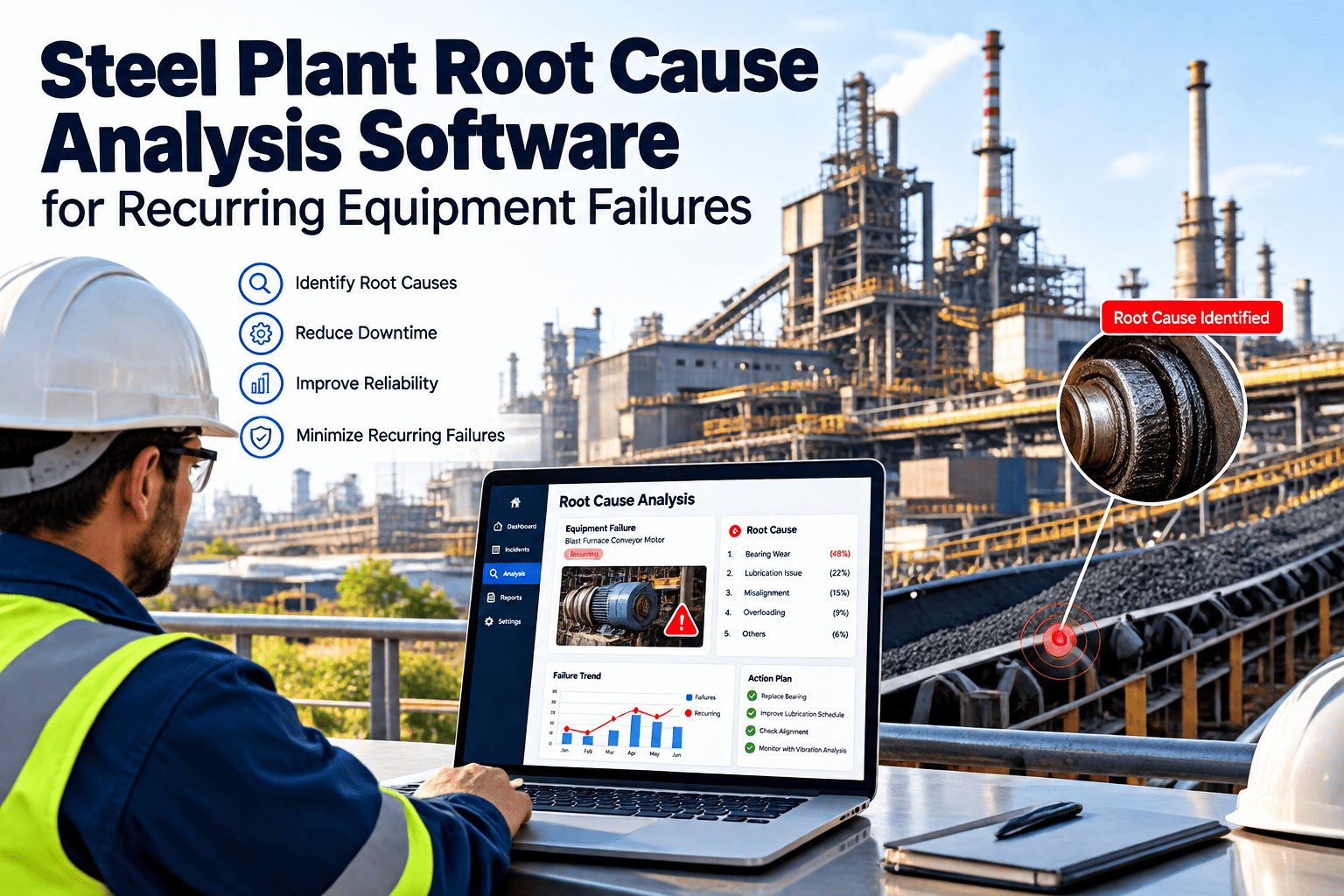
Root Cause Analysis AI for Steel Plant Failures
How AI-assisted RCA identifies repeat failures, bad actors, maintenance gaps, and corrective actions across steel plant assets — and why it works where manual RCA programs consistently fail.
12%
of steel plant failures receive documented RCA — the rest recur
34%
of repeat failures are traceable to the same uncorrected root cause
68%
reduction in repeat failures when AI RCA and corrective actions are tracked
5 min
AI RCA draft generation vs 2–4 hours manual process
Why Traditional RCA Programs Fail in Steel Plants
RCA methodology is well-understood. The failure is not conceptual — it is structural. Three conditions combine to make manual RCA unsustainable in production-pressure environments.
01
Data Is Never in One Place
A complete RCA requires failure history from the CMMS, sensor trends from SCADA, work order records, inspection logs, and parts history. Assembling this manually for one failure takes 45–90 minutes before analysis even begins. When the same information is in four systems with different access levels, it simply does not get assembled.
02
Competing With the Next Breakdown
In a steel plant with active production, the reliability engineer who should be doing RCA on Monday's gearbox failure is responding to Tuesday's hydraulic leak by 8 AM. RCA gets queued, then deprioritized, then forgotten when the next review cycle shows no documented corrective actions from last quarter's failures.
03
No Closed-Loop on Corrective Actions
Even when RCA is completed and a corrective action is identified, the follow-through tracking fails. Corrective actions sit in a spreadsheet or an email thread, not in the work order system. When the same failure recurs, nobody can verify whether the corrective action was implemented — because there is no structured record that it was.
How AI-Assisted RCA Works in Oxmaint — The Four-Layer Process
Oxmaint's AI RCA does not replace the reliability engineer's judgment — it eliminates the data assembly and draft-writing work that consumes 80% of the time while contributing nothing to analytical quality.
Layer 1
Automatic Failure Data Assembly
At work order closure, the AI pulls failure code, technician symptom description, sensor readings at time of fault, last PM completion date, previous failure events on the same asset, and parts used. All data assembled without manual lookup — in under 3 seconds.
Layer 2
Root Cause Draft Generation
The AI generates a structured RCA draft: symptom description, probable root cause (ranked by probability from failure pattern data), contributing factors (PM gap, operating condition, component age), and initial corrective action recommendation. Draft produced in under 5 minutes.
Layer 3
Bad Actor and Repeat Failure Detection
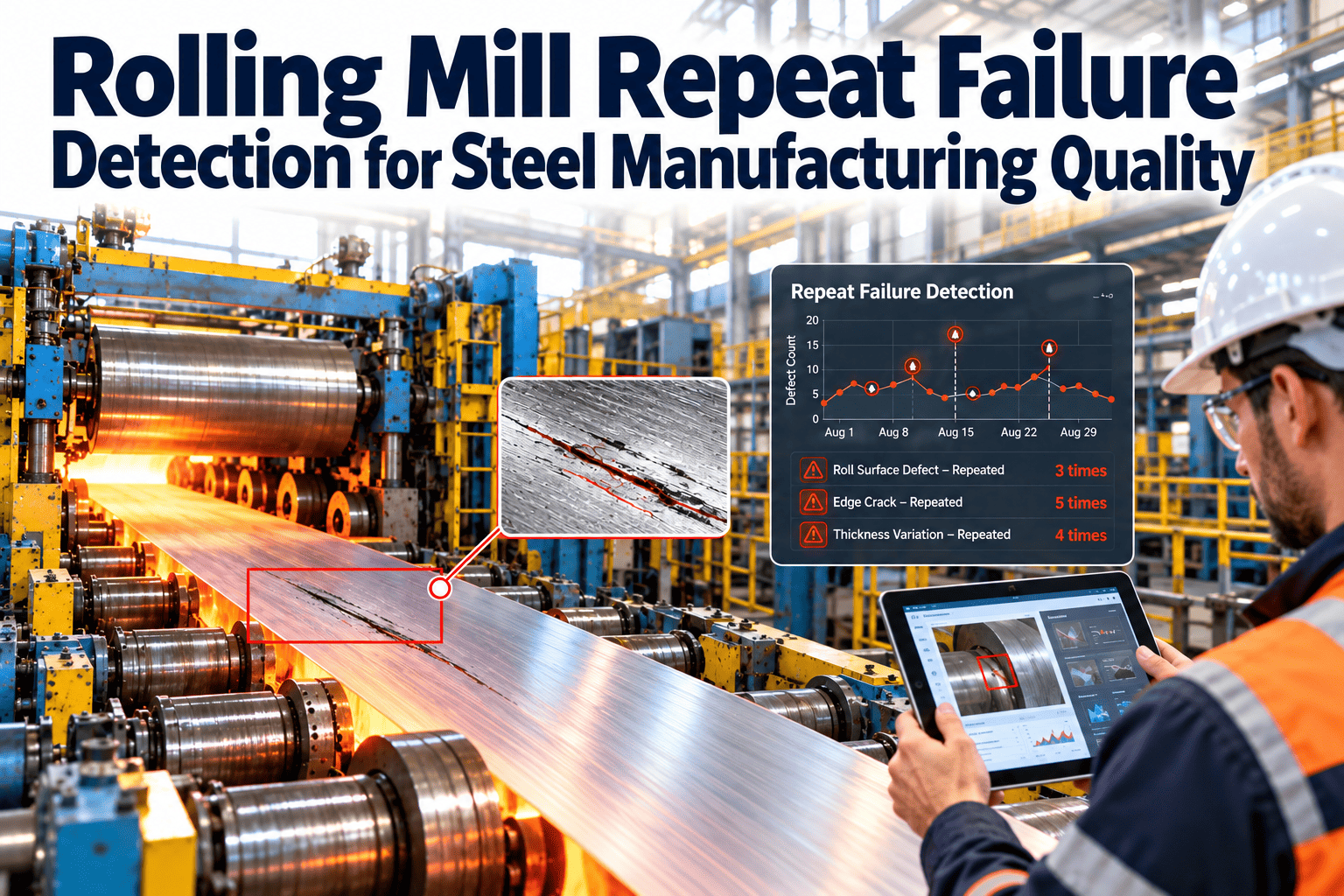
The AI flags the asset as a "bad actor" when the same failure mode recurs within a defined window (default: 90 days). It surfaces all previous RCA records, corrective actions, and their completion status — making pattern visibility automatic rather than dependent on someone running a manual report.
Layer 4
Corrective Action Tracking to Closure
Every corrective action generated by AI RCA becomes a tracked work order — not a note in a spreadsheet. The system monitors completion status, escalates overdue actions, and blocks the asset from being marked "resolved" on a repeat failure until the corrective action from the previous event is verified complete.
AI RCA Output — What a Completed Analysis Looks Like
The following illustrates an AI-generated RCA for a rolling mill drive motor failure on RM-MOT-07. All data pulled automatically from the CMMS at work order closure.
AI RCA Report · RM-MOT-07 · Rolling Mill Drive Motor · Generated: Auto at WO closure
Failure Event
Motor trip on overcurrent — production line stopped 4.5 hours
Symptom
Technician reported high operating temperature prior to trip; ammeter showed 118% FLA for 22 minutes before shutdown
Root Cause (AI — 84% confidence)
Drive-end bearing deterioration causing increased motor load — consistent with 34% vibration elevation over 8-day period preceding failure
Contributing Factor
Last bearing lubrication: 118 days ago. Recommended interval: 90 days. PM overdue by 28 days at time of failure
Pattern Flag
BAD ACTOR — 3rd bearing-related failure on RM-MOT-07 in 14 months. Previous corrective action (lubrication interval adjustment) not implemented
Corrective Actions (AI-recommended)
1. Adjust PM lubrication interval to 75 days — WO auto-created · 2. Add vibration monitoring to RM-MOT-07 — engineering review request sent · 3. Review all class-similar motors for same lubrication gap — bulk PM audit triggered
See the Oxmaint AI generate a complete RCA in under 5 minutes from a real steel plant work order — live, not recorded.
Bring your most frustrating repeat failure. We will show you what the AI surfaces.
Bad Actor Analysis — Finding the Assets Driving 80% of Your Downtime
In most steel plants, 10–15% of assets generate 70–80% of unplanned downtime cost. Identifying these "bad actors" manually requires a reliability engineer to run and analyze multiple cross-asset reports. Oxmaint AI identifies bad actors automatically and continuously.
| Bad Actor Trigger |
Detection Method |
AI Action |
Outcome |
| Same failure mode — 2+ times in 90 days |
Failure code pattern match across WO history |
Flag asset, surface all previous RCA records |
Corrective action escalated to engineering |
| Maintenance cost above 3× asset peer group |
Cost per asset vs class benchmark |
Alert maintenance manager, recommend lifecycle review |
Capital replacement or overhaul decision triggered |
| MTTR trending up over 6-week window |
Work order duration trend analysis |
Flag increasing repair complexity, check skill match |
Technician assignment or SOP review initiated |
| PM overdue at time of failure — 2nd occurrence |
Last PM date vs failure date on WO |
Adjust PM interval recommendation, create corrective WO |
PM frequency increased on asset and class-siblings |
| Corrective action from prior RCA not completed |
Corrective action WO status at repeat failure date |
Block "resolved" status, escalate to supervisor |
Closed-loop accountability enforced |
"Root cause analysis is the highest-leverage activity in reliability engineering — and the most consistently underdone. In twenty years of auditing steel plant maintenance programs, the pattern is identical: RCA documentation for less than 15% of failures, corrective actions tracked in spreadsheets nobody updates, and the same assets generating the same failure modes year after year while the maintenance team runs faster on the same treadmill. The AI RCA tool changes the economics of the process. When the first draft is generated automatically at work order closure, the time cost drops from four hours to fifteen minutes of review and approval. When the corrective action becomes a tracked work order automatically, the follow-through rate goes from under 20% to over 85%. The technology does not make engineers redundant — it makes them able to apply their judgment to analysis rather than spending their time assembling data and writing boilerplate."
Marcus Obi-Mensah, CMRP, CRE
Certified Maintenance and Reliability Professional · Certified Reliability Engineer · 20 years reliability engineering in integrated steel and heavy industrial operations · Former Head of Reliability Engineering · Specialist in failure analysis and bad actor elimination programs
Frequently Asked Questions
Does AI RCA replace the reliability engineer's judgment in steel plants?
No — AI RCA generates a structured draft and flags patterns; the reliability engineer reviews, edits, and approves every analysis before it is finalized. The AI handles data assembly, draft writing, and pattern detection — tasks that consume 80% of the time while requiring little analytical judgment. The remaining 20% — contextual interpretation, corrective action design, and approval — stays with the engineer. Most plants see engineers shift from documentation writers to analytical decision-makers, which is a significantly higher-value use of their time.
Book a demo to see the review and approval workflow.
Can the AI identify bad actors across a fleet of 500+ steel plant assets?
Yes. The bad actor detection engine runs continuously across the full asset register — not just the assets that triggered a work order this week. It cross-references failure frequency, maintenance cost trend, MTTR trend, and corrective action completion status across every asset and flags those that exceed configurable thresholds. A reliability engineer running this manually would need a full day per month to produce the same analysis. The AI produces it continuously and escalates exceptions automatically.
Start a free trial and run a bad actor analysis on your existing failure data.
How does Oxmaint track corrective actions to ensure they are implemented?
Every corrective action generated from an AI RCA is automatically converted into a tracked work order — assigned, prioritized, and monitored against an SLA. The system does not allow the original failure event to be marked "permanently resolved" on a repeat occurrence until the corrective action work order from the previous event is verified complete. Overdue corrective actions escalate to the maintenance manager automatically. This closed-loop structure is what eliminates the spreadsheet-tracking failure mode that plagues most manual RCA programs.
Book a demo to see corrective action tracking in Oxmaint.
What data does the AI RCA engine need to generate an accurate analysis?
The AI generates useful drafts from work order data alone — failure code, technician symptom description, asset class, and last PM date. Accuracy improves significantly when sensor data (vibration, temperature trends) is connected via SCADA integration, and when work order history covers 6+ months. Plants with mature CMMS data — 12+ months of structured failure codes and PM records — see the highest diagnostic accuracy from day one. Plants starting fresh build accuracy progressively as work orders accumulate structured closure data.
Stop Your Steel Plant's Worst Repeat Failures — Start With AI-Assisted RCA
Oxmaint AI generates structured RCA drafts at work order closure, identifies bad actors continuously, and tracks corrective actions to completion — so repeat failures get eliminated, not just repaired again.