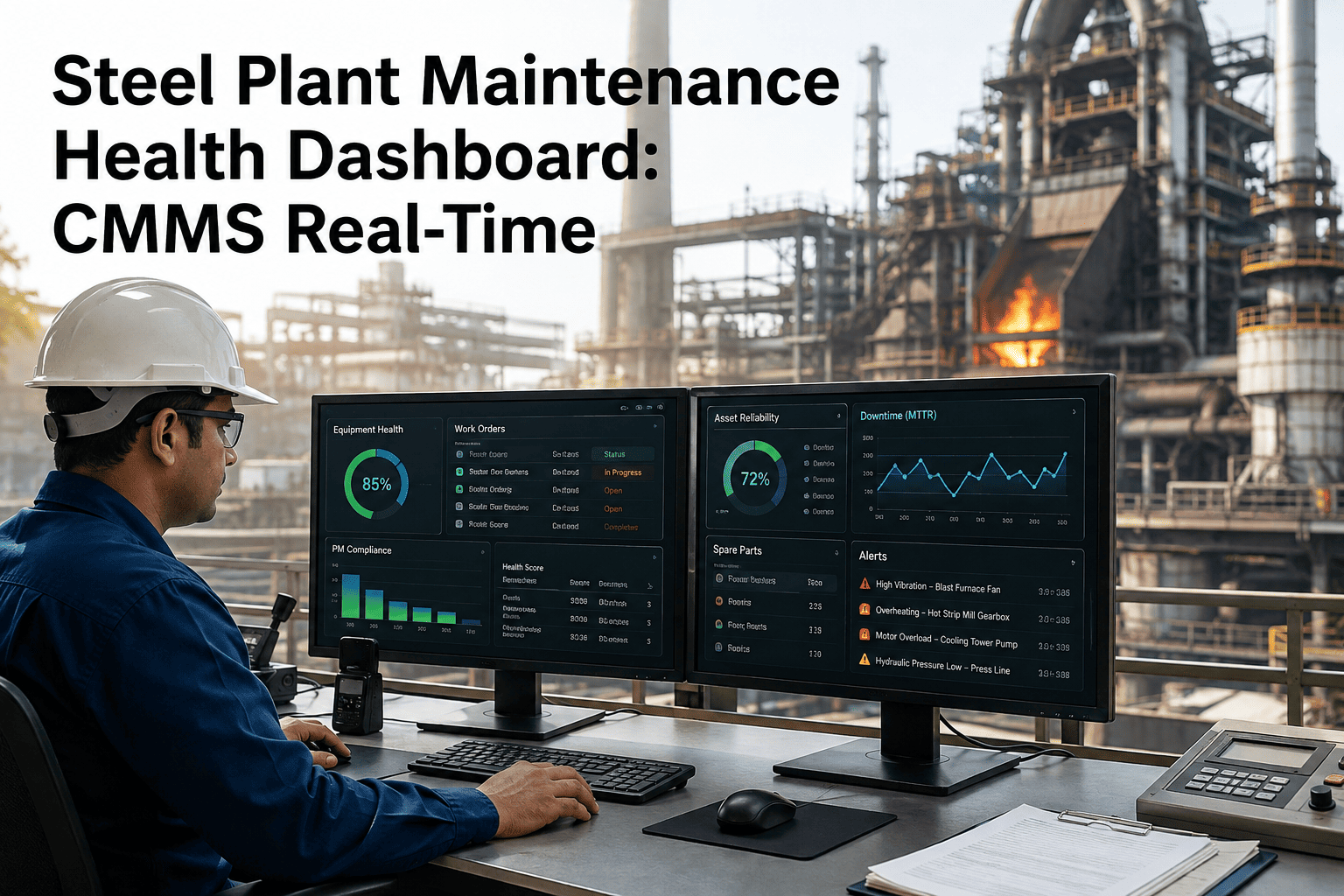
SCADA-CMMS integration for steel plants represents the critical bridge between real-time equipment monitoring and actionable maintenance workflows. In modern steel production, Supervisory Control and Data Acquisition (SCADA) systems generate vast amounts of operational data—temperature, vibration, pressure, and flow rates—yet this information often remains siloed from the Computerized Maintenance Management System (CMMS) where work is planned and executed. This disconnect leads to delayed responses, missed warning signs, and reactive maintenance cycles that compromise reliability. By integrating SCADA data directly into the CMMS, steel plants can automate work order generation, prioritize tasks based on actual asset health, and create a closed-loop feedback system that transforms raw data into strategic maintenance actions. Schedule a consultation to explore how seamless integration can transform your maintenance operations.
The Connectivity Gap in Steel Operations
Steel plants operate some of the most complex industrial machinery in the world. While SCADA systems monitor these assets continuously, maintenance teams often rely on manual inspections or scheduled intervals to identify issues. This gap between operational visibility and maintenance action creates blind spots where minor anomalies escalate into catastrophic failures. Bridging this gap requires more than just data access—it demands intelligent workflows that trigger the right response at the right time.
Core Integration Capabilities
Effective integration goes beyond simple data transfer. It requires intelligent logic that understands the context of operational data and translates it into meaningful maintenance tasks. The right platform enables conditional triggers, priority mapping, and feedback loops that continuously improve maintenance strategies.
When SCADA alarms exceed defined thresholds, work orders are automatically created in the CMMS with relevant context, sensor readings, and recommended actions.
Critical alarms trigger high-priority work orders assigned to immediate response teams, while minor deviations schedule routine inspections during next available window.
Move from time-based to condition-based maintenance. Triggers based on vibration trends, temperature spikes, or pressure drops ensure intervention only when needed.
Technician findings and repair data feed back into the SCADA logic, refining alarm thresholds and improving future trigger accuracy based on actual outcomes.
Real-World Use Cases
Steel plants deal with diverse equipment types, each requiring specific monitoring strategies. From rolling mill motors to furnace cooling systems, SCADA-CMMS integration delivers tangible value across every production area.
Motor Vibration Monitoring
Scenario: Vibration sensors on critical rolling mill motors detect increasing amplitude.
Action: Integration logic identifies trend exceeding baseline. CMMS generates inspection work order with vibration history attached. If threshold breached, automatic shutdown request initiated.
Outcome: Bearing replacement scheduled during planned stop, avoiding unplanned motor failure.
Furnace Cooling Systems
Scenario: Flow meters detect reduced coolant flow in furnace panels.
Action: High-priority alert sent to maintenance team. CMMS creates emergency work order with safety permits pre-attached. Technician dispatched with thermal imaging equipment.
Outcome: Blockage cleared before panel overheating, preventing potential breakout incident.
Hydraulic Pressure Stability
Scenario: Hydraulic power units show pressure fluctuations outside normal operating range.
Action: System logs deviation history. CMMS schedules filter inspection and fluid analysis. Procurement automatically notified if fluid replacement likely.
Outcome: Contamination identified early, preventing pump damage and maintaining press reliability.
Implementation Roadmap
Successful integration requires careful planning to ensure data quality, security, and user adoption. A phased approach allows plants to validate triggers, refine logic, and build confidence before full-scale deployment.
Phase 1: Asset Criticality & Data Mapping
Identify critical assets for integration. Map SCADA tags to CMMS asset IDs. Define initial alarm thresholds and trigger logic. Establish data security protocols.
Phase 2: Pilot Integration
Connect limited asset group (e.g., one production line). Test work order generation logic. Validate technician response times. Refine alarm thresholds based on false positive rates.
Phase 3: Workflow Optimization
Expand to additional asset classes. Integrate inventory checks (auto-reserve parts). Enable mobile notifications for technicians. Implement feedback loops from completion data.
Phase 4: Enterprise Scale & Analytics
Full plant deployment. Advanced analytics on trigger effectiveness. Predictive model refinement. Cross-functional reporting between operations and maintenance.
Measurable Benefits
Integrating SCADA and CMMS delivers quantifiable improvements across maintenance KPIs. Plants moving from reactive to condition-based strategies see significant reductions in downtime and maintenance costs.
Technical Considerations
Steel plant environments present unique challenges for integration. Network security, data volume, and legacy system compatibility must be addressed to ensure reliable operation.