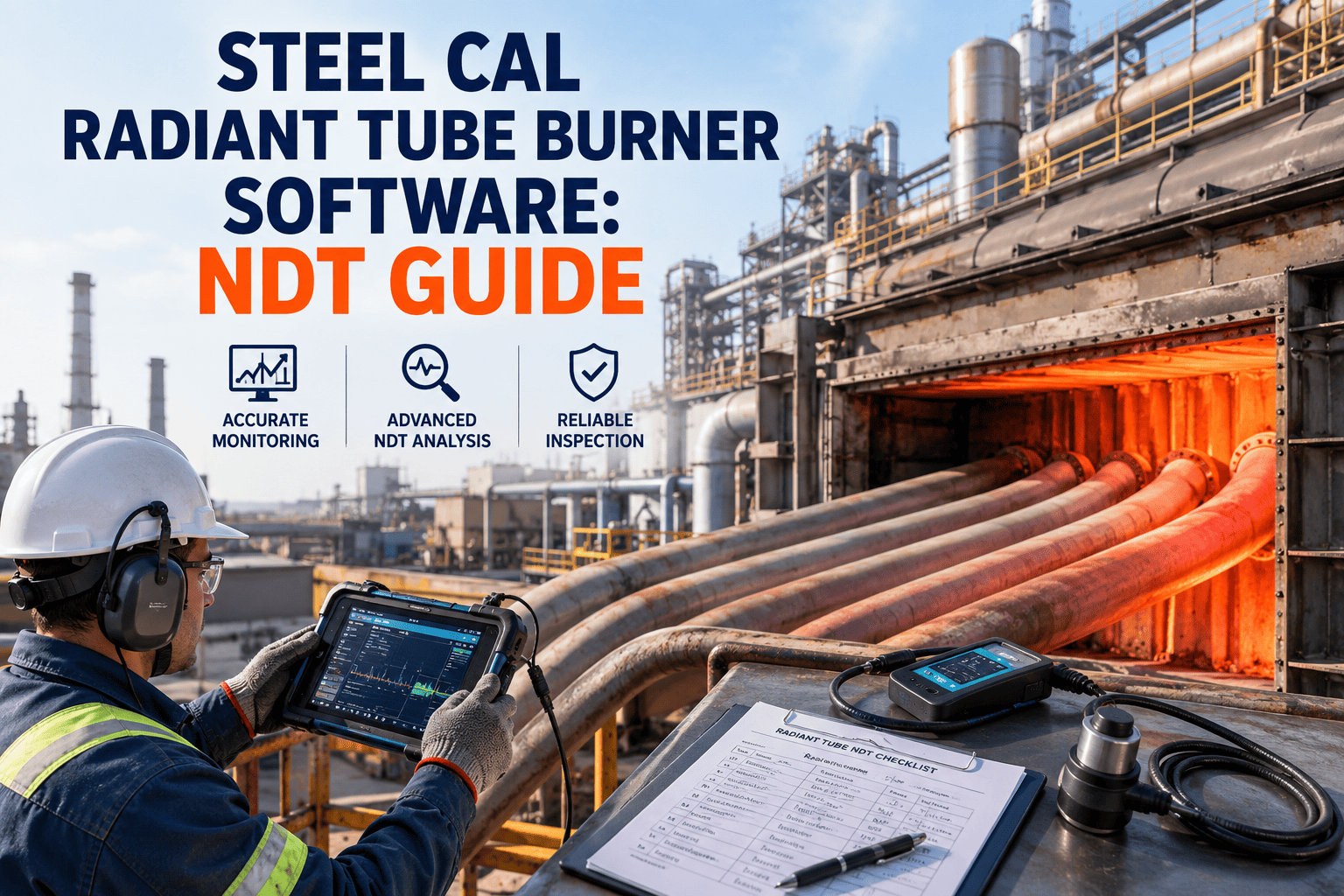
A radiant tube on a continuous annealing line runs at roughly 900 to 920 degrees Celsius, with the tube wall itself running fifty to a hundred degrees hotter than the strip it's heating, day after day, for years. Nobody sees the failure coming from the outside — the tube looks the same from the walkway right up until the fire-facing wall thins past the point it can hold pressure and ruptures into the furnace atmosphere, at which point the line is down, the atmosphere is compromised, and the strip inside the furnace may be scrapped along with whatever downstream product was scheduled to be made from it. The three signals that actually predict this failure — wall thickness, thermocouple accuracy, and burner tile condition — exist on every CAL and CGL line already; the problem is almost always that they're checked on a calendar instead of tracked as a trend over the tube's full service life, and OxMaint turns those three signals into one predictive maintenance record per tube instead of three disconnected inspection sheets.
Radiant Tube PdM
Stop Discovering Tube Failures From the Rupture Itself
OxMaint tracks wall thickness NDT readings, thermocouple drift, and burner tile wear per tube, per zone — so a failing radiant tube shows up as a trend line weeks before it shows up as an unplanned outage.
Why Radiant Tubes Fail Quietly, Then All at Once
A radiant tube's job looks simple from the outside — burn gas inside a sealed tube, let the tube wall radiate heat to the strip, keep the flame away from the metal itself. In practice, the fire-facing side of the tube spends its entire service life fighting three slow processes at once: thermal cycling every time the line stops and restarts, oxide scale growth on the inside surface where flue gas contacts the alloy, and localized hot-spotting wherever flame shape drifts off-center inside the tube. Any one of these alone is manageable. Together, over months, they thin the tube wall unevenly, and the tube that looks structurally fine on a visual walk-down can be a fraction of its rated wall thickness in the one spot the burner flame has been drifting toward for the last six months — a spot no operator can see from the walkway and no visual inspection was ever designed to catch. Because the degradation happens on the inside surface, in the one zone of the furnace nobody is standing next to, it is functionally invisible without instrumented inspection — which is exactly why so many radiant tube failures still arrive as an unplanned event instead of a scheduled tube change. The frustrating part for a reliability team is that the tube isn't failing randomly — it's failing in a pattern that would be entirely predictable if the three relevant data points were ever looked at together instead of one at a time on three different schedules.
Five Tube Geometries, One Shared Failure Pattern
CAL and CGL furnaces run I-type, U-type, W-type, P-type, and PP-type radiant tubes depending on furnace zone and heating duty, and while the geometry changes how the tube is supported and how many burner ends it has, the underlying failure mechanism is the same across all five: wall thinning at the point of highest flame contact. Longer, more complex geometries like W and P type tubes simply have more bends where flame impingement and expansion stress can concentrate, which is part of why they're inspected more frequently on most lines. Furnace zone matters as much as geometry — a tube in the highest-temperature soaking zone will lose wall thickness faster than the same shape of tube sitting in a cooler preheat zone, which is why a single fixed inspection interval applied across every tube in the furnace rarely matches how those tubes are actually aging in practice, day to day, campaign after campaign.
I-Type
Single straight tube, one burner end. Simplest geometry, fewest stress points, typically used in shorter heating zones.
U-Type
Single hairpin bend. Common in preheat and heating sections where a compact footprint is needed per zone.
W-Type
Double hairpin bend, longer flame path. More bends mean more locations where flame drift can create a hot spot.
P-Type
Extended single-pass geometry for longer soaking zones, often paired with recuperative burners for efficiency.
PP-Type
Twin-pass variant of the P-type, used where zone length and heat output both need to be maximized in one tube.
The Three Signals That Actually Predict Failure
Every CAL line already generates the data needed to see a tube failure coming — the problem is almost never a missing sensor, it's that the three signals live in three different places and get reviewed on three different schedules. Wall thickness NDT gets logged on a paper inspection sheet during a shutdown. Thermocouple readings sit in the control system, watched for absolute temperature but rarely for drift. Burner tile condition gets assessed visually during a combustion tune-up, months apart from the other two checks. None of the three tells the whole story alone, but together they describe exactly how close a tube is to failing — and the reason this matters more in a steel plant than almost anywhere else in the process is that a radiant tube failure doesn't just cost the tube, it costs the atmosphere control that the entire anneal cycle depends on.
Tube Wall Thickness — Ultrasonic NDT
Periodic UT readings taken at known hot-spot locations on each tube, tracked as a trend against original wall thickness. A tube losing wall thickness faster than its sister tubes in the same zone is the clearest early warning available, and it only means something when readings are compared over time, not viewed as a single pass or fail.
Thermocouple Drift
A thermocouple that has drifted low reads a lower temperature than the tube actually is, which prompts the burner to fire harder to hit setpoint — quietly overheating a tube the control system believes is running normally. Tracking drift against a reference or a redundant sensor catches this before it becomes accelerated wall loss.
Burner Tile Wear
A cracked or eroded burner tile changes how the flame shapes inside the tube, moving the hot spot away from where the tube was designed to handle it. Tile condition logged at every combustion check, cross-referenced against the wall thickness trend on that same tube, explains why a hot spot appeared where it did.
Why Tube-Level History Beats Zone-Level Averages
Most CAL lines track furnace performance by zone — average temperature, average fuel consumption, average tube age — because that's how the control system is organized and how the combustion team has always reported it. The problem is that failure doesn't happen at the zone level, it happens to one specific tube, and averaging across a dozen tubes in a zone hides the one outlier that's actually heading toward failure behind eleven tubes that are perfectly healthy. A zone average of eighty-five percent remaining wall thickness sounds fine right up until it turns out that number is ten tubes at ninety-two percent and one tube at forty percent, sitting exactly where the flame has been drifting for months. Tube-level history — one ID, one location, one trend line going back to installation — is the only view granular enough to catch that outlier before it becomes the next unplanned atmosphere breach. It also makes tube changeout decisions defensible: instead of pulling a tube on a fixed campaign schedule regardless of its actual condition, or leaving one in service past a safe point because nobody flagged it, the record shows exactly which tubes are approaching their limit and which ones have years of service life left, which turns a maintenance planning meeting from a debate about gut feel into a five-minute review of a ranked list.
One Record Per Tube
Wall Thickness, Thermocouple, and Tile Data — In One Place
OxMaint ties NDT readings, thermocouple drift, and burner tile inspections to the same tube ID and furnace zone, so a hot spot shows up as one connected trend instead of three separate reports nobody cross-references.
What an Unplanned Radiant Tube Failure Actually Costs
A radiant tube rupture is not a routine outage — it's a furnace atmosphere event. The tube separates flue gas from the controlled annealing atmosphere inside the furnace shell, and a breach lets combustion products into a space that's carefully held at a specific dew point and gas composition to protect the strip surface. Beyond the immediate line stop, the strip already in the furnace at the moment of rupture is frequently scrapped, the affected zone has to cool before anyone can safely replace the tube, and the line often can't restart at full speed until the atmosphere has been re-purged and re-verified. None of that downtime is close to the cost of the tube itself — a radiant tube is a relatively inexpensive component next to the hours of lost production, scrapped coil, and re-purge time that follow an unplanned rupture on a line running around the clock. The scheduling cost compounds further because a rupture rarely happens at a convenient moment in the production calendar — it happens whenever the weakest point on the weakest tube finally gives out, which means the outage lands on whatever order is running that day rather than a day the plant had already set aside for maintenance.
Furnace Atmosphere Contamination
Flue gas entering the controlled atmosphere changes dew point and gas chemistry mid-anneal, risking surface defects on strip that's already inside the furnace when the breach occurs.
Zone Cool-Down Before Replacement
A ruptured tube can't be safely replaced at operating temperature. The zone has to cool, extending the outage well beyond the physical swap time for the tube itself.
Scrapped In-Process Strip
Strip inside the furnace at the moment of failure is often scrapped outright, since the anneal cycle was interrupted mid-process with no way to reliably complete it to spec.
Slow Restart and Re-Purge
Getting the atmosphere back to spec after a breach takes time, meaning the line frequently can't return to full speed the moment the new tube is installed.
We used to change radiant tubes on a fixed campaign schedule and still had two unplanned ruptures a year. Once we started trending wall thickness against thermocouple drift per tube, both of our last three changeouts happened during a planned shutdown instead of a middle-of-the-night atmosphere alarm.
Furnace Reliability Engineer — Continuous galvanizing line, integrated steel producer
Frequently Asked Questions
How often should radiant tube wall thickness actually be checked?
It depends on tube age, zone temperature, and prior trend behavior more than a fixed calendar — a tube already showing accelerated thinning needs closer intervals than a new one sitting in a cooler zone. OxMaint flags which tubes are due based on their own trend, not a blanket schedule applied across the whole furnace.
Can thermocouple drift really cause a tube to fail faster?
Yes. A thermocouple reading low makes the control system fire the burner harder to reach setpoint, which overheats the actual tube wall while the display shows a normal, in-spec temperature — the tube ages faster than the control room has any reason to suspect.
Does burner tile condition really affect where a tube wears?
Yes. A cracked or eroded tile changes flame shape inside the tube, shifting the hot spot away from where the tube design expects the highest heat load, which is why tile checks matter alongside wall thickness data rather than as a standalone combustion check.
What's the earliest warning sign of a radiant tube heading toward failure?
A wall thickness reading dropping faster than its sister tubes in the same zone, especially when paired with a thermocouple on that same tube reading persistently low relative to a reference sensor nearby.
Can OxMaint track this across multiple furnaces and tube geometries?
Yes — I, U, W, P, and PP type tubes across multiple CAL and CGL lines each get their own trend record. Book a demo to see it set up against your own furnace zones.
Plan the Changeout, Not the Outage
Turn Wall Thickness, Thermocouple, and Tile Data Into One Predictive Record
OxMaint tracks every radiant tube's condition across all three signals, so the next tube change happens on your schedule, not the furnace's.