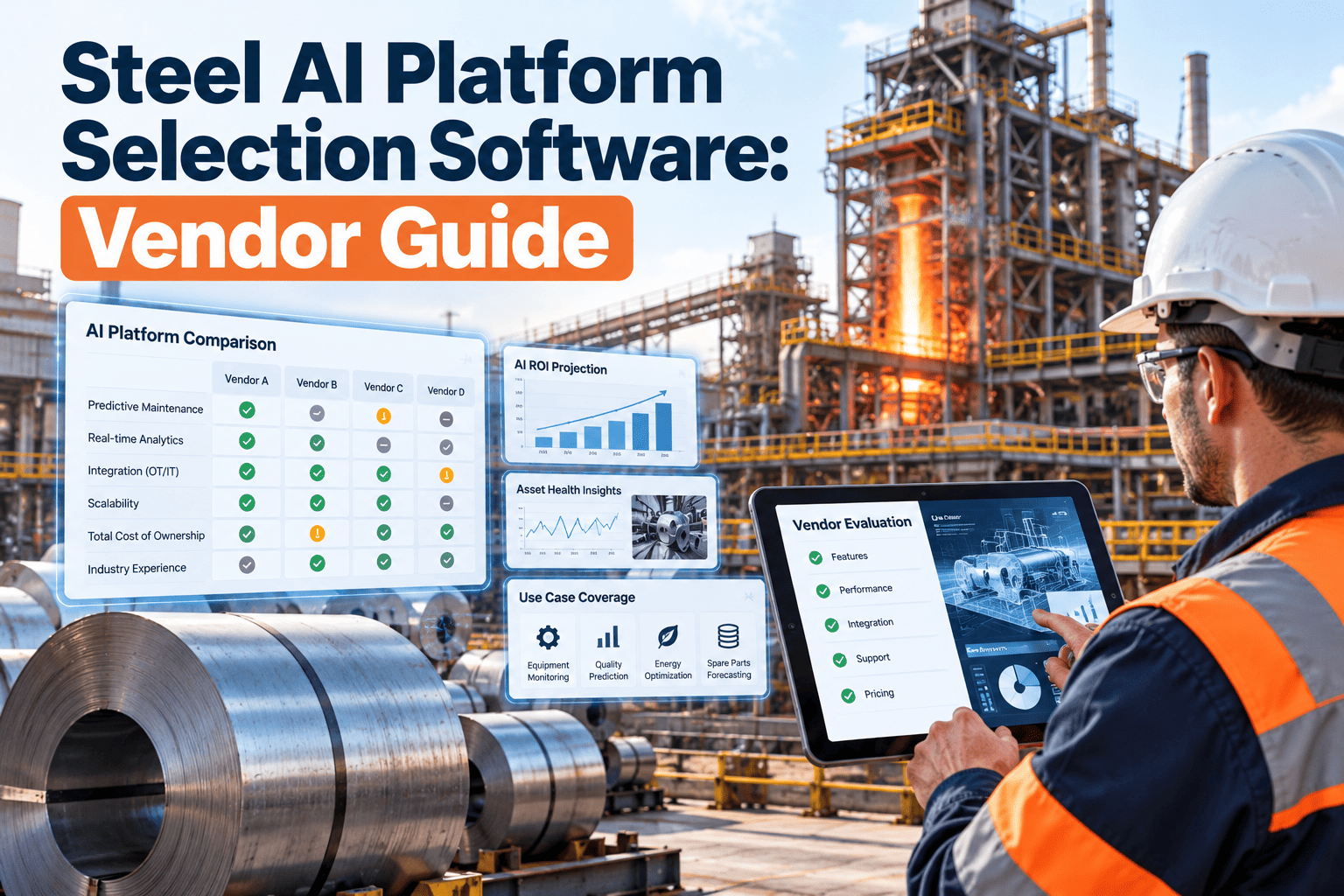
Every steel group eventually faces the same question: which AI platform should sit behind our reliability and quality programmes? The market is crowded with cloud giants, GPU vendors, industrial software suites, and niche steel specialists, and each one demonstrates well on a clean dataset. The harder test is what happens in a dusty hot strip mill with legacy PLCs and a maintenance team that must act on every alert. A fair comparison needs steel-specific criteria, and a walkthrough of how maintenance execution fits the decision is a useful place to begin.
Steel AI Platform Selection Software: A Vendor Comparison Framework for Maintenance and Reliability Teams
Compare NVIDIA, iFactory, Azure IoT, and specialised steel AI vendors on the criteria that decide success in a steel plant, then connect the chosen platform to work orders, spares, and technicians through a CMMS.
The Four Mistakes Steel Groups Make When Buying AI
Most failed AI programmes in heavy industry do not fail on algorithm quality. They fail on fit, integration, and ownership, and those are all decisions made before the contract is signed.
Buying a technology instead of a use case
A platform is selected because it is impressive, and only afterwards does the team ask which failure mode or quality problem it will address.
Judging on a clean demonstration dataset
Vendor demos run on tidy data. Steel plants produce noisy, interrupted, and poorly labelled signals, and models behave differently on them.
Ignoring who acts on the alert
An alert that lands in a dashboard nobody opens has no value. The path to a planned work order must be part of the evaluation.
Leaving data ownership vague
Contracts that do not state who owns models, labelled data, and derived insights create switching costs that appear years later.
Four Vendor Types and What Each Really Provides
The names in a steel AI shortlist often belong to different categories. Comparing a GPU platform with a vision inspection product is like comparing an engine with a car, so classify first and compare second.
| Vendor Type | Examples in This Guide | What You Typically Get | What You Must Add Yourself |
|---|---|---|---|
| GPU and edge AI platform | NVIDIA | High-performance compute, edge hardware, and development frameworks for vision and analytics workloads | Steel-specific models, labelled defect or failure data, integration with plant systems, and an operations workflow |
| Hyperscale cloud IoT and analytics | Azure IoT | Device connectivity, data storage, digital twin services, and machine learning tooling at enterprise scale | Plant connectors, steel process logic, model development, and a maintenance execution layer |
| Industrial AI application suite | iFactory and similar suites | Packaged analytics for predictive maintenance, quality, and OEE with faster time to first result | Verification that the models fit your processes, plus a clear link into your CMMS and spares system |
| Specialised steel AI vendor | Surface inspection, caster, and furnace-focused providers | Deep process knowledge in a narrow area such as coil surface quality or caster breakout prevention | Coverage for the rest of the plant, since each product usually addresses one process |
Vendor offerings change quickly. Treat this table as a way to classify what you are buying, and confirm current product scope directly with each vendor.
Bring the Maintenance Workflow Into the AI Decision Early
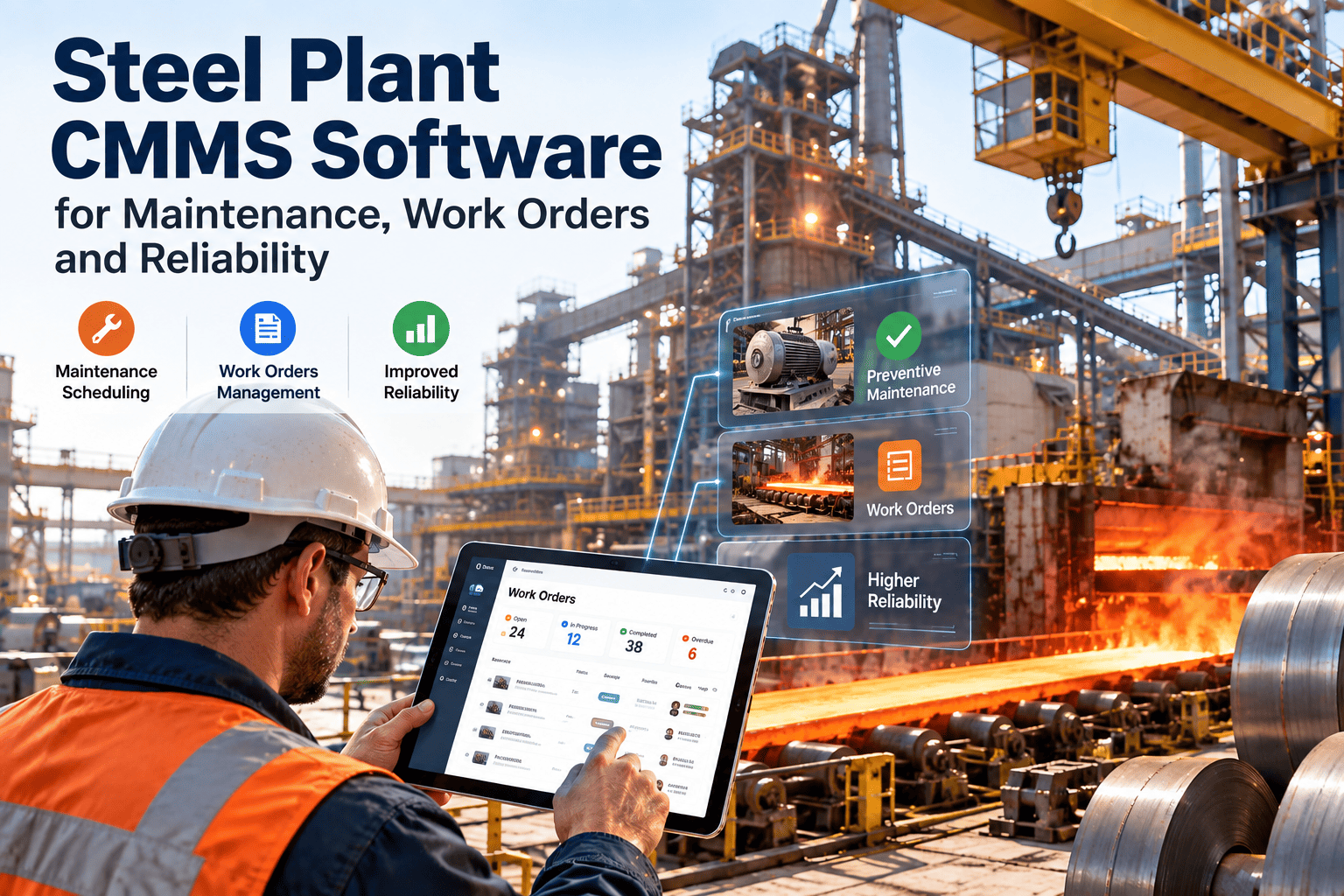
Oxmaint turns AI alerts and inspection findings into assigned, scheduled, and closed work orders, so the platform you pick has somewhere useful to send its output.
Seven Criteria That Separate a Steel-Ready Platform From a Demo
Use these criteria as a written scorecard. Each one maps to a question you can ask a vendor and a proof you can request.
1. Steel process fit
Ask for references from the same process, such as blast furnace blowers, caster segments, or hot strip mill drives. General industrial credentials do not guarantee steel performance.
2. Legacy and OT integration
Steel plants run mixed generations of PLCs, drives, and historians. Confirm supported protocols and how data is collected without disturbing control systems.
3. Harsh environment readiness
Heat, dust, vibration, and electromagnetic noise affect sensors and cameras. Ask what happens to data quality and uptime when conditions are poor.
4. Explainability
Engineers trust recommendations they can inspect. Request examples showing which signals triggered an alert and how confidence is expressed.
5. Alert-to-action path
Check how an alert becomes a work order, who is notified, and how the outcome is fed back to improve the model.
6. Data ownership and security
Clarify where data is stored, who owns trained models, how access is controlled, and what happens to your data if the contract ends.
7. Five-year total cost
Include licences, compute, sensors, integration, model upkeep, and internal staff time, not only the first-year subscription.
How to Score Vendors Without Letting the Best Presenter Win
A simple weighted score keeps discussion anchored. Agree weights first, score independently, then compare notes.
- Assign each criterion a weight that totals 100, and get reliability, operations, IT, and finance to agree before any demonstration.
- Score every vendor from 1 to 5 against each criterion, using written evidence rather than impressions.
- Multiply score by weight, add the results, and note the gaps where a vendor scores below 3 on a high-weight criterion.
- Treat any score below 3 on integration or alert-to-action as a blocker to resolve, not a trade-off to average away.
- Re-score after the pilot using plant data, because the post-pilot score is the one that matters.
Which Vendor Type Suits Which Steel Problem
The best platform depends on the problem. This matrix shows where each category tends to be strongest, so you can match the shortlist to the use case rather than the brand.
| Steel Use Case | GPU / Edge Platform | Cloud IoT | Industrial AI Suite | Specialised Steel Vendor |
|---|---|---|---|---|
| Rotating equipment condition monitoring | Possible with custom work | Strong for data handling | Strong with packaged models | Rarely the focus |
| Coil surface defect detection | Strong compute base | Supporting role | Varies by vendor | Strong where product exists |
| Caster or furnace process optimisation | Needs process models added | Needs process models added | Limited | Strong in niche |
| Plant-wide data platform and digital twin | Visualisation and simulation support | Strong for scale | Moderate | Rarely offered |
| Fast pilot on a single asset class | Slower, build required | Moderate | Strong | Strong in niche |
Reading the Matrix Honestly
- Most steel groups end up combining two categories, for example a cloud data layer with a specialised inspection product.
- Combining vendors raises integration effort, so the alert-to-action path must be defined once, in one place.
- A pilot on a single asset class is a cheaper way to learn than a plant-wide commitment.
The Layers Between a Sensor and a Repaired Machine
AI is one layer in a longer chain. Selection discussions that stop at the model miss the layers where projects usually stall.
Layer 1: Sensing and Capture
Vibration, temperature, current, cameras, and process signals collected from the equipment.
Layer 2: Connectivity and Storage
Gateways, historians, and cloud or on-premises storage that make the data usable.
Layer 3: AI Models and Analytics
Anomaly detection, remaining life estimates, and quality classification, where the platform vendors compete.
Layer 4: Maintenance Execution
Work orders, scheduling, parts, and technician instructions, where the CMMS closes the loop and records the outcome.
Why Layer 4 Decides the Return
- A prediction creates value only when someone plans and completes the repair in time.
- Repair outcomes, parts used, and findings feed back into model validation.
- Asset history and failure codes in the CMMS give analytics a reliable record to learn from.
Warning Signs During Vendor Conversations
Certain answers should slow the process. Keep this list beside the scorecard during demonstrations.
- The vendor cannot name a steel process reference you can speak to directly.
- Accuracy claims are quoted without describing the dataset, the failure types, or the false alarm rate.
- Integration with your maintenance system is described as a future roadmap item.
- Model outputs cannot be explained to a reliability engineer in plain terms.
- Pricing excludes sensors, integration work, or per-asset expansion costs.
- Data ownership and exit terms are left out of the proposal.
A Twelve-Week Pilot That Produces a Real Decision
A good pilot is small, measurable, and tied to a business question. It should end with a go or no-go, not a presentation.
-
Weeks 1-2Choose one asset class with known failures and good records. Agree success measures such as warning lead time, false alarms, and avoided stops.
-
Weeks 3-5Connect data sources, confirm data quality, and load asset history and failure codes from the CMMS.
-
Weeks 6-9Run the platform in shadow mode, comparing its warnings with actual condition findings from technicians.
-
Weeks 10-11Route warnings to work orders and measure response time, planning quality, and repair outcomes.
-
Week 12Re-score the vendor against the weighted criteria and decide whether to expand, adjust, or stop.
Questions to Put to Every Vendor in Writing
Written answers are easier to compare than demonstration impressions. Send the same list to every vendor and score the responses against your criteria.
- Which steel processes and equipment types have you deployed on, and can we speak with a maintenance or reliability user at one of those sites?
- What data do you need, at what sampling rate, and how do you handle gaps, drift, and sensor failures?
- How were your models trained and validated, and what false alarm rate should we expect on our equipment?
- How does an alert reach a planner, and which maintenance systems do you integrate with today rather than on a roadmap?
- What happens to our data, labelled events, and trained models if we end the contract?
- Who maintains the models over time, and what internal skills do we need to keep the platform useful?
- What does a typical expansion from one asset class to the whole plant cost in licences, sensors, and services?
Building a Five-Year Cost View Before You Compare Prices
Subscription price is often the smallest part of the cost. Build the same cost model for every vendor so the comparison reflects what you will actually spend.
| Cost Element | What to Include | Often Missed |
|---|---|---|
| Platform and licences | Subscription, per-asset or per-sensor fees, and user licences | Price steps as asset coverage grows |
| Infrastructure | Cloud compute, storage, edge hardware, and network upgrades | Data egress and storage growth over time |
| Sensing and installation | Sensors, cameras, cabling, and shutdown access for fitting them | Replacement of devices damaged by heat or dust |
| Integration | Connectors to PLCs, historians, ERP, and the CMMS | Rework when a plant system is upgraded |
| People and upkeep | Data engineering, model review, training for planners and technicians | Time spent reviewing alerts that turn out to be false |
Measuring the Benefit Side Fairly
- Use your own downtime cost per hour and your own failure history, not vendor averages.
- Count only failures the platform warned about early enough for a planned repair.
- Deduct the cost of false alarms, since each one consumes planner and technician time.
- Track benefits through work order and stoppage records so the finance team can verify them.
Decide Who Owns the Platform After Go-Live
- Name one reliability owner who reviews alert quality every month and can retire noisy alert rules.
- Give planners a clear rule for when an alert becomes a work order and when it stays under observation.
- Review model performance against closed work order findings each quarter, and record what changed.
- Keep a written record of data sources, model versions, and approvals so audits and vendor changes do not start from zero.
What Oxmaint Contributes Regardless of Which Platform You Choose
Oxmaint is a maintenance management platform, not a replacement for a specialist AI vendor. It supplies the execution and records layer that every AI choice depends on.
- Asset management with structured hierarchies and failure codes that improve data quality for model training.
- Work order management that turns alerts and inspection findings into tracked jobs.
- Preventive maintenance and condition-based triggers that sit alongside AI-driven warnings.
- Inventory tracking so predicted work is matched to available spares.
- Mobile inspections that capture findings and photos for model validation.
- Reports and dashboards that show whether AI-driven work is reducing breakdowns.
Steel AI Platform Selection Questions
Should we pick one platform or combine several?
Most plants combine a data layer with a specialist product. Define the alert-to-work-order path once so integration stays manageable.
Is a GPU or cloud platform enough on its own?
Usually not. They supply infrastructure, while steel models, labelled data, and maintenance workflow must be added or sourced separately.
How do we compare vendors fairly?
Use one weighted scorecard and a pilot on the same asset class. Book a demo to see how results flow into work orders.
What data do we need before a pilot?
Clean asset records, failure history, and reliable sensor signals. Start free to organise asset and failure data first.
Who should sit on the selection team?
Reliability, operations, automation or IT, procurement, and finance, with one named owner accountable for the final scorecard.
Make the AI Platform Decision Based on Plant Results, Not Demo Polish
Use Oxmaint to organise asset history, route alerts into work orders, and measure the outcome of whichever steel AI platform you pilot.