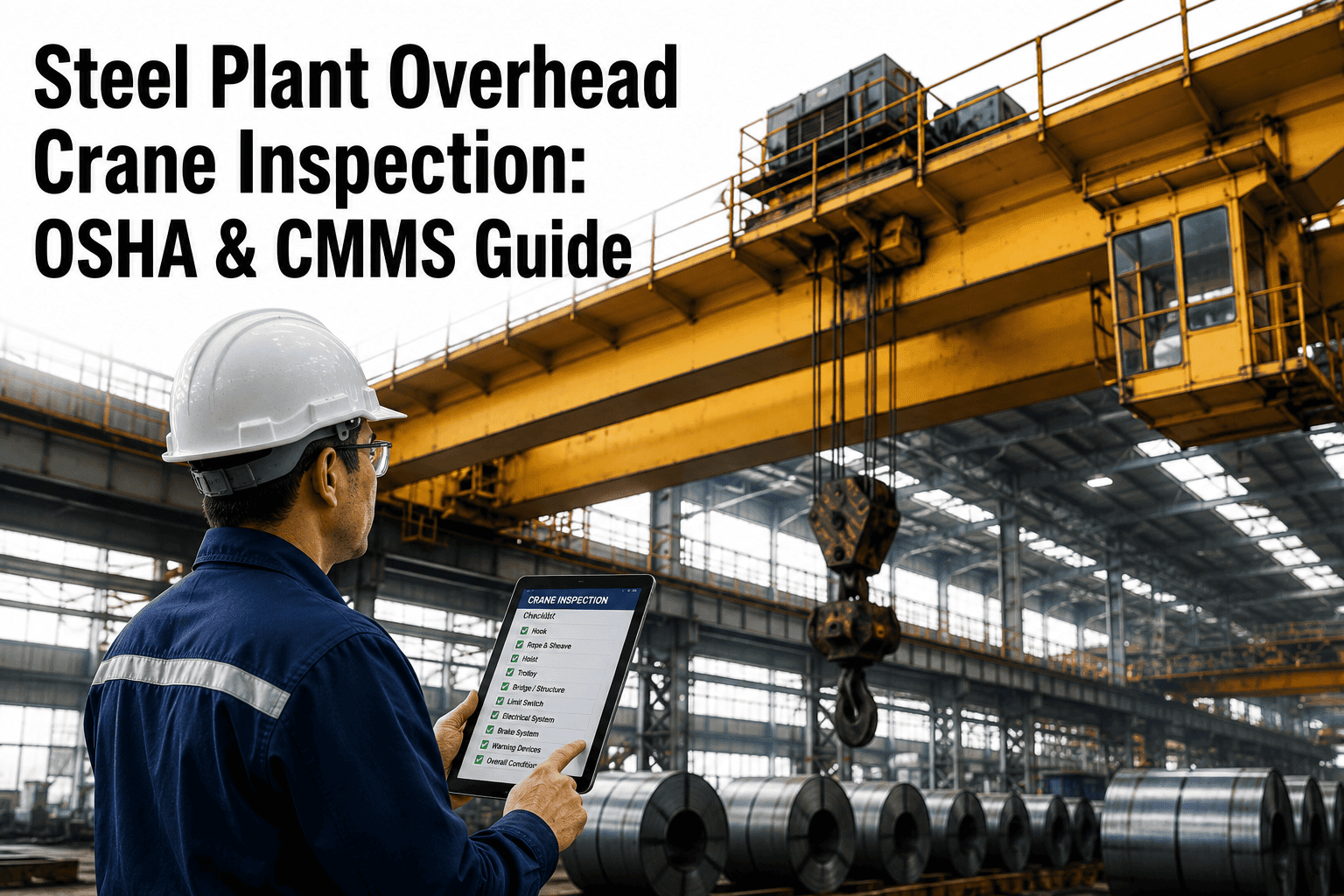
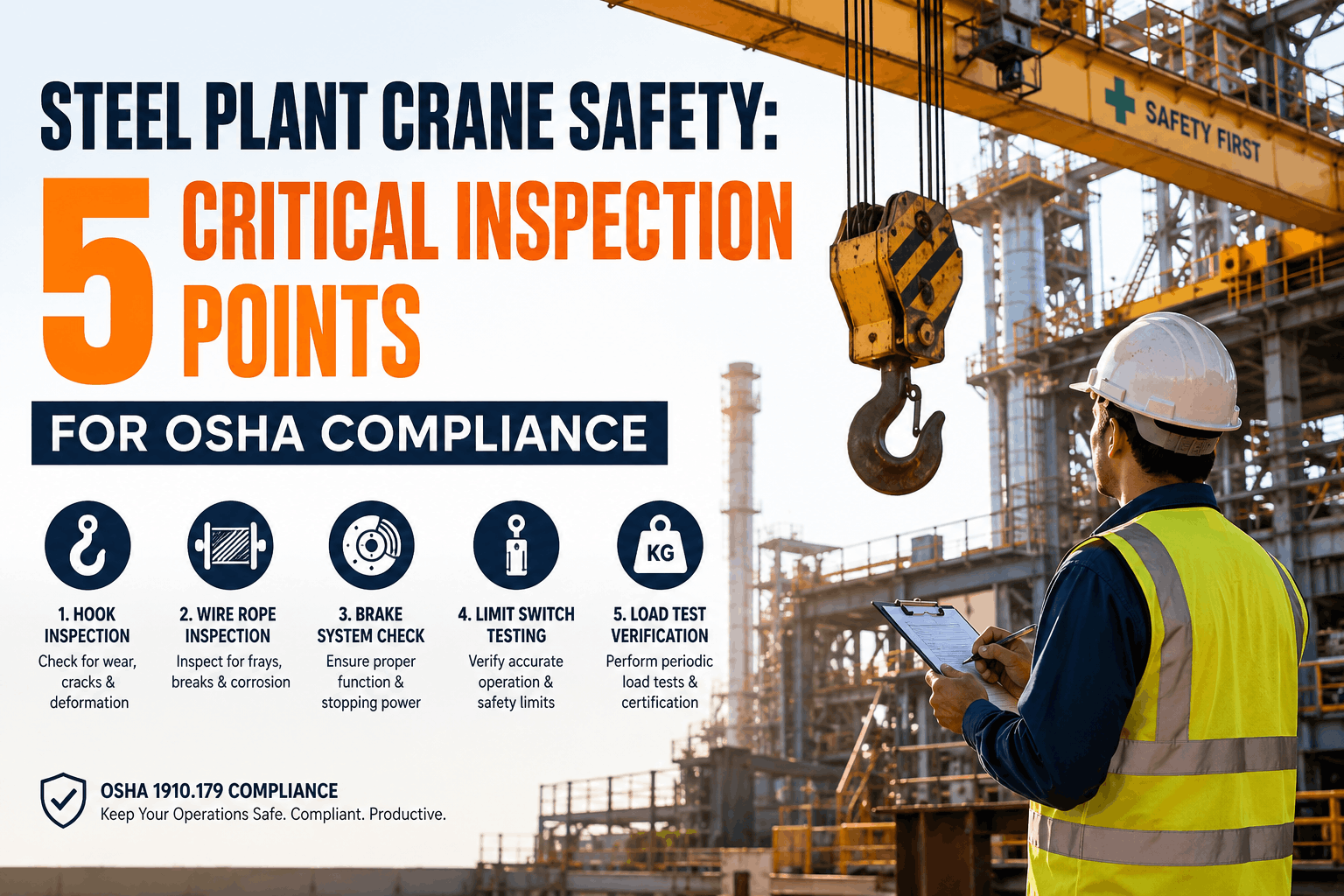
This checklist covers the crane safety inspection requirements under OSHA 1910.179, ASME B30.2 (overhead and gantry cranes), and ASME B30.17 (overhead and gantry cranes — top running, single girder) applicable to steel plant EOT, ladle, and charging cranes. Use this checklist to verify inspection compliance at each required frequency — frequent (daily/weekly), periodic (monthly), and annual (load test). Track inspection completion and generate your CMMS-based compliance record against each item. Book a demo to see how Oxmaint.ai automates crane inspection scheduling and certification tracking.
For maintenance supervisors, EHS managers, and inspection teams managing overhead crane fleets in steel plant environments — melt shops, casting bays, and rolling facilities.
OSHA 1910.179 establishes three inspection frequency categories for overhead cranes. Each category has mandatory inspection items that must be documented. In steel plant environments, the extreme duty conditions — thermal exposure, corrosive atmospheres, and high-frequency lift cycles — require inspection intervals at the maximum frequency within each category.
FrequentDaily to Monthly
Operational checks before each shift — hoist brakes, limit switches, hooks, rope reeving, and all functional controls. OSHA 1910.179(j)(1)(i). Steel plant cranes: perform at every shift start.
Periodic1–12 Months
Detailed inspection of all structural, mechanical, and electrical components. OSHA 1910.179(j)(1)(ii). Steel plant high-duty cranes: perform monthly. Ladle cranes: perform every 2 weeks.
AnnualAnnual / Load Test
Formal load test at 100–125% SWL with documented results. OSHA 1910.179(k). Required after installation, major repair, and annually for cranes with ratings above applicable thresholds.
Regulatory References
OSHA 1910.179Overhead and gantry cranes — design, inspection, testing, maintenance, and operation requirements
ASME B30.2Overhead and gantry cranes — top running, double girder, electric overhead travelling crane
ASME B30.17Overhead and gantry cranes — top running, single girder
ASME B30.11Monorails and underhung cranes — applicable to casting bay monorail systems
CMAA Spec 70Specifications for top running bridge and gantry type multiple girder electric overhead travelling cranes
OSHA 1910.179(j)(2)(ii) — hooks shall be inspected at frequent intervals. Hooks showing deformation, cracks, or wear shall be replaced. Load-bearing components in this assembly are safety-critical — any item below requires immediate removal from service.
WRP
Wire Rope Inspection & Discard Criteria
Frequent + Periodic
OSHA 1910.179(j)(2)(i) — running ropes shall be visually inspected each day the crane is in service. A thorough inspection shall be made at least monthly and a full inspection of rope shall be performed annually. In steel plants, thermal and corrosive environments require more frequent inspection than these minimums.
BRK
Brake System Inspection & Load-Holding Test
Periodic + Annual
OSHA 1910.179(f) — all brakes shall be checked before operation each day. The hoist brake must hold the rated load with the crane in the stalled condition. Load testing at rated capacity is required to verify brake adequacy under actual operating conditions.
STR
Structural & Runway Inspection
Periodic + Annual
OSHA 1910.179(j)(2)(iii) — structural members that are cracked, bent, or corroded shall be inspected by a qualified engineer. Bridge girder deflection under load, end carriage wheel condition, and runway rail alignment affect both crane performance and the structural integrity of the building crane runway.
ELC
Electrical System & Control Inspection
Periodic
OSHA 1910.179(g) — crane electrical equipment shall be inspected. Limit switches, overload protection, contactor condition, and conductor wear on festoon or conductor bar systems are the primary electrical items requiring structured inspection in steel plant overhead crane environments.
OPR
Operator Certification & Training Records
Annual Review
OSHA 1910.179(b)(8) — only designated qualified persons shall operate cranes. ASME B30.2-3.1.1 defines operator qualification requirements. Steel plant ladle and charging crane operators require additional qualification specific to molten metal handling operations beyond standard overhead crane certification.
Automate This Checklist in Oxmaint.ai
Every item on this checklist can be configured as an automated inspection work order in Oxmaint.ai — generated at the correct frequency for each crane's duty class, assigned to the designated inspection team, and archived with the completed records that OSHA and ASME require. Operator certification expiry alerts, load test scheduling, and wire rope discard tracking included.
Can Oxmaint.ai configure different inspection frequencies for ladle cranes vs. standard EOT cranes in the same facility?
Yes. Each crane is configured as an individual asset with its own inspection schedule parameters. Ladle cranes can be set to biweekly periodic inspections while standard EOT cranes in the same facility receive monthly periodic inspections — all managed from the same compliance dashboard. The system generates work orders on the correct schedule for each crane independently and flags any overdue inspections regardless of which crane type is involved. Start a free trial to configure your crane fleet inspection schedules.
How does the platform manage operator certification expiry tracking across a large crane fleet?
Operator certifications are stored per employee per crane type with the certificate number, issuing authority, and expiry date. The platform generates pre-expiry alerts — configurable at 30, 60, and 90 days before expiry — to the maintenance manager and the HR department to initiate recertification. When a certification lapses, the system flags the operator as unqualified for that crane type, which is visible to the permit authorisation workflow when that operator is assigned to a crane work order. Book a demo to see the certification tracking module.
Does Oxmaint.ai generate the annual load test record in a format suitable for regulatory submission?
Yes. The annual load test is configured as a specific inspection type within each crane's asset record. The completed load test record captures the test load (as a percentage of SWL), the test duration, the inspector's identity, the witness identity, ambient conditions, and any observations during the test period. This record is stored against the crane asset with its completion timestamp and is exportable as a PDF report formatted for regulatory submission or third-party auditor review. Certificate expiry dates are automatically tracked from the test completion date.
Stop Managing Crane Compliance on Paper
Oxmaint.ai automates the inspection schedule for every crane in your fleet — wire rope checks, brake tests, load certifications, and operator qualification tracking — with the digital records that OSHA inspectors require and that paper systems cannot reliably produce.