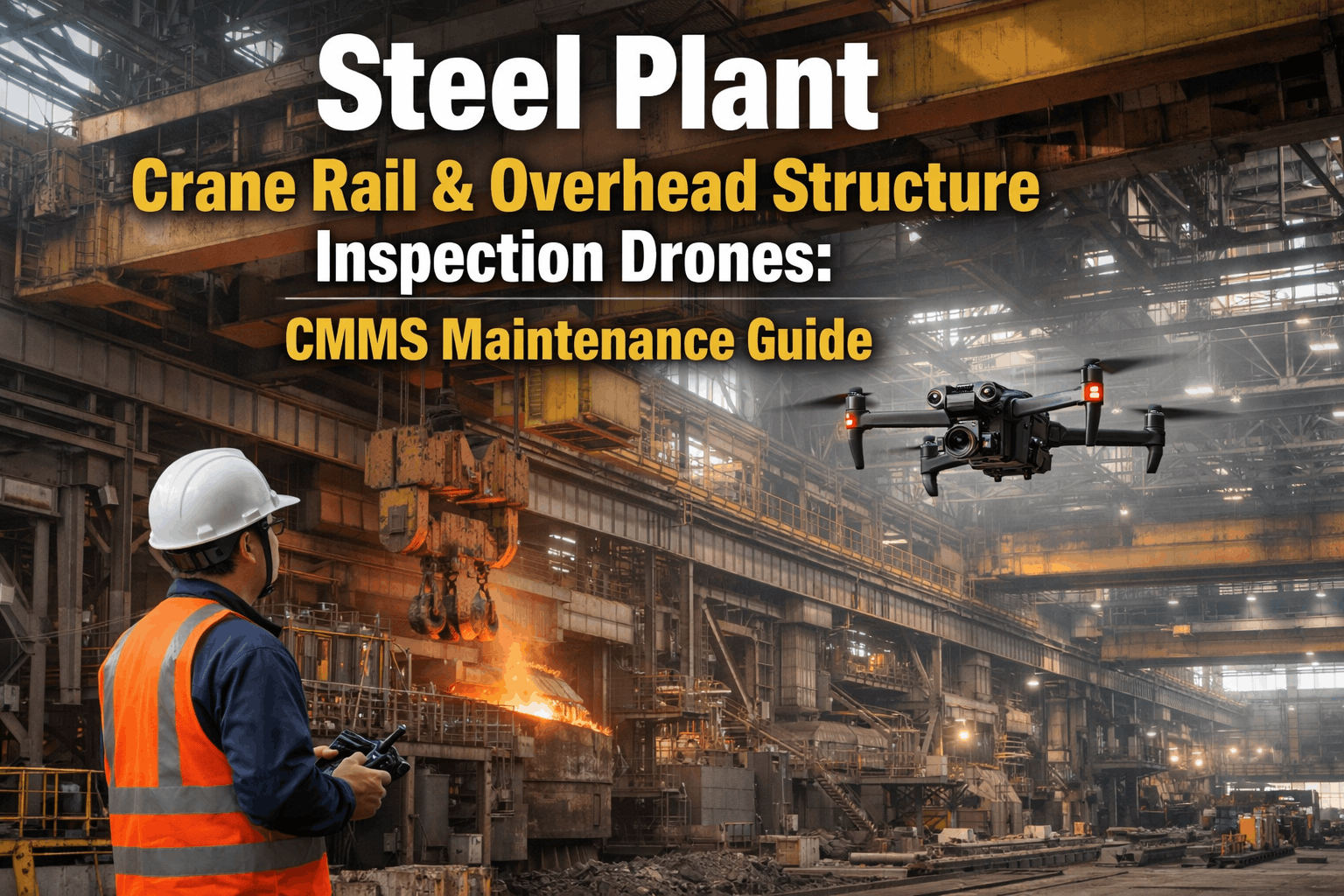
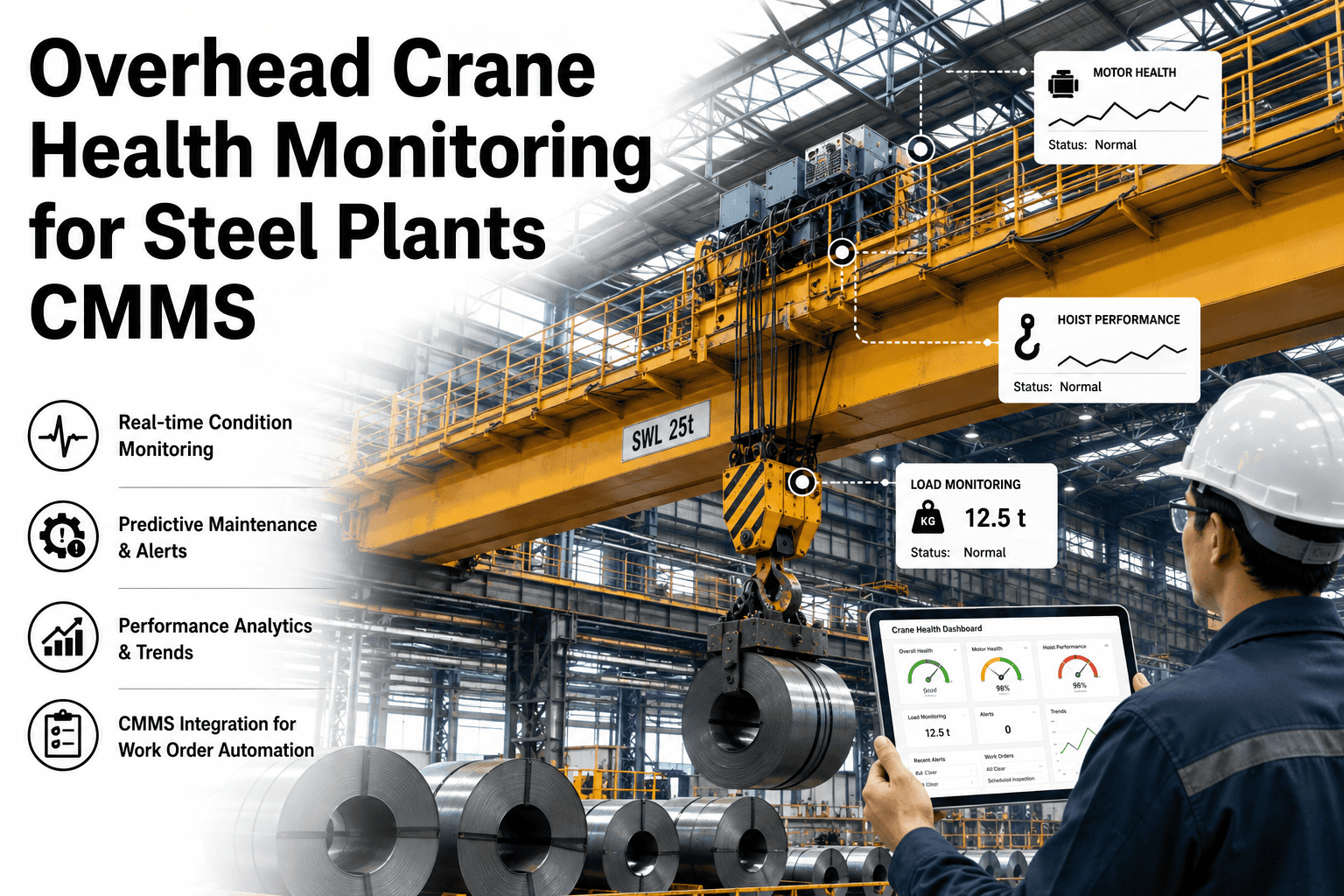
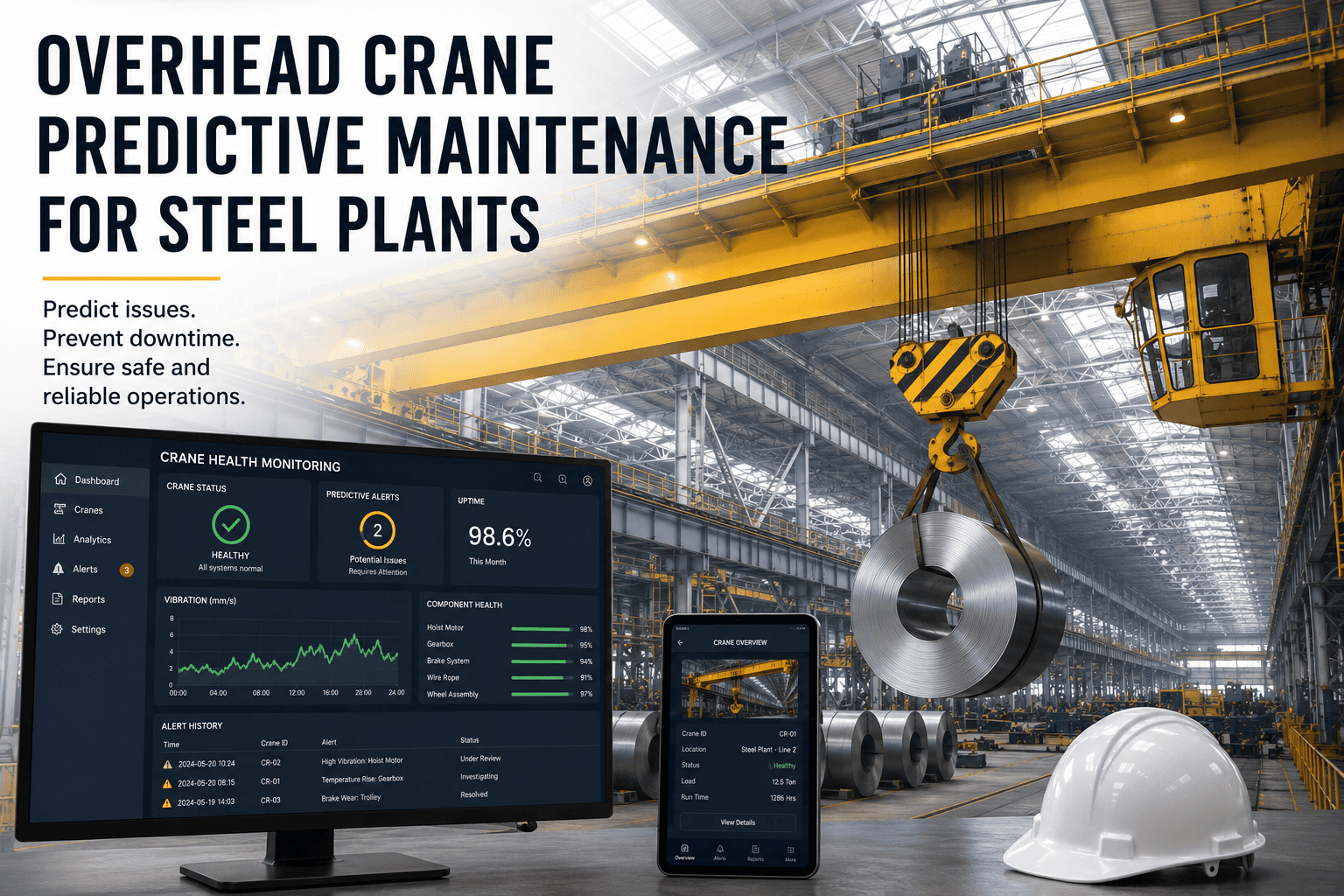
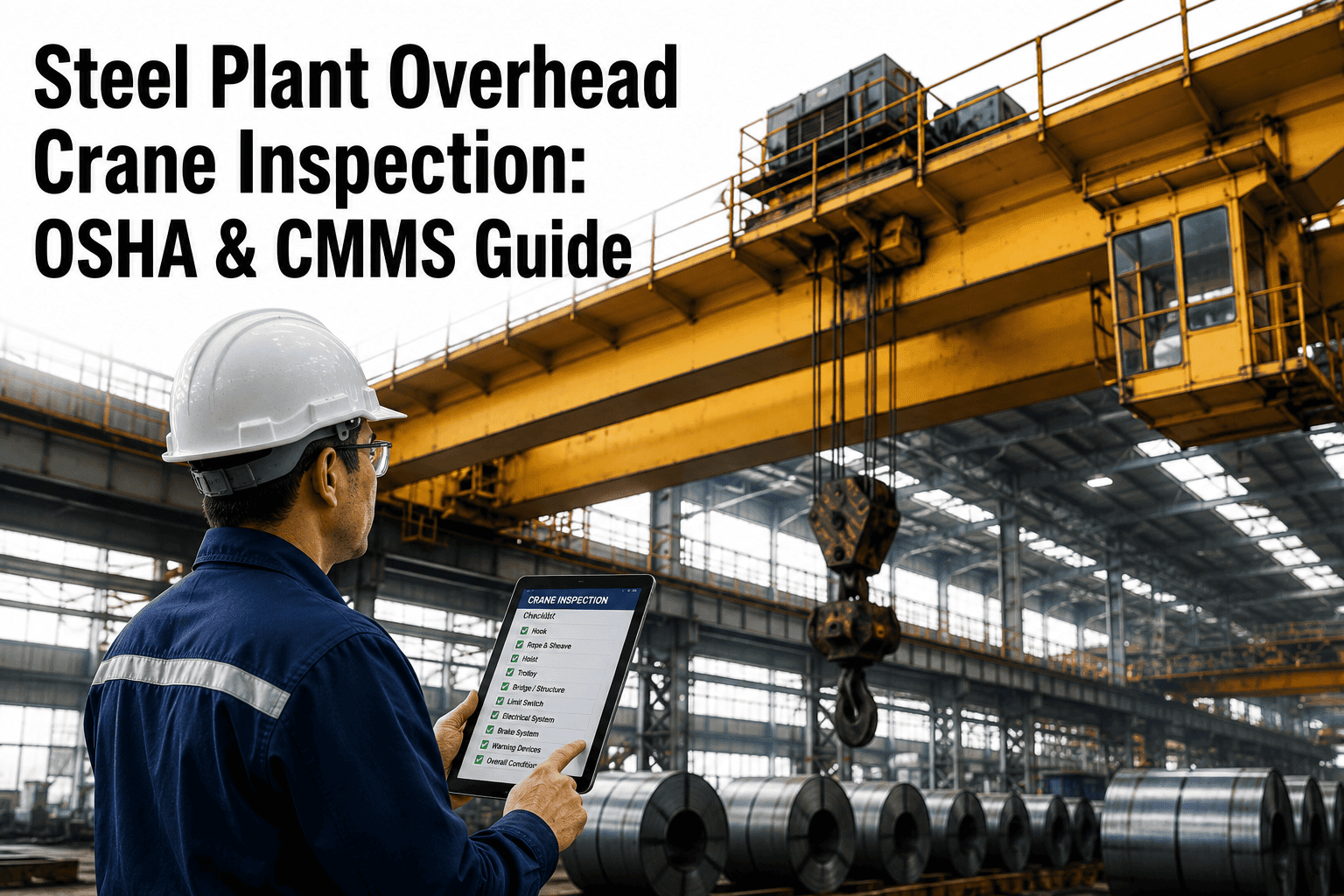
The ladle crane at ArcelorSteel's Middletown melt shop carried 280-ton ladles of molten steel across the casting bay 38 times per shift. The crane runway — 410 feet of heavy rail mounted on built-up steel girders 65 feet above the melt shop floor — had not received a full structural inspection in 4 years.
$5.1M
Total cost of a single crane runway failure at an integrated steel melt shop
47 min
Full crane runway inspection by drone — zero production shutdown required
4 years
Average gap between full overhead structural inspections using traditional methods
94%
Reduction in inspection cost vs. scaffold/rope access methods for overhead structures
Why Overhead Structures Are Steel's Biggest Inspection Blind Spot
Every steel plant maintenance manager knows the problem: the structures carrying the heaviest loads and facing the harshest conditions are the ones you can see the least. Crane runways, roof trusses, exhaust ductwork supports, and overhead utility bridges sit in a zone that is simultaneously critical and inaccessible.
Crane Runway Girders
Built-up plate girders supporting 300-ton crane loads with millions of fatigue cycles. Web stiffener welds, cap plate connections, and bearing seats develop fatigue cracks invisible from ground level. Corrosive melt shop fume accelerates degradation at weld toes and connection interfaces — exactly where fatigue failures initiate.
Crane Rail & Fastening Systems
Heavy rail (135 lb/yd or heavier) bolted or clipped to runway girder cap plates. Rail clips corrode, loosen, and fail under repetitive loading. Rail surface wear — galling, shelling, and head wear — transfers dynamic loads into the runway structure at amplified levels. Rail joint gaps open and close with thermal cycling, causing impact loading at joint locations.
Roof Trusses & Purlins
Spans of 100-200 feet over melt shop bays, exposed to rising heat and corrosive fume. Gusset plate connections lose section from corrosion. Purlin clips fatigue from thermal cycling. Bottom chord members in direct heat exposure zones degrade faster than design assumptions predicted. Failures drop structural steel onto active production areas.
Exhaust Ductwork & Supports
EAF and BOF exhaust systems suspended from overhead structures, carrying extreme temperatures and abrasive particulate. Support hangers fatigue and corrode. Ductwork expansion joints fail, transferring thermal loads into the structural frame. Hanger rod corrosion is invisible from below until the ductwork visibly sags.
Overhead Utility Bridges
Cable trays, pipe racks, and utility bridges spanning between buildings at 40-80 feet elevation. These structures carry electrical feeders, hydraulic lines, cooling water mains, and communication infrastructure. Corrosion-driven section loss in support members can cause cascading utility failures that shut down multiple production areas simultaneously.
What Inspection Drones See That Ground-Level Observation Cannot
A drone hovering 3 feet from a crane runway girder web captures data that no ground-level observer, vibration sensor, or crane-mounted camera can replicate. Multi-sensor payloads detect problems across the full spectrum of overhead structural failure modes.
| Detection Type | Sensor Used | What It Finds | Cost if Missed |
| Fatigue Cracking |
HD Camera + AI Crack Detection |
Weld toe cracks, stiffener termination cracks, cope hole cracks, connection plate fractures |
$500,000-$5,000,000 per structural failure event |
| Rail Clip Failure |
HD Camera + LiDAR |
Corroded clips, missing fasteners, loose bolts, clip deformation, rail lateral displacement |
$200,000-$900,000 per rail section failure + runway damage |
| Rail Surface Wear |
LiDAR Profilometry |
Head wear profiles, galling patterns, shelling, joint gap measurement, rail straightness |
$150,000-$400,000 per rail replacement section + crane wheel damage |
| Corrosion Mapping |
HD Camera + Ultrasonic Thickness |
Section loss in girder webs, flange corrosion, gusset plate pitting, hanger rod wastage |
$300,000-$2,000,000 per member replacement under emergency conditions |
| Thermal Anomalies |
Thermal Imaging |
Overheated electrical connections, bearing hot spots on crane trucks, bus bar degradation |
$100,000-$1,500,000 per electrical failure or crane fire |
| Connection Deterioration |
HD Camera + AI Classification |
Bolt corrosion, weld cracking, plate deformation, bracket failures, base plate grout loss |
$200,000-$3,000,000 per connection failure under loaded crane |
ArcelorSteel's $5.1 million runway failure started as a corroded rail clip that any inspection drone would have flagged as a severity-4 finding on its first flight. Sign up free to connect drone inspection findings to automated structural maintenance workflows.
65 Feet Above Molten Steel. Your Most Critical Structures. Your Longest Inspection Gap.
Your crane runway girders have not been closely inspected in years. Your roof truss connections are corroding in heat and fume you cannot see from the floor. An inspection drone flies the full length of every runway, every truss, every overhead structure in under an hour — during production — and feeds every finding directly into your CMMS. Stop waiting for the crane operator to feel the sway.
Drone Inspection Program: Flight Zones & Frequencies
An effective drone inspection program for steel plant overhead structures is not a single annual flight. It is a tiered program with frequencies matched to structural criticality, loading severity, and environmental exposure. The CMMS manages the entire schedule.
01
Weekly: Crane Rail Visual Scan
Automated drone flight along full runway length, both rails. HD camera captures rail surface condition, clip/fastener status, and joint gap dimensions. AI processes images against baseline and flags any change in clip position, rail alignment, or surface condition. Flight time: 12-18 minutes per runway. Zero production impact — flights run during shift changes or low-activity windows.
02
Monthly: Runway Girder Structural Scan
Full multi-sensor inspection of runway girder webs, flanges, stiffeners, and connections. HD camera for crack detection, thermal imaging for electrical and bearing anomalies, LiDAR for dimensional measurement and deformation tracking. Covers both sides of each girder, all bearing seats, and column-to-girder connections. AI compares current scan against historical data to detect change rates.
03
Quarterly: Roof Truss & Overhead Structure Survey
Complete survey of roof trusses, purlins, exhaust ductwork supports, overhead utility bridges, and all overhead connections. Focus on gusset plates, hanger rods, expansion joints, and bottom chord members in high-heat zones. Ultrasonic thickness measurements on members showing corrosion to establish section loss rates and remaining useful life calculations.
04
Annual: Comprehensive Baseline Update
Full LiDAR point cloud of all overhead structures to update the facility's structural digital model. Dimensional comparison against original design and previous annual baselines detects settlement, drift, thermal deformation, and load-induced deflection. This baseline drives the AI models that detect structural change during weekly and monthly flights. Produces a complete structural condition report for engineering review and insurance documentation.
Drone Types for Steel Plant Overhead Inspection
| Drone Category | Best Application | Payload Capability | Limitations in Steel Plants |
| Small Inspection Quad |
Indoor confined runway bays, between girder webs, close-proximity crack inspection |
HD camera, basic thermal; 200-400g payload |
Limited battery (15-20 min); wind/draft sensitivity near exhaust systems |
| Mid-Size Industrial Drone |
Full runway surveys, roof truss inspection, outdoor overhead structures |
HD + thermal + LiDAR; 1-3 kg payload; 30-45 min flight time |
Requires GPS-denied navigation (SLAM) for indoor steel structures with magnetic interference |
| Heavy-Lift Inspection Drone |
UT thickness measurement flights, heavy sensor payloads, extended surveys |
Full sensor suite including contact UT probes; 5-8 kg payload; 20-30 min flight time |
Size restricts access to tight spaces; higher cost; specialized pilot certification |
| Tethered Drone System |
Extended duration monitoring during outage inspections; continuous surveillance of active repair zones |
Unlimited flight time via power tether; full sensor suite; data streaming |
Limited mobility radius; tether management in cluttered overhead environments |
| Autonomous Cage Drone |
GPS-denied indoor navigation around crane structures, girder interiors, confined overhead spaces |
HD + thermal; collision-protected frame; autonomous flight path following |
Lower image quality due to cage vibration; limited payload for advanced sensors |
Traditional Inspection vs. Drone + CMMS Program
Traditional InspectionDrone Inspection + CMMS
Inspection Access
Scaffold, man-lifts, rope access; requires full production shutdown for melt shop runways
Drone flies during production; no scaffold, no shutdown, no confined space permits
Frequency
Every 3-5 years due to cost and shutdown requirements; critical areas go years between inspections
Weekly rail scans, monthly girder inspections, quarterly full surveys; continuous condition tracking
Detection Capability
Visual only; inspector fatigue at height; limited time in hazardous positions; subjective assessment
HD + thermal + LiDAR + UT; AI-classified findings; objective, repeatable, measurable over time
Documentation
Engineering reports delivered weeks after inspection; photos without GPS/timestamp; filed in project folders
Immediate CMMS integration; every finding geolocated, timestamped, severity-graded; trend history maintained
Safety Exposure
Workers at height above active melt shop; fall hazards; heat exposure; confined space entry in girder interiors
Zero human work at height; pilot operates from ground level; no fall risk, no heat exposure, no confined entry
Annual Cost Per Plant
$165,000 per inspection + $1.8M production loss per shutdown event (every 3-5 years)
$85,000/year (drone fleet + CMMS platform + planned repairs from findings)
Every year between traditional inspections is a year where fatigue cracks propagate, rail clips corrode, and connection welds deteriorate — unmonitored and untracked. Drone inspection with CMMS integration eliminates the gap entirely. Book a demo to see what your overhead structures look like from 3 feet away.
CMMS Integration: From Drone Data to Executed Repairs
Raw drone footage is not maintenance. The value is in the closed loop: the drone inspects, AI classifies the findings, the CMMS creates work orders, maintenance teams execute, and completion data feeds back into the structural condition model. Every flight makes the system smarter.
01
Drone Captures Multi-Sensor Data
HD images at 0.3mm pixel resolution. Thermal profiles of every connection and bearing. LiDAR point cloud for dimensional measurement. Ultrasonic thickness readings on flagged corrosion areas. All data tagged with GPS coordinates, timestamp, and asset ID from the CMMS asset registry.
02
AI Classifies & Grades Findings
Computer vision models trained on structural steel defects classify each finding: crack type and length, corrosion stage, fastener condition, deformation magnitude. Each finding receives a severity grade (1-5) based on structural consequence, progression rate, and proximity to failure threshold. Grade 4-5 findings flag for immediate engineering review.
03
CMMS Creates Prioritized Work Orders
Severity 4-5: Immediate work order with structural engineering notification, repair procedure, access requirements, and materials list. Severity 2-3: Scheduled repair work order queued for the next planned maintenance window. Severity 1: Monitored condition — tracked in CMMS with watch frequency increased for next drone flight. Every work order includes drone imagery, GPS location, and historical trend data.
04
Repair Execution & Verification
Maintenance team executes the repair with full context from the drone data package. Post-repair, the next scheduled drone flight verifies the repair quality — weld profiles, coating condition, fastener installation — and updates the CMMS record. The structural condition model adjusts remaining-life calculations based on the repair. Continuous improvement, continuous verification.
ROI: Integrated Steel Plant (2 Melt Shop Bays, 6 Crane Runways)
Avoided unplanned crane runway shutdowns (est. 1 major event prevented/yr)$3,200,000
Eliminated scaffold/rope access inspection costs$330,000
Avoided production shutdown for traditional inspections$1,800,000
Insurance premium reduction (continuous documented inspection program)$185,000
Extended structural life through early-stage repair vs. emergency replacement$420,000
Reduced OSHA exposure and citation risk$95,000
Total Annual Savings$6,030,000
Program Cost (drone fleet + CMMS platform + planned structural repairs)$385,000
Net Annual Benefit$5,645,000
$5.6 Million in Net Annual Savings. One Drone Fleet. Every Runway and Overhead Structure Monitored.
A single crane runway failure costs more than a decade of continuous drone inspection. Oxmaint connects every drone finding to automated work orders, structural condition tracking, engineering notifications, and compliance documentation across your entire plant's overhead infrastructure.
Frequently Asked Questions
Can drones fly inside an active melt shop with EAFs operating?
Yes, with operational controls. Industrial inspection drones are rated for ambient temperatures up to 120-150°F and can operate in melt shop environments during low-intensity production phases — between heats, during ladle turnaround, or during furnace charging when radiant heat is lowest. Flight paths are programmed to avoid the direct radiant zone above the furnace during tapping and melting. Cage-protected drones provide additional resilience against thermal updrafts and airborne particulate. Most plants schedule runway flights during the 15-20 minute turnaround window between heats, completing a full rail scan of one runway per window.
Book a demo to discuss flight scheduling for your specific melt shop operations.
How does the drone navigate without GPS inside a steel building?
Indoor steel structures block GPS signals and create magnetic interference that disrupts compass-based navigation. Industrial inspection drones use Visual-Inertial Odometry (VIO) and LiDAR SLAM — the same technologies used by autonomous vehicles — to navigate by building a real-time 3D map of the environment and tracking their position within it. The drone learns the structural layout on its first flight and navigates autonomously on subsequent missions. Some platforms use pre-programmed flight paths defined by the operator, while advanced systems adjust dynamically around unexpected obstacles like temporary scaffolding or parked maintenance equipment.
What qualifications do drone pilots need for steel plant operations?
In the United States, commercial drone operations require an FAA Part 107 Remote Pilot Certificate. Indoor flights in steel plants typically fall under the owner's operational authority rather than FAA airspace regulations, but plant safety requirements apply. Pilots must complete plant-specific safety orientation, hot work awareness, crane operation coordination, and emergency procedures. Most steel plants either train in-house maintenance personnel for Part 107 certification or contract with industrial drone inspection service providers who carry their own certifications, insurance, and safety programs.
Sign up free to explore both in-house and contracted drone inspection models.
How accurate is AI crack detection compared to a certified structural inspector?
Current AI crack detection models achieve detection rates of 92-97% for surface cracks of 1mm width or greater in structural steel, compared to 70-85% for human visual inspection at height (where fatigue, access limitations, and time pressure degrade performance). AI does not replace the structural engineer's judgment on crack significance, repair methodology, or remaining life assessment — it replaces the human eye in the detection step, catching more defects with higher consistency. Every AI-flagged finding is available for remote engineering review with full imagery, measurements, and location data before any repair decision is made.
How does this integrate with our existing crane inspection and OSHA compliance program?
Drone inspection complements and strengthens existing crane inspection requirements under OSHA 1910.179 and ASME B30.2. The CMMS maintains crane runway structural inspection as a distinct asset maintenance program that feeds into the overall crane certification record. Drone findings document the structural condition of the runway — which is a required element of crane safety that traditional crane inspections often defer due to access limitations. The CMMS generates compliance reports showing inspection frequency, findings, repairs, and structural condition trending that exceed the documentation requirements of any regulatory audit.
Your Crane Runways Are 65 Feet Above Molten Steel. When Was the Last Time Anyone Looked Closely?
ArcelorSteel lost $5.1 million because a corroded rail clip went undetected for 14 months in a structure nobody could safely reach during production. Your crane runways, your roof trusses, your overhead connections all have the same blind spots right now. A drone fleet flies every runway, every truss, every overhead structure in under an hour and reports every finding to your CMMS before the pilot leaves the building. The demo takes 30 minutes. The first runway flight usually finds what 4 years of ground-level observation missed.