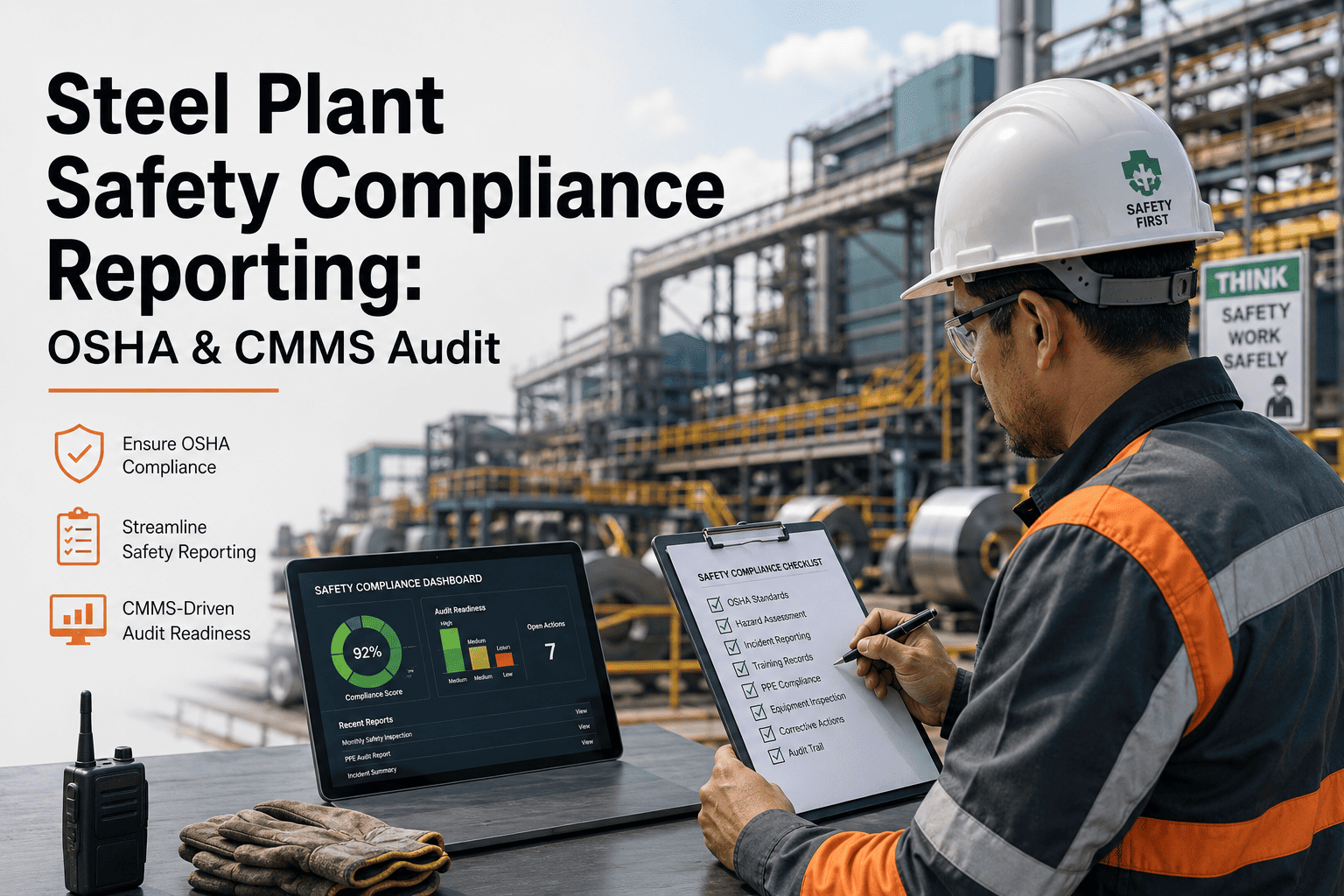
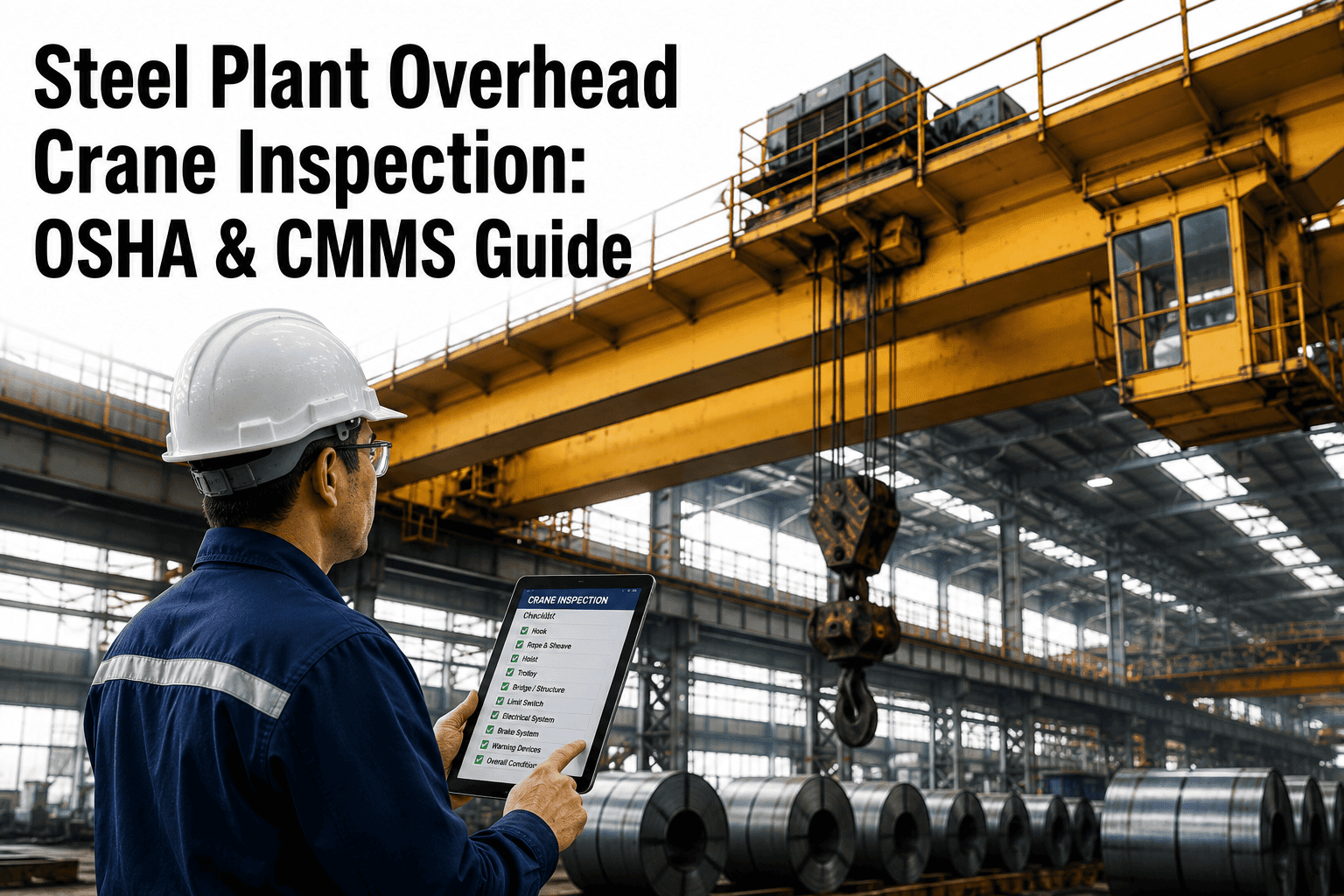
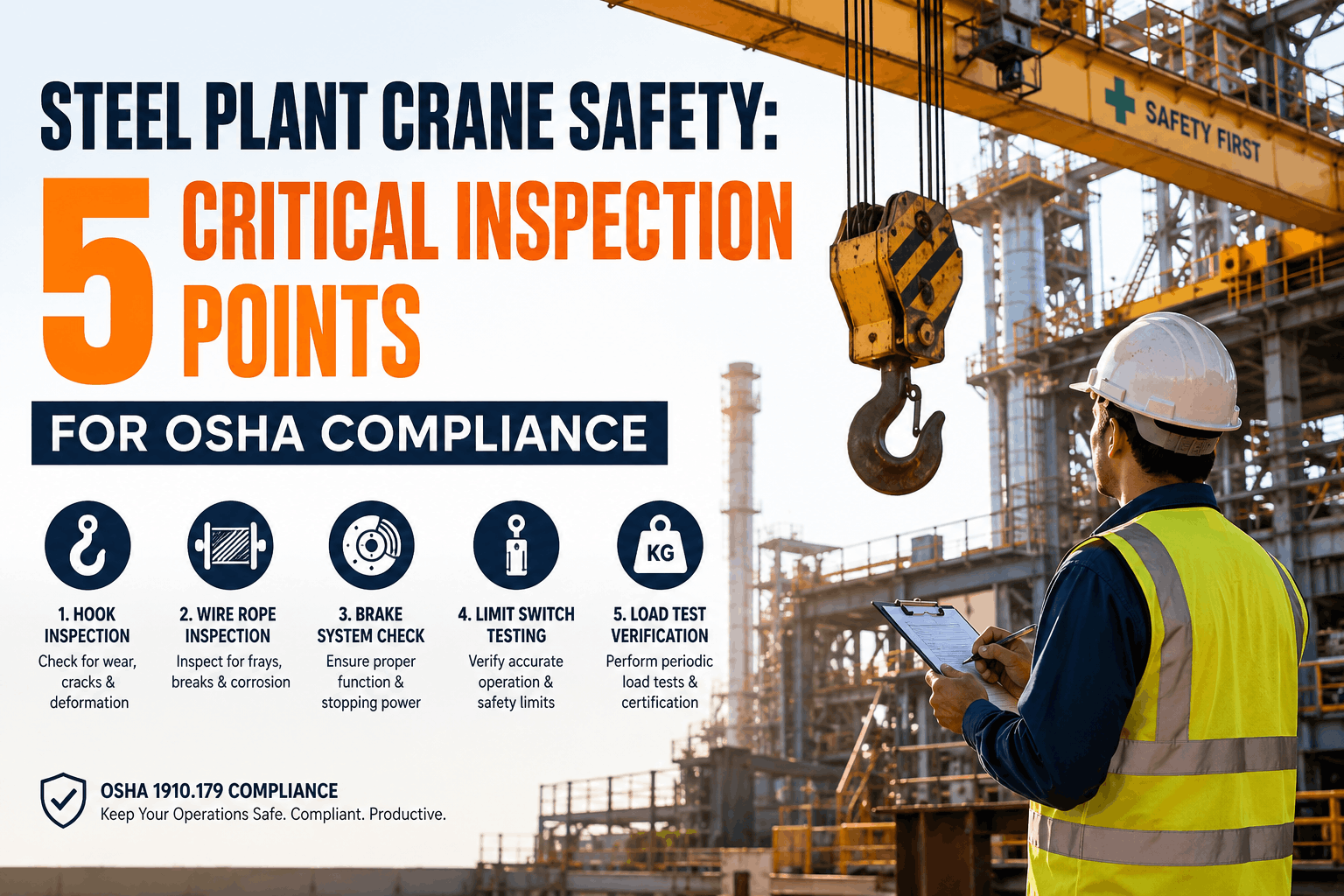
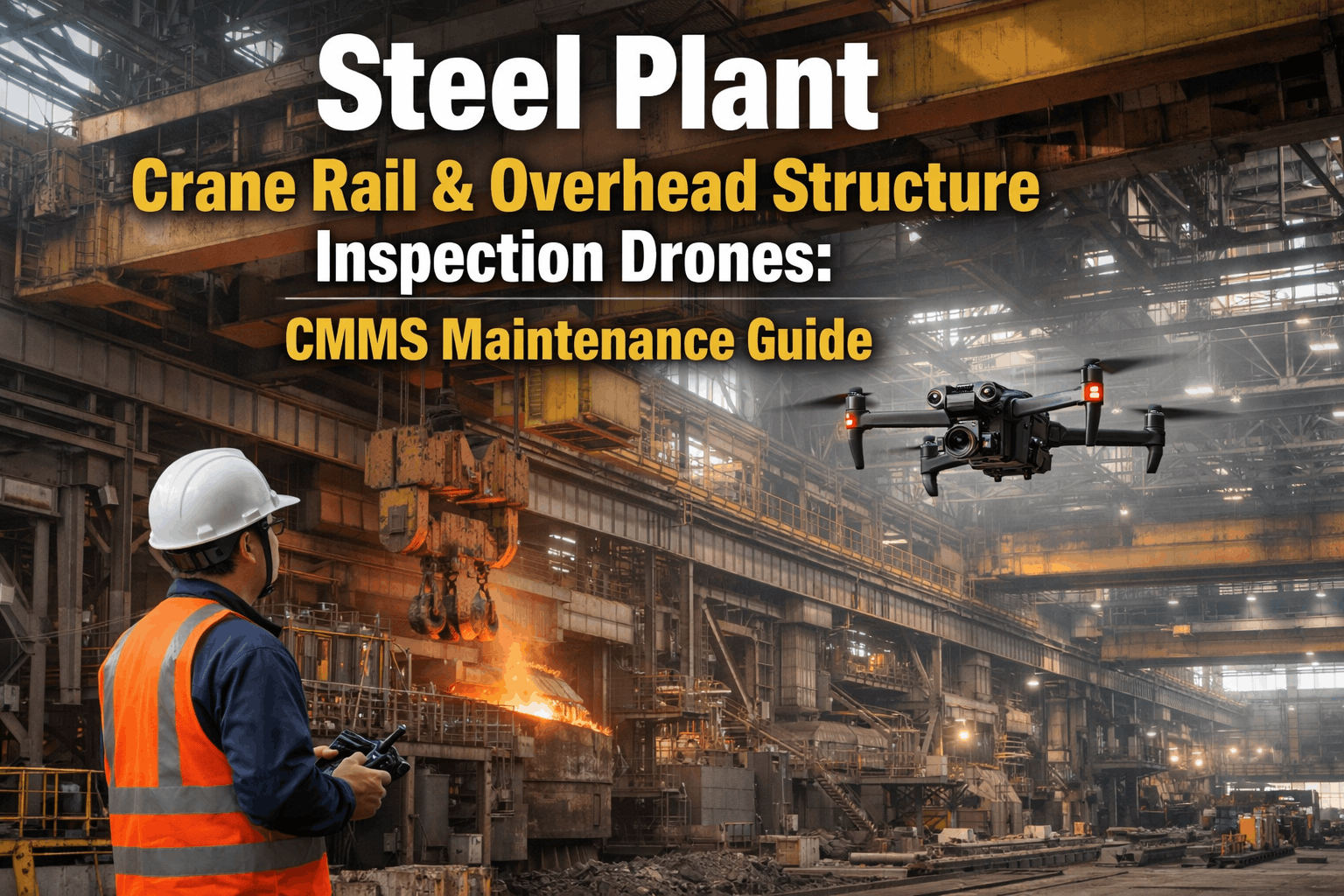
Steel plant overhead crane safety hinges on disciplined inspection compliance with OSHA 1910.179 — and when a ladle crane lifts 200 tons of molten metal, a missed wire-rope defect or expired load test can trigger catastrophic failure, production shutdown and regulatory penalties. This guide breaks down the full inspection cycle mills must follow, from daily frequent checks to annual periodic audits, load-test scheduling and wire-rope condition documentation, so your crane records stay audit-ready. If your team is still tracking inspections on spreadsheets or paper tags, Start Free Trial with OxMaint to digitize the entire workflow and eliminate compliance gaps before the next OSHA visit.
Crane Safety Compliance Guide
Can your last overhead crane inspection pass an OSHA audit tomorrow?
OSHA 1910.179 mandates documented frequent and periodic inspections, annual load tests, and certified operators for every overhead and gantry crane in a steel facility — yet 60% of mills still rely on paper logs that inspectors can't find in under five minutes. When a ladle crane fails, the cost isn't just a citation; it's a molten-metal incident.
$48K
Average OSHA penalty per serious crane-safety violation in a steel facility — multiplied by each un-inspected crane on site.
What OSHA requires for overhead crane safety in steel plants
OSHA standard 1910.179 classifies overhead crane inspections into two tiers — frequent and periodic — and both demand written, dated records that a compliance officer can produce on demand.
1910.179
The governing OSHA standard covering all overhead and gantry cranes in general industry, including steel mills and foundries
2 Tiers
Frequent inspections (daily to monthly) and periodic inspections (1–12 month intervals) — both with distinct scope checklists
125%
Load test requirement: new, altered, or repaired cranes must be tested at 125% of rated load before returning to service
5 Years
Typical retention window compliance officers expect for periodic inspection records, load-test certificates and operator certifications
Beyond the standard itself, OSHA inspectors look for three things during a steel plant crane audit: a current documented inspection for every crane on the floor, evidence that deficiencies were flagged and corrected, and proof that every operator is certified or qualified for the specific equipment they're running. A CMMS designed for crane safety compliance — like OxMaint — ties all three together by auto-scheduling inspections, storing digital certificates, and generating audit-ready reports in seconds rather than days.
FREQUENT VS PERIODIC INSPECTION SCOPE
Crane inspection checklist: frequent vs periodic scope
A frequent inspection catches developing defects before they become failures; a periodic inspection certifies the crane is structurally and mechanically sound for continued molten-metal service.
Daily–Monthly
Frequent Inspection Scope
All functional operating mechanisms for proper adjustment and excessive wear
Wire rope and load chain condition — broken wires, kinks, wear, and lubrication
Hoist limit switches, braking system drift, and upper-block anti-collision
Tire pressure and hook deformation (ladle cranes: hook-latch engagement)
Oil leakage from gear cases, hydraulic systems, and trolley drives
Unusual sounds, vibrations, or smell from motors and brake coils during operation
1–12 Months
Periodic Inspection Scope
Structural members: cracked, deformed, or corroded welds in bridge and trolley frames
Loose bolts, pins, rivets, and sheaves — documented torque-check on critical fasteners
Excessive wear on brake-system parts: linings, drums, wheels, and pawl friction surfaces
Power plant: motor mount integrity, electrical contactor wear, resistor bank condition
Crane hook magnetic-particle or dye-penetrant testing (recommended annually for ladle service)
ANNUAL LOAD TEST & WIRE ROPE DOCUMENTATION
How to schedule crane load tests and wire-rope condition records
OSHA requires a 125% load test after any repair, alteration, or new installation — and ladle cranes in molten-metal service should be tested annually regardless, per ASME B30.2 recommendations adopted by most steel-industry insurers.
Month 1
Baseline Load Test & Certification
Conduct 125% rated-load test; document deflection readings, brake hold-test results, and load-cell calibration certificate in the crane's permanent record.
Months 2–5
Frequent Inspection Cycle
Daily operator walk-arounds and monthly maintenance-tech inspections logged with digital checklists; wire-rope diameter measured and recorded at the same rope sections each time.
Month 6
Mid-Year Periodic Inspection
Certified inspector performs structural, mechanical, and electrical assessment; wire-rope removed if broken-wire count exceeds 6 per lay or diameter reduction hits 7%.
Months 7–11
Deficiency Tracking & Re-inspection
Open work orders tracked to closure; any critical deficiency (hook deformation, brake drift, rope damage) takes the crane out of molten-metal service until certified safe.
Month 12
Annual Periodic + Load Test Recertification
Full periodic inspection, 125% load test, hook NDT, and wire-rope replacement if due; audit-ready compliance packet generated and archived for the next 5 years.
Wire Rope Replacement Formula
Replace wire rope when: (broken wires in one rope lay ≥ 6) OR (diameter reduction ≥ 7% of nominal) OR (visible kinks, bird-caging, or heat damage from molten-metal splatter). Document the measurement location on the rope so the same section is checked every cycle — rope condition is the #1 cited deficiency in OSHA crane inspections at steel mills.
WORKED EXAMPLE
The real cost of a missed ladle crane inspection
A Midwest mini-mill operating 14 overhead cranes — including 3 ladle cranes in continuous molten-metal service — was tracking inspections on a wall-mounted clipboard and a shared Excel file.
The Situation
14 cranes, 3 in ladle service, inspections on paper logs. During an OSHA follow-up visit, the mill could not produce the last periodic inspection for Crane #7 and had no wire-rope measurement records for 2 of 3 ladle cranes.
The Penalty
$48K per serious violation × 3 cranes = $144K in direct OSHA citations, plus 4 days of production downtime while the cranes were quarantined for emergency inspection.
The Hidden Cost
Downtime at a mini-mill runs $8K–$12K per hour. Four days of partial crane outage cost an estimated $420K in lost production — nearly 3× the OSHA fine itself.
The Fix
After deploying OxMaint CMMS, the mill digitized all 14 crane inspection schedules, set automatic 30-day reminders for periodic inspections, and cut audit-prep time from 3 days to 15 minutes.
HOW OXMAINT HELPS
How OxMaint CMMS keeps crane records audit-ready
OxMaint replaces paper logs and spreadsheets with a digital crane-safety compliance engine that auto-schedules every inspection tier, tracks deficiencies to closure, and produces OSHA-ready audit packets on demand.
Automated Inspection Scheduling
Auto-generates work orders for daily, monthly, and periodic inspections per OSHA 1910.179 — with escalating reminders so no crane misses its cycle. Outcome: 100% on-time inspection rate, zero expired-cert citations.
Digital Wire-Rope & Load-Test Records
Capture wire-rope measurements, load-test certificates, and NDT results in a permanent digital file per crane — searchable by asset, date, or inspector. Outcome: audit packets generated in under 5 minutes vs. 3 days on paper.
Deficiency-to-Work-Order Tracking
Every flagged deficiency auto-creates a corrective work order with priority, due date, and parts requirements — tracked to closure with photo evidence. Outcome: critical defects repaired 40% faster, cranes returned to service safely.
Operator Certification Management
Store and track every operator's certification, qualification, and renewal date — with alerts 60 days before expiry so no one operates a ladle crane with an expired credential. Outcome: zero operator-certification gaps during audits.
See OxMaint on your cranes — book a 30-minute demo
Watch how a digital CMMS transforms crane safety compliance from a paper chase into a real-time dashboard your team and your auditor can both trust.
How often must overhead cranes be inspected in a steel plant?
OSHA 1910.179 requires two tiers: frequent inspections (daily to monthly) covering functional mechanisms, wire rope, brakes, and limit switches; and periodic inspections (1–12 month intervals) covering structural members, gears, bearings, and electrical systems. The exact interval depends on crane usage and environment, but ladle cranes in molten-metal service should receive a periodic inspection at least every 12 months.
What is the OSHA load test requirement for overhead cranes?
OSHA requires a load test at 125% of rated capacity before initial use, after any alteration or repair, and after any prolonged period of idleness. For ladle cranes in steel-plant service, most insurers and ASME B30.2 recommend an annual load test regardless of repairs. The test must be documented with deflection readings and a certified load-test report stored in the crane's permanent record.
Do overhead crane operators in steel plants need certification?
OSHA 1910.179 requires that crane operators be trained and qualified for the specific equipment they operate, though it does not mandate a third-party certification like the construction standard 1926.1427. However, many steel mills adopt ASME B30 standards and require documented operator qualifications, medical evaluations, and refresher training — all of which can be tracked and automated in a CMMS like OxMaint.
What are the most common OSHA crane violations at steel mills?
The top three cited deficiencies are missing or incomplete periodic inspection records, wire-rope defects (broken wires, kinks, or diameter reduction beyond allowable limits) that were not documented or corrected, and expired or missing operator qualifications. Each can result in a serious-violation penalty of $15K–$48K per crane, multiplied across the fleet if the pattern is systemic.
How does a CMMS improve crane safety compliance?
A CMMS like OxMaint auto-schedules frequent and periodic inspections per OSHA 1910.179, digitizes wire-rope and load-test records, tracks deficiencies to closure with photo evidence, and generates audit-ready compliance reports in minutes. Mills typically cut audit-prep time by 80% or more and eliminate expired-inspection citations entirely. You can Book a Demo to see the crane-safety module in action.
Stop tracking crane inspections on paper
Deploy OxMaint in under a week and turn your crane-safety program into a real-time, audit-ready system that OSHA inspectors and your reliability team will both respect.