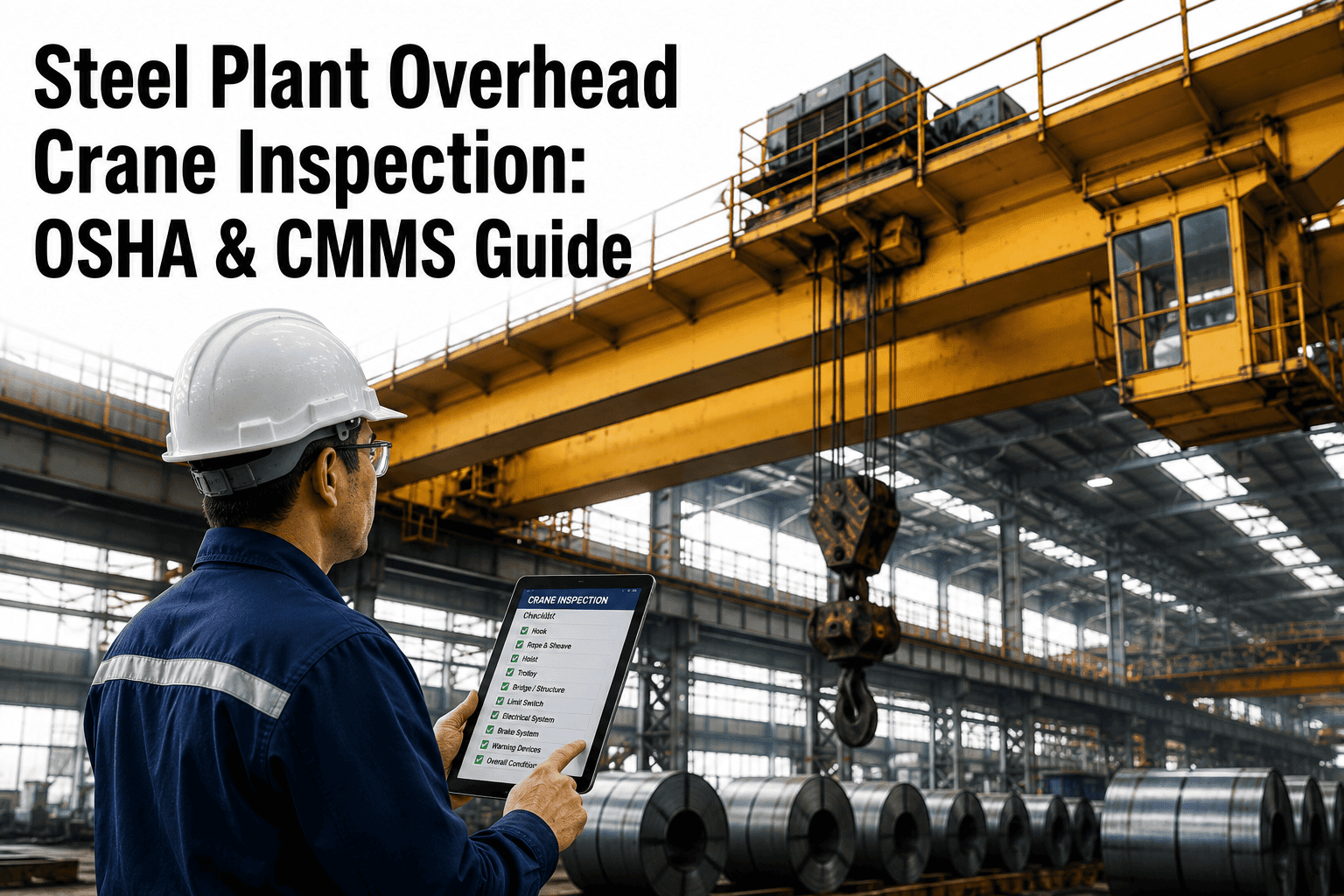
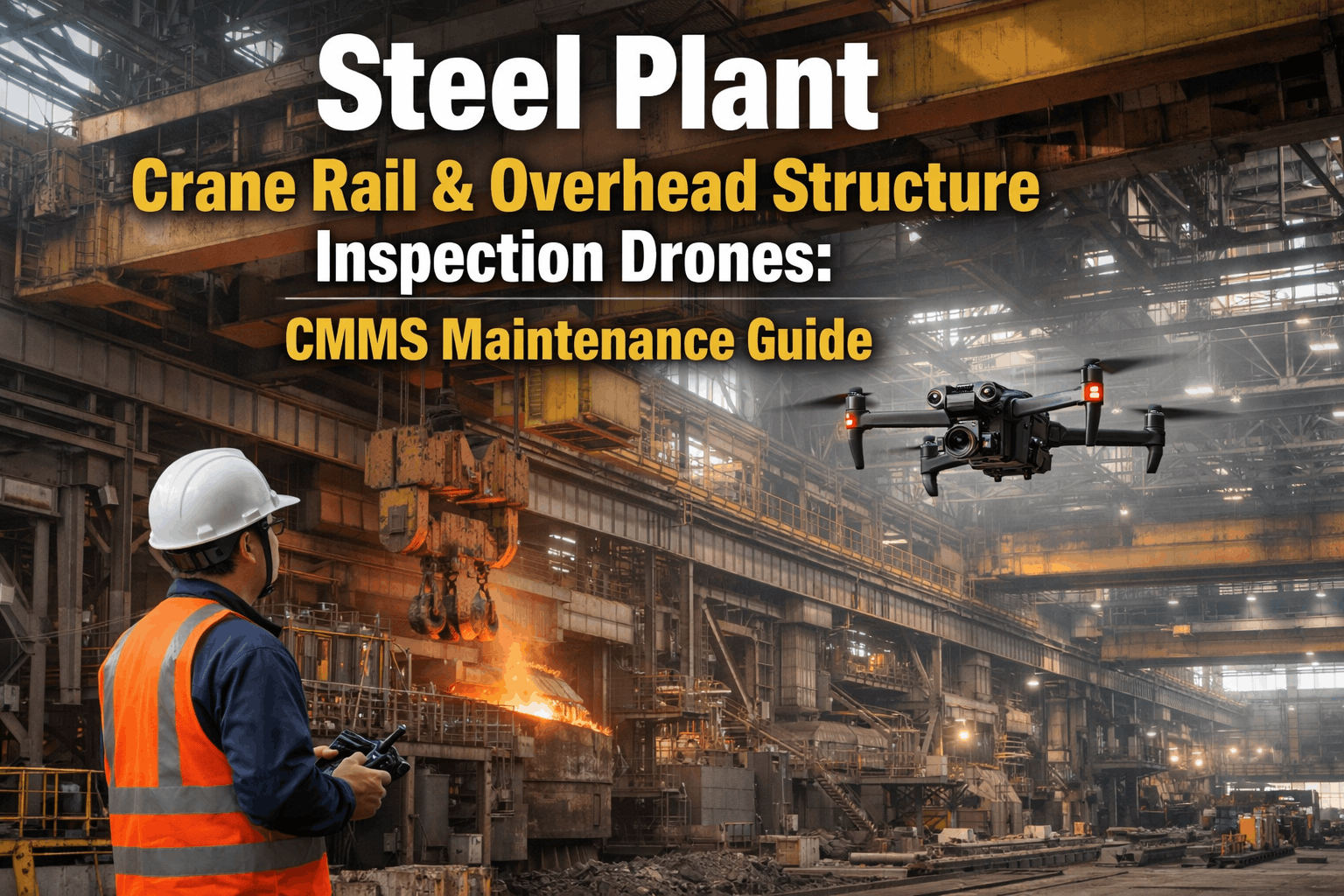
Steel plant cranes are not ordinary overhead cranes. They carry the most dangerous loads in industrial manufacturing — 300-ton ladles of molten steel at 1,600°C, 25-ton slabs at 900°C, 100-ton torpedo cars of liquid iron, and multi-ton coils swinging above production personnel. A crane failure in a warehouse drops a pallet and creates a bad day. A crane failure in a steel plant drops molten metal and creates a catastrophe. The consequences of a ladle crane hoist failure are so severe — fatalities, plant destruction, environmental disaster, multi-year legal proceedings — that steel plant crane maintenance operates under a completely different risk framework than general industrial crane maintenance. Every component in the load path between the hook and the building structure is a potential single point of catastrophic failure: the wire rope, the drum, the gearbox, the shaft, the brake, the structural connections, the bridge girder, the runway rail, and the building columns. A single failed component in that chain can release hundreds of tons of molten material with zero warning. This is why steel plant crane maintenance isn't just a reliability activity — it's a safety management system that requires documented inspections, certified testing, regulatory compliance tracking, and complete maintenance history for every load-bearing component. A CMMS in this context isn't a productivity tool. It's a legal record, a safety system, and the institutional memory that ensures no inspection is missed, no defect is forgotten, and no crane returns to service without every required check completed and documented.
Steel Plant Cranes: Where Failure Is Not an Option
300+ tons
Molten steel ladle weight — lifted 50–80 times per day, every day, for decades
1,600°C
Temperature of molten steel — thermal radiation degrades wire ropes, brakes, and structural steel
200,000+
Lift cycles per year for a primary ladle crane — extreme fatigue loading
Zero tolerance
For missed inspections — regulatory, legal, and moral obligation
Crane Classification: Not All Steel Plant Cranes Carry Equal Risk
Steel plants operate 50–200+ cranes across the facility, but they are not equal in criticality. A charging crane at the BOF operates under fundamentally different risk and maintenance requirements than a maintenance bay crane in the roll shop. Facilities that implement a CMMS with crane-specific classification and inspection tracking ensure maintenance resources focus on the cranes where the consequences of failure are catastrophic.
CRITICAL
Hot Metal / Ladle Cranes
Carry 150–350 ton ladles of molten steel and iron between BOF, ladle furnace, degasser, and caster. A hoist failure drops 1,600°C liquid metal. Dual hoist systems (main + auxiliary) with independent braking. CMMS Class A — maximum inspection frequency.
Charging Cranes (BOF/EAF)
Load scrap, hot metal, and alloys into the converter or furnace. Operate directly over open vessels of molten steel. Extreme thermal exposure — ambient temperatures reaching 60–80°C at crane level with radiant heat spikes during charging.
Torpedo/Hot Metal Transfer Cranes
Handle torpedo cars and transfer ladles carrying liquid iron from blast furnace to steelmaking. Load path failure releases hot metal at 1,400–1,500°C in uncontained areas.
Failure consequence: Fatalities, plant destruction, environmental disaster, regulatory shutdown. OSHA Class D / FEM Group A8 duty cycle. Inspection frequency: daily operator checks, weekly detailed inspections, monthly NDE on critical components, annual comprehensive engineering assessment.
HIGH
Caster Ladle Turret Cranes
Position ladles on the caster turret and remove empty ladles. Operate directly above the caster — a dropped ladle onto the casting strand causes a breakout and potential explosion from water contact with molten steel.
Slab/Billet Handling Cranes
Handle hot slabs (800–1,000°C) from caster to slab yard and slab yard to reheating furnace. Electromagnetic or tong-type lifting — dropped slabs damage equipment and create projectile hazards.
Soaking Pit / Reheat Cranes
Load and unload ingots or slabs from soaking pits and reheating furnaces. Continuous thermal exposure with cyclic loading. Tong mechanisms subject to extreme wear.
Failure consequence: Serious injury risk, significant equipment damage, production loss of $200K–$2M per event. Weekly detailed inspections, monthly engineering review, quarterly NDE on load path.
MEDIUM
Coil Handling Cranes
Handle finished coils (10–35 tons) in cold mill, warehouse, and shipping areas. C-hook, coil grab, or magnet lifting. Ambient temperature operation, moderate duty cycle.
Maintenance Bay Cranes
Support roll shop, motor shop, and general maintenance. Variable loads, moderate frequency. Used for roll changes, motor replacements, and general heavy lifting.
Scrap Yard Cranes
Handle scrap with magnets or grapples. High cycle frequency but lower consequence of failure. Impact loading from scrap handling creates structural fatigue.
Failure consequence: Injury risk, equipment damage, production disruption. Monthly detailed inspection, quarterly engineering review, annual NDE on load path.
The Load Path: Every Link in the Chain Must Hold
The "load path" is the continuous chain of structural and mechanical components that transfers the load weight from the hook to the building structure. In a steel plant ladle crane, this chain includes 12–15 major component groups — and a failure in any single one drops the load. CMMS tracking must cover every component in this chain, with inspection requirements scaled to the component's failure consequence and degradation rate.
1
Hook & Hook Block
Forged alloy steel hook carrying the full load. Failure modes: throat opening from overload, fatigue cracking at the shank-to-hook transition, latch failure allowing sling displacement. Ladle hooks are specialized designs rated for 400+ ton loads with safety factors of 4:1 minimum.
Inspection: Daily visual for cracks/deformation | Monthly dimensional check (throat opening measurement) | Annual NDE (magnetic particle or ultrasonic)
2
Wire Rope
Multi-strand wire rope carrying the full load tension. Failure modes: broken wires from fatigue/abrasion, internal wire breaks invisible to visual inspection, core degradation from heat exposure, bird-caging from shock loading. Ladle crane ropes operate in thermal radiation zones that accelerate lubricant evaporation and wire degradation.
Inspection: Daily visual for broken wires/kinks/bird-caging | Monthly detailed count of broken wires per lay length | Quarterly electromagnetic rope testing (MRT) for internal breaks | Replace at regulatory limits or condition thresholds
3
Drum & Drum Shaft
Rope winds onto the drum under full load tension. Failure modes: drum shell cracking, shaft fatigue at keyway transitions, bearing failure allowing drum misalignment, groove wear causing rope damage. Dual-drum ladle hoists carry half the load per drum — but a single drum failure still causes asymmetric loading and potential load release.
Inspection: Monthly visual for shell cracks | Quarterly shaft NDE at keyways | Annual groove wear measurement | Bearing vibration monitoring continuous or route-based
4
Gearbox & Drive Train
Multi-stage reduction gearbox transmitting motor torque to the drum. Failure modes: gear tooth fatigue/pitting/spalling, shaft bearing failure, oil contamination causing accelerated wear, coupling failure. Gearbox failure doesn't directly release the load (brakes hold) but prevents controlled lowering — creating a "load stuck at height" emergency requiring crane-to-crane rescue.
Inspection: Monthly oil sample for wear metals/water/particle count | Quarterly vibration analysis | Annual gear tooth inspection via borescope port | Oil change per manufacturer interval
5
Braking Systems
The last line of defense against load release. Ladle cranes require a minimum of two independent braking systems — each capable of holding 125–150% of rated load independently. Failure modes: brake lining wear, spring fatigue reducing clamping force, solenoid/hydraulic release mechanism failure, thermal fade from proximity to molten metal. A brake that holds 99% of rated load is a brake that will allow 3 tons of a 300-ton ladle to accelerate downward — this is not acceptable.
Inspection: Daily functional test | Weekly lining wear measurement | Monthly spring force measurement | Quarterly full load brake holding test | Annual complete brake overhaul
6
Structural — Trolley Frame, Bridge Girder, End Trucks, Runway
The structural steel carrying the entire crane and load weight to the building columns. Failure modes: fatigue cracking at welded connections (the #1 structural failure mode in crane girders), web buckling, runway rail wear/misalignment, end truck wheel wear, and building column connection degradation. Structural failures can be sudden and catastrophic — a fatigue crack grows invisibly for years then propagates to failure in a single load cycle.
Inspection: Monthly visual of welded connections | Quarterly NDE of known fatigue-prone details | Annual comprehensive structural survey by qualified engineer | Runway rail alignment measurement annually
One Missed Inspection. One Undetected Crack. One Load Release. One Catastrophe.
OxMaint tracks every crane, every component, every inspection, and every defect — ensuring nothing falls through the cracks in your crane safety management system. Complete load-path traceability from hook to building structure.
Steel plant cranes operate under overlapping regulatory requirements from OSHA, ASME, CMAA, and potentially state-specific regulations. Missing a required inspection isn't just a maintenance gap — it's a regulatory violation that creates legal liability, voids insurance coverage, and in the event of an incident, becomes the centerpiece of litigation. Schedule a demo to see how OxMaint automates crane compliance tracking.
Every Shift
Operator Pre-Shift Inspection
Visual check of wire ropes for broken wires, kinks, bird-cagingHook and latch conditionBrake functional test (hoist, bridge, trolley)Limit switch function verificationWarning devices (horn, lights, alarm)Controller operation and emergency stop
OSHA 1910.179(j) — Operator inspection required before each shift. Defects reported immediately; crane removed from service for load-path defects.
Monthly
Frequent / Periodic Inspection
Detailed wire rope examination with broken wire countHook dimensional measurement (throat opening, twist)Brake lining wear measurementGearbox oil level and conditionElectrical connections and collector systemStructural bolt torque verification (sample)
OSHA 1910.179(j)(2) — Frequency based on crane classification and severity of service. Steel plant critical cranes: monthly minimum. Records maintained and available for inspection.
Quarterly
Engineering Inspection — Load Path NDE
Electromagnetic rope testing (MRT) for internal wire breaksHook NDE (magnetic particle or ultrasonic)Structural weld NDE at fatigue-prone connectionsBrake spring force measurementVibration analysis on hoist gearbox and motorsRunway rail alignment and wear measurement
ASME B30.2 / CMAA 70 — Qualified inspector or engineer required. NDE procedures and results documented with acceptance criteria. Critical cranes may require monthly NDE on specific components.
Annually
Comprehensive Engineering Assessment
Full structural survey by qualified structural engineerLoad test (rated load or 125% as required)Complete brake system overhaul and certificationHook recertification with full NDEElectrical system insulation testingComplete gearbox inspection (internal where feasible)Runway and building structure assessment
OSHA 1910.179(j)(2) / ASME B30.2 — Annual comprehensive assessment plus load test. Report documented by qualified engineer with findings, recommendations, and compliance status. Legal record retained for the life of the crane.
Steel-Plant-Specific Degradation: What Kills Cranes That Warehouses Never See
Steel plant cranes face environmental attacks that no crane standard was originally designed to address. Understanding these steel-specific degradation mechanisms is essential to setting inspection frequencies and replacement intervals that keep cranes safe in this uniquely hostile environment.
Thermal Radiation Damage
Ladle and charging cranes operate in continuous thermal radiation from open ladles, BOF vessels, and furnace doors. Wire rope lubricant evaporates at elevated temperatures, leaving wires to abrade against each other without lubrication — accelerating fatigue failure by 50–200% compared to ambient-temperature operation. Brake linings experience thermal fade during extended holds over open vessels. Structural steel in the trolley frame and bridge girder undergoes thermal cycling that can exceed design assumptions, creating fatigue in connections designed for mechanical loading only.
CMMS response: Wire rope replacement intervals reduced 40–60% versus manufacturer recommendations. Brake holding capacity tested at elevated temperature conditions. Structural inspection frequency doubled for cranes operating over molten metal.
Dust & Particulate Contamination
Iron oxide dust, graphite, and slag particles are airborne throughout the melt shop and casting areas. This abrasive contamination infiltrates gearbox seals, open gear meshes, rope sheaves, and electrical equipment. Gearbox oil contamination from dust ingress is the leading cause of premature gear wear in steel plant cranes — contaminated oil acts as a lapping compound grinding away gear tooth surfaces. Electrical collector systems (festoon cables, conductor bars) accumulate conductive dust that causes tracking, short circuits, and insulation breakdown.
CMMS response: Gearbox oil analysis every 30 days (versus 90 in clean environments). Sealed gearbox breathers with desiccant. Electrical system cleaning scheduled monthly. Collector system inspection frequency doubled.
Extreme Duty Cycle Fatigue
A primary ladle crane at a BOF shop may perform 50–80 lifts per day at or near rated capacity — accumulating 200,000+ load cycles per year at duty ratings that exceed CMAA Class F (severe service). At this cycle frequency, components designed for a 20-year fatigue life may reach their design limit in 8–12 years. Structural connections, particularly welded details at load-transfer points, accumulate fatigue damage that is invisible until a crack initiates. Once a fatigue crack starts in a high-stress connection, propagation to failure can occur in weeks to months under continued cycling.
CMMS response: Cumulative lift cycle tracking per crane. Fatigue-critical connections mapped and NDE scheduled based on accumulated cycles, not calendar time. Remaining fatigue life estimation using actual load history versus design curves.
Splash & Spill Exposure
Metal splashes during charging, tapping, and ladle transfers deposit steel and slag on crane components. Wire ropes accumulate metal deposits that create stress risers and prevent proper lubrication. Hook blocks and lower sheaves collect splash that interferes with rope reeving. In severe events — a ladle spill or BOF eruption — the crane structure itself is exposed to direct contact with molten material, requiring immediate shutdown and structural assessment before return to service.
CMMS response: Post-incident inspection protocols triggered automatically by spill/eruption events. Splash exposure history tracked per crane for structural integrity assessment. Wire rope replacement criteria include accumulated splash exposure, not just broken wire counts.
ROI: Steel Plant Crane Maintenance & Safety CMMS
Annual ROI — Integrated Steel Plant (80–150 Cranes)
$5.2M
Prevented Catastrophic Crane Failures
1–2 potential catastrophic failures prevented annually through load-path component tracking, NDE scheduling compliance, and defect escalation management
$3.1M
Unplanned Crane Downtime Reduction
35–50% reduction in unplanned crane stops through PM compliance, condition monitoring integration, and component life tracking — each critical crane hour down costs $50K–$200K in production loss
$1.8M
Optimized Component Replacement
Wire rope, brake, and bearing replacement based on condition data rather than conservative calendar intervals — extending useful life 15–30% while maintaining safety margins
$900K
Regulatory Compliance & Liability Protection
Complete documented inspection history eliminates OSHA citation risk and provides legal defense in incident investigations — one citation for uninspected crane can exceed $150K in penalties
$500K
Maintenance Labor Efficiency
Standardized inspection checklists, mobile completion, and automated scheduling reduce inspection administration 40–60% while improving thoroughness
Expert Perspective: Crane Safety in Steel Plants
"
I spent 18 years as crane safety manager at two integrated mills — one with a paper-based inspection system and one where we implemented a CMMS for crane management. At the paper-based plant, we had 120 cranes and 14 crane inspectors generating over 8,000 inspection records per year. The records went into binders organized by crane number in a filing cabinet in my office. When OSHA asked to see the inspection history for Ladle Crane #3 during a compliance audit, my team spent four hours assembling records from multiple binders, discovering two quarterly inspections that couldn't be located and three that had been completed but never filed. The resulting citation wasn't for a defective crane — it was for inadequate documentation. That citation cost $145,000 in penalties and consumed six months of legal effort to resolve. At the CMMS plant, the same request took 90 seconds: pull up the crane asset, display the complete inspection history with every checklist item, every finding, every corrective action, and every completion signature with timestamp. Full audit trail, instant access, zero gaps. But the real value wasn't audit defense — it was the system's ability to prevent gaps from occurring in the first place. When an inspection is due, the system generates the work order, assigns it to the qualified inspector, provides the specific checklist for that crane classification, tracks completion in real time, and escalates overdue items to my inbox within 24 hours. At the paper plant, an overdue inspection was discovered when someone checked the binder. At the CMMS plant, an overdue inspection triggered an automatic alert before the due date, an escalation if not completed on time, and a management notification if the escalation wasn't resolved. In three years with the CMMS, we never had a single overdue critical crane inspection.
Crane inspection documentation is a legal record — gaps in documentation become the focus of every investigation and audit
Automated scheduling with overdue escalation ensures zero missed inspections — the system catches what humans forget
Classify cranes by consequence of failure — not all cranes need the same inspection frequency or rigor
Track cumulative load cycles, not just calendar time — fatigue life is consumed by cycles, not by dates
Steel plant crane maintenance is where safety management, regulatory compliance, and production reliability converge into one of the most consequential maintenance disciplines in heavy industry. The cranes that carry molten metal, hot slabs, and massive loads above workers and critical equipment deserve the most rigorous maintenance tracking available. If you're ready to move from paper-based inspection records to a CMMS that ensures every crane, every component, and every inspection is tracked and documented with zero gaps, book a free demo to see how steel plant crane safety management works on OxMaint.
Every Crane Classified. Every Component Tracked. Every Inspection Documented. Every Life Protected.
OxMaint manages the complete steel plant crane safety system — classification-based inspection scheduling, load-path component tracking, NDE records, wire rope lifecycle management, brake certification, regulatory compliance documentation, and instant audit-ready reporting. One platform for every crane in the plant.
What OSHA regulations specifically apply to overhead cranes in steel plants?
Steel plant overhead cranes fall primarily under OSHA 29 CFR 1910.179 (Overhead and Gantry Cranes) for general industry, supplemented by OSHA's General Duty Clause (Section 5(a)(1)) which requires employers to provide a workplace free from recognized hazards. The 1910.179 standard requires: pre-shift operator inspections before each use, periodic inspections at intervals that depend on the severity of service (daily to annual), load testing after initial installation and after any significant modification or repair, and maintenance of inspection records. For steel plants specifically, the "severity of service" classification pushes inspection frequencies toward the maximum — ladle cranes operating in continuous severe service require the most frequent inspection intervals. Additionally, ASME B30.2 (Overhead and Gantry Cranes) and CMAA 70/74 (Crane Manufacturers Association specifications) provide the technical standards that define inspection procedures, acceptance criteria, and engineering assessment requirements. While these are technically voluntary consensus standards, OSHA inspectors routinely reference them as the recognized industry standard, and failure to meet ASME/CMAA requirements is often cited under the General Duty Clause. Some states (notably California through Cal/OSHA) have additional crane safety requirements. The CMMS must track compliance against all applicable standards and maintain the inspection records that prove compliance.
How does the CMMS handle crane wire rope lifecycle management?
Wire rope lifecycle management in the CMMS tracks each rope as a serialized asset from installation to retirement. The lifecycle record includes: installation data (rope specification, manufacturer, date installed, drum and sheave configuration), service conditions (crane classification, estimated load cycles per month, thermal exposure zone), inspection results at every frequency (daily visual findings, monthly broken wire counts per lay length, quarterly electromagnetic rope testing results showing internal condition), and retirement data (removal date, retirement reason, total service months, estimated total load cycles). The system calculates remaining useful life based on multiple criteria simultaneously: regulatory limits (maximum broken wires per lay length per ASME B30.2), condition trend (rate of degradation based on inspection history), calendar age versus manufacturer recommendation, and cumulative load cycles versus fatigue design life. When any criterion approaches its threshold, the CMMS generates a rope replacement work order with sufficient lead time for procurement, scheduling, and coordination with production. For ladle cranes specifically, the system applies steel-plant-specific factors: reduced service life limits for thermal radiation exposure, accelerated inspection frequency when degradation rate increases, and mandatory replacement intervals that are typically 40–60% shorter than the manufacturer's ambient-temperature recommendations. Historical rope performance data — average service life, failure modes, and performance by supplier — informs procurement decisions and replacement interval optimization.
What is electromagnetic rope testing (MRT) and why is it essential for steel plant cranes?
Electromagnetic rope testing (also called magnetic rope testing or MRT) is a non-destructive examination method that detects both external and internal wire breaks in wire rope. The rope passes through a magnetic sensor head that saturates the rope cross-section with a magnetic field. External and internal broken wires create measurable disturbances in the magnetic field — localized flux leakage at break points (detecting individual broken wires) and changes in total metallic cross-section (detecting loss of load-bearing area from internal degradation). MRT is essential for steel plant cranes because visual inspection can only detect external wire breaks — and in wire ropes exposed to thermal radiation and internal lubricant degradation, internal wire breaks often outnumber external breaks by 3:1 or more. A rope that looks acceptable externally may have lost 15–20% of its load-bearing cross-section from internal breaks that are completely invisible to the human eye. For ladle cranes carrying molten steel, relying solely on visual inspection for wire rope condition assessment is a safety risk that no responsible facility should accept. MRT provides quantitative data on the actual load-bearing capacity of the rope, enabling condition-based replacement decisions with full knowledge of the rope's internal state. The CMMS schedules MRT inspections at quarterly intervals for critical crane ropes, records the results as percentage of metallic cross-section loss and broken wire count by location, and triggers replacement when the cross-section loss exceeds predetermined thresholds — typically 10% for critical ladle cranes versus the 15–20% limit acceptable for ambient-temperature service.
How should crane structural fatigue be tracked and managed?
Structural fatigue management starts with identifying the fatigue-critical details — specific welded connections and structural features where cyclic stress from repeated loading creates conditions for fatigue crack initiation. In crane bridge girders and trolley frames, the most fatigue-prone locations are: web-to-flange fillet welds (particularly at mid-span where bending stress is maximum), stiffener terminations (welds that end abruptly on a stressed plate), connection plates at load transfer points (where concentrated loads enter the structure), and cross-member connections (points of combined bending and torsion). Each fatigue-critical detail has a stress category (per AWS D14.1 or Eurocode 3) and a corresponding fatigue life curve that predicts how many load cycles the detail can sustain before crack initiation. The CMMS manages structural fatigue through three integrated functions. First, cumulative cycle tracking: the system records estimated load cycles per crane based on production data (lifts per shift × shifts per day × days per year), adjusted for load magnitude using duty cycle data from load monitoring systems. Second, fatigue life calculation: accumulated cycles are compared against the design fatigue life for each structural detail category, providing a remaining fatigue life estimate that updates continuously. Third, inspection scheduling: when remaining fatigue life drops below threshold values (typically at 50% and 75% of design life), the system triggers NDE inspection at the specific fatigue-critical locations to check for crack initiation. If cracks are found, the system initiates engineering assessment, repair planning, and revised inspection intervals. This approach replaces calendar-based structural inspections with a physics-based approach that directs NDE resources to the specific locations most likely to have developed fatigue damage — dramatically improving detection probability while reducing wasted inspection effort on low-risk locations.
What happens when a crane inspection finds a deficiency — how does the CMMS manage the corrective action process?
When an inspection identifies a deficiency, the CMMS manages a structured corrective action process that depends on the severity classification of the finding. Immediately dangerous: if the inspector identifies a load-path component with a condition that could lead to imminent failure (critical crack, rope with excessive broken wires, brake unable to hold load), the CMMS supports immediate crane lockout by generating an urgent "crane out of service" notification, blocking any maintenance release until the specific deficiency is resolved, and notifying the crane safety manager and operations management. The crane cannot be returned to service until the corrective work order is completed, quality-checked, and released by an authorized person — all documented in the system. Safety-significant: deficiencies that don't require immediate shutdown but need prompt correction (developing crack requiring monitoring, brake lining approaching minimum thickness, gearbox oil contamination). The CMMS generates a priority work order with a defined deadline (typically 7–30 days depending on severity), tracks progress, and escalates if the deadline approaches without completion. The specific finding remains flagged on the crane's asset record until resolved. Maintenance-significant: normal wear items and housekeeping findings that don't affect safety but need attention (minor oil leaks, worn paint, missing access covers). Work orders generated at normal priority for completion during next available maintenance window. In all cases, the corrective action record maintains the complete chain: original inspection finding with photos/measurements, severity classification and rationale, corrective action taken with parts used and labor recorded, verification inspection confirming the deficiency is resolved, and return-to-service authorization. This complete chain is the documentation that OSHA and legal counsel examine in every audit and investigation.