Steel plant overhead cranes are the circulatory system of production—ladle cranes lifting 300-tonne molten metal, charging cranes handling red-hot scrap, and material handling cranes moving equipment across the facility at speeds that would kill anyone caught underneath. A single crane failure represents catastrophic risk: a molten steel ladle dropping onto the shop floor causes immediate casualties, surrounding equipment damage, and production loss that can shut down an integrated mill for days. OSHA treats crane safety as the highest-priority violation category in industrial facilities. Crane-related citations rank #1 in citation frequency across all industrial sectors—more citations than the next two violation categories combined. In 2023 alone, OSHA issued $364 million in crane-related fines, up nearly 600% since 1990. The standard governing overhead and gantry cranes in general industry is OSHA 29 CFR 1910.179, which is deceptively simple on its face: regular inspections, documented maintenance, qualified operators, and safe work practices. Yet the implementation details are complex and highly specific. The standard defines precise removal-from-service criteria for hooks (5% increase in throat opening, 10-degree twist, visible cracks), wire rope (12 broken wires in one rope lay length for 6-strand rope), and brakes (excessive wear patterns that affect holding capability). Compliance gaps—where inspections may have happened but documentation doesn't prove it—are OSHA's most common enforcement trigger. This comprehensive guide walks through OSHA 1910.179 requirements, the five critical inspection points that prevent catastrophic failures, and how OxMaint's digital inspection system keeps your facility audit-ready while eliminating the documentation gaps that trigger citations. Start Free Trial to digitize your crane inspection program and maintain signed, dated, audit-ready records that satisfy OSHA requirements and protect your facility from liability.
OSHA 1910.179 Crane Inspection Requirements: Understanding the Three Mandatory Intervals
OSHA 1910.179 defines three mandatory inspection intervals, each with specific requirements and documentation obligations. The distinction between them is critical—confusing the requirements or mixing intervals creates compliance gaps that trigger citations. Frequent Inspection: Daily to monthly intervals, depending on the crane's use and service conditions. For a ladle crane in a steel mill (severe service equipment), frequent inspection must occur every shift—before the first shift and after the last shift. Frequent inspection is visual and functional: are the hooks damaged, is the wire rope frayed, do the brakes respond properly, are there unusual noises? The crane can operate after a cursory visual check, but the operator must be alert to problems. Importantly, frequent inspection does not require written documentation during the inspection itself—but OSHA expects evidence that it happened. Monthly Wire Rope Certification: In addition to frequent visual inspection, running wire ropes must be thoroughly inspected at least monthly and the inspection must be documented on a signed, dated certification record that identifies which ropes were inspected. The certification does not require external documentation of every finding; it is essentially the inspector's professional attestation that the ropes were examined and are safe for continued operation. Deficiencies found during this inspection—12+ broken wires, kinking, crushing, corrosion affecting load-bearing area, or more than one-third reduction in diameter—require immediate removal from service. Periodic Inspection: Complete inspection of all crane components at intervals defined by the crane's activity and severity of service—typically 12 months for general industry cranes but quarterly for severe-service equipment (ladle cranes, charging cranes, soaking pit cranes). Periodic inspection includes frequent inspection requirements plus detailed examination of: structural members (deformation, cracks, corrosion), fasteners (loose bolts, rivets), mechanical components (pins, bearings, shafts, gears, wear on brakes), hoist operations (performance verification), electrical systems (functionality), and load indicators (calibration accuracy). Documentation for periodic inspection is formal and detailed—inspectors must document findings and create a record available for OSHA review. Book a Demo to see how OxMaint's inspection system manages all three intervals automatically and generates the signed, timestamped documentation OSHA expects.
Five Critical Crane Inspection Points: Steel Plant Crane Failure Prevention
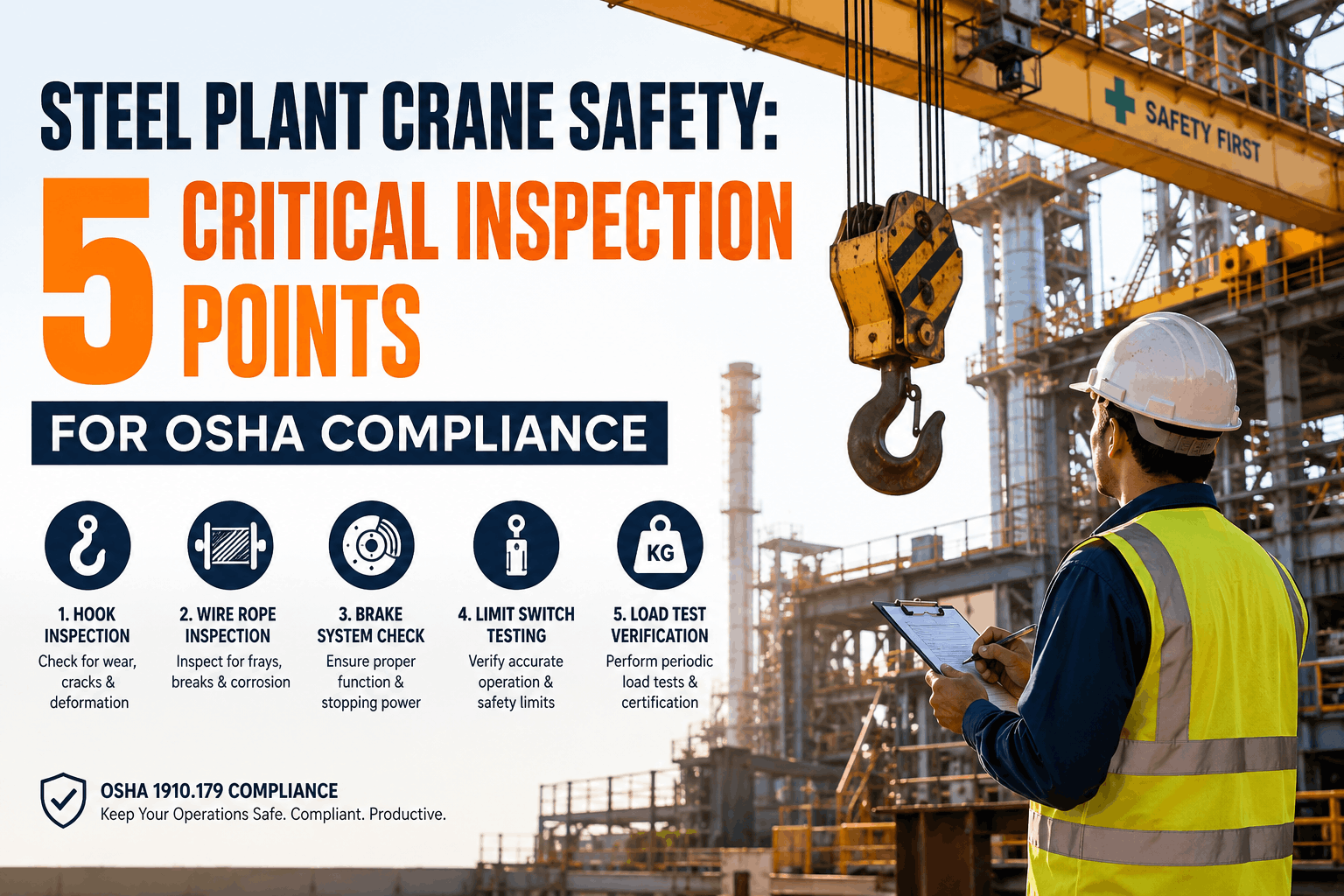
These five inspection points represent the most common failure modes in steel plant cranes and the areas OSHA enforcement focuses on. Performing these inspections rigorously and documenting findings prevents catastrophic failures and ensures compliance. Hook Inspection (Primary Failure Point): Crane hooks in steel mills are subjected to extreme loads—a ladle crane hook regularly handles 300 tonnes of molten metal at operating temperatures that soften the steel. Hooks fail by deformation (the hook throat opening increases), distortion (the hook twists out of plane), and cracking (microscopic stress fractures that grow until the hook fails). OSHA removes from service: any hook with throat opening increased 5% or more from nominal, twisted 10 degrees or more, or showing visible cracks. Steel mill operators often accept "minor" hook damage—a slightly widened throat opening, a hairline crack—thinking the hook still functions. These are removal-from-service conditions. The hook must be replaced; welded repairs are not permitted under OSHA. Monthly hook inspection with certified written records is mandatory. OxMaint's photo documentation capability allows inspectors to capture the hook's condition and attach images to the inspection record—creating visual evidence of compliance. Wire Rope Inspection (Secondary Failure Point): Running ropes on ladle cranes, charging cranes, and material handlers experience cyclic loading that fatigues wire. Ropes fail by: broken wires (when 12 or more are broken in one rope lay length or 4 in a single strand), kinking (structural deformation that eliminates the rope's load capacity), crushing (compression damage that collapses the rope structure), and corrosion (pitting that reduces load-bearing cross-section by >one-third). Monthly thorough inspection with signed certification is mandatory. Many steel mills conduct visual inspection but fail to document monthly certifications—OSHA's most common rope-related citation. Even if ropes appear intact, failure to document monthly inspection and certification is a violation. OxMaint's monthly certification system prompts inspectors when monthly inspections are due, captures signed records with rope identification and date, and archives them for audit review. Brake System Inspection (Tertiary Failure Point): Brake failures don't result in catastrophic drop—they result in uncontrolled lowering where the load descends when it should be stationary, potentially crushing personnel or equipment underneath. Brake inspection focuses on: brake pad thickness and wear patterns, brake linings condition, mechanical linkages and pivot points, and functional operation (does the brake hold the test load without slippage). Excessive wear on pads, linings, pawls, or ratchets requires replacement before continued operation. Brake testing under full load (125% of rated load) is required initially and periodically throughout the equipment's life. Load Testing Documentation (Quaternary Failure Point): Before initial use and after any alterations affecting rated capacity, cranes must be load tested with written documentation of the test and results. The test load is typically 125% of rated capacity (or per manufacturer specification) applied across the entire crane's travel path. All brakes, hoists, and bridge trucks must function smoothly without slipping or uncontrolled movement. Documentation includes the test load applied, inspector name, date, and confirmation that the equipment is ready for operation. Operational testing confirms: hoisting and lowering functions, trolley travel smoothness, bridge travel without binding, and limit switch performance. Operational Tests and Limit Switch Verification (Quinary Failure Point): Upper limit switches prevent the hoist from over-traveling and potentially breaking the hoist block or wire rope. Each crane must have limit switches protecting the full range of motion. Switches must be tested periodically to ensure they function—a failed limit switch might not stop an over-travel until catastrophic damage occurs. Test by manually driving the hoist to the limit in each direction and confirming the switch stops motion. Document the test result. OxMaint includes limit switch verification in the operational test checklist and tracks functionality status. Start Free Trial to digitize all five critical inspection points and maintain the signed records that prove your facility's compliance commitment.
Crane Operator Qualification and Safe Work Practices
A critical misunderstanding in general industry: OSHA 1910.179 requires cranes to be operated only by "designated personnel"—people formally trained on the specific crane's operation, load ratings, safety features, and emergency procedures. This is different from construction-industry crane certification (NCCCO certification) which is required under 29 CFR 1926 Subpart CC. Many steel mills incorrectly require construction-level certification for their general industry bridge cranes. While third-party certification is valuable and demonstrates competence, the legal obligation under 1910.179 is to designate qualified personnel—meaning people with documented training appropriate to your equipment. Ensure every crane operator has: written training documentation covering that specific crane's operation; awareness of the rated load capacity and prohibition against exceeding it; knowledge of pre-use inspection procedures (visual check for obvious damage, brake function); understanding of load path and exclusion zones (never place loads over personnel); and emergency response knowledge (how to call for help if the crane malfunctions). For steel mill operations, this is critical given the extreme loads and personnel risk. A ladle crane operator must understand that a 300-tonne ladle cannot be held indefinitely if brakes fail—they must be prepared for emergency response and know how to contact the control room if they sense problems. OxMaint's training module tracks operator certifications and re-certification schedules, ensuring your facility maintains proof of operator qualification for every designated crane operator.
Classify Each Crane by Service Type and Establish Inspection Schedules
Determine whether each crane is general service or severe service. Severe service equipment (ladle cranes, charging cranes, soaking pit cranes) requires more frequent inspection intervals. Set up schedules: frequent inspection daily or per-shift, monthly wire rope certification, and periodic inspection quarterly (severe) or annually (general).
Designate and Train Inspection Personnel
Assign specific, named individuals as qualified inspectors for each crane. Provide training on OSHA 1910.179 requirements, removal-from-service criteria, documentation expectations, and the specific crane's design. Document their training completion. Designate backup inspectors for continuity.
Create Inspection Checklists for All Three Intervals and Document Findings
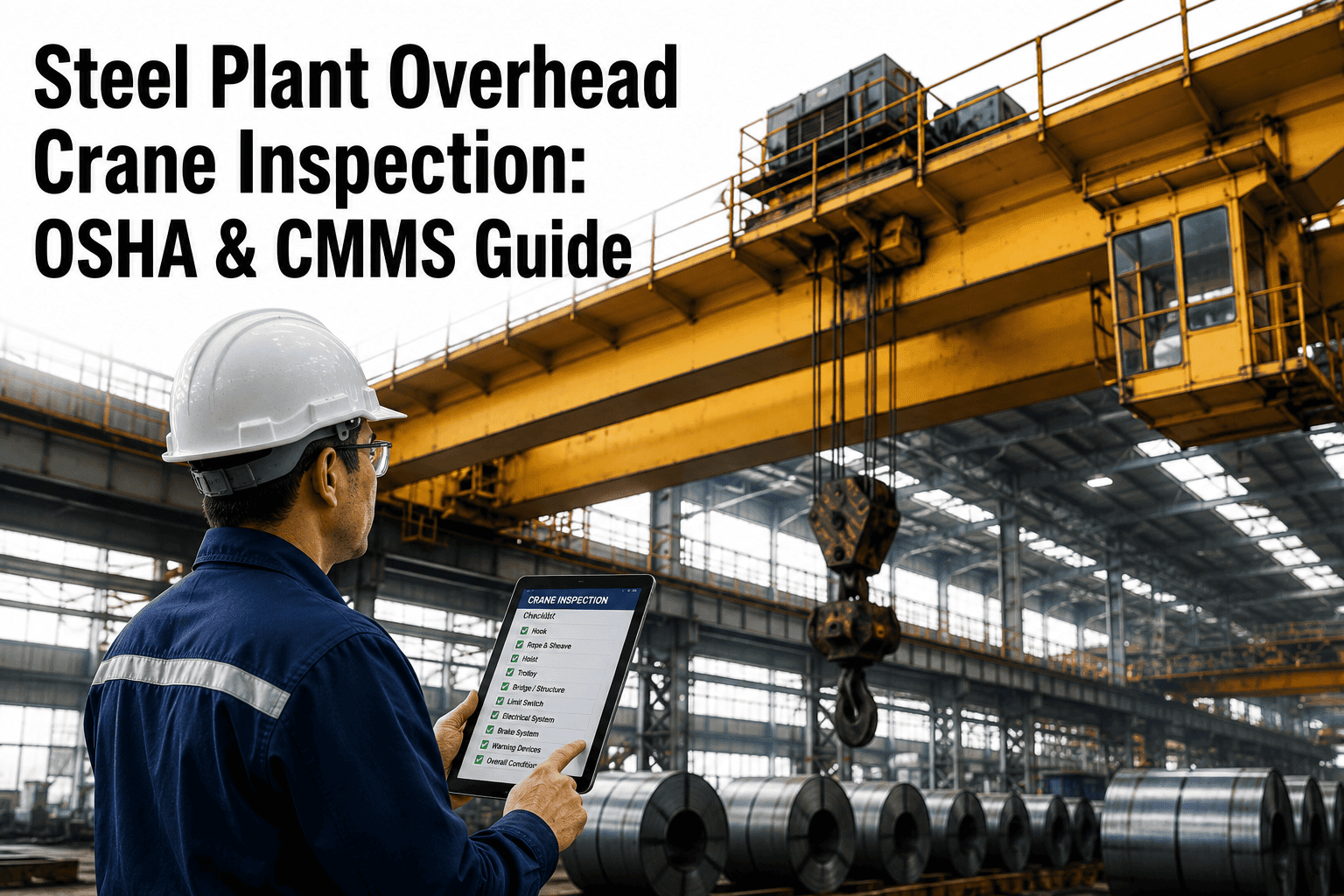
Develop checklists for frequent inspection (quick visual scan), monthly wire rope certification (detailed rope examination), and periodic inspection (comprehensive component review). Use OxMaint to make these digital checklists that capture findings, photographs, inspector signature, and date—creating audit-ready documentation.
Execute Inspections on Schedule and Maintain Removal-From-Service Protocol
Perform inspections on the defined schedule. When deficiencies are found that meet OSHA removal-from-service criteria (hooks with 5%+ throat opening increase, ropes with 12+ broken wires, brakes with excessive wear), tag the equipment out of service immediately. Do not operate it while waiting for repair parts. Document the removal and repair completion.
Archive Records and Prepare for OSHA Audit
Maintain all inspection records, wire rope certifications, load test documentation, and operational test results in a single system accessible for OSHA review. OxMaint's archive provides timestamped, searchable records. When OSHA arrives, you can produce complete documentation for any crane within seconds—eliminating the scramble to find old spreadsheets or lost papers.
Frequently Asked Questions: Steel Plant Crane Safety and OSHA Compliance
How often must ladle cranes be inspected in steel mills?
Ladle cranes are severe-service equipment under OSHA 1910.179. Frequent inspection required every shift. Monthly wire rope certification with signed record mandatory. Periodic complete inspection required quarterly (every 3 months), not annually.
What are the OSHA removal-from-service criteria for crane hooks?
Remove from service immediately if: throat opening increased 5% or more from original dimension, hook twisted 10 degrees or more, visible crack present anywhere on the hook, or safety latch failed. Welded repairs are not permitted under OSHA. Hooks must be replaced, not repaired.
How many broken wires require immediate wire rope removal from service?
For 6-strand rope: 12 or more broken wires in one lay length, or 4 or more in a single strand within one lay. Immediate removal also required for kinking, crushing, bird-caging, heat damage, corrosion pitting, or >one-third diameter reduction from wear.
Is written documentation required for every frequent inspection?
OSHA doesn't require written documentation during the inspection itself, but expects evidence that frequent inspection occurred. Many facilities document the pre-shift visual check on a log or checklist. OxMaint's daily inspection check mark creates that evidence automatically.
Do my crane operators need NCCCO certification?
OSHA 1910.179 requires "designated personnel" to operate cranes—not NCCCO certification. NCCCO is required for construction cranes under 29 CFR 1926 Subpart CC. For general industry, documented training is sufficient. Many facilities add NCCCO anyway as a professional credential and to avoid confusion between rules.
What must load testing documentation include?
Test load applied (amount), inspector name and signature, date, and confirmation that equipment functions smoothly without slipping or uncontrolled movement. Tests required before initial use and after any alterations affecting rated capacity. Documentation must be retained and available for OSHA review.
Can I use an idled crane without re-inspection?
No. Cranes idle 1–6 months require frequent-level inspection before returning to service. Cranes idle >6 months require complete periodic inspection. Documentation of pre-service inspection is mandatory. OxMaint's re-entry protocol ensures compliance when equipment is returned to operation.
How does OxMaint help with crane compliance?
OxMaint schedules all three inspection intervals, provides digital checklists, captures inspector signatures and timestamps, flags removal-from-service criteria, and archives records for OSHA audit. When OSHA arrives, your facility produces complete documentation in seconds—proving compliance and eliminating citation risk.



.png)


