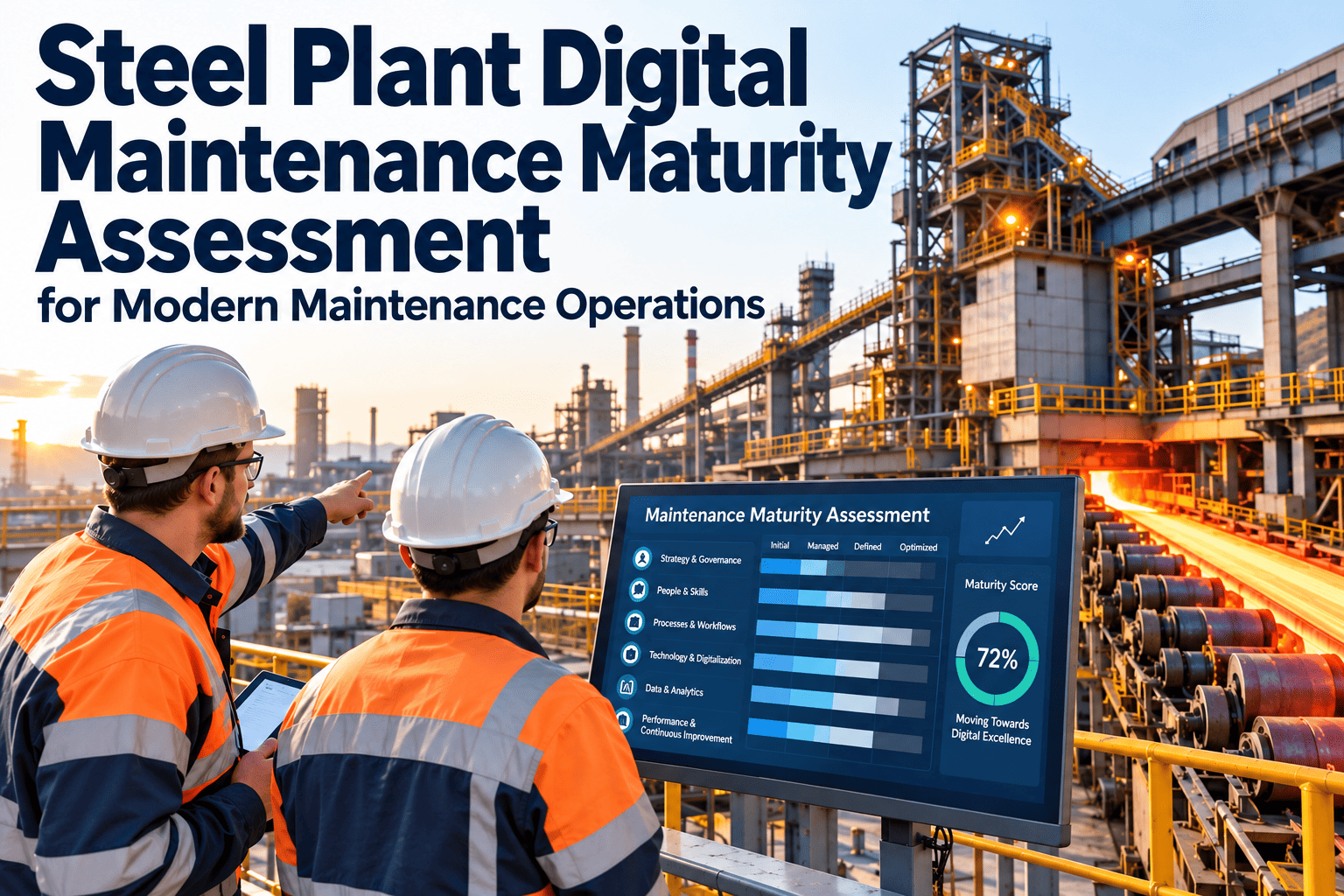
Steel Plant Digital Maintenance Maturity Assessment for Modern Maintenance Operations
By Corin Hale on October 28, 2026
Most steel plants already own a lot of digital equipment: PLCs on every drive, a historian full of tags, an ERP for purchasing and a CMMS that someone set up years ago. The harder question is whether maintenance workflows and asset data are mature enough to use any of it. This steel plant digital maintenance maturity assessment for modern maintenance operations gives you a tickable self-check across six dimensions, level-up actions for every stage and a 90-day plan, and shows how a steel plant CMMS supports each step.
Digital Transformation Steel / Self-Assessment Checklist
Steel Plant Digital Maintenance Maturity Assessment for Modern Maintenance Operations
Tick what is true on your plant today, not what is planned. Thirty-six core statements across six dimensions, plus the actions that follow, show where your maintenance workflows, asset data and technology really stand, which of five maturity levels you are operating at, and the next move that makes smart steel plant and Industry 4.0 steel ambitions achievable instead of aspirational.
Complete this short checklist first. It takes ten minutes and prevents the most common assessment mistakes.
0
Preparation Checklist
Tick these before anyone scores a single statement, so the result reflects the plant and not a good week.
Ticked: of 6
Scoring without evidence produces a number nobody trusts and an action plan nobody follows.
Part 1 The Six-Dimension Maintenance Maturity Checklist
Tap or click any statement to tick it. Each dimension has six statements, so every dimension scores from zero to six, and the running score updates as you tick. Ticks are not saved, so note your six scores before leaving the page.
1
Asset Register and Hierarchy
The foundation of steel plant maintenance software: if the asset list is wrong, everything built on it is wrong.
Ticked: of 6
Weakest signal to watch: two names for the same machine, one used by operations and one by maintenance.
2
Work Management and Planning
Where steel mill maintenance software earns its keep: the daily discipline of raising, planning and closing work.
Ticked: of 6
Weakest signal to watch: work orders closed in bulk at month end with no failure codes.
3
Inspections and Safety Records
Rounds, permits and isolation records that stand up in an audit and feed corrective work.
Ticked: of 6
Weakest signal to watch: an inspection finding that exists only on a clipboard and in someone's memory.
4
Spares and Inventory
Digital maintenance fails quietly when the right part is not on the shelf or cannot be found.
Ticked: of 6
Weakest signal to watch: a shutdown that starts and then waits for a part nobody knew was missing.
5
Condition Monitoring and Data
The bridge from time-based care to steel plant predictive maintenance, judged on process rather than sensor count.
Ticked: of 6
Weakest signal to watch: alerts that people see but nobody is assigned to act on.
6
Integration and Analytics
Whether data flows between systems and whether anyone uses it to change decisions.
Ticked: of 6
Weakest signal to watch: a dashboard everyone admires and nobody uses to change a plan.
Core checklist total of 36
Scoring Guide: From Ticks to Maturity Level
Count the ticks in one dimension and find the row. This table is a self-assessment guide for prioritising your own work. It is not a benchmark, it does not compare you with other plants, and it carries no published industry score.
Ticks in a dimension
Reading
What it usually looks like
Where to focus
0 to 1
Level 1: paper and memory
Knowledge sits with individuals, records are partial and history cannot be queried
Agree a single register and start raising work orders for every job
2 to 3
Level 2: digitised records
Data exists in a CMMS or spreadsheets but is inconsistent, late or incomplete
Standardise codes, types and mandatory close-out fields
4 to 5
Level 3: standardised and planned
Disciplined routines exist with a few gaps that show up as exceptions
Close the remaining gaps, then connect condition data to work orders
6
Level 4 or beyond: candidate
Every statement is true on a normal shift; proof comes from sustained results
Confirm with a month of evidence before claiming Level 4 or 5
Three cautions. First, six ticks in every dimension does not make a plant predictive; Level 5 is demonstrated by decisions and results over time. Second, your overall level is set by your lowest dimension, because a strong condition monitoring score cannot compensate for a weak asset register. Third, repeat the exercise every quarter with the same group so you are comparing yourself with yourself.
Turn Your Lowest Score Into a Working Routine
Oxmaint is a CMMS where the asset register, work orders, inspections, inventory and reports live in one place. Start with the dimension you scored lowest and set it up for one plant area this week.
Find your current level from the scoring guide, then tick the actions below as you complete them. Skipping a level is the most common reason industrial maintenance software projects stall.
A
Level 1 to Level 2: Paper and memory to digitised records
Jobs arrive by radio and phone, and history lives in logbooks and in the heads of experienced fitters.
Ticked: of 4
Avoid trying to load the whole plant first; one clean area teaches more than a thousand rough records.
B
Level 2 to Level 3: Digitised records to standardised and planned
Records exist, but entries are typed freely, closed late and dominated by reactive work.
Ticked: of 4
A plant that skips this level usually carries its data problems straight into analytics.
C
Level 3 to Level 4: Standardised to connected and condition-based
Routines are good, but condition data sits in separate systems and alerts are read in one place and acted on in another.
Ticked: of 4
The most common stall at this level is alerts with no owner.
D
Level 4 to Level 5: Connected to predictive and optimised
Condition-based work exists on critical equipment, but alert fatigue and specialist-only analytics limit the benefit.
Ticked: of 4
Expansion without a tuned rule set simply multiplies the noise.
E
Sustaining Level 5: Keeping a predictive plant predictive
The risk at the top of the staircase is complacency: models drift, equipment changes and strategy reviews lapse.
Ticked: of 4
Level 5 is demonstrated by decisions and results over time, not by tool ownership.
Part 3 Prerequisite Checklist Before AI or Digital Twin
Tick each foundation only when it is true for the pilot area. Any unticked box above a planned AI project is a risk to schedule and budget.
F
Foundations Before AI or Digital Twin
Work from the first item down. You cannot reliably stand on item five if item two is missing.
Ticked: of 6
Digital twin and AI vendors rarely start with your hierarchy, so check these yourself before signing anything.
Part 4 Data Quality Audit Checklist
Use these six checks as a quick audit of your own work order history before you trust any dashboard or model built on it.
G
Work Order History Audit
Whatever your level, the same six data quality dimensions decide whether the next step works.
Ticked: of 6
Run this audit on a sample first; a one-hour sample usually shows the pattern.
Part 5 Plant Area Coverage Checklist
Tick each area once it has had its own session and its own six scores. Uneven results are normal and useful because they show the weakest link.
H
Assess Each Plant Area Separately
A plant-wide score hides how different each area is. These are tendencies to test, not findings.
Ticked: of 6
Compare areas with themselves over time; the melt shop and the rolling mill are not like-for-like.
Part 6 CMMS Configuration Checklist
Steel plant CMMS capabilities map directly to the six dimensions. Tick each one when it is live for your pilot area.
I
Oxmaint Workflow Setup
Each item maps to one maturity dimension. These describe what a CMMS workflow can be configured to do in Oxmaint.
Ticked: of 6
Set up one plant area first, prove it, then copy the configuration.
Part 7 Baseline Measures Checklist
Without a baseline you cannot show improvement. Tick each measure once its starting value is written down and agreed.
J
Baseline Measures
Record where you are now, using standard formulas, before changing anything.
Ticked: of 6
Commonly cited targets exist for some of these; set your own from your baseline and governing standard.
Part 8 90-Day Plan Checklist
Pick the one dimension that limits you and aim to move it up one level. A single focused quarter beats a plant-wide programme that touches everything and finishes nothing.
K
Days 1 to 14: Assess and baseline
Run the assessment and write the starting point down.
Ticked: of 4
Exit test: scores and baselines are written down and agreed.
L
Days 15 to 30: Fix the foundations
Clean the pilot data before building on it.
Ticked: of 4
Exit test: a technician can raise and code a job without help.
M
Days 31 to 60: Run the routine
Make the new habits stick on normal shifts.
Ticked: of 4
Exit test: exceptions fall week on week.
N
Days 61 to 90: Connect and review
Link one condition signal and re-score.
Ticked: of 4
Exit test: the lowest dimension has moved up a level, with evidence.
Overall progress across all eight parts of 108
Frequently Asked Questions
How do I use a steel plant digital maintenance maturity assessment?
Run it per plant area with planners, reliability, technicians, operations and automation in the room. Tick only what you can demonstrate, score each dimension, and treat the lowest as your limit. Book a demo to walk through it on your own data.
Do we need a digital twin to be a smart steel plant?
No. A smart steel plant is built on a clean asset hierarchy, failure codes and disciplined work orders first. A digital twin is worth considering only for critical assets once that data can be trusted.
Is the score a benchmark against other steel mills?
No. It is a self-assessment guide for sequencing your own improvements. Compare yourself with yourself each quarter, and compare externally only like with like, such as EAF with EAF, normalised per tonne or operating hour.
When is steel plant predictive maintenance realistic?
When critical assets have baselines, alarm limits, tag-to-asset mapping, a named responder and a path from alert to work order. Without those, pilots tend to stall regardless of the analytics used. Get started by building that path.
What does the best CMMS for steel plants need to do?
Hold a clean hierarchy, enforce work order close-out, run mobile inspections, track spares and report KPIs, then accept condition-based triggers. Judge any steel mill maintenance software on whether your crews will actually use it every shift.
Know Your Level. Then Move Up One Step.
Take your lowest dimension and make it a working routine in Oxmaint: a clean register, disciplined work orders, mobile inspections and reports your reliability team can trust. Build the foundations that make industry 4.0 in steel real.