The melt shop at Korvald Steel's Duisburg facility ran three electric arc furnaces around the clock. Each furnace cycled every 58 minutes: charge, melt, tap, turnaround. Between cycles, a 14-person maintenance crew had exactly 22 minutes to visually inspect refractory linings, electrode arms, water-cooled panels, and slag door mechanisms before the next heat began. They worked in 1,400°F residual ambient temperatures, limited to 8-minute exposure windows per OSHA guidelines. In October 2024, a hairline crack in the #2 furnace's delta closure went undetected during a turnaround inspection. The crack propagated over 11 days. On the twelfth day, the refractory failed mid-heat. Molten steel breached the furnace shell, triggering an emergency shutdown that lasted 9 days. Direct repair cost: $1.2 million. Lost production across 216 heats: $3.8 million. Downstream rolling mill idle penalties: $680,000. Environmental remediation for the spill zone: $410,000. Total: $6.09 million. From a crack that a thermal-equipped robot would have flagged in 0.3 seconds. In January 2025, Korvald deployed a fleet of 7 quadruped robots and built a plant-wide digital twin connecting 14,000 sensor points, robotic patrol data, and their CMMS into a single operating model. In the first 90 days, the system identified 43 developing failures across furnaces, ladle turrets, continuous casters, and overhead cranes — all resolved through planned maintenance at a combined cost of $127,000. The digital twin predicted the #3 furnace would need a full reline 6 weeks before the scheduled outage window. Maintenance pulled the reline forward, avoided an unplanned breach, and saved an estimated $4.1 million. Book a demo to see how digital twin and robot fleet integration transforms steel plant maintenance.
Steel manufacturing is the most asset-intensive, highest-consequence maintenance environment in heavy industry. Temperatures exceed 3,000°F inside furnaces. Cranes carry 300-ton ladles of molten metal over personnel areas. Rolling mills operate at 40 feet per second. Equipment failures do not create inconvenience — they create catastrophic safety events, environmental incidents, and multi-million-dollar production losses. In 2025 and 2026, the convergence of three technologies is reshaping how steel plants manage these risks: quadruped inspection robots that go where humans cannot safely or frequently go, plant-wide digital twins that model every asset's real-time condition, and CMMS platforms that convert sensor intelligence into executed maintenance. This guide covers how the integration of robotic fleets, digital twins, and CMMS creates a maintenance operating system for steel plants — one that sees failures forming weeks before they happen, dispatches work automatically, and turns the most dangerous inspection environments in manufacturing into continuously monitored, data-driven operations.
$6M+
Average cost of a single unplanned furnace failure in integrated steel operations
14,000
Sensor points feeding real-time data into a plant-wide digital twin model
43
Developing failures caught in 90 days by robot fleet + digital twin integration
70%
Reduction in unplanned downtime at plants using integrated predictive systems
Why Steel Plants Need Legs, Not Wheels
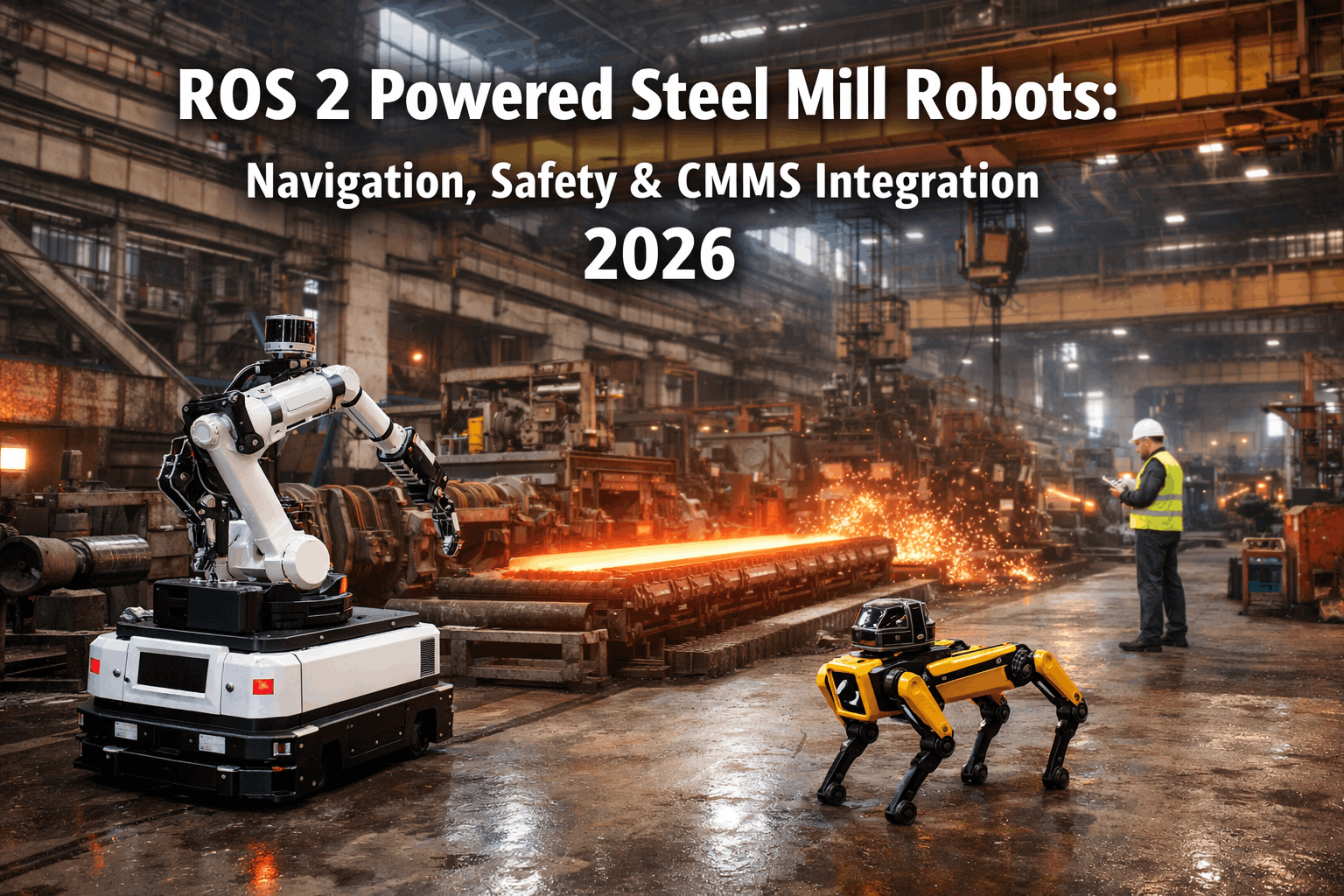
Steel plants are hostile terrain by design. Floors are uneven with slag buildup, scale deposits, and thermal warping. Grating walkways span molten metal transport paths. Stairs and ladders connect casting floors to pulpit levels to crane runways. Temperatures swing from ambient to 200°F within 10 feet of operating equipment. Wheeled robots cannot survive this environment. Quadruped robots can.
Melt Shop Floors
Slag spills, scale debris, and thermal warping create surfaces that immobilize wheeled platforms within minutes. Quadruped legs step over slag piles, navigate around spill zones, and maintain stability on uneven steel grating at ambient temperatures up to 180°F.
Furnace Perimeters
The 15-foot zone around operating EAFs reaches 200°F+ with radiant heat spikes during tapping. Robots equipped with heat-shielded chassis perform thermal scans of furnace shells, electrode clamps, and water-cooled panels during production — inspections no human can safely do during operation.
Continuous Caster Segments
Narrow access corridors between caster segments, overhead spray chambers, and oscillating mold assemblies. The robot's 32-inch profile navigates between segments to inspect roll alignment, spray nozzle patterns, and bearing housings without production stoppage.
Rolling Mill Basements
Below the rolling stands: hydraulic systems, scale pits, coolant return lines, and motor drive assemblies in confined, wet, oil-contaminated spaces. Quadrupeds inspect these areas on schedule instead of only when something fails catastrophically.
Overhead Crane Runways
Crane rail inspections traditionally require full production shutdown and man-lift access. Quadruped robots traverse crane runway structures during off-peak windows, scanning rails for wear, alignment drift, and fastener degradation using LiDAR and HD imaging.
The Digital Twin: Your Plant's Living Maintenance Model
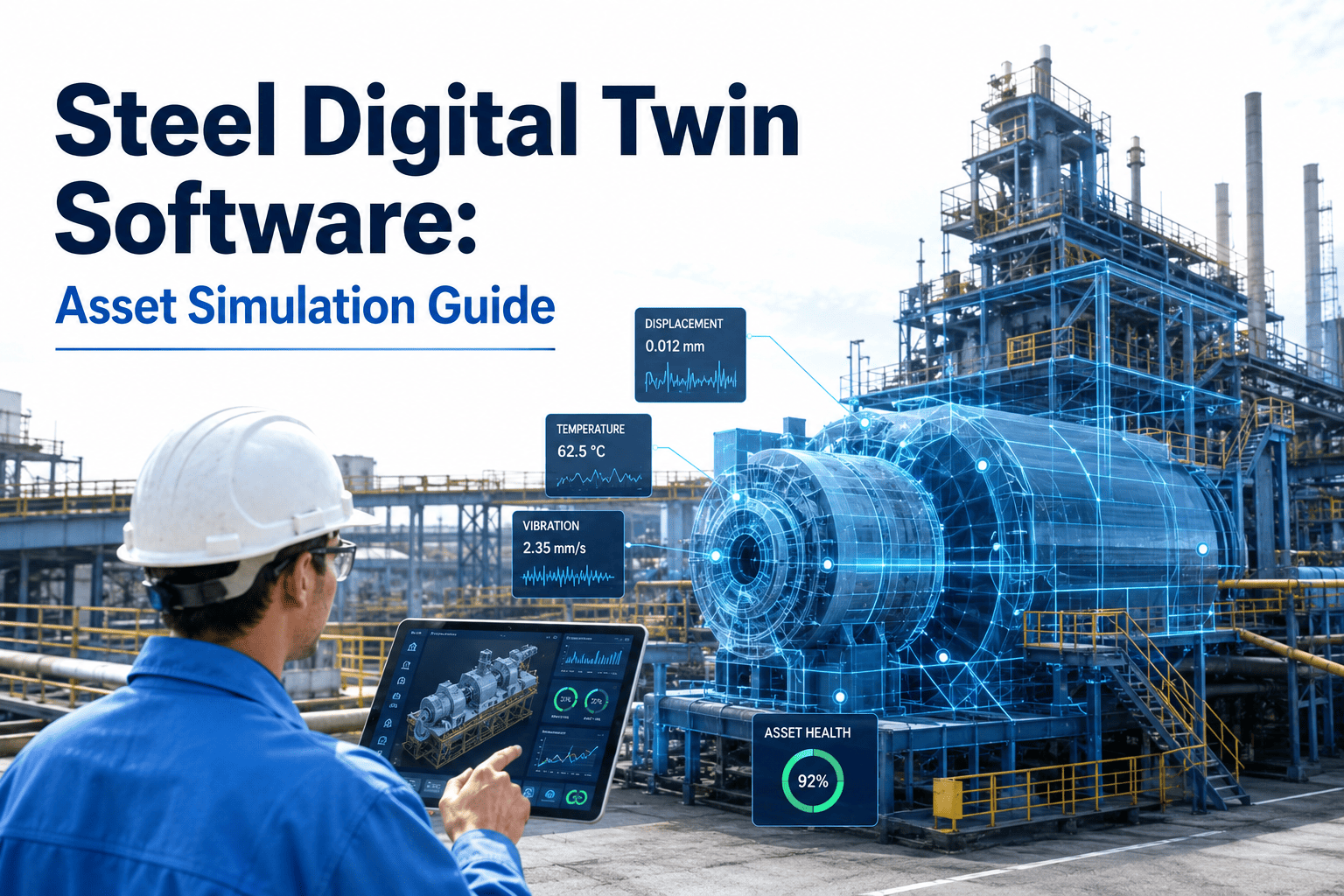
A digital twin is not a 3D visualization. It is a real-time computational model of every physical asset in your plant, continuously updated by sensor data, robotic inspection findings, maintenance records, and production telemetry. When a robot detects a 12°F thermal anomaly on a furnace transformer bushing, the digital twin correlates that reading with the bushing's age, load history, ambient conditions, and the failure signatures of every similar bushing across the fleet. It does not just flag the anomaly. It calculates remaining useful life, recommends the maintenance action, and estimates the cost of inaction.
| Digital Twin Layer | Data Sources | What It Models | Maintenance Value |
| Asset Geometry |
LiDAR scans, BIM models, robot mapping |
Physical dimensions, positions, clearances, spatial relationships between assets |
Detects structural deformation, settlement, misalignment before visible damage |
| Thermal Profile |
Robot thermal cameras, fixed IR sensors, furnace thermocouples |
Heat distribution across shells, refractory wear patterns, hot spots on electrical systems |
Predicts refractory failures 4-8 weeks ahead; catches electrical faults at inception |
| Vibration Signature |
Robot-mounted accelerometers, fixed vibration sensors on rotating equipment |
Bearing health, gear mesh condition, motor balance, foundation integrity |
Identifies bearing failures 6-12 weeks before seizure; prevents rolling mill crashes |
| Corrosion & Wear |
Robot HD cameras, ultrasonic thickness gauges, historical inspection data |
Wall thickness trends, corrosion rate mapping, erosion patterns in pipes and vessels |
Schedules replacements at optimal remaining life; eliminates surprise pipe bursts |
| Process Telemetry |
PLC/SCADA data, power consumption, flow rates, chemistry readings |
Equipment operating efficiency, energy consumption patterns, process drift |
Connects maintenance condition to production quality; optimizes outage timing |
| Environmental |
Robot gas sensors, dust monitors, ambient temperature arrays |
Emission profiles, air quality zones, fugitive dust sources, gas leak locations |
Ensures regulatory compliance; prevents environmental incidents and fines |
Korvald's digital twin processed 14,000 sensor inputs and weekly robotic patrol data to predict the #3 furnace reline — 6 weeks before the refractory would have failed in production. That single prediction saved $4.1 million. Sign up free to connect your plant's sensor data and robotic inspections into a unified maintenance intelligence platform.
Your Furnace Shell Is Talking. Your Caster Bearings Are Talking. Is Anyone Listening?
Every asset in your steel plant generates signals — thermal, vibrational, chemical, structural — that indicate its trajectory toward failure. A digital twin connected to a robot fleet and your CMMS hears every signal, correlates it with historical patterns, and converts it into a work order before the failure occurs. Stop reacting. Start predicting.
Robot Fleet + Digital Twin + CMMS: The Integrated Loop
The power is not in any single technology. It is in the closed loop: robots inspect, the digital twin interprets, the CMMS acts, and the results feed back into the model. Each cycle makes the system smarter.
01
Robot Fleet Patrols
7 quadruped robots execute scheduled patrols across melt shop, caster, rolling mill, and utilities. Each robot carries thermal, HD, LiDAR, vibration, and gas sensors. Patrols run during production — no shutdowns required. Weekly coverage: 100% of inspectable assets.
02
Data Feeds Digital Twin
Patrol data uploads automatically to the digital twin platform. AI models compare current readings against historical baselines, fleet-wide patterns, and manufacturer degradation curves. Anomalies are classified by type, severity, and predicted time to failure.
03
CMMS Generates Work Orders
Critical findings (severity 4-5) trigger immediate work orders with asset location, sensor evidence, recommended repair procedure, required parts, and estimated labor hours. Moderate findings (severity 1-3) enter the planned maintenance queue, optimized around production schedules.
04
Execution & Feedback
Maintenance teams execute work orders with full context. Completion data — actual condition found, parts used, time spent — feeds back into the digital twin, refining its predictive models. Each repair makes the next prediction more accurate.
What the Robot Fleet Catches in a Steel Plant
| Detection Type | Location | Sensor Used | Cost if Missed |
| Refractory Thinning |
EAF shell, ladle linings, tundish |
Thermal + LiDAR |
$1.2M-$6M per breach event |
| Bearing Degradation |
Caster rolls, rolling mill stands, conveyors |
Vibration + Acoustic |
$200K-$1.5M per seizure + production loss |
| Electrical Hot Spots |
Transformer bushings, bus bars, MCC panels |
Thermal Imaging |
$500K-$3M per arc flash or transformer failure |
| Hydraulic Leaks |
Rolling mill AGC systems, caster oscillators |
HD Camera + Thermal |
$150K-$800K per system failure |
| Crane Rail Wear |
Ladle cranes, charge cranes, scrap handling |
LiDAR + HD Camera |
$300K-$2M per derailment or structural failure |
| Gas & Emission Leaks |
Ductwork, baghouse, off-gas systems |
Gas Detection Array |
$100K-$5M in EPA fines + remediation |
Manual vs. Integrated: Steel Plant Maintenance at Scale
Traditional MaintenanceRobot Fleet + Digital Twin + CMMS
Furnace Inspection
Visual only during 22-min turnarounds; 8-min human exposure limit; critical areas missed
Continuous thermal monitoring during production; full shell scan every shift; no exposure risk
Failure Prediction
Calendar-based relines and replacements; reactive to visible damage; no trend analysis
AI-predicted remaining useful life; degradation trending across asset fleet; 4-12 week advance warning
Confined Spaces
Permit-required entry; 2-hour setup; limited to annual or breakdown inspections
Robot enters autonomously on schedule; weekly or bi-weekly coverage; zero human risk
Data Continuity
Paper logs, disconnected spreadsheets, tribal knowledge lost with turnover
Every reading timestamped, geolocated, and stored; complete asset history; AI-searchable
Outage Planning
Fixed schedules; scope discovered during shutdown; overruns common
Scope defined weeks ahead by digital twin; parts pre-staged; outage duration reduced 25-40%
Annual Maintenance Cost
$18.5M (reactive repairs + unplanned downtime + overtime + safety incidents)
$9.2M (planned maintenance + robot fleet + digital twin platform + CMMS)
Every hour of unplanned downtime in a steel melt shop costs $45,000-$85,000 in lost production alone — before repair costs, safety investigations, or environmental response. The integrated system does not just reduce cost. It eliminates the categories of failure that create catastrophic loss. Book a demo to see the integration in action.
ROI: Integrated Steel Plant (1.5M Ton Annual Capacity)
Avoided unplanned furnace & caster shutdowns$4,200,000
Reduced outage duration through pre-scoped maintenance$1,850,000
Eliminated confined space entry contractor costs$380,000
Insurance premium reduction (documented robotic inspection program)$290,000
Extended refractory and consumable life through optimized timing$1,100,000
Avoided environmental fines through continuous emission monitoring$520,000
Total Annual Savings$8,340,000
Program Cost (robot fleet + digital twin + CMMS platform)$2,100,000
Net Annual Benefit$6,240,000
$6.24 Million in Net Annual Savings. One Integrated Platform. Zero Blind Spots.
The math for steel is unforgiving: a single furnace breach costs more than the entire annual investment in robotic inspection, digital twin modeling, and CMMS integration. Oxmaint connects every robotic finding and sensor reading to automated work orders, parts procurement, outage planning, and compliance tracking across your entire plant.
Frequently Asked Questions
Can robots survive the heat and dust inside a steel plant?
Enterprise quadruped platforms deployed in steel environments use heat-shielded chassis rated for sustained ambient temperatures up to 200°F, with burst tolerance to 300°F for short-duration furnace perimeter patrols. IP67-rated enclosures protect sensors and electronics from dust, scale, and water spray. Sacrificial lens covers on cameras are replaced during routine maintenance cycles. Boston Dynamics Spot has been deployed in steel and aluminum smelting facilities since 2023, with platforms logging over 10,000 operating hours in melt shop environments.
Book a demo to discuss environmental hardening for your specific plant conditions.
How long does it take to build a plant-wide digital twin?
Initial deployment typically follows a phased approach. Phase 1 (weeks 1-4): Robot fleet mapping of the physical plant using LiDAR to create the 3D spatial model. Phase 2 (weeks 3-8): Integration of existing sensor networks, SCADA/PLC data, and historical maintenance records. Phase 3 (weeks 6-12): AI model training on your plant's specific asset fleet and failure patterns. Most plants have a functional digital twin within 90 days, with predictive accuracy improving continuously as the system accumulates operational data. The model never stops learning.
What is the robot fleet size needed for a typical integrated steel plant?
Fleet sizing depends on plant footprint and patrol frequency requirements. A typical 1.5M-ton integrated operation with EAF melt shop, continuous caster, and rolling mill requires 5-8 quadruped robots for full coverage with bi-weekly patrol cycles on all areas. High-criticality zones like furnace perimeters and caster segments may use dedicated robots on daily or per-shift cycles. Robot-as-a-Service models allow scaling the fleet up during planned outages when intensive inspection coverage is needed.
How does the digital twin integrate with our existing SCADA and Level 2 systems?
Modern digital twin platforms connect to SCADA, PLC, DCS, and Level 2 process control systems through standard industrial protocols including OPC-UA, MQTT, and Modbus TCP. The digital twin sits as a read-only consumer of process data — it does not write to or control production systems. API integrations connect the twin's predictive outputs to the CMMS for work order generation. Most plants achieve full sensor integration within the existing network architecture without modifications to control systems.
Sign up free to explore integration architecture for your plant.
What about safety around molten metal and crane operations?
Robot patrol routes are programmed with exclusion zones around active tapping, pouring, and crane travel paths. The robots use real-time integration with crane positioning systems to avoid active lift zones. Patrols in high-risk areas are scheduled during planned idle windows or between heats. Emergency stop systems respond to plant-wide alarm conditions. The fundamental safety improvement is replacing human presence in dangerous inspection zones — every robot patrol is a permit-required confined space entry or high-heat exposure that a technician does not have to perform.
Your Furnace Shell Has Not Been Fully Scanned During Production. Ever. The Robot Fleet Will Do It Today.
Korvald lost $6.09 million because a hairline crack hid in a space that was too hot to inspect during operation. Your melt shop, your caster basement, your rolling mill drive tunnels all have the same blind spots right now. A robot fleet connected to a digital twin and CMMS walks through every one of them, models every asset's trajectory, and generates work orders before failures become emergencies. The demo takes 30 minutes. The first furnace perimeter patrol usually pays for the entire program.