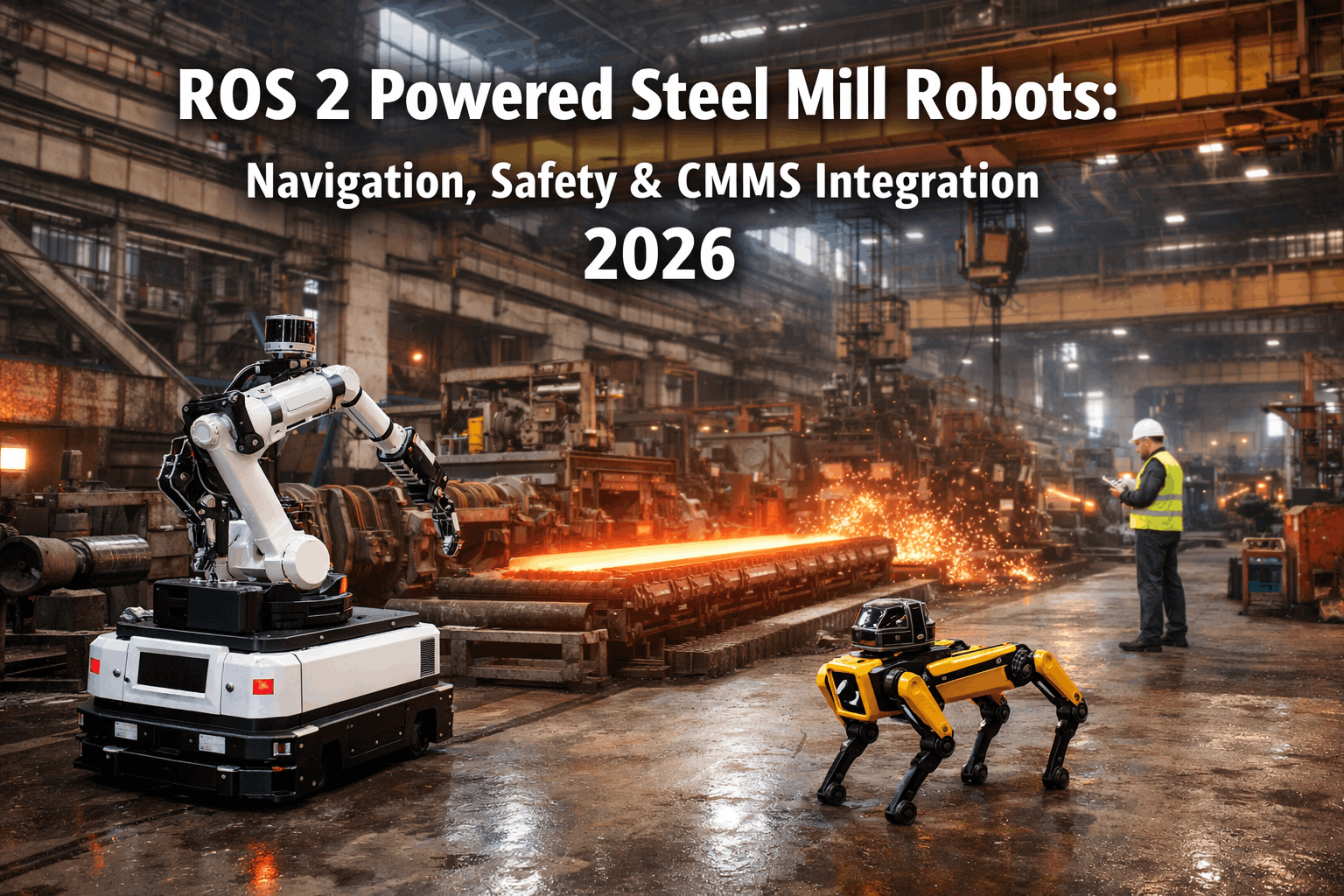
Digital twin technology is transforming how steel plants maintain their growing fleets of inspection robots, maintenance crawlers, autonomous drones, and quadruped patrol systems.
Digital twins generate the predictive intelligence — but maintenance action still requires work orders, scheduling, parts procurement, and technician dispatch. Oxmaint CMMS bridges the gap between your digital twin platform and maintenance execution — converting remaining useful life predictions into scheduled work orders, auto-ordering replacement parts when components approach end-of-life, and tracking the complete maintenance history for every robot in your fleet.uction
What a Robot Digital Twin Actually Does in a Steel Plant
Vibration, temperature, motor current, joint angle, battery state, and operational speed stream from physical robot sensors to the digital twin model in real time via IIoT protocols (MQTT, OPC-UA).
Digital twin models robot kinematics, structural characteristics, and mechanical degradation. Simulates different operational scenarios to estimate remaining useful life (RUL) of bearings, gears, motors, and joints.
AI/ML algorithms (neural networks, SHAP/LIME explainability) analyze sensor trends against degradation models. Predicts when specific components will breach safety thresholds — days or weeks before actual failure.
Converts RUL predictions into optimal maintenance windows. Balances repair urgency against production schedules. Auto-generates work orders in CMMS with part numbers, estimated labor, and priority ranking.
Turn Digital Twin Predictions Into Maintenance Action
Oxmaint converts remaining useful life estimates from your digital twin platform into scheduled work orders, auto-orders replacement parts, and tracks the complete maintenance history for every robot in your steel plant fleet.
Top Digital Twin Platforms for Steel Plant Robotics
Siemens Xcelerator / MindSphere
Comprehensive industrial digital twin ecosystem. MindSphere IoT platform connects to robotic sensors; Xcelerator portfolio provides physics-based simulation for robot kinematics and wear modeling. Edge AI processing enables on-premises deployment in steel plant networks. Integrates with Siemens PLM for full lifecycle management.
ABB Ability / RobotStudio
ABB Ability platform with built-in digital twin for ABB robotic arms already deployed in steel plants (ladle maintenance, slide gate operations). RobotStudio creates virtual robot cells for offline programming and wear simulation. Condition monitoring specifically tuned for foundry-protection robots operating in extreme steel environments.
AVEVA (Schneider) Unified Operations
Plant-scale digital twin platform connecting process, asset, and operational data. AVEVA Predictive Analytics uses ML for robot fleet health scoring. Asset Performance Management module tracks degradation across all robotic systems. Cloud/hybrid deployment supports both connected and air-gapped steel plant networks.
PTC ThingWorx / Vuforia
ThingWorx IoT platform ingests robot sensor data; predictive analytics engine estimates remaining useful life for mechanical components. Vuforia AR overlays digital twin data onto physical robots for guided maintenance — technicians see bearing health, motor temperatures, and joint wear in AR headset while performing repairs.
NVIDIA Omniverse / Isaac Sim
GPU-accelerated physics simulation platform for creating high-fidelity digital twins of entire robot fleets. Isaac Sim provides robotic simulation with real-world physics, sensor modeling, and synthetic data generation for AI training. Enables virtual testing of robot patrol routes, inspection paths, and failure scenarios before deployment.
GE Vernova / Predix
Asset Performance Management platform purpose-built for heavy industrial environments. Digital twin models for rotating machinery (motors, gearboxes, bearings) directly applicable to robotic actuators and drive systems. Advanced analytics detect degradation patterns specific to high-temperature, high-vibration steel plant conditions.
Steel Plant Robot Types and Their Digital Twin Requirements
| Robot Type | Key Sensors for DT | Critical Wear Points | DT Prediction Target | Maintenance Impact |
|---|---|---|---|---|
| Inspection Drones | Motor RPM, battery voltage, IMU, rotor vibration | Motor bearings, propeller balance, battery degradation, ESC thermal | Flight hours to motor replacement; battery cycle life remaining | Pre-flight replacement vs. mid-mission failure |
| Magnetic Crawlers | Wheel torque, magnet adhesion force, UT sensor calibration | Magnetic wheel wear, drive motor brushes, sensor head alignment | Surface-hours before grip failure; sensor drift timeline | Prevents detachment during vertical inspection |
| Quadruped Robots | Joint torque, actuator temp, gait IMU, foot contact force | Hip/knee actuators, foot pads, harmonic drives, joint seals | Actuator RUL per joint; gait degradation onset | Joint replacement before mobility loss |
| Robotic Arms (Ladle) | Joint angle, payload force, motor current, foundry temp | Wrist/elbow gears, foundry-protection seals, cable harness | Gear mesh wear rate; seal integrity under heat cycling | Prevents failure during molten steel operations |
| Gunning Manipulators | Extension position, nozzle pressure, lance rotation torque | Hydraulic seals, extension bearings, nozzle wear, ceramic insulation | Nozzle life remaining; hydraulic seal leak onset | Avoids mid-repair equipment failure |
| Conveyor/Transport AGVs | Wheel encoder, drive current, obstacle sensor, load cell | Drive wheels, steering actuators, LiDAR window fouling | Wheel replacement interval; steering calibration drift | Prevents transport disruption in melt shop |
Connect Your Digital Twin Platform to Maintenance Execution
Oxmaint integrates with Siemens, ABB, AVEVA, PTC, and other digital twin platforms — converting RUL predictions into work orders, auto-scheduling maintenance windows, and building the repair history for every robot in your steel plant.
Steel Industry Digital Twin Leaders
ArcelorMittal
Deployed digital twin technology across European plants. Virtual replicas of physical systems synchronized with real-time data for behavior modeling, failure prediction, and process optimization.
Tata Steel
Kalinganagar plant operates single data platform from ore to shipment. 260+ algorithms for real-time decision-making including charge composition, furnace modes, quality vision, and predictive maintenance. Leads €75M HIsarna digital twin project.
POSCO
Smart blast furnace uses AI analyzing camera video, temperature, and charge composition in real time. Automated blast/fuel adjustment increased daily output by 240 tons pig iron. Deep learning for production line perfection goal.
JFE Steel
AI-optimized robotic grinding system at Chita Works. Robot independently determines part position, detects defects, and optimizes movements — 60% speed increase over traditional methods. Digital twin enables continuous robot performance improvement.
ROI: Digital Twins for Robot Fleet Maintenance
Frequently Asked Questions
What is a robot digital twin in steel manufacturing?
A robot digital twin (RDT) is a real-time virtual replica of a physical robotic system — synchronized continuously with sensor data from the actual robot. In steel manufacturing, this applies to inspection drones, magnetic crawlers, quadruped patrol robots, robotic arms (ladle maintenance, slide gate operations), gunning manipulators, and transport AGVs. The RDT follows a four-layer architecture: the physical twin (the actual robot with embedded sensors tracking vibration, temperature, motor current, joint angle, and operational parameters); the data layer (IIoT connectivity via MQTT/OPC-UA streaming sensor data in real time); the virtual model (physics-based simulation of robot kinematics, structural characteristics, and mechanical degradation using AI/ML); and the service layer (predictive maintenance outputs including remaining useful life estimates, failure probability, and automated work order generation). The digital twin enables steel plants to predict when specific robot components — bearings, gears, motors, seals, battery cells — will degrade to failure threshold, scheduling replacement during planned downtime rather than experiencing unexpected failures during critical inspection missions.
Which digital twin platforms work best for steel plant robots?
Six leading platforms serve steel plant robot maintenance: Siemens Xcelerator/MindSphere for comprehensive industrial IoT with edge AI and physics-based simulation; ABB Ability/RobotStudio with robot-native digital twins already deployed in steel (ladle robots, foundry-protection arms); AVEVA Unified Operations for plant-wide asset performance management connecting robot fleet health to overall production; PTC ThingWorx/Vuforia combining IoT sensor aggregation with AR-guided maintenance overlays; NVIDIA Omniverse/Isaac Sim for GPU-accelerated multi-robot fleet simulation and AI training; and GE Vernova/Predix for heavy-industry asset performance management tuned to high-temperature, high-vibration environments. Platform selection depends on existing infrastructure (ABB shops benefit from native ABB twins), scale (NVIDIA for large multi-robot fleets), and integration requirements (all platforms need CMMS connectivity for maintenance execution).
How does a digital twin connect to CMMS for maintenance?
Integration follows a prediction-to-action pipeline: the digital twin continuously monitors robot health and generates remaining useful life (RUL) estimates for every tracked component. When any component's RUL crosses a configurable threshold (e.g., bearing predicted to fail within 14 days), the twin generates a maintenance trigger. This trigger feeds into CMMS via API, which auto-creates a work order with: the specific robot asset, the component requiring attention, the predicted failure timeline, recommended replacement parts (auto-linked to inventory), estimated labor hours, and priority ranking relative to production schedule. The CMMS then schedules the work into the optimal maintenance window — balancing robot availability against production demands. After repair, the technician closes the work order with actual parts used and labor time, feeding this data back to the digital twin to refine future predictions. This closed-loop system continuously improves prediction accuracy while ensuring no digital twin alert goes unaddressed.
What ROI can steel plants expect from robot digital twins?
Industry benchmarks show digital twins deliver a 20% reduction in unexpected work stoppages, 10% reduction in labor costs through optimized scheduling, and up to 5% revenue increase from improved uptime and operations (McKinsey supply chain research). In steel-specific deployments, ArcelorMittal achieved 12% energy reduction across European plants, POSCO gained 5% production efficiency plus 10% energy savings, and JFE Steel saw 60% faster robotic processing with AI-optimized systems. For robot maintenance specifically, the ROI compounds: every prevented mid-mission drone failure avoids not just the $5,000-$50,000 robot repair cost, but the inspection downtime, rescheduling delays, and potential safety incidents from unmonitored assets. With the predictive maintenance market growing at 26.5% CAGR to $70.73 billion by 2032, and the digital twin market at 47.9% CAGR to $149+ billion by 2030, steel plants investing in robot digital twins now are positioning for significant competitive advantage.
Your Robot Fleet Deserves Digital Twin Intelligence
Oxmaint connects digital twin predictions to maintenance execution — converting RUL estimates into work orders, auto-scheduling repairs, tracking parts inventory, and building the complete maintenance history for every robot in your steel plant.