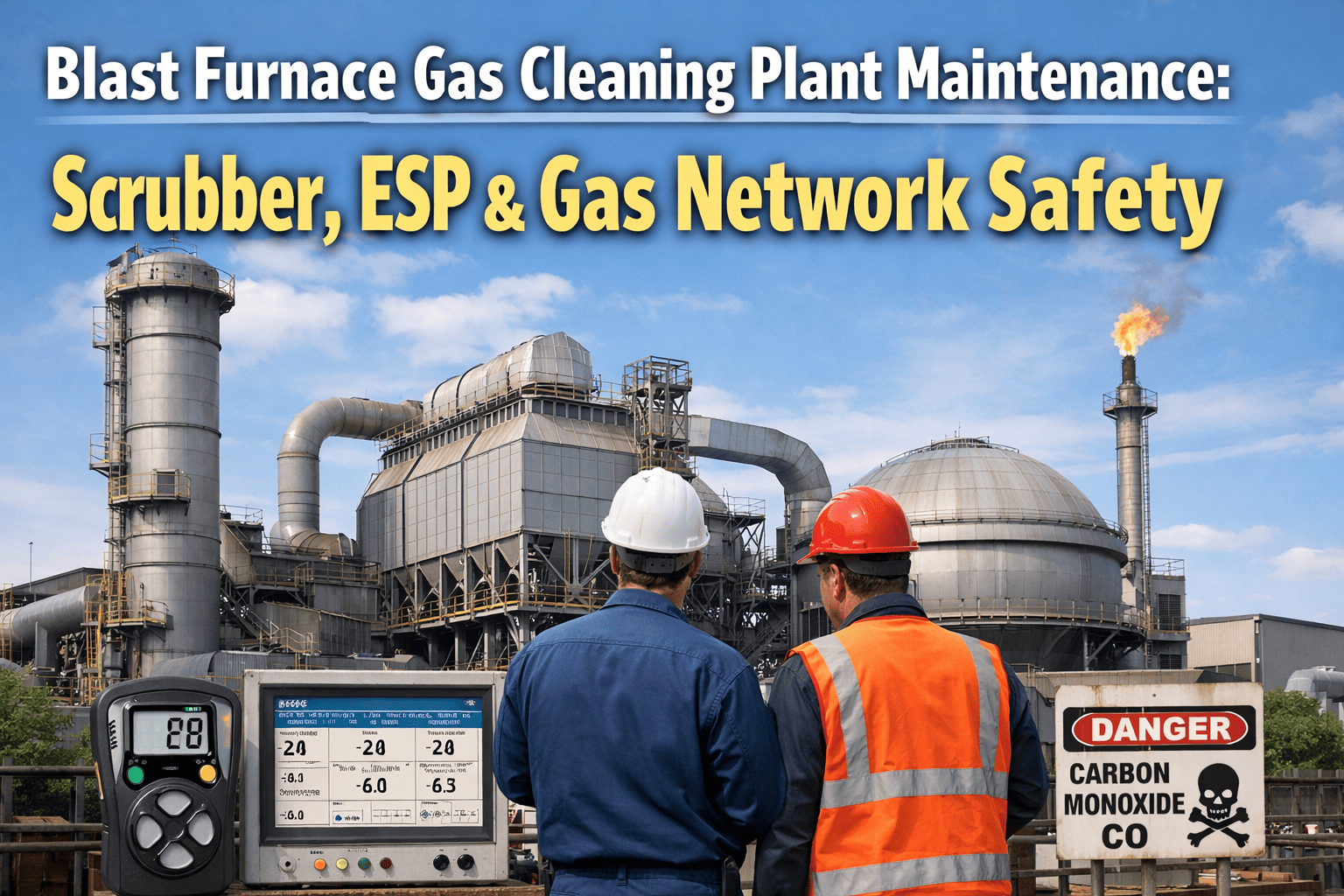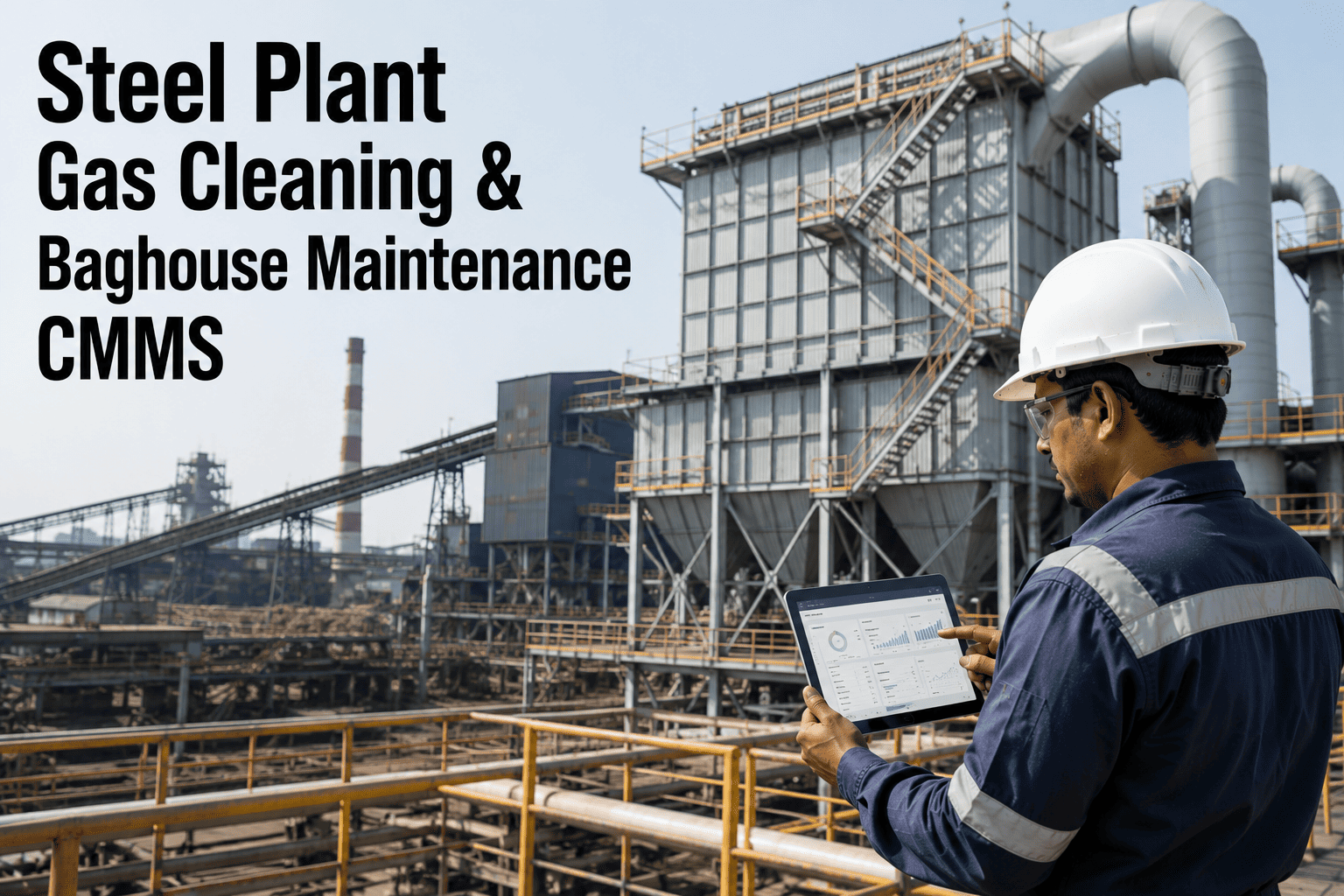
Steel plant gas cleaning systems — including blast furnace gas cleaners, EAF baghouses, and wet scrubbers — are the environmental and operational backbone of any integrated steel facility, and keeping them running requires disciplined, data-driven maintenance. A single baghouse failure can idle a furnace line for 6–12 hours, trigger emission permit violations, and cost upwards of $250K per incident in lost production and regulatory penalties. This guide walks maintenance and reliability teams through preventive maintenance strategies, filter replacement cycles, and inspection checklists for gas cleaning steel plant equipment — and shows how a purpose-built CMMS like OxMaint eliminates spreadsheet chaos, predicts failures, and keeps your baghouse PM program audit-ready. Ready to modernize your maintenance workflow? Start Free Trial and see the difference on your own assets.
Steel Gas Cleaning CMMS
Cut baghouse downtime by 40% and eliminate emission excursions with AI-driven PM
OxMaint centralizes work orders, predictive analytics, and spare-parts inventory for blast furnace gas cleaners, EAF baghouses, and wet scrubbers — so your reliability team prevents failures instead of reacting to them.
The Cost of Reactive Maintenance
Why steel plant gas cleaning maintenance can't run on spreadsheets
Gas cleaning systems in steel plants handle some of the harshest operating conditions in heavy industry — temperatures exceeding 400°F at EAF baghouse inlets, abrasive particulate loads, and corrosive scrubber liquors. When maintenance is tracked on whiteboards or legacy spreadsheets, PM compliance typically falls below 60% within the first quarter.
A mid-sized steel plant operating two EAFs and one blast furnace typically runs 80–120 gas cleaning assets — baghouses, ID fans, scrubber pumps, dampers, and dust handling conveyors. Without a centralized CMMS, work orders get lost between shifts, critical spares (like custom-sized filter bags with 8-week lead times) go unordered, and maintenance teams operate in permanent firefighting mode. OxMaint replaces that chaos with a single source of truth: every asset, every work order, every PM trigger, and every spare part tracked and synchronized in real time.
Baghouse PM Checklist for Steel Plants
Essential EAF baghouse and blast furnace gas cleaner PM tasks
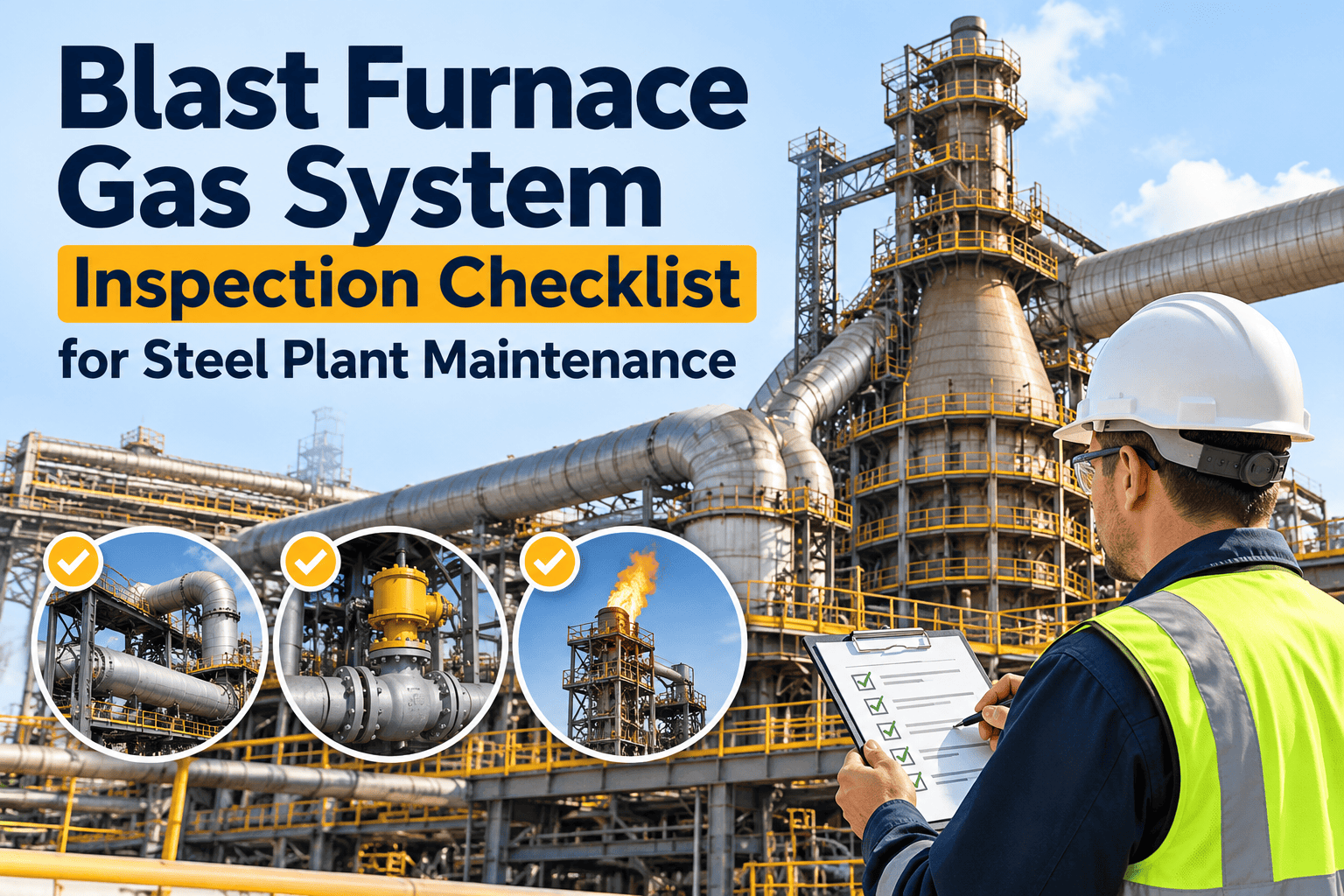
Preventive maintenance for steel gas cleaning systems follows three escalating tiers — daily operator rounds, weekly mechanical inspections, and monthly/quarterly deep PM. Below is a condensed checklist mapped to typical OEM recommendations and ISO 55000 asset management principles.
- Inspect baghouse differential pressure (target: 2–6 in. w.c.; flag if >8)
- Verify pulse-jet cleaning cycle is firing in correct sequence
- Check ID fan bearing temperature and vibration trends
- Inspect scrubber recirculation pump flow rates and pH levels
- Walk down dust discharge system for blockages or leaks
- Lubricate ID fan and damper bearings per OEM schedule
- Inspect compressed air header pressure for pulse-jet system (80–100 psi)
- Check hopper dust levels and rotary valve operation
- Examine access doors and gaskets for air in-leakage
- Test emission monitor (CEMS) calibration and alarm setpoints
- Internal baghouse inspection — torn or blinded filter bags
- Clean or replace pulse-jet diaphragm valves and solenoids
- Perform ID fan vibration analysis and ultrasonic testing
- Inspect and descale wet scrubber nozzles, packing, and mist eliminator
- Full thermographic scan of motor control centers and switchgear
Filter & Component Lifecycle Guide
EAF baghouse filter replacement and gas cleaner maintenance cycles
Different gas cleaning assets in a steel plant have vastly different maintenance frequencies. Knowing the optimal replacement window — and tracking it automatically — is the difference between a planned 4-hour shutdown and a 12-hour unplanned outage.
| Asset / Component | Typical Service Life | PM Frequency | Failure Warning Signs |
|---|---|---|---|
| EAF baghouse filter bags (Polyester / P84) | 18–36 months | Quarterly inspection | Rising ΔP, opacity spikes, visible dust at stack |
| Blast furnace gas cleaner cyclones | 5–8 years (liner-dependent) | Semi-annual internal inspection | Reduced capture efficiency, erosion on inlet vanes |
| Wet scrubber mist eliminator blades | 3–5 years | Monthly washdown + annual deep clean | Liquid carryover, ΔP creep, corrosion pitting |
| Pulse-jet diaphragm valves | 2–4 million cycles | Quarterly function test | Weak pulse, continuous air leak, solenoid chatter |
| ID fan bearings (SKF / Timken) | 50,000–100,000 hours | Monthly vibration analysis | Vibration >0.2 in/s, temperature >180°F |
Real-World Scenario
A 180-asset steel plant: from reactive firefighting to 92% PM compliance
Consider an integrated steel mini-mill operating two EAFs and one blast furnace — roughly 180 gas-cleaning-related assets, including baghouses, scrubbers, ID fans, dampers, and dust handling equipment. The maintenance team was spending $42K per year on emergency filter bag replacements and unplanned contractor labor.
- PM compliance tracked on Excel — averaged 54%
- Filter bags replaced reactively after opacity excursions
- 3–4 unplanned baghouse outages per quarter
- Spare parts inventory accuracy: ~60% (stockouts common)
- $42K/yr emergency labor + $180K/yr lost production
- PM compliance automated to 92% within 90 days
- Filter bags scheduled by runtime hours + ΔP trend data
- Unplanned outages reduced to <1 per quarter
- Spare parts inventory accuracy: 98% (auto-reorder triggers)
- $31K/yr labor savings + $120K/yr recovered production
How OxMaint Helps
OxMaint capabilities built for steel gas cleaning maintenance
OxMaint is an AI-powered CMMS and EAM platform engineered for the realities of heavy industrial maintenance. Here is how specific capabilities map directly to your gas cleaning and baghouse PM challenges — and the measurable outcomes they deliver.
Predictive Maintenance via AI
OxMaint ingests vibration, temperature, and ΔP sensor data from ID fans and baghouses, then uses machine-learning models to flag bearing degradation or filter blinding 7–21 days before failure — cutting unplanned downtime 30–50%.
Automated Work Order Scheduling
Trigger PM work orders automatically by runtime hours, calendar intervals, or condition thresholds. Technicians receive digital work orders on mobile devices with step-by-step checklists, photos, and OEM manuals attached — eliminating paper and missed tasks.
Spare Parts Inventory Auto-Reorder
Track every filter bag, diaphragm valve, and bearing by SKU with min/max thresholds. OxMaint auto-generates purchase requisitions when stock dips below safety levels, preventing the 8-week lead-time stockouts that derail baghouse PM windows.
Maintenance Analytics & Audit Trail
Real-time dashboards show PM compliance, MTBF, MTTR, and cost-per-asset. Every work order, reading, and part replacement is timestamped and logged — giving you an instant, audit-ready trail for EPA emission compliance and ISO 55000 alignment.
See It On Your Assets
Book a 30-minute demo and see how OxMaint transforms your gas cleaning PM program
Walk through a live environment configured for steel plant baghouses and wet scrubbers. See AI-driven failure predictions, automated work orders, and real-time PM compliance dashboards in action.
Frequently Asked Questions
Steel plant gas cleaning maintenance — your questions answered
How often should EAF baghouse filter bags be replaced in a steel plant?
EAF baghouse filter bags typically last 18–36 months depending on steel production volume, inlet temperature spikes, and particulate load. The most reliable replacement trigger is not a calendar date but a combination of rising differential pressure (consistently above 6–8 in. w.c.), opacity trend data, and visual inspection during quarterly outages. OxMaint tracks runtime hours and sensor trends to auto-generate replacement work orders before bags fail — preventing the 6–12 hour unplanned outages that cost $20K–$40K per event. Book a Demo to see automated bag replacement scheduling on your asset list.
What is the ideal differential pressure range for a steel plant baghouse?
A healthy baghouse differential pressure runs between 2 and 6 inches water column. Readings below 2 in. w.c. may indicate a torn bag or broken seal causing bypass, while sustained readings above 8 in. w.c. signal filter blinding, moisture condensation, or a failed pulse-jet cleaning cycle. OxMaint lets you set ΔP thresholds that automatically trigger inspection work orders — so your team investigates the root cause before an opacity excursion or fan motor overload occurs.
Can a CMMS help with EPA emission compliance for steel gas cleaning systems?
Yes. A CMMS like OxMaint creates a time-stamped, tamper-proof audit trail for every PM task, inspection reading, sensor alarm, and spare part replacement on your gas cleaning assets. During an EPA audit or Title V permit review, you can generate a full compliance report in minutes showing that PM was performed on schedule, CEMS calibration was current, and corrective actions were documented — eliminating the manual record-scrambling that typically consumes days of engineering time.
How long does it take to implement a CMMS for a steel plant maintenance team?
A focused implementation for gas cleaning assets typically takes 2–4 weeks: Week 1 for asset hierarchy import (baghouses, fans, scrubbers, dampers), Week 2 for PM template configuration and spare-parts loading, and Weeks 3–4 for team onboarding and mobile app rollout. OxMaint provides guided onboarding and data migration support, so your team transitions from spreadsheets to a live CMMS without a prolonged IT project.
What are the most common causes of baghouse failure in steel plants?
The top causes are delayed filter bag replacement (blinding from over-saturation), pulse-jet valve failure (weak or no cleaning pulse), condensation from operating below acid dew point, and air in-leakage at access doors that creates localized high-velocity zones and premature bag erosion. Roughly 40% of these failures are preventable with on-time PM and condition monitoring — which is exactly what OxMaint automates through sensor-triggered work orders and predictive analytics. Start Free Trial to see how quickly you can deploy preventive triggers.
Start Your Maintenance Transformation
Stop firefighting baghouse failures — start preventing them with OxMaint
Join steel plants that cut unplanned downtime 30–50%, hit 90%+ PM compliance, and turned maintenance from a cost center into a reliability engine. Your assets, your data, your rules — powered by AI.
Free 14-day trial · No credit card