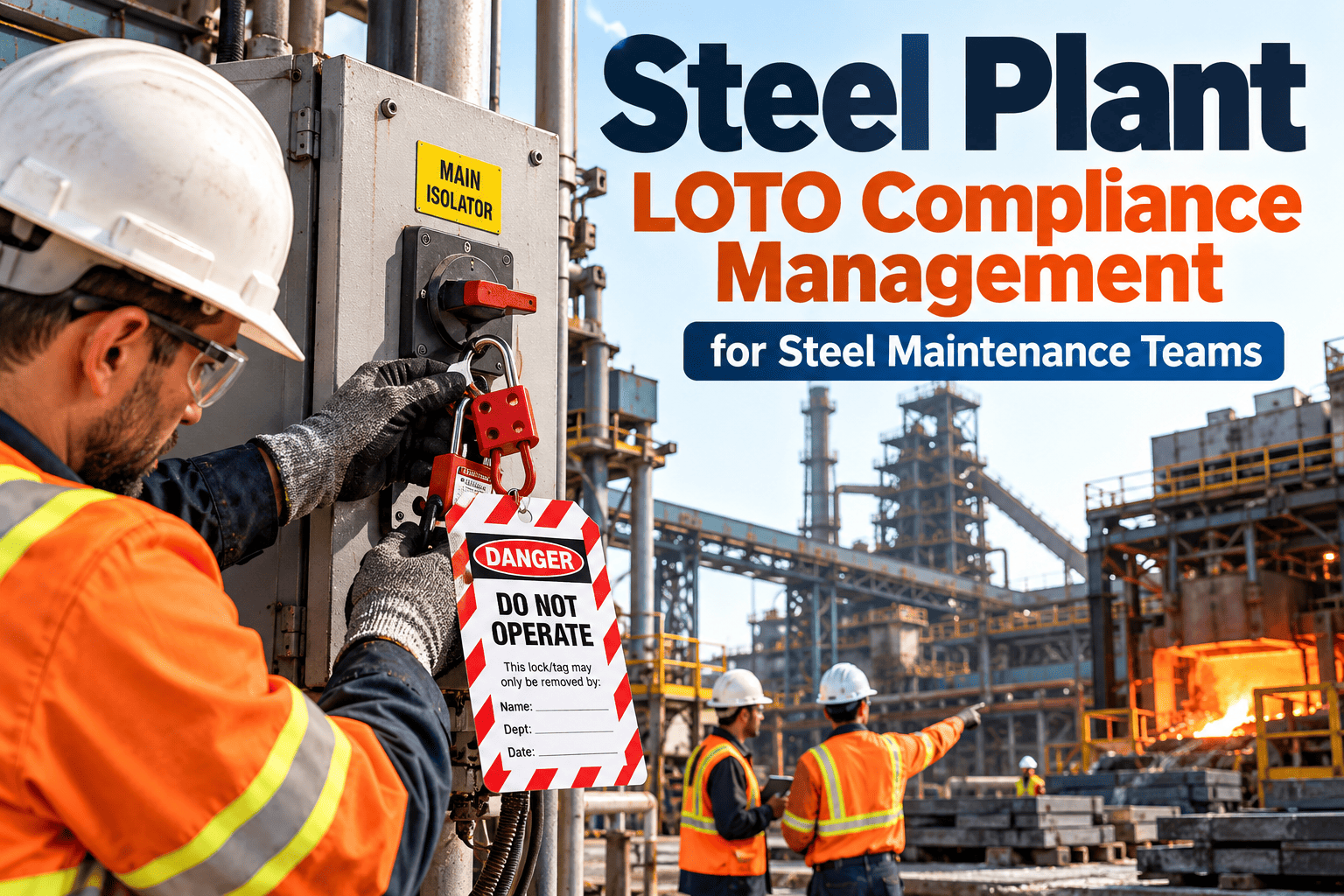
A steel plant does not have one lockout program, it has hundreds stacked together: furnace transformers, mill drives, crane main switches, gas mains, hydraulic power packs and conveyors, each with its own isolation points. Compliance fails in the gaps between them, in a generic procedure copied across machines, an annual inspection that quietly slips, or a lock left on at shift change. This guide shows how maintenance and EHS leaders can keep procedures, group lockout, periodic inspections, training and audit records under control, and how steel plant CMMS software from Oxmaint turns each of those duties into scheduled, recorded work.
Steel Plant LOTO Compliance Management for Steel Maintenance Teams
Lockout/tagout compliance in a steel mill is a scheduling, evidence and handover problem as much as a safety problem. Oxmaint maintenance management software can be configured to hold each energy control procedure against its asset, spread annual periodic inspections across the year, track who inspected what, and keep the certification record ready for any audit.
Why LOTO Compliance Breaks at Steel Plant Scale
A small shop can run lockout from a binder. A mill cannot. A single hot strip line can have thousands of isolation points across electrical, hydraulic, pneumatic, gas and water systems, worked by in-house crews and contractors across rotating shifts. The standard asks for the same four things everywhere, and each one needs a home in your maintenance system.
The pattern behind most program failures is that these four duties live in four places: a procedure library, a stores cabinet, an annual spreadsheet and a training matrix. A CMMS gives them one asset-centred record, which is why it sits at the center of maintenance safety rather than beside it.
Energy Source Matrix for Steel Equipment
Steel equipment carries energy that does not disappear when the main breaker opens. Electrical supply ranges from 480V up to medium voltage, and the rest hides in oil, gas, springs, water and suspended weight. Use this matrix as a starting point for machine-specific procedures, then confirm each line with your own electrical, hydraulic and process engineers.
| Equipment | Energy sources to control | Isolation method | Verification |
|---|---|---|---|
| EAF transformers and hydraulics | High-voltage supply, electrode and roof hydraulics, tilt cylinders, cooling water, gravity on raised electrodes | Open and lock the furnace supply disconnect, isolate and lock hydraulic pumps, lower or mechanically block electrodes, roof and tilt | Confirm the supply is dead with the approved test method, check accumulator gauges at zero, try the controls from the pulpit |
| Rolling mill drives and roll gap | Main motor and drive supply, stored mechanical energy in the roll gap and screwdown, hydraulic AGC, lubrication | Lock out drive and motor control center feeders, relieve screwdown and hydraulic gap pressure, block or restrain rolls and loopers | Attempt a start at the local and remote stations, confirm roll movement is not possible, check gauges at zero |
| Overhead cranes, gravity and 1910.179 | Crane main switch, runway power, trolley and hoist drives, suspended loads, ladles and tongs under gravity | Position the crane in a safe location, set down or block the load, open and lock the main switch before preventive maintenance as 1910.179 requires | Try the pendant or cab controls, confirm the hook and load are supported, apply rail stops where adjacent cranes share the runway |
| Gas and water utilities | Blast furnace gas, coke oven gas, natural gas, nitrogen, oxygen, cooling and descaling water at pressure | Close and lock isolation valves, install blanks or double block and bleed where the procedure specifies, depressurize and drain | Verify zero pressure at the bleed point, gas test where toxic or flammable gas could remain, link to the permit where confined space applies |
| Conveyors and hoppers | Motor supply, belt tension and takeup, material load in chutes and hoppers, pull-cord and brake systems | Lock out the drive at the motor control center, release takeup tension, clear or support material in hoppers and chutes | Try start from local and remote stations, confirm the belt and takeup are stationary, check the hopper gate cannot move |
| Hydraulic accumulators | Stored fluid and gas pre-charge pressure that persists after pumps stop | Isolate the pump, open the manual dump or bleed valve, lock the accumulator isolation valve in the safe position | Read the pressure gauge to zero, crack a test point if the procedure requires it, confirm cylinders cannot move |
Each row is a pattern, not a procedure. A real procedure names the exact disconnect, valve tag number and gauge for that machine, which is why the procedure belongs on the asset record and not in a generic folder.
Group Lockout and Shift Handover
Steel outages involve crews from mechanical, electrical, hydraulics, operations and contractors working on the same line at the same time. Group lockout keeps that manageable, but only if the handover is controlled just as tightly as the isolation.
- An authorized lead isolates the equipment and applies locks to the energy-isolating devices
- Keys go into a group lock box so the isolation cannot be undone while the box is locked
- Each worker applies a personal lock to the group device before starting work
- No one removes another worker's lock, and the box is only opened when every personal lock is off
- Contractors apply their own locks under the same procedure, not a parallel one
- Shift and personnel changes require an orderly transfer of lockout protection
- The outgoing worker briefs the incoming worker on status, remaining energy and open steps
- The incoming worker applies a personal lock before the outgoing lock is removed
- The handover is recorded against the work order, with time, names and the isolation state
- Unresolved locks at end of shift are escalated, never cut off without authorization
In a CMMS, the isolation work order carries the group lock owner, the list of personal locks applied and the handover entries. A supervisor opening the job at 06:00 sees who holds protection, instead of reconstructing it from a whiteboard.
Where LOTO Meets Permit to Work and Confined Space
Lockout is one layer of a wider permit system. Match the permit to the hazard, not the trade: a job that looks like one task can need several controls at once. The permit does not replace isolation, and HSE guidance is clear that issuing a permit does not by itself make a job safe. The precautions it references must actually be in place.
The practical link is simple. The permit references the isolation, and the isolation work order references the permit. When both live in the same system, a gas main job with a welding step and a vessel entry shows its isolation certificate, permit and lock list together.
Put every isolation, procedure and inspection on the asset.
See how a CMMS can hold energy control procedures, schedule periodic inspections and keep lock records beside the work order for each steel plant asset.
The 12-Month Periodic Inspection Timeline
Section (c)(6) requires each energy control procedure to be inspected at least annually, by an authorized employee other than the one using the procedure. Plants that leave this to the last quarter end up with a rush of sign-offs. A CMMS can be configured to spread the inspections evenly, balancing procedures by area and inspectors by availability.
The sequence above is an example. Order it around your own outage calendar, and set the interval shorter than a year wherever risk or equipment change justifies it. The annual requirement is a minimum.
What the Inspector Actually Does
- Observe a representative sample of authorized employees servicing equipment with the procedure
- Review responsibilities under the procedure with each authorized employee
- For tagout, extend the review to affected employees
- Check the procedure text matches the isolation points actually on the machine
- An inspection work order per procedure with a mobile checklist
- A rule that the inspector cannot be the primary procedure user
- Photo and note capture at the machine, tied to the asset
- Automatic overdue flags and reassignment when an inspector is absent
NIOSH publication 2022-106 gives best practice for conducting the periodic inspection for each procedure and is a useful reference when writing the checklist.
Common LOTO Program Failures, Root Causes and CMMS Controls
Most findings repeat. They come from weak systems, not careless people, and each has a control that can be built into routine maintenance work.
| Failure | Typical root cause | CMMS control |
|---|---|---|
| Generic procedures | One template reused across dissimilar machines, so isolation points and stored energy are not specific | Procedure attached to each asset, with required fields for energy sources, isolation devices and verification step |
| Missing periodic inspection | Annual inspection tracked on a personal spreadsheet and forgotten as production pressure rises | Recurring inspection work orders per procedure, spread across months, with overdue dashboards |
| Shared locks | Crews hang one lock for the whole team to save time or because personal locks are short | Isolation work order lists each person's lock, and group lock box steps are mandatory checklist items |
| Skipped try-out | Verification treated as optional once the lock is on, especially on remote or hot equipment | Verification step cannot be closed without a recorded result, name and time |
| Contractor and shift handover gaps | Outgoing crews leave without briefing, and outside crews follow a different practice | Handover entries logged on the job, contractor locks and permits recorded under the same work order |
| Stale procedures after equipment change | Modification closes without a link back to the energy control procedure | Change work orders trigger a procedure review task, and the affected procedure shows as due for re-inspection |
A public Department of Labor release from December 2014 on a US steel operation included a repeated violation for failure to conduct periodic inspections and develop procedures for a shear. It is a reminder that these two basics, procedures and inspections, are where steel operations are most exposed.
The Audit Evidence Pack
Under (c)(6)(ii) the employer certifies that the periodic inspection was done. The certification record includes four elements, and a CMMS can be configured to capture all of them automatically as the inspection work order closes.
What a Complete Evidence Pack Holds
- Current energy control procedure for each asset, with revision history
- Completed periodic inspection record with the four required elements
- Training and retraining records for authorized and affected employees
- Lock and tag issue records and group lock box logs
- Isolation work orders with verification results and handover entries
- Contractor induction and lock-application records
- Findings raised from inspections, with corrective work orders and closure dates
- Links to related permits for confined space and hot work jobs
With records on the asset, an auditor request for the shear procedure and its last inspection becomes a single search instead of a day of digging.
Measuring LOTO Compliance Without Inventing Targets
Set targets from your own baseline and your governing standard. Track simple ratios first, and read them by area rather than as one plant average.
How Oxmaint Fits Into the LOTO Workflow
Oxmaint is maintenance management software with an asset register, work orders, PM scheduling, inspection checklists and a compliance audit trail. For LOTO, these generic capabilities can be configured into one flow.
Digital inspection also helps knowledge management. Procedures, photos and inspector observations stay with the asset, so lessons from one mill reach the next shift and the next site. It sits naturally beside steel plant predictive maintenance and equipment reliability work, because the same asset hierarchy and clean work order history support both. The best CMMS for steel plants is the one your crews will actually use at the machine, so mobile ease and a clear asset structure matter more than a long feature list.
Frequently Asked Questions
Make Every Lock, Inspection and Record Easy to Prove.
Give your steel maintenance teams one place for energy control procedures, annual periodic inspections, group lockout records and audit evidence, so compliance becomes routine work instead of a yearly scramble.