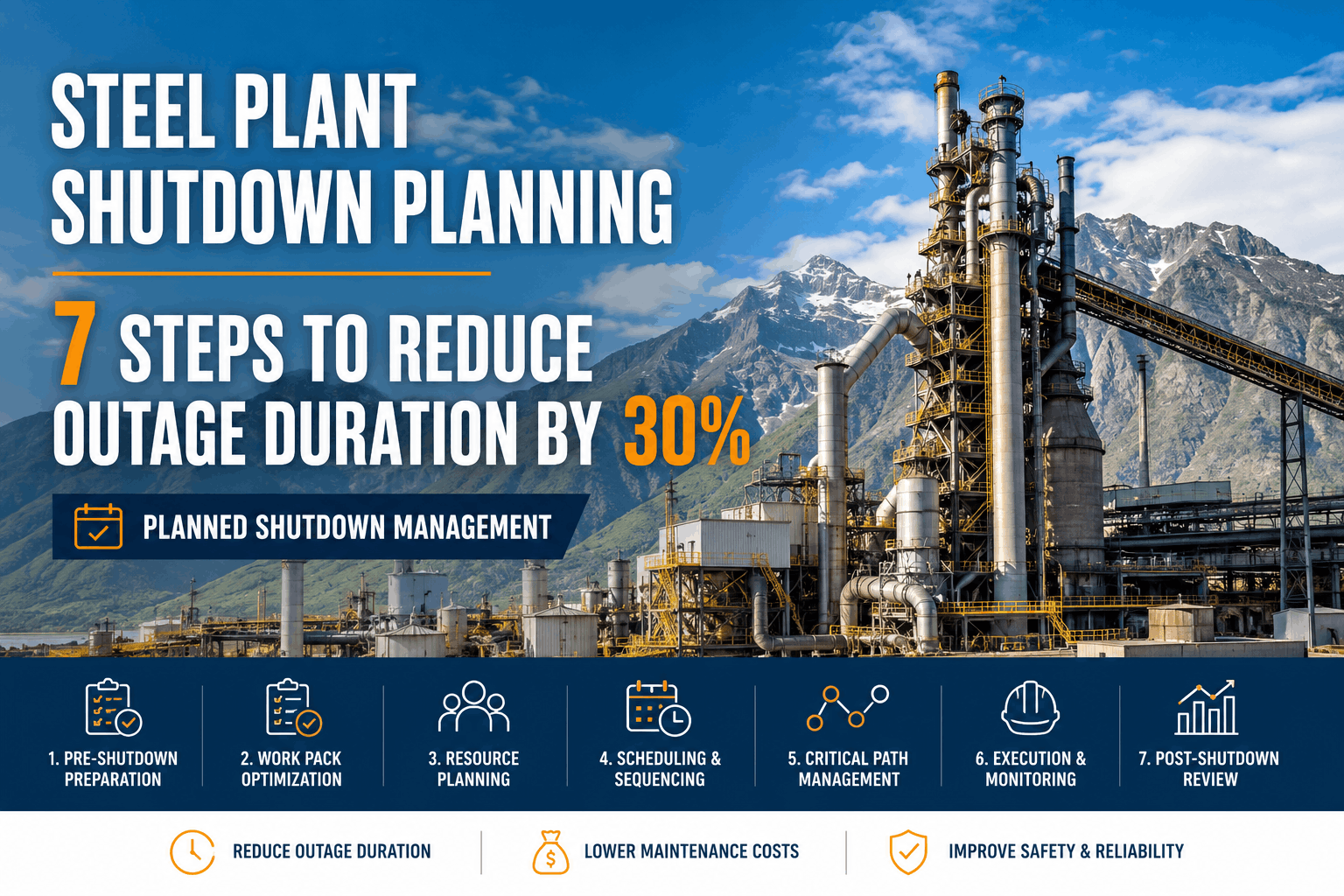
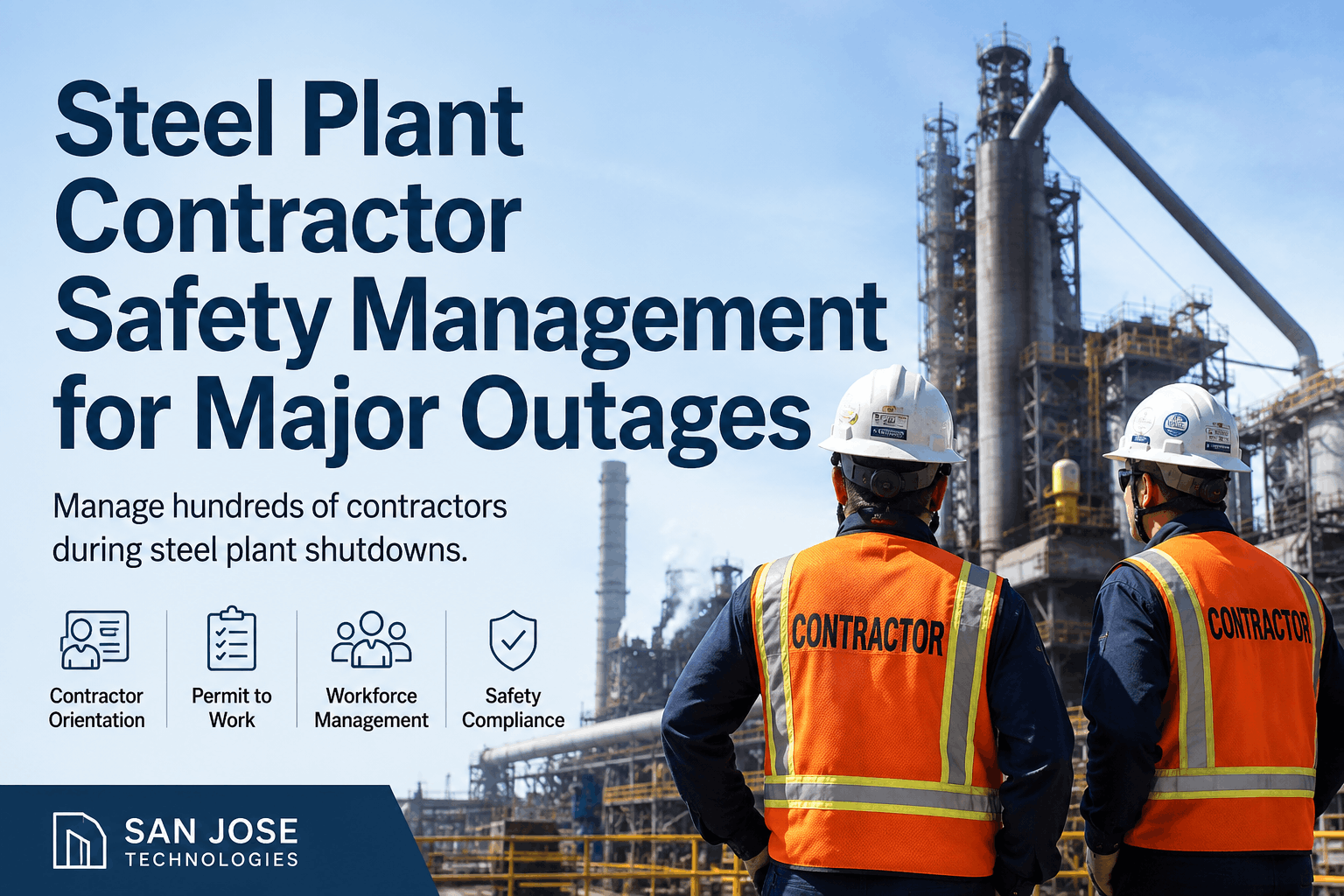
A steel plant annual shutdown is not a maintenance event — it is a production-critical project where every unplanned extra day costs between $1.2M and $3.5M in lost output, and where 70% of turnarounds globally still run over schedule and over budget. The difference between a shutdown that delivers full value and one that overruns by weeks comes down entirely to planning discipline, scope control, and real-time execution tracking. This guide covers every phase — from scope freeze 16 weeks out to post-shutdown review — and shows exactly how Oxmaint's Shutdown Module connects planning, work orders, contractor coordination, and documentation into a single controlled system.
Industry Reality Check
The Stakes Behind Every Steel Plant Shutdown
$500K+
Average cost per hour of unplanned blast furnace downtime — steel & metallurgy sector
70%
of turnaround projects globally run over schedule and over budget without structured management
500–2,000
Individual work orders in a typical intermediate blast furnace shutdown — without CMMS, managed by radio and whiteboard
30%
Shorter shutdown durations reported by plants using digital work order tracking versus paper-based coordination
Shutdown Framework
The 6-Phase Steel Plant Turnaround Model
Each phase has a defined owner, defined deliverables, and a defined gate before the next phase begins. Skipping or compressing any phase does not save time — it transfers that time into overruns during execution, when every hour costs the most.
01
Scope Definition & Freeze 16–12 weeks out
Every task enters the shutdown scope through a formal work order request — inspections due, deferred PMs, capital projects, and condition-based findings from predictive monitoring. The scope freeze date is non-negotiable: changes after freeze trigger formal change control with cost and schedule impact documented. Uncontrolled scope creep is the single leading cause of turnaround overruns.
Scope Register
Work Order Classification
Change Control Gate
02
Resource & Contractor Mobilization 12–8 weeks out
Contractor selection and mobilization planning begins immediately after scope freeze. Each contractor receives a digital work package — their assigned tasks, sequence dependencies, permit requirements, and site safety induction documentation. Material and spare parts procurement runs in parallel: long-lead items for blast furnace refractory, converter linings, and rotating machinery must be confirmed before Week 8 to avoid delivery risk during execution.
Contractor Portal Access
Work Package Distribution
Parts Procurement Tracking
03
Critical Path Scheduling 8–4 weeks out
Every task in the shutdown scope maps to the critical path: the longest dependent chain from first shutdown step to plant restart. Tasks on the critical path receive dedicated resource commitment and daily progress review. Tasks off the critical path are sequenced to use available windows without creating new constraints. In a typical steel plant shutdown, blast furnace reline sequences, converter vessel relining, and reheating furnace refractory work dominate the critical path.
Critical Path Mapping
Task Dependency Logic
Resource Leveling
04
Safety & Permit Preparation 4–1 weeks out
Every shutdown work order carries its safety permit requirements as a dependency — no task starts without the correct permit in place. Pre-shutdown permit preparation includes energy isolation registers (LOTO), confined space entry permits for vessels and ducts, hot work permits for welding and cutting near gas lines, and radiation work permits for NDT teams. A steel plant shutdown concentrates 150–400 personnel into a restricted area simultaneously — permit gaps at this density have catastrophic consequences.
LOTO Register
Confined Space Permits
Hot Work Authorization
05
Execution & Real-Time Tracking Shutdown days
Execution is where plans meet reality. Every work order progresses through a digital status — assigned, in progress, quality hold, complete — visible in real time to the shift turnover coordinator. Daily progress against the critical path is reviewed at a morning standup with every contractor supervisor present. Scope additions discovered during execution (vessel inspections revealing unexpected wear, for example) enter the change control process with immediate cost and schedule impact assessment before the work begins.
Live Work Order Dashboard
Shift Handover Logs
Scope Change Management
06
Restart, Commissioning & Post-Shutdown Review Final phase
Restart follows a controlled commissioning sequence — systems energized in order, each step signed off before the next begins. The post-shutdown review captures every overrun, scope change, near-miss, and contractor performance rating while the data is fresh. This documentation becomes the planning baseline for the next shutdown: work orders that were added after scope freeze become candidates for early inclusion next cycle, and tasks that revealed more work than estimated are re-scoped with accurate hours for next time.
Commissioning Checklist
Lessons Learned Register
Next Cycle Baseline
Scope Management
Steel Plant Shutdown Scope: Equipment Priority by Risk
| Equipment Area |
Typical Shutdown Tasks |
Downtime Cost If Deferred |
Shutdown Priority |
| Blast Furnace |
Refractory inspection, tuyere replacement, stave cooling check, burden equipment overhaul |
$1.2M–$3.5M per day unplanned |
Critical |
| BOF / Converter |
Vessel lining inspection & repair, lance maintenance, trunnion bearing check, gas recovery system |
$500K–$1.2M per day |
Critical |
| Reheating Furnace |
Refractory relining, burner overhaul, walking beam inspection, recuperator cleaning |
$300K–$800K per day |
High |
| Continuous Caster |
Mold copper replacement, strand guide roll inspection, oscillation system service, cooling nozzle cleaning |
$400K–$900K per day |
High |
| Rolling Mill |
Roll change, bearing replacement, coiler mandrel inspection, descaler nozzle cleaning, hydraulic system overhaul |
$200K–$600K per day |
High |
| Coke Oven Battery |
Door frame lapping, oven wall inspection, ascension pipe replacement, heating flue cleaning |
$150K–$400K per day |
Moderate |
| Gas Cleaning & Handling |
Electrostatic precipitator inspection, gas holder inspection, compressor overhaul, gas pipe integrity check |
Regulatory + $100K–$300K |
Moderate |
Plan Your Next Shutdown in Oxmaint
Every Work Order, Every Contractor, Every Permit — In One Dashboard
Oxmaint's Shutdown Module manages task sequencing, contractor portal access, critical path tracking, permit dependencies, and real-time progress from every work face. Plants report up to 30% shorter shutdown durations vs. paper-based coordination.
Contractor Management
Managing 150–400 Contractors Without Losing Control
Paper-Based Coordination
Oxmaint Shutdown Module
Work packages distributed as printed documents — version control is manual, update distribution is unreliable
Digital work packages via contractor portal — every update distributed instantly, always on the latest revision
Permit status tracked on whiteboards and shift logs — gaps discovered after work has already started
Permit dependencies block work order start — no task progresses without the correct permit confirmed in the system
Progress reported verbally at morning meetings — actual vs. planned gap only visible once per day
Live work order status visible to shift coordinator in real time — critical path slippage flagged automatically
Scope additions added verbally or on paper — cost and schedule impact calculated after the shutdown
Change control workflow captures scope additions with cost and schedule impact before work begins
Contractor performance recorded informally — no structured basis for next-cycle selection decisions
Contractor performance rated per work package — documented record feeds procurement decisions for next shutdown
Cost Control
Shutdown Cost Structure: Where Overruns Hide
1
Scope Creep
Work added after freeze without formal change control is the largest single driver of cost overruns. Every undocumented addition extends the schedule and consumes contingency budgets silently.
2
Material Delays
Long-lead refractory bricks, custom gaskets, and OEM spare parts ordered too late cause critical path delays. A single missing component can hold 40 personnel idle on the critical path.
3
Permit Gaps
Waiting for energy isolation sign-off, confined space entry authorization, or hot work permits during execution hours wastes more time than almost any technical problem. Every permit gap is a planning failure.
4
Discovered Work
Inspections that reveal unexpected refractory damage, corroded structural members, or degraded equipment beyond scope are inevitable. The response time and resource availability when discovered determines cost impact.
5
Restart Failures
Rushed commissioning sequences that miss quality checkpoints create post-restart failures within days — often requiring a second, unplanned outage more expensive than the original shutdown extension would have been.
6
Knowledge Gaps
35% of blast furnace maintenance specialists will retire within five years. Shutdowns managed through verbal knowledge and informal coordination become progressively more expensive as that institutional knowledge leaves.
Expert Review
What Turnaround Leaders Are Saying
"We had been running shutdowns from spreadsheets and radio communication for fifteen years. When we moved to Oxmaint, the first thing that changed was not the technology — it was the conversation in the morning standup. For the first time, everyone in the room was looking at the same data. The shift coordinator knew exactly which tasks were behind on the critical path before the contractors even arrived on site. Our next shutdown came in 4 days under the planned duration. For us, at $1.8M per day of lost production, that was the business case on its own."
Turnaround Manager
Integrated Steel Plant — Blast Furnace + BOF + Rolling Mill
Frequently Asked Questions
Steel Plant Shutdown Planning — Common Questions
How far in advance should a steel plant begin shutdown planning?
Best practice for a major steel plant shutdown starts 16 weeks before the planned start date — with scope collection opening immediately and a hard scope freeze at Week 12. Planning earlier than 16 weeks improves long-lead material procurement and contractor availability, particularly for specialized refractory crews, non-destructive testing teams, and OEM service engineers. Plants that begin planning less than 8 weeks out consistently experience material delivery risk and contractor quality compromise, both of which are leading contributors to overruns.
Start a free Oxmaint trial and build your shutdown scope register from day one.
What is the biggest cause of steel plant shutdown cost overruns?
Uncontrolled scope creep after the freeze date is consistently the largest driver of overruns — ahead of material delays, contractor performance issues, and discovered defects. Work added verbally or informally after scope freeze has no documented cost or schedule impact, so the overrun only becomes visible after the shutdown ends. The second leading cause is permit gaps during execution: waiting for LOTO sign-offs, confined space authorization, or hot work permits in a 150–400 person workforce can hold critical path work idle for hours. A formal change control process and permit dependency tracking in a CMMS eliminates both.
Book a demo to see how Oxmaint manages scope change and permit control during execution.
How does CMMS improve shutdown duration versus paper-based management?
Digital shutdown management reduces duration through three mechanisms: permit dependency enforcement ensures no task waits for manual sign-off chasing; real-time work order status makes critical path slippage visible hours earlier than daily shift reports; and digital shift handovers eliminate the verbal communication gaps where tasks fall between shifts. Plants using Oxmaint's Shutdown Module report up to 30% shorter planned shutdown durations compared to paper and whiteboard coordination. For a plant with $1.8M daily production loss, a 2-day reduction in duration recovers $3.6M — more than the total platform cost for multiple years.
See the shutdown tracking dashboard in your free Oxmaint trial.
How should steel plants handle work discovered during shutdown that was not in the original scope?
Every discovered work item must go through a formal change control process before resources are mobilized — not after. The change request documents the task description, estimated labor hours, material requirements, cost impact, and schedule impact on the critical path. The shutdown manager approves or defers the work based on risk, cost, and schedule constraints. Approving undocumented work verbally is how shutdowns accumulate $500K–$2M of uncontrolled additions that only appear on the final cost reconciliation. Oxmaint's change control workflow captures this automatically with a mobile-friendly submission process.
Book a demo to see the change control workflow configured for steel plant shutdowns.
What documentation should a steel plant retain after each shutdown?
Post-shutdown documentation must include: all work orders with as-found and as-left condition records; the complete cost vs. budget reconciliation with variance explanations; contractor performance ratings per work package; all safety incidents and near-misses with root cause analysis; scope change register showing every post-freeze addition with its cost and schedule impact; and a lessons-learned register with specific actions for the next cycle. This documentation is also the planning baseline for the next shutdown — work orders added after freeze become early-stage candidates for next cycle, and tasks with underestimated hours are re-scoped with accurate data. Oxmaint exports the full audit trail for management and compliance reporting in under 4 hours.
Start your free trial to see the shutdown documentation and export format.
Oxmaint Shutdown Module
Run Your Next Steel Plant Shutdown in a Single Controlled System
Task sequencing. Contractor portal. Permit dependencies. Real-time critical path. Scope change control. Post-shutdown audit export. Everything a steel plant shutdown needs — connected, tracked, and documented from scope freeze to restart sign-off.