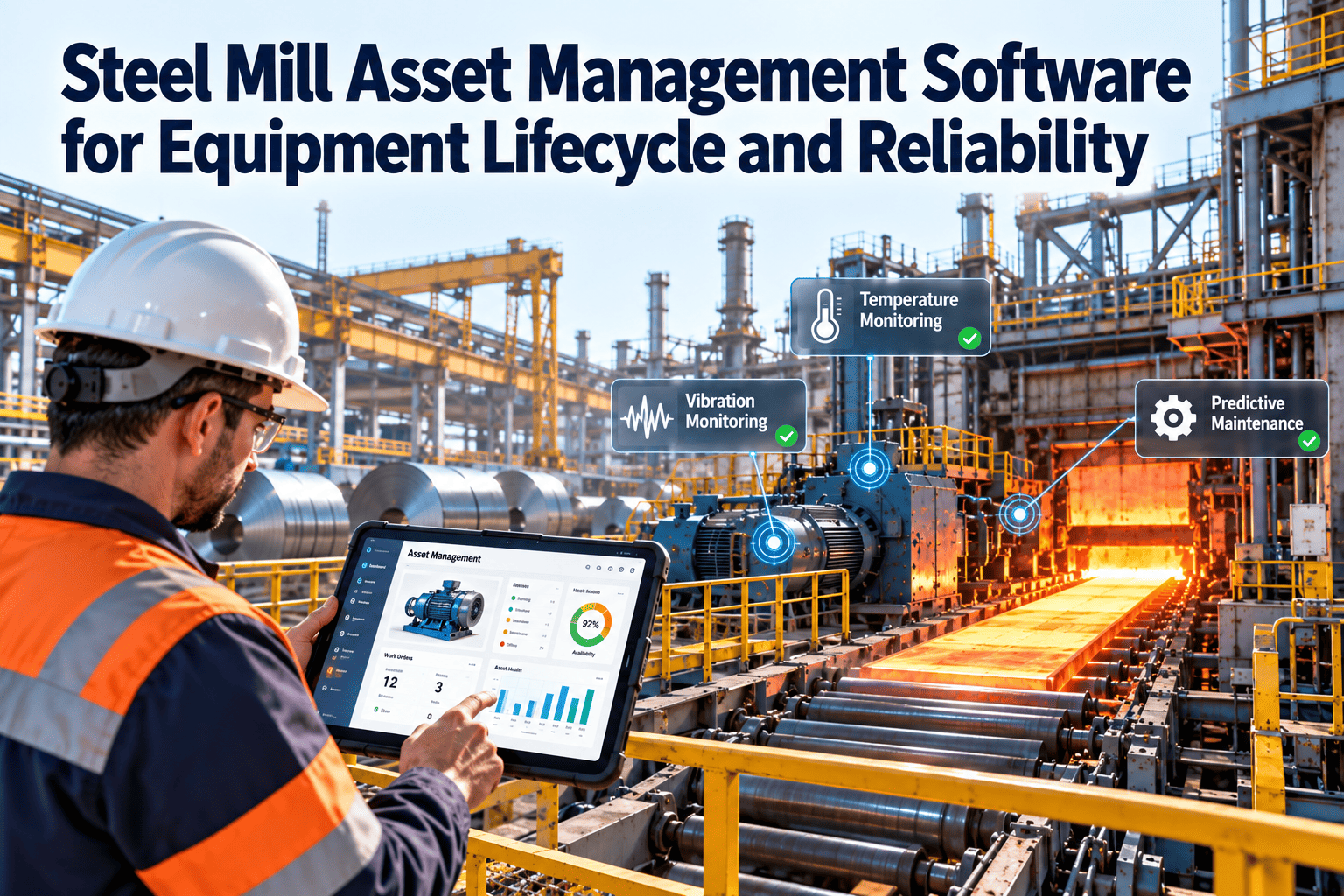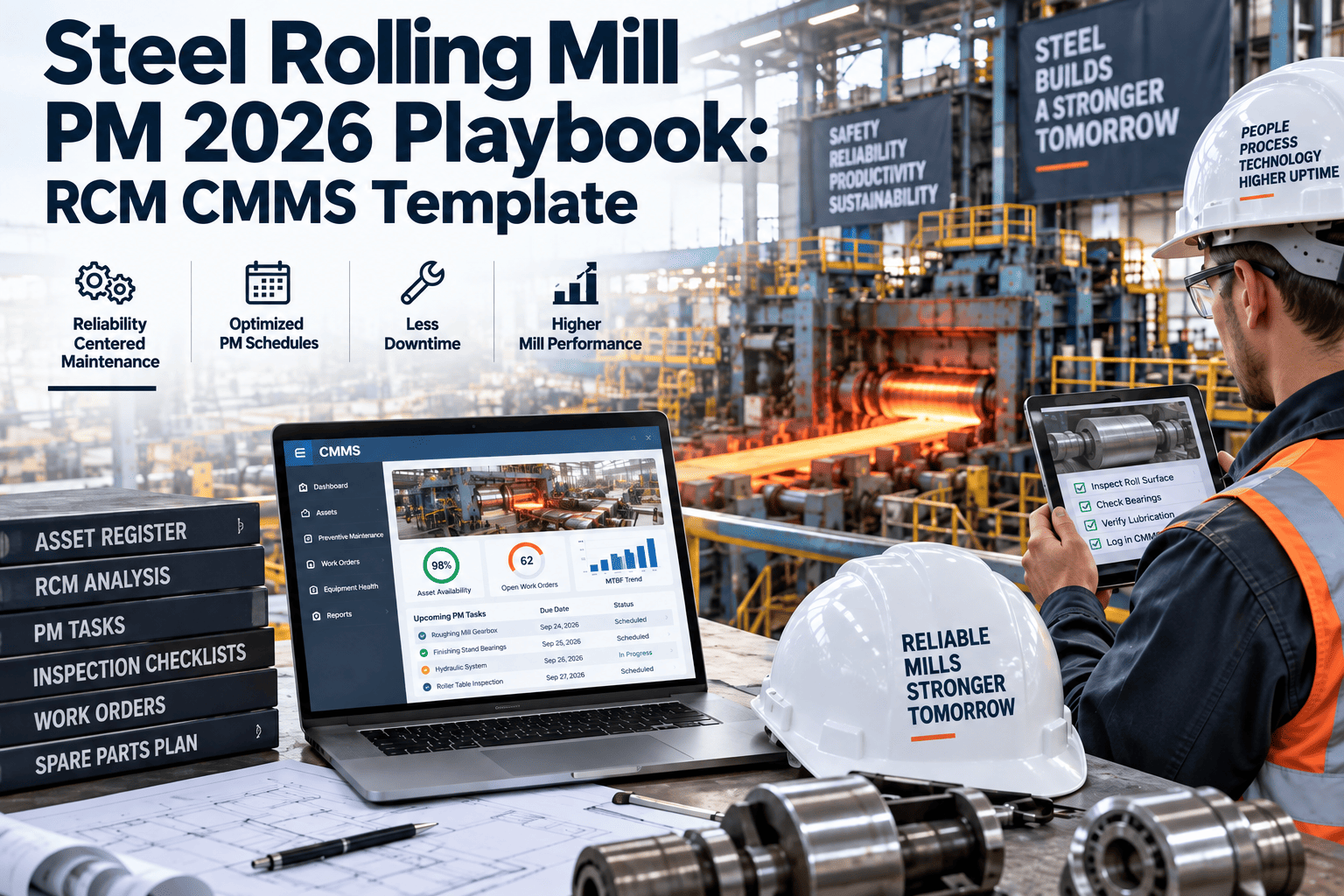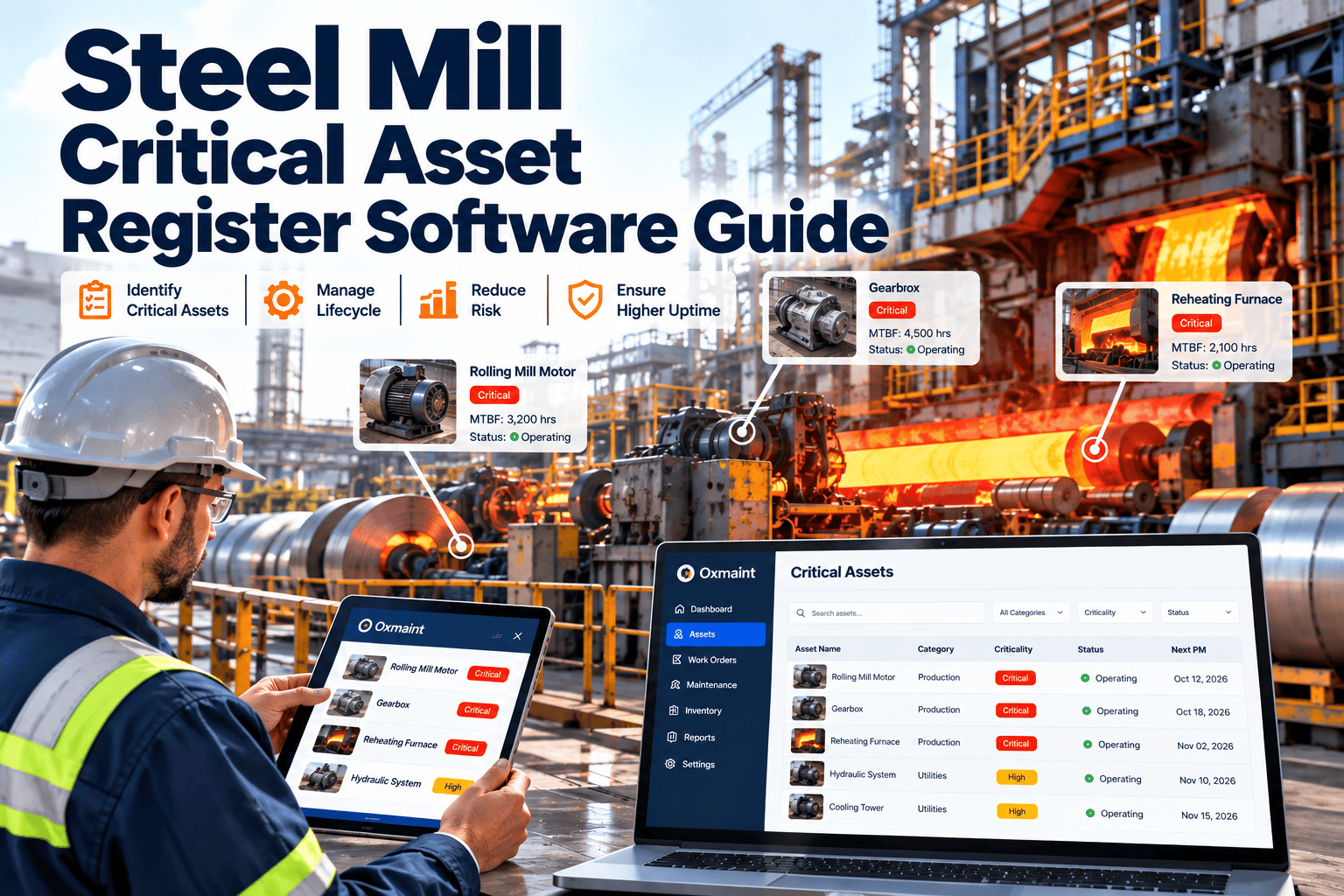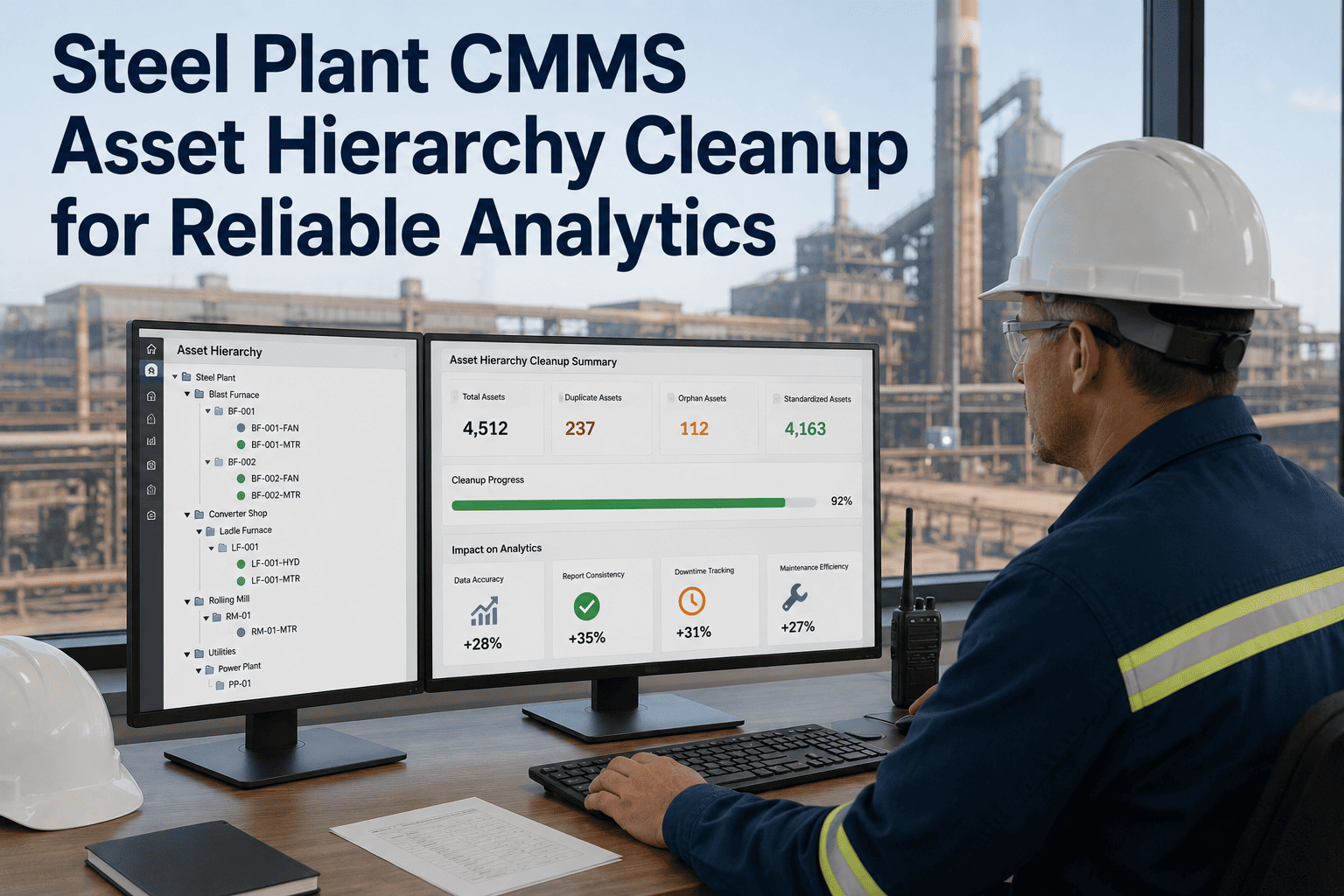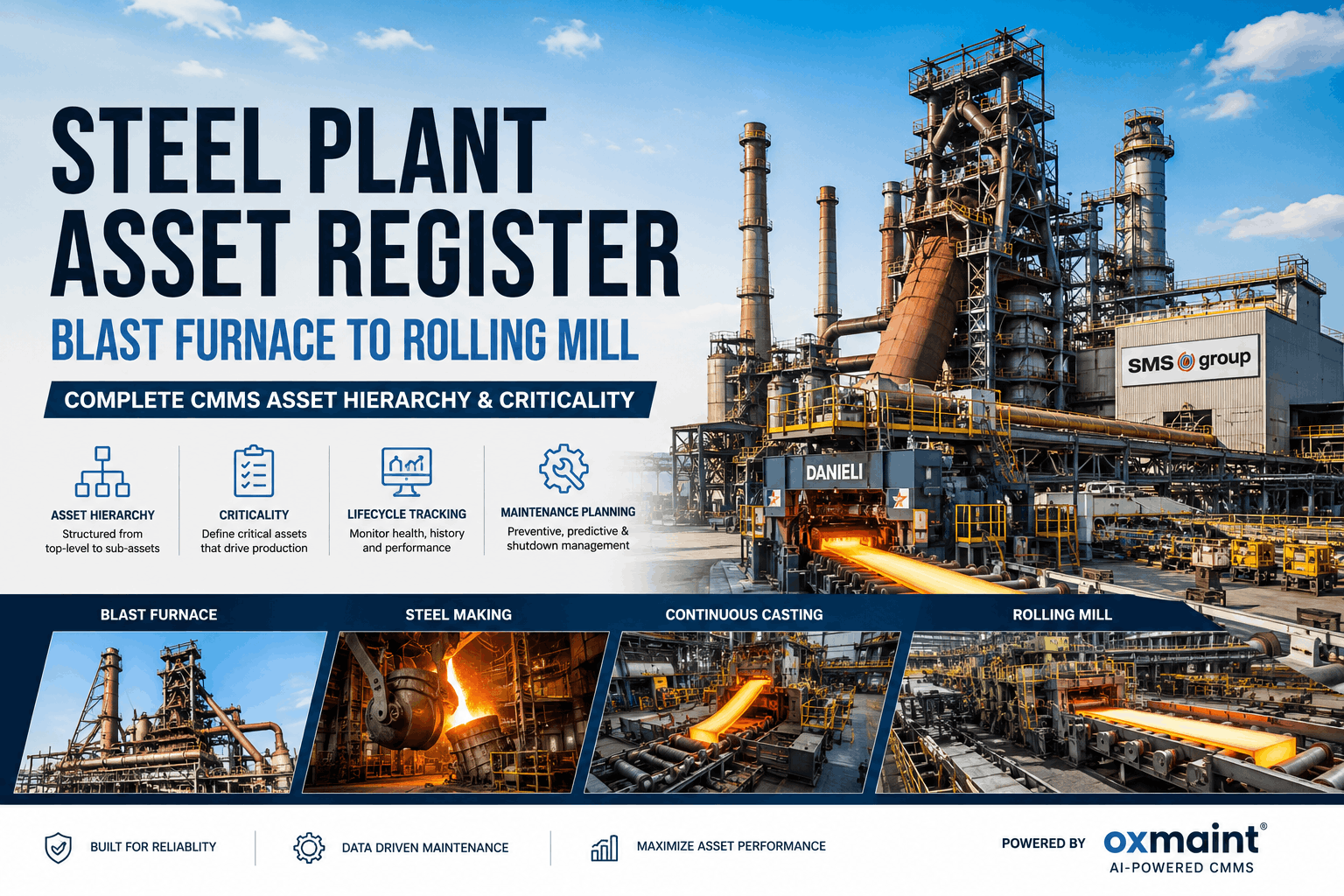
A steel plant asset register is not a flat list of equipment. A blast furnace is a 500-million-dollar asset consisting of staves, cooling circuits, tuyere positions, tap holes, hot blast stoves, and the gas cleaning plant — each a maintainable sub-asset with its own lifecycle and criticality. A rolling mill is not a single asset; it is roughing stands, intermediate stands, finishing stands, coilers, hydraulic packs, and drive train components. Continuous casting combines mold oscillation systems, segment drives, spray cooling, torch cut-off, and strand guides. The only CMMS worth implementing in a steel plant is one that supports deep asset nesting — 4–6 levels of sub-component hierarchy — so that each maintainable unit is tracked against its own PM schedule, criticality classification, and failure history. Most platforms collapse this hierarchy into spreadsheet rows, destroying the ability to track individual tuyere positions or rolling mill stand bearings against their specific wear patterns and replacement cycles. Sign Up Free to build your steel plant asset register in OxMaint with multi-zone hierarchy, criticality profiling, and lifecycle tracking that matches the complexity your plant operates at.
Why Generic Asset Management Fails for Steel Plants
A typical facilities management CMMS tracks assets as a flat list: Pump 001, Motor 002, Conveyor 003. This design works for buildings and light manufacturing. In a steel plant, this approach is catastrophic. When you log "Blast Furnace A cooler failure" without specifying which cooling circuit, which stave position, and which specific cooler tube, you lose the ability to track degradation patterns specific to that cooling location. After the repair, you cannot tell if this cooler tube failure is part of a recurring failure mode affecting the entire stave circuit (early reline risk) or an isolated component issue. You cannot predict whether to schedule tube replacement at the next major maintenance window or if cooler circuit redesign is needed. The data collapses into "cooler failures: 7 this year," which means nothing for maintenance strategy. Book a Demo to see how OxMaint's multi-zone asset hierarchy preserves the location and sub-component specificity that makes steel plant maintenance data actionable.
Building a Steel Plant Asset Register: Structure and Criticality Framework
A properly structured asset register begins with production zones (Blast Furnace, Steelmaking, Casting, Hot Rolling, Cold Rolling, Utilities) and nests down to specific equipment groups, individual assets, and sub-components. Each asset record includes criticality classification — safety-critical (A), production-critical (B), or standard (C) — that determines PM frequency, parts stocking strategy, and dispatch priority. Sign Up Free to implement OxMaint's pre-built steel plant asset taxonomy, which eliminates the engineering effort of designing asset hierarchy from scratch.
Blast Furnace Asset Nesting: Staves to Sub-Zones
Parent: Blast Furnace / Child zones: Shaft zone, Belly zone, Hearth zone / Sub-children: Individual stave circuits (North-1, North-2, etc.) with cooling flow and temperature data per position / Leaf components: Individual tuyeres, tap hole equipment, hot blast stove valve sets, each tracked against design life and heat count. Shell thermocouples and stave wear measurements feed per-position degradation curves, enabling prediction of reline timing 12+ months ahead rather than surprises during campaign.
Steelmaking Vessel Tracking: BOF, EAF, Ladle Structure
Parent: Steelmaking / Children: BOF Vessel, EAF Vessel, Ladle Furnace, Tundish / Sub-children: Vessel lining (tracked on heat count), tilting drive, oxygen lance, stirring systems, alloy handling subsystems, magnetic stirring. Each vessel tracks refractory lining status independently — lining thickness trends, heat count accumulation, tramp element trends per vessel per campaign. Heat count limits trigger planned reline campaigns months ahead of predicted breakdown.
Continuous Caster Multi-Level Structure
Parent: Continuous Caster / Children: Mold assembly, strand guide, spray cooling, torch cut-off, runout table / Sub-children: Mold oscillation drive, mold powder distribution, segment positioning actuators, segment segment cooling circuits, spray nozzles (200+ per caster), cut-off consumables, guide roll position actuators. Caster maintenance combines high-frequency replacements (spray nozzles monthly, torch cartridges per 200 sequences) with critical structural reliability requiring bearing and hydraulic system discipline across hundreds of precision positioning points.
Rolling Mill Stand Structure and Drive Train
Parent: Hot Strip Mill / Children: Roughing Mill, Intermediate Mill, Finishing Mill / Sub-children: Stand-level: individual mill stands (Stand-1 through Stand-7 for roughing, finishing standup) with individual drive motors, bearings, and hydraulic load control. Drive-train level: motors, gearbox, hydraulic packs, cooling systems per stand. Bearing position level: roughing stand bearing 1–4 positions with vibration sensors, load profiles, lubrication schedules. Each bearing position tracked independently, MTBF trended separately, PM triggered by vibration signature changes.
Utility Systems: Compressors, Pumps, Electrical
Parent: Utilities / Children: Compressed air, cooling water circulation, hydraulic power units, electrical distribution / Sub-children: Main compressors, aftercoolers, drying systems; cooling towers, heat exchangers, circulation pumps per circuit; HPU motors, pumps, accumulators, pressure relief systems; transformers, switchgear, power factor correction. Utility assets feed production zones and are tracked for availability criticality — a cooling water pump failure that cascades into blast furnace downtimeerequires faster response than the same pump failure if it only affects space cooling.
Asset Register Implementation and Criticality Assignment
Building a complete steel plant asset register takes 4–8 weeks of structured effort. Most plants begin with production zone walkdowns, photographing and tagging equipment, building the asset list with maintenance and operations input. Once the physical asset list is built, assign criticality classifications: A (safety-critical, any failure could result in injury or death), B (production-critical, any failure stops output), C (standard, failure degrades output or increases cost but permits workaround). Use these classifications to drive PM frequency targets, spare parts stocking decisions, and labor dispatch priorities. Book a Demo to see how OxMaint streamlines asset registration using mobile guided workflows and photography integration.
Production Zone Walkdown and Physical Asset Tagging
Conduct facilitated walkdowns of each production zone with maintenance and operations subject matter experts. Identify all maintainable equipment, photograph each asset, record basic specifications (manufacturer, model, serial number, installation date), and assign a unique asset identifier. This step is data-intensive but foundational — it ensures your asset list reflects reality, not a five-year-old asset list that hasn't been updated since the last mill modification.
Asset Hierarchy Design and Criticality Classification
Using the physical asset list, design the parent-child hierarchy reflecting how your plant operates. Assign criticality: A assets (blast furnace cooling, BOF tilt drive, continuous caster drives) get 85%+ PM compliance targets and parts stocking for rapid response. B assets get 75%+ PM targets and standard parts availability. C assets are scheduled based on available labor and production windows. This classification drives everything downstream — scheduling, spare parts investment, labor allocation.
PM Template Design for Each Asset Type
For each major asset class (blast furnace cooling, rolling mill bearing, caster drive), design the PM work order template specifying what gets checked, measured, and recorded. Include threshold values — cooling water flow should be X gpm ±Y%, bearing temperature should be <80°C, spray nozzle orifice diameter should be Z mm. Build these thresholds into the digital PM form so technicians see whether they're within spec in real time, not three days later after manual analysis.
Sensor and Monitoring Point Registration
Identify where condition monitoring data lives — vibration sensors on mill bearing positions, thermocouples on blast furnace cooling circuits, oil particle count on hydraulic systems. Register each monitoring point as a child-level asset attribute in your CMMS. Link sensor data feeds to specific assets so that when a vibration sensor triggers an alert, the alert automatically creates a work order against the correct bearing position, not a generic "mill stand" asset.
Historical Maintenance Data Migration and Backlog Clearing
Migrate 2–3 years of historical work order data into OxMaint linked to the new asset hierarchy. This enables MTBF and MTTR baseline calculation on day-one. As work order history populates, clear deferred maintenance backlog over 8–12 weeks while protecting newly scheduled PM from compression. Historical data also provides the training foundation for AI pattern detection — the system learns what normal failure modes look like before you ask it to detect anomalies.
Frequently Asked Questions: Steel Plant Asset Registers
How deep should a blast furnace asset hierarchy go?
Minimum 5–6 levels: Plant > Blast Furnace > Zone (Shaft/Belly/Hearth) > Stave Circuit > Individual Tuyere/Cooler Position > Sub-component (cooling tube, valve, etc.). This depth enables tracking individual stave position thermal trends and tuyere position heat count — the specificity needed for campaign life prediction and reline planning.
Should equipment spares be registered as assets or inventory stock?
Refractory bricks, bearing sets, and hydraulic seals are consumables, not maintainable assets — track them in spare parts inventory linked to the parent asset. Refractory lining as a whole is an asset (tracked on heat count), but individual bricks are consumables. Rotating backup equipment (a spare rolling mill bearing) can be asset-tagged if it's high-value and tracked for condition before deployment.
How do you handle assets that were installed before good records existed?
Start with best-estimate installation date and serial number from equipment tags. Build asset records from equipment nameplates and maintenance history reconstruction. Historical work orders often contain installation references ("new pump installed Jan 2010") that help backfill missing specs. Once the asset is in the system, subsequent work order data increasingly accurate the installation record through activity history.
Can asset registers be updated after deployment without disrupting CMMS continuity?
Yes — OxMaint asset hierarchy can be modified, assets added, and criticality reclassified without affecting historical work order data. Typically, you'll discover missed assets and hierarchy improvements during the first 8–12 weeks of operation. These refinements are normal and expected — the structure becomes more accurate as it reflects operational reality more closely.
Should redundant or parallel equipment be tracked separately or combined?
Track redundant equipment separately (Cooler Circuit North-A and Cooler Circuit North-B, not "North Coolers"). This enables you to trend individual circuit MTBF, detect if one circuit is degrading faster, and identify whether failure patterns are asset-specific or systemic. Combining them masks the very pattern detection you need for predictive maintenance planning.