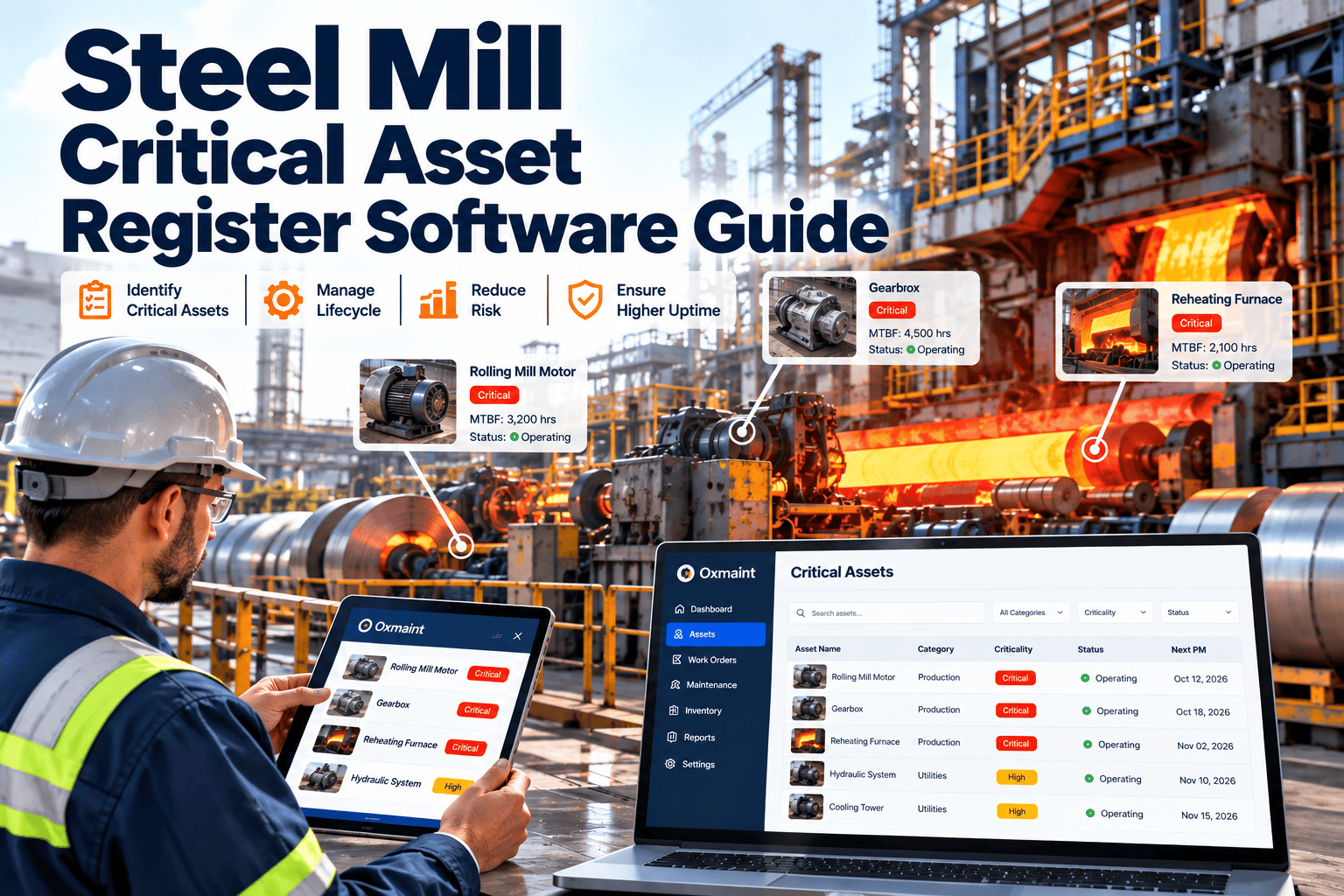
Ask a steel plant maintenance head how many assets they have, and the honest answer is usually "more than the CMMS says." A blast furnace is not one asset — it is 40-plus individual stave circuits and 20 to 40 tuyeres, each of which should be its own record with its own history. The gap between the list in the system and the equipment actually on the floor is where maintenance goes blind: work logged against the wrong "Pump #3," failure patterns hidden in noise, and a planned tuyere swap blocked because nobody tracked the 8-to-12-week spare lead time. Building the asset register — a structured, parent-child hierarchy of every maintainable asset, drilled down to the sub-asset and classified by criticality — is consistently the most underestimated task in a first CMMS implementation, and the one that determines whether everything built on top of it actually works. This guide covers how to build a steel plant asset register from blast furnace to rolling mill. Start a free Oxmaint trial with steel equipment hierarchies pre-built to the sub-asset level, or book a demo to see tuyere and caster-segment records with criticality tiers.
Steel · Asset Management · CMMS Hierarchy
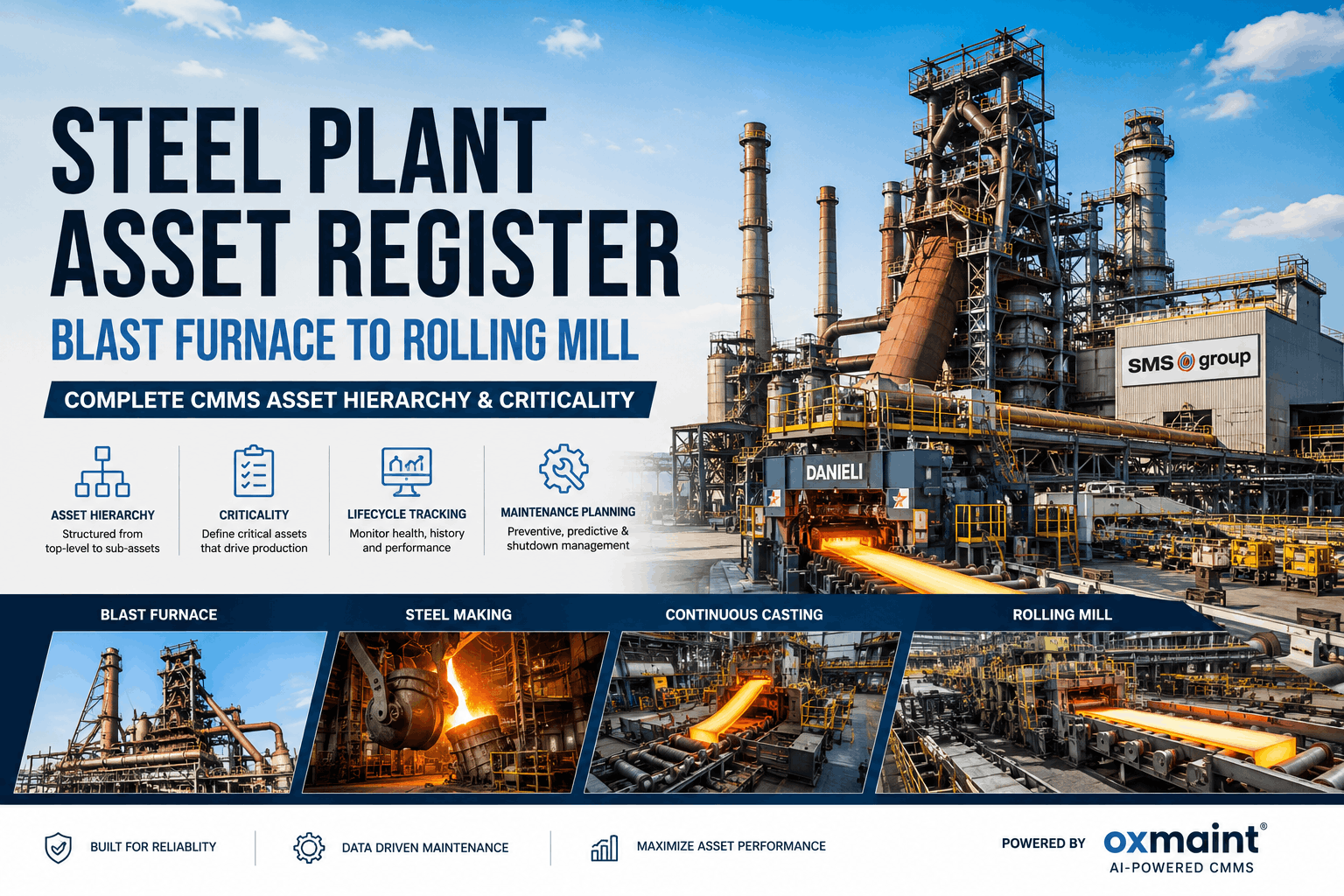
Steel Plant Asset Register: Blast Furnace to Rolling Mill
How to build a steel plant asset register in a CMMS — blast furnace tuyere sub-assets, caster segment records, rolling mill roll tracking, and the criticality classification that turns a flat list into a maintenance strategy.
-
40+
stave circuits in one blast furnace, each its own record
-
20–40
tuyeres tracked as individual assets per position
-
5
fields make a minimum viable asset record
-
4–5
hierarchy levels from plant down to component
The Drill-Down
One Furnace, Explodes Into Hundreds of Records
An asset register is a tree, not a list. Each level is parent to the one below, and each child belongs to exactly one parent. That structure is what lets a work order attach to the exact tuyere — not "the furnace" — and lets failure data roll up cleanly. Here is a steel plant drilled from plant level down to a single position.
- Level 1 · Plant Integrated Steel Works Rolls up total maintenance cost across every zone
- Level 2 · Zone Ironmaking — Blast Furnace No. 2 The $500M+ production area
- Level 3 · System Stave Cooling System The life-extension system for campaign duration
- Level 4 · Equipment Tuyere Assembly Managed as a set of individual units
- Level 5 · Sub-Asset / Position Tuyere Position 14 Its own install date, service hours, cooling history, and failure-mode class — outlet-temp trending flags failure 7–14 days ahead
Best practice keeps it navigable: use no more than 2–3 sub-levels under each asset, and follow an established taxonomy like ISO 14224 rather than inventing your own. Too deep is cumbersome; too flat destroys root-cause analysis. Book a demo to see the steel asset tree drilled to position level.
Where the Records Multiply
The Sub-Assets That Must Be Tracked by Position
Stopping at "blast furnace" or "caster" misses the failure-mode intelligence that lives one level down. In steel, the same equipment repeats across positions — and each position wears differently. These are the sub-assets that earn their own records.
-
Blast Furnace
40+ stave circuits, each with a zone ID and shift-level temperature-differential monitoring; 20–40 tuyeres per position with install date, service hours, and cooling performance.
-
Steelmaking (BOF)
Converter lining, oxygen lance, ladle and tundish refractory — each tracked against heat counts so lining-thickness projections drive planned relines.
-
Continuous Caster
Mold copper, oscillation mechanism, and strand-guide rolls tracked per segment — e.g. caster segment #4 spray-nozzle records, each on per-heat wear.
-
Rolling Mill
Rolls tracked per position and stand, bearings on vibration signature, chocks assessed at each roll change, liner wear logged per position against tonnage.
Component-level tracking is what reveals which specific part drives the majority of an asset's maintenance cost — intelligence that is structurally invisible in a flat list. Sign up for Oxmaint to register every stave, tuyere, and segment as its own asset.
The Step That Makes It a Strategy
Criticality: Not Every Asset Is Equal
A register becomes a maintenance strategy only when every asset carries a criticality tier. The tier decides PM frequency, spare-parts stocking, inspection priority, and the order in which work orders escalate. Steel plants classify against four dimensions: production, safety and environmental, quality, and regulatory impact.
- A Safety Critical Failure risks life or a catastrophic event — hot blast valves, blower bearings, gas-plant safety devices. Highest inspection priority, insurance-level spare stocking.
- B Production Critical Failure stops or throttles the line — tuyeres ($200K+/day when down), caster mold plates, mill drives. Planned PM and buffered spares by lead time.
- C Standard Failure is tolerable and quickly recoverable. Default PM treatment and economic-order spare buffers — resources not diverted from A and B assets.
Criticality depends on both the part and the equipment it serves: a bearing in a blast furnace blower is vital; the same bearing in a non-critical pump is merely desirable. In Oxmaint, an asset's tier is inherited by its linked spare parts through the BOM. Book a demo to see criticality inherited from asset to spare part automatically.
The Minimum Viable Record
Five Fields Make an Asset Real
Everything beyond these five fields adds value but should not delay the register going live. Get these right for every asset first — the naming convention alone should encode location and type, so LINE3-FILL-001 says more than a random serial ever could.
| Field | What It Captures |
|---|---|
| Identifier | Unique code encoding location and type (e.g. BF2-TUY-14) |
| Name | Plain description tied to the naming convention |
| Location | Its position in the hierarchy — zone, system, parent |
| Type | Asset class, driving the PM template and reporting group |
| Criticality tier | A, B, or C — the field that sets maintenance strategy |
A register missing these is a list; a register with them is the foundation every PM schedule, spare-parts policy, and reliability KPI is built on.
The Register Gap
The Walkdown Always Finds Assets Nobody Knew Existed
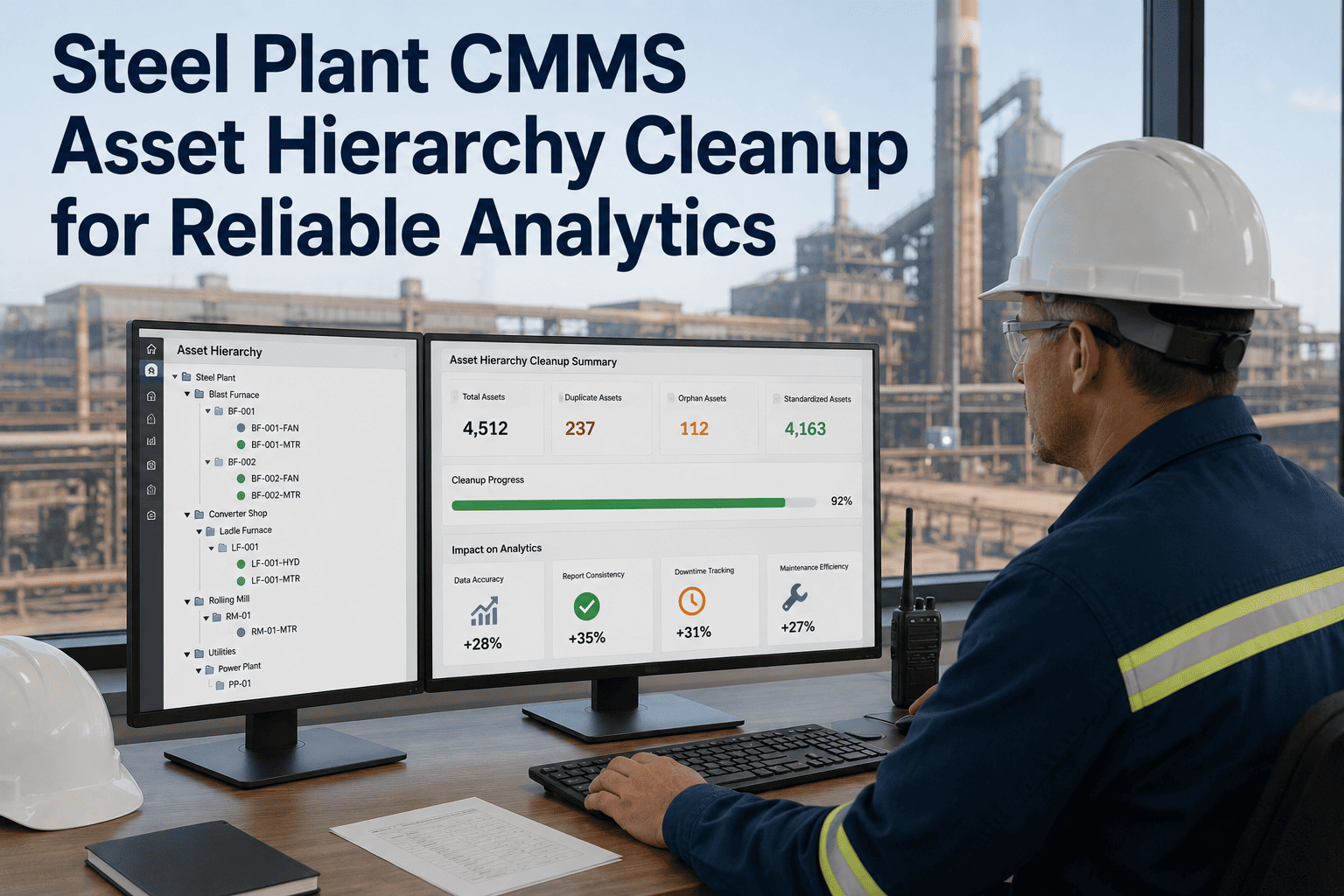
Most plants have a register gap — the CMMS list does not match the floor, producing blind spots on unregistered assets and wasted effort on assets that no longer exist. The physical walkdown that builds an accurate register is exactly why it is the most time-consuming part of a CMMS rollout, and exactly why it pays off: every hidden asset found is a future emergency avoided. Do not trust legacy spreadsheets or old CMMS exports — they carry decommissioned assets, duplicates, and missing entries. Walk every area, then load top-down so parents exist before children and nothing is orphaned.
Build the Register
Four Stages From Floor to Foundation
Building the register from scratch is the most consistently underestimated task in maintenance improvement — but the sequence is well-proven. Follow it in order and the hierarchy holds up for years.
- 1 Physical walkdown Walk every zone and document all maintainable assets and critical sub-components. Do not rely on existing lists — the walkdown is where unknown and decommissioned assets surface.
- 2 Load top-down Enter plant, then zones, then systems, then equipment, then sub-assets — parents before children, using a controlled vocabulary for types and locations to avoid inconsistency.
- 3 Classify criticality Apply the A/B/C tier to every asset against the four-dimension framework. This is the step that makes the register a strategy foundation rather than a list.
- 4 Link history & validate Map any prior maintenance records to the new hierarchy for day-one failure analysis, then have technicians and reliability engineers review before it goes live.
The platform itself deploys fast — most BF teams run digital inspections within 48 hours, with QR-code tags letting technicians scan the exact sub-asset on the floor. Sign up for Oxmaint to build your steel asset register top-down with QR tagging.
Oxmaint for Asset Registers
How Oxmaint Structures Steel Assets
-
Nested Hierarchy
Plant to Position, No Depth Limit
Build deep parent-child trees from plant down to individual tuyere or segment — each level with its own PM schedule and record, so a work order targets the exact sub-asset, not the whole machine.
-
Criticality Tags
A/B/C on Every Asset
Tag each asset with a criticality tier that drives PM frequency, inspection priority, and work-order escalation — and inherits automatically to linked spare parts through the BOM.
-
Cost Roll-Up
Reliability Data by Level
Because history ties to the right point in the tree, costs and MTBF roll up cleanly — total spend at plant level, failure patterns at component level, no data lost to a flat list.
-
QR Asset Tagging
Scan the Exact Sub-Asset
Unique QR tags on critical child assets let a technician scan the specific tuyere or bearing — logging wrench time and parts against the correct record, lifting first-time-fix rates.
-
Production-Basis PM
Heats, Tonnage, or Condition
Each registered asset can trigger PM by heat count, tonnage, operating hours, or sensor condition — so refractory and rolls are serviced on real wear, not a calendar date.
-
Fast, Focused Start
Critical Assets First
Avoid the over-scoping that stalls rollouts — register the furnace, caster, and one mill first with digital inspections live in 48 hours, then expand across the plant.
Frequently Asked
Steel Asset Register Questions
Why register a tuyere or stave as its own asset instead of just "the furnace"?
Because failure-mode intelligence lives at the sub-asset level. Managing 20–40 tuyeres as individual records — each with its own install date, service hours, and cooling history — is the difference between planned and emergency replacement, with per-unit outlet-temperature trending flagging a failing unit 7–14 days ahead. Logged against "the furnace," that signal is lost in noise. Book a demo to see every tuyere and stave tracked individually.
How many levels should a steel asset hierarchy have?
Most plants use a 4–5 level structure: Plant, Zone, System, Equipment, and Component/Sub-asset. Best practice is no more than 2–3 sub-levels under any one asset — too few lumps items together and loses clarity, too many becomes cumbersome. Following an established taxonomy like ISO 14224 keeps it consistent and adaptable rather than a bespoke structure nobody else understands.
What is a criticality tier and why does the register need one?
A criticality tier (A safety-critical, B production-critical, C standard) rates each asset against production, safety, quality, and regulatory impact. It determines PM frequency, spare-parts stocking, inspection priority, and work-order escalation order. Without it, every asset receives default treatment — under-resourcing high-consequence failures and over-resourcing low-risk equipment. It is the step that turns the register into a maintenance strategy. Sign up for Oxmaint to classify criticality across a steel fleet.
Why is building the asset register so time-consuming?
Because no accurate list exists before the build begins. The physical walkdown required to create one always reveals assets nobody knew existed and assets listed but no longer present. Legacy spreadsheets and old CMMS exports carry decommissioned assets, duplicates, and missing entries, so they cannot be trusted as a shortcut. It is the most underestimated task in a CMMS rollout — and the foundation everything else depends on. Book a demo to see a register built from an accurate walkdown.
Register · Classify · Roll Up
A Flat List Hides the Failure. A Hierarchy Reveals It.
Every unregistered stave, untracked tuyere, and unclassified asset is a maintenance blind spot waiting to become an emergency. Oxmaint gives steel plant teams one platform to build a deep asset hierarchy from plant to position, register every sub-asset with its own history, classify criticality that flows to spare parts, and roll reliability data up cleanly by level — the foundation that makes every PM schedule and predictive alert actually work.