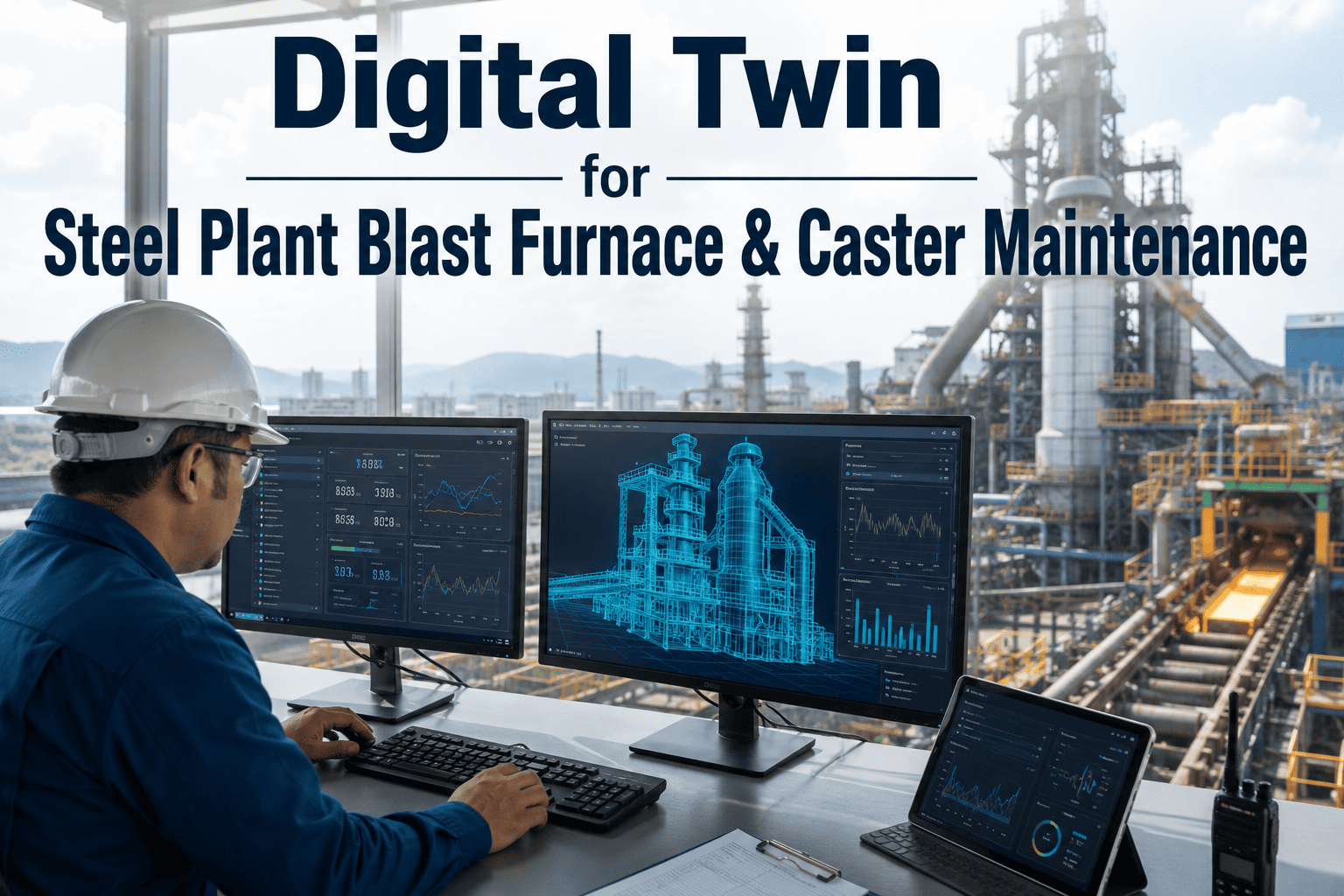
A digital twin for steel plant maintenance is a live, physics-based virtual replica of blast furnaces, continuous casters, and rolling mills that ingests real-time sensor data to simulate wear, predict failures, and optimise maintenance windows — reducing unplanned downtime by 25–40% and extending refractory and equipment life by thousands of hours. For integrated steel mills where a single unplanned blast furnace shutdown can exceed $1M per day, a blast furnace digital twin and caster digital twin integrated into your CMMS shift maintenance from reactive firefighting to condition-based, predictive action. This guide covers how steel digital twin models work, where they deliver the fastest ROI, and how OxMaint connects twin-driven alerts to automated work orders, inventory, and analytics — you can Start Free Trial to see it on your assets today.
Simulate Every Asset. Predict Every Failure. Eliminate Reactive Maintenance.
A steel plant digital twin mirrors your blast furnace refractory wear, caster thermal profile, and rolling mill drive health in real time — feeding OxMaint AI-driven work orders before breakdowns cost you a ton of production.
What if your maintenance team knew the exact remaining useful life of every refractory brick, caster segment, and mill drive bearing — weeks before failure?
Three Digital Twin Models That Transform Steel Plant Maintenance
A digital twin steel plant deployment is not a single monolithic model — it is a portfolio of asset-specific twins, each solving a high-cost failure mode. These three models deliver 70–80% of the total maintenance ROI.
Blast Furnace Refractory Wear Twin
A blast furnace digital twin simulates refractory erosion using thermocouple data, cooling stave temperatures, and heat-flux calculations to model brick thickness in real time. It predicts shell hot spots and campaigns end-of-life windows 4–8 weeks in advance — enabling planned relining instead of emergency shutdowns that cost $800K–$1.2M per day.
Caster Thermal & Segment Wear Twin
A caster digital twin models mould heat flux, strand shell growth, and segment roller wear to detect breakouts before they occur. By correlating taper deviation and cooling-water delta-T against strand speed, it flags segment misalignment 3–5 heats early — preventing $200K breakout events and slab quality losses.
Rolling Mill Drive & Vibration Twin
A rolling mill digital twin fuses vibration spectra, motor torque, and bearing temperature to model drive-train degradation. It identifies gear-tooth pitting and bearing spalling 1,000–3,000 operating hours before catastrophic failure — converting $150K emergency gearbox rebuilds into $35K planned interventions during scheduled roll changes.
How Much Does a Steel Plant Digital Twin Save? ROI Breakdown
For a typical integrated mill producing 2.5M tons/year, digital twin maintenance delivers $4.2M–$7.8M in annual avoided costs. The payback period for twin software and sensor integration averages 8–14 months when connected to a CMMS that automates the work-order response.
120–180 unplanned hours eliminated per year across BF, caster, and mill through early-warning work orders
Refractory campaigns extended 15–30%; caster segment life increased 20% through condition-based maintenance
Caster thermal twin reduces breakouts and off-spec slabs by 35–50%, saving 8,000–12,000 tons of scrap annually
Spare-parts stocking cut 22%; overtime labour reduced 30% as emergency callouts drop to scheduled repairs
| Asset / Twin Application | Annual Avoided Cost | Implementation Cost | Payback Period |
|---|---|---|---|
| Blast Furnace Refractory Twin | $2.1M – $3.4M | $280K – $450K | 6 – 10 months |
| Continuous Caster Thermal Twin | $1.4M – $2.2M | $180K – $320K | 7 – 11 months |
| Rolling Mill Drive Vibration Twin | $0.7M – $1.3M | $90K – $170K | 4 – 8 months |
| Combined Mill-Wide Twin + CMMS | $4.2M – $7.8M | $550K – $950K | 8 – 14 months |
How to Implement a Steel Plant Digital Twin in 5 Phases
A phased rollout starting with your highest-cost failure mode delivers value in 90 days — not the 18-month ERP-style implementations that stall most digital transformation projects. Here is the proven 5-phase path from sensor to CMMS-automated work order.
Asset Prioritisation & Data Audit
Rank assets by criticality and downtime cost. Select the top 1–2 assets (typically BF shell or main caster strand). Audit existing sensor coverage — most mills need 15–30 additional thermocouples or vibration sensors at $2K–$8K each to feed the twin.
Physics Model Build & Historical Calibration
Engineers build the finite-element or thermal model using design drawings, operating data, and failure history. The twin is calibrated against 2–5 years of past events — validating that it would have predicted the last 3 breakdowns before they occurred.
Real-Time Data Pipeline & Twin Go-Live
Connect the SCADA/ historian (Pi System, IP21, or similar) to the twin model via a streaming data pipeline. The twin now updates every 1–5 minutes with live sensor readings and displays wear state, remaining useful life, and risk score on dashboards.
CMMS Integration — Twin Alerts to Work Orders
This is where most twin projects fail. OxMaint closes the loop: when the twin predicts a failure threshold breach, OxMaint auto-generates a work order with asset ID, failure mode, recommended action, required spare parts, and priority — routed to the right technician. No manual data entry, no alert fatigue.
Model Refinement & Scale to Next Asset
Every work-order outcome (verified failure, false alarm, repair performed) feeds back into the twin model, improving prediction accuracy 5–12% per quarter. Once the first twin hits 85%+ accuracy, replicate the playbook on the next priority asset.
How OxMaint Turns Digital Twin Predictions Into Prevented Failures
A digital twin without a CMMS is a dashboard nobody acts on. OxMaint is the AI-powered CMMS that connects twin predictions to automated work orders, spare-parts reservation, and compliance-ready audit trails — so your team fixes the problem before production ever feels it.
Auto-Generated Predictive Work Orders
When the blast furnace twin flags a refractory hot-spot threshold breach, OxMaint instantly creates a priority work order — pre-filled with asset ID, failure mode, repair procedure, and required spares. Cuts response time from hours to minutes.
Spare-Parts Auto-Reservation
OxMaint checks inventory the moment a twin-triggered work order opens. If the caster segment or mill drive bearing is in stock, it reserves it; if not, it auto-generates a purchase requisition with lead-time alerts. No more discovering parts are missing at 2 AM.
AI Failure Pattern Recognition
OxMaint's AI engine correlates twin alerts with historical work-order data across your mill — discovering patterns like "BF cooling stave #14 always fails 3 weeks after carbon injection rate exceeds 140 kg/thm." These insights auto-update your PM schedules.
ISO 55000 Audit-Ready Compliance Trail
Every twin-triggered alert, work order, repair action, and outcome is time-stamped and logged automatically. OxMaint generates compliance reports for ISO 55000, ISO 14224, and internal reliability reviews in one click — eliminating 40+ hours of manual audit prep per quarter.
A 2.5M-ton integrated steel plant deployed a blast furnace digital twin integrated with OxMaint CMMS. In the first 8 months, the twin predicted 3 refractory hot-spot events 5–7 days before shell temperature alarms. OxMaint auto-generated work orders, reserved gunning material, and scheduled repairs during planned casting breaks — avoiding an estimated $2.8M in emergency shutdown costs. Total software + integration investment: $420K. Net first-year savings: $2.38M.
See OxMaint's Digital Twin CMMS on Your Blast Furnace, Caster, and Mill
Book a 30-minute demo and our steel-industry reliability engineers will walk you through a live twin-integrated work-order flow on assets like yours — from predictive alert to completed repair.
Digital Twin Steel Plant Maintenance — Your Questions Answered
What is a digital twin in a steel plant?
A digital twin in a steel plant is a real-time virtual model of a physical asset — such as a blast furnace, continuous caster, or rolling mill — that continuously ingests sensor data (temperature, vibration, pressure, flow) and uses physics-based simulation to mirror the asset's wear state, performance, and remaining useful life. Unlike a static 3D model, a steel plant digital twin updates every few minutes and predicts future failures, enabling maintenance teams to act weeks before breakdowns occur.
How much does a blast furnace digital twin cost to implement?
A blast furnace digital twin typically costs $280K–$450K to implement, including sensor upgrades, physics model development, historian integration, and CMMS connectivity. Most steel plants recover this investment in 6–10 months, as a single prevented emergency BF shutdown saves $800K–$1.2M per day. To explore a tailored ROI model for your furnace, Book a Demo with our team.
How does a caster digital twin prevent breakouts?
A caster digital twin prevents breakouts by modelling mould heat flux, strand shell thickness, and taper deviation in real time. When the twin detects that shell growth is insufficient for the current casting speed — the precursor to a sticker breakout — it triggers an alert 3–5 heats before the critical threshold. Connected to OxMaint CMMS, this alert auto-generates a work order to inspect mould taper and adjust cooling water flow, preventing $150K–$200K breakout events.
Can a digital twin integrate with an existing CMMS?
Yes — a digital twin must integrate with a CMMS to deliver value. The twin predicts; the CMMS acts. OxMaint provides REST API connectors that link twin prediction engines directly to work-order automation, spare-parts reservation, and PM scheduling. Without this integration, twin alerts become dashboards that maintenance teams ignore. You can Start Free Trial and test the integration workflow on your assets in under 14 days.
What is the ROI of a rolling mill digital twin for maintenance?
A rolling mill digital twin delivers $700K–$1.3M in annual avoided costs per mill line, primarily by detecting gear-tooth pitting, bearing spalling, and roll-neck fatigue 1,000–3,000 operating hours before catastrophic failure. This converts $150K emergency gearbox rebuilds into $35K planned interventions during scheduled roll changes. Implementation costs $90K–$170K with a payback period of 4–8 months — the fastest ROI of the three core steel plant twin models.
Stop Reacting to Failures. Start Predicting Them.
Deploy OxMaint's AI-powered CMMS with digital twin integration and cut unplanned downtime 30–50%, extend asset life, and build a fully audit-ready maintenance operation. Your blast furnace, caster, and rolling mill data is waiting — put it to work.
Free 14-day trial · No credit card