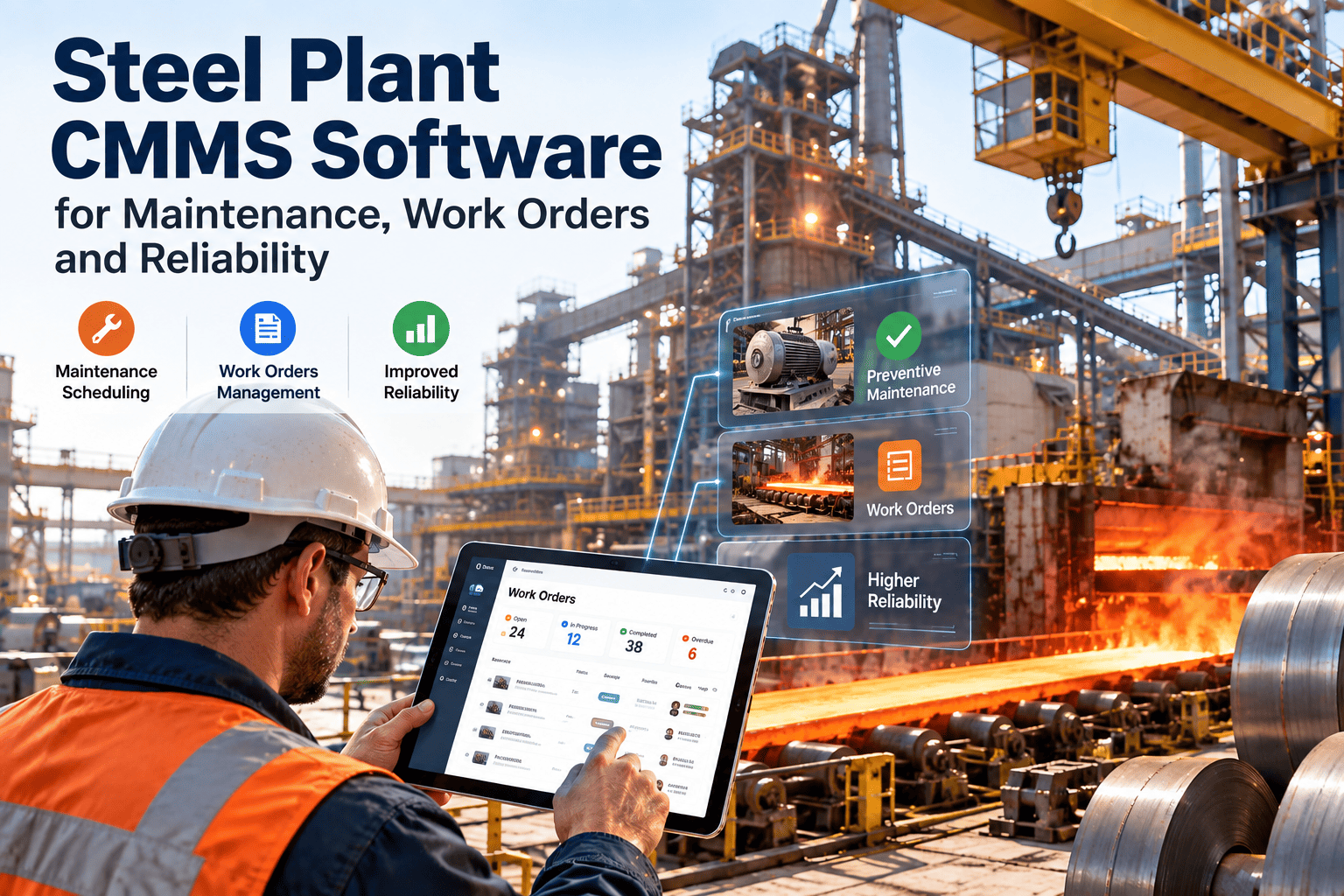
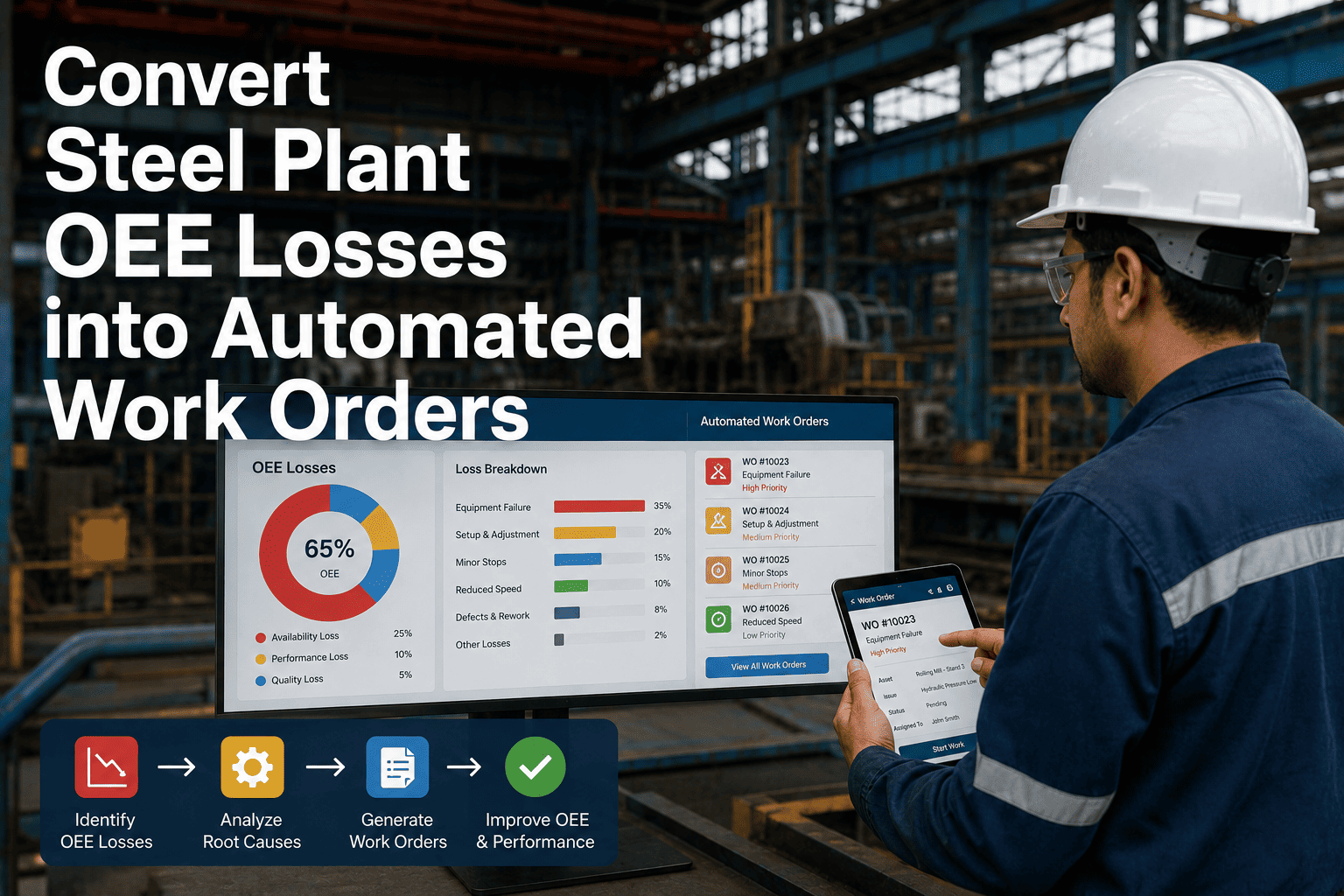
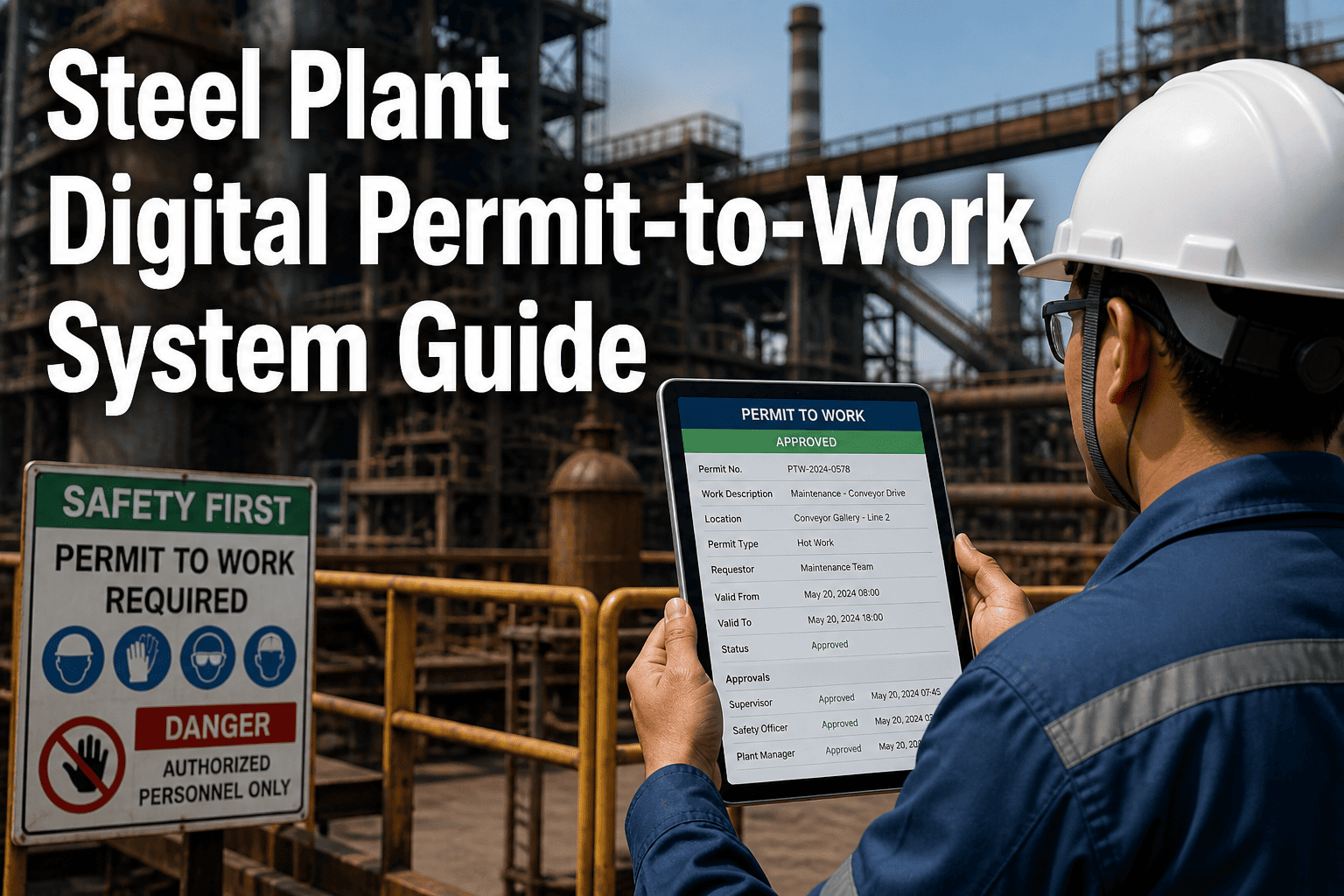
Steel plant work order management represents one of the most critical operational challenges in maintaining production reliability. Organizing maintenance requests into efficient workflows—tracking from initial request through completion, minimizing downtime, and maximizing equipment availability—requires balancing dozens of competing priorities simultaneously. AI-powered work order management transforms this complexity into optimized maintenance schedules that reduce costs while improving equipment reliability. Schedule a consultation to explore how intelligent work order management can transform operations at your steel plant.
Why Steel Plant Work Order Management Matters
Steel plants operate hundreds of critical assets with varying maintenance requirements, failure modes, and production impacts. Managing work orders efficiently directly impacts equipment uptime, maintenance costs, safety compliance, and production throughput. Poor work order management creates cascading inefficiencies throughout the maintenance organization.
Work Order Management Architecture
Modern work order management combines maintenance request data, asset criticality ratings, technician availability, and advanced optimization algorithms to generate optimal maintenance schedules that balance production needs with equipment reliability.
Work Order Types & Management Strategies
Different maintenance work order types present unique management challenges. Effective optimization requires understanding the specific characteristics and constraints of each work category.
Key Work Order Variables
Effective work order management requires balancing multiple variables simultaneously. AI systems consider dozens of factors in real-time to generate maintenance schedules that optimize overall plant performance.
| Variable Category | Key Parameters | Planning Impact | Typical Improvement |
|---|---|---|---|
| Asset Criticality | Production impact, safety risk, replacement cost, failure history | Priority ranking, response time, resource allocation | 35-50% better prioritization |
| Work Order Attributes | Priority level, estimated duration, required skills, parts needed | Scheduling accuracy, completion rates, backlog management | 40-60% OTD improvement |
| Resource Constraints | Technician availability, skill certifications, tool access, shift patterns | Assignment optimization, workload balancing, overtime reduction | 20-30% utilization increase |
| Parts & Materials | Inventory levels, lead times, storage locations, kitting requirements | Work order readiness, delay reduction, carrying costs | 25-40% inventory reduction |
| Production Windows | Schedule gaps, throughput targets, quality constraints, changeovers | Maintenance timing, downtime minimization, coordination | 15-25% downtime reduction |
| Compliance Requirements | Regulatory inspections, safety protocols, documentation, audits | Risk mitigation, audit readiness, penalty avoidance | 30-45% compliance improvement |
Traditional vs. AI-Powered Work Order Management
Understanding the difference between manual maintenance management approaches and AI-powered optimization reveals why leading steel producers are transitioning to intelligent work order systems.
- Paper-based or spreadsheet tracking with limited visibility
- Reactive response to equipment failures and breakdowns
- Single-objective focus (cost OR availability)
- Limited visibility into backlog and resource capacity
- Supervisor-dependent quality and consistency
- Digital workflow across all assets and maintenance types
- Predictive scheduling before problems occur
- Multi-objective balancing in real-time
- Complete backlog visibility and capacity analysis
- Consistent optimization 24/7
Work Order Completion Optimization
Work order completion rates directly impact maintenance effectiveness. Higher completion rates reduce backlog, improve equipment reliability, and enable proactive maintenance. AI optimization finds the optimal balance for each work type and production situation.
| Strategy | When to Apply | AI Optimization Approach | Typical Benefit |
|---|---|---|---|
| Priority Escalation | Critical asset work orders | Auto-escalate overdue items, notify supervisors, reassign resources | Achieve 98%+ critical WO completion |
| Backlog Management | Accumulated deferred maintenance | Sequence by risk and production windows, bundle related tasks | Reduce backlog 40-50% |
| Resource Leveling | Uneven technician workload | Balance assignments across crews, optimize shift coverage | Improve utilization to 85%+ |
| Parts Readiness | Work orders delayed by materials | Verify inventory before scheduling, auto-generate purchase requests | Reduce parts delays 60% |
| Skill Matching | Specialized maintenance tasks | Match technician certifications to work requirements, plan training | Reduce rework 35% |
Request to Completion Workflow
Managing work orders from initial request through final completion involves complex handoffs between operations, maintenance, and supply chain. AI optimization considers all factors simultaneously to make globally optimal workflow decisions.
ROI of Work Order Management Optimization
AI work order management delivers returns through multiple value streams—reduced downtime, improved completion rates, lower maintenance costs, and better resource utilization. Benefits compound as the system learns plant-specific patterns.
Technical Specifications
AI work order management platforms must meet demanding specifications for workflow quality, integration depth, and response speed to deliver value in dynamic steel production environments.
Implementation Approach
Successful AI work order management deployment requires careful integration with existing systems and processes. A phased approach builds confidence while delivering quick wins on the path to full optimization.
Integration Capabilities
AI work order management systems integrate deeply with existing plant systems to enable real-time optimization and automated maintenance across the production chain.
| System | Integration Type | Data Exchange |
|---|---|---|
| ERP/Finance | Real-time bidirectional | Work order costs, labor tracking, parts consumption, budget allocation |
| CMMS/EAM | Transaction-based | Asset records, work order history, maintenance plans, completion data |
| IoT/Sensors | Event-triggered | Equipment alerts, condition monitoring, predictive maintenance triggers |
| Inventory Management | Scheduled batch | Parts availability, stock levels, warehouse locations, reorder points |
| Production Scheduling | Real-time | Production windows, equipment availability, downtime coordination |
Common Challenges & Solutions
Work order management optimization deployments face unique challenges from request variability, resource constraints, and organizational change. Understanding these challenges and proven solutions accelerates successful implementation.
| Challenge | Impact | Solution |
|---|---|---|
| Request overload | Too many low-priority requests overwhelm teams | Request validation workflows, priority scoring, auto-categorization |
| Resource shortages | Insufficient technicians for workload volume | Workload forecasting, contractor integration, overtime optimization |
| Technician resistance | Manual workarounds eliminate system benefits | Mobile app adoption, simplified interfaces, demonstrated value building trust |
| Data quality gaps | Incomplete asset records limit optimization | Data cleansing workflows, asset verification, feedback loops |
| Multi-site coordination | Local optimization misses resource sharing opportunities | Hierarchical planning, technician pooling across sites, best practice sharing |