Bearing failures are responsible for approximately 40% of all machinery breakdowns in steel mills, according to the American Society of Mechanical Engineers (ASME). A single $50 roll bearing that fails unexpectedly can trigger production losses of $25,000 to $50,000 per hour—turning a minor component into a six-figure catastrophe. Yet over 99% of bearings are designed to outlast the equipment they serve. The gap between expected life and premature failure comes down to one thing: whether you can see the damage developing before it reaches the point of no return. Condition-based maintenance (CBM) closes that gap by replacing calendar-driven schedules with real-time intelligence from vibration sensors, thermal monitoring, oil analysis, and acoustic detection—giving your maintenance team a clear window into bearing health across every roll, stand, and drive in the mill.
Why Bearings Fail: The Root Cause Breakdown
Premature bearing failure in rolling mills is not random. It follows predictable patterns rooted in a handful of interrelated causes. Understanding these root causes is essential because each one produces distinct warning signatures that condition monitoring can detect—often weeks before visible damage appears. Research consistently shows that inadequate lubrication, contamination, misalignment, and overloading account for the vast majority of premature failures in steel mill roll bearings.
The 4 Stages of Bearing Degradation
Every bearing failure progresses through four distinct stages, each producing increasingly detectable signals. The key to condition-based maintenance is catching degradation in the earliest possible stage—where intervention is low-cost and the bearing can often be saved. AI-powered monitoring systems detect Stage 1 anomalies that are completely invisible to human inspection.
Subsurface Initiation
Microscopic cracks form below the raceway surface. Invisible to the naked eye. Detectable only through ultrasonic frequencies (20-60 kHz) and advanced envelope analysis.
Micro-Pitting
Surface micro-pitting begins. Natural frequency of bearing components gets excited. Detectable in high-frequency range (1-20 kHz). Still invisible without magnification.
Visible Spalling
Cracks, flaking, and spalling become visible. Bearing defect frequencies (BPFO, BPFI, BSF) appear clearly in velocity spectrum. Audible noise begins. Replace immediately.
Catastrophic Failure
Multiple cracks, excessive spalling, rolling element deformation, cage disintegration. Extreme heat and noise. Bearing seizure imminent—remove from service immediately.
AI Detection Window
Advanced AI monitoring detects Stage 1 anomalies weeks or months before traditional vibration analysis catches Stage 3 damage. This extended detection window is what transforms maintenance from reactive to truly predictive.
5 Monitoring Techniques That Power Steel Mill CBM
No single technique catches every failure mode. Effective condition-based maintenance combines multiple monitoring approaches, each targeting different types of bearing degradation at different stages. Here is how each technique works and what it detects in a rolling mill environment.
Vibration Analysis
Accelerometers capture vibration signatures across frequency bands. AI algorithms identify bearing defect frequencies (BPFO, BPFI, BSF, FTF) and track degradation progression from Stage 1 through failure.
Thermal Monitoring
Infrared cameras and temperature sensors detect abnormal heat patterns from friction, lubrication failure, or overloading. Bearing operating temperature should not exceed 50 degrees Celsius under normal conditions.
Oil & Grease Analysis
Laboratory and inline analysis of lubricant for metal wear particles, water contamination, viscosity changes, and chemical degradation. Reveals internal bearing condition without disassembly.
Acoustic Emission
Ultrasonic sensors detect high-frequency sounds (20-60 kHz) generated by subsurface cracking and micro-pitting—inaudible to human ears. The earliest possible indicator of developing bearing damage.
Motor Current Signature Analysis (MCSA)
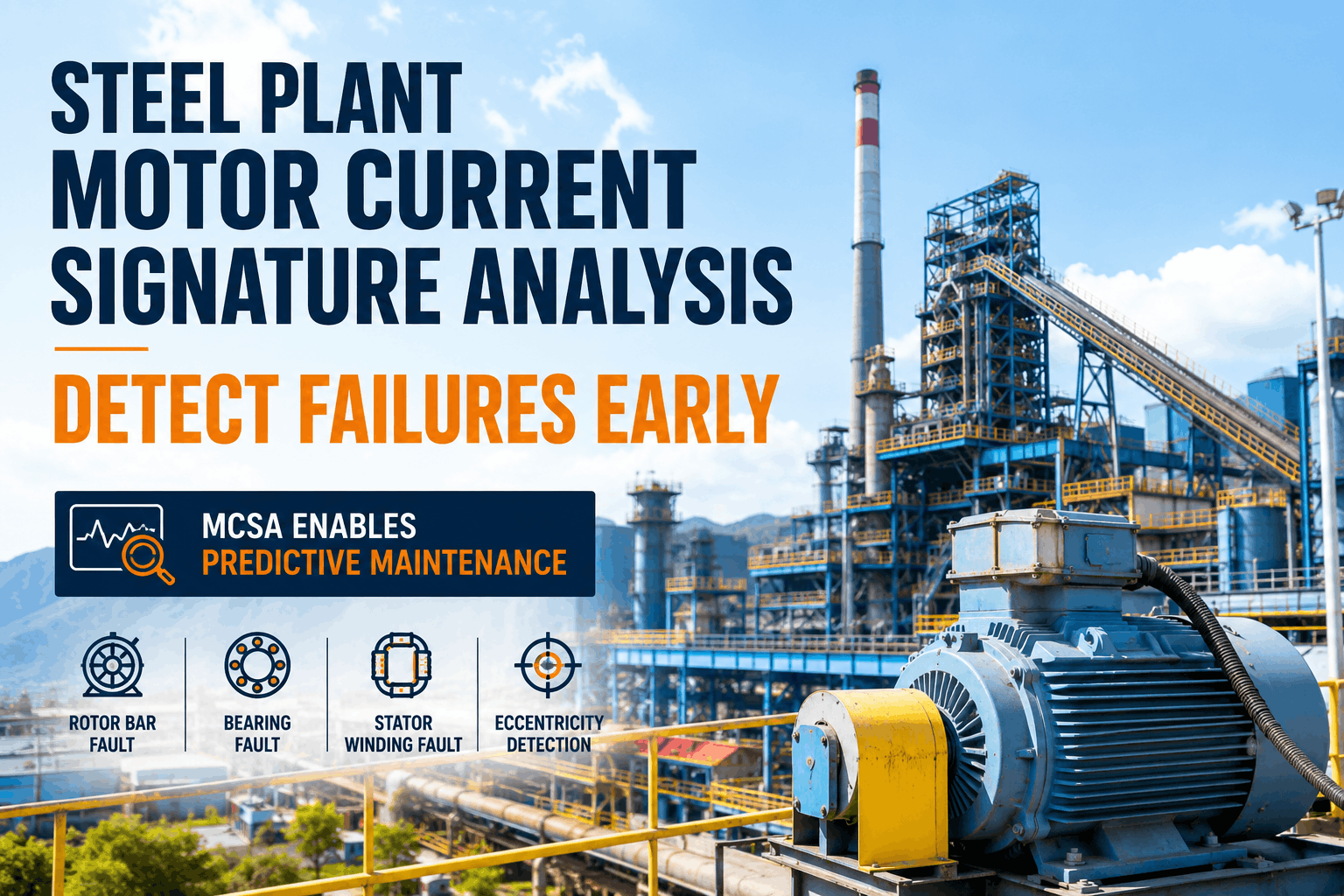
Monitors electrical current drawn by the motor to infer mechanical condition of connected equipment—including roll bearings, gearboxes, and couplings. The major advantage for hot strip mills: no sensors need to be placed on the equipment itself. All monitoring happens remotely from the motor control cabinet, completely avoiding the extreme heat and water that destroy conventional sensors. MCSA detects bearing faults, gear defects, misalignment, and coupling wear through subtle changes in the electrical signature.
Get Complete Bearing Visibility Across Your Mill
OxMaint's condition monitoring CMMS integrates vibration, thermal, oil, and MCSA data into a single dashboard—with AI-powered alerts that tell your team exactly which bearings need attention and when.
Bearing Types in Steel Mills: Monitoring Priorities
Different roll positions use different bearing types, each with unique failure characteristics and monitoring requirements. Mapping the right monitoring strategy to each bearing type is critical for an effective CBM program.
How CBM Works: From Sensor to Scheduled Repair
A condition-based maintenance program for roll bearings is not just about collecting data. It is about creating a closed loop from detection through diagnosis to action. Here is the complete workflow that turns raw vibration signals into optimized maintenance schedules.
Continuous Data Collection
Sensors capture vibration, temperature, acoustic, and electrical data around the clock. Edge devices pre-process signals locally, extracting key frequency components and filtering noise before transmission.
AI Feature Extraction
Machine learning models extract statistical features (kurtosis, RMS, skewness) from time-domain and frequency-domain signals. Deep learning networks like LSTM and CNN identify degradation patterns invisible to standard analysis.
Fault Classification
AI classifies detected anomalies by bearing component (inner race, outer race, rolling element, cage) and severity level. Modern CNN models trained on scalograms achieve over 99% classification accuracy for fault identification.
Remaining Life Estimation
Health indicators are tracked over time and extrapolated to predict remaining useful life (RUL). Probabilistic models provide confidence intervals so maintenance teams know both the expected and worst-case timelines.
Smart Prioritization
AI ranks all flagged bearings by risk—considering failure probability, production impact, spare parts availability, and upcoming maintenance windows. Maintenance teams know exactly where to focus limited resources.
Automated Work Orders
When action thresholds are triggered, the CMMS automatically generates work orders with specific diagnosis, recommended actions, parts lists, and optimal scheduling aligned to planned maintenance stops.
CBM vs. Traditional Maintenance: The Numbers
The gap between condition-based monitoring and traditional approaches is not theoretical. Steel mills that have implemented CBM programs report dramatically different outcomes across every key performance metric.
Build a Bearing CBM Program That Delivers Results
From sensor selection to AI-powered diagnostics, OxMaint's CMMS platform gives your steel mill the complete condition monitoring infrastructure to eliminate unplanned bearing failures and extend equipment life.