Legacy identity and access management was built for a world that no longer exists — a world where employees sat at desks, applications lived in data centres, and access reviews happened once a year in a spreadsheet. Today's industrial enterprise has technicians logging in from mobile devices on offshore platforms, AI agents calling SAP APIs autonomously, contractors rotating across three plants in a week, and IoT sensors authenticating thousands of times per second. AI-driven identity governance replaces the static rulebooks and manual reviews of legacy IAM with systems that learn normal access patterns, detect anomalies in real time, and enforce least-privilege dynamically. When connected to maintenance platforms like Oxmaint and enterprise systems like SAP, AI identity governance ensures that the right person — or the right machine — has exactly the right access, for exactly the right duration, every single time. Start your free Oxmaint trial with enterprise-grade identity governance built in. Or book a demo to see how Oxmaint handles role-based access, SAML SSO, and AI-powered access intelligence.
Identity Security
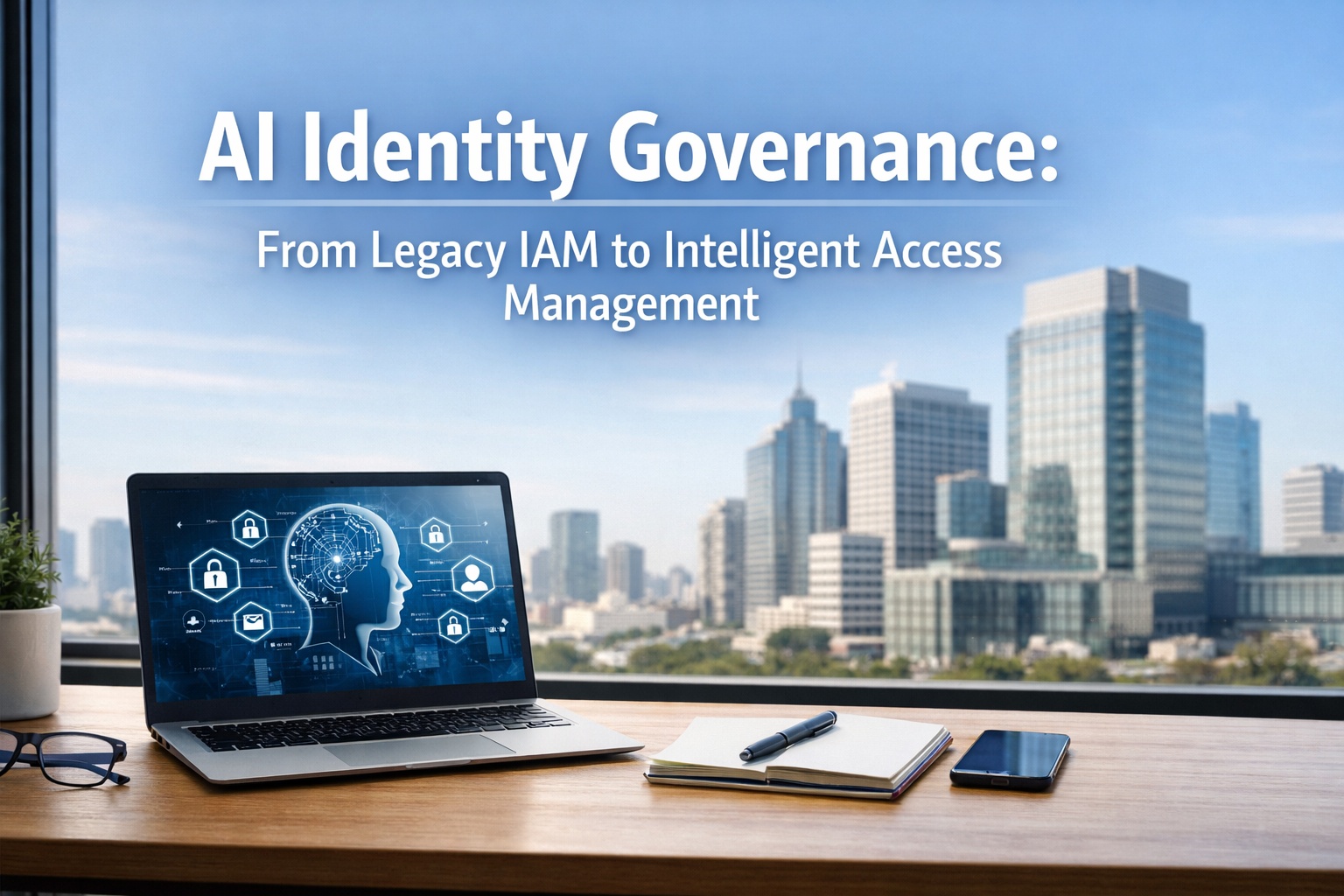
AI Identity Governance: From Legacy IAM to Intelligent Access Management
How AI transforms identity governance from annual checkbox exercises into continuous, adaptive, risk-aware access control.
Why Legacy IAM Is Failing Industrial Enterprises
Legacy IAM systems were designed around two assumptions: identities are human, and access is binary (granted or denied). Both assumptions are now wrong. In a modern maintenance operation, identities include technicians, contractors, AI agents, IoT devices, and service accounts — each with different lifecycle patterns, risk profiles, and access needs. Legacy systems handle this complexity through more rules, more exceptions, and more manual reviews. The result is access sprawl, audit fatigue,and a growing gap between what the policy says and what actually happens on the network.
01
Access Accumulation
Employees collect permissions over years. Role changes add access but rarely remove it. After three job rotations, a planner has technician, supervisor, and admin privileges simultaneously — none of which were explicitly revoked.
Average enterprise user has 3.4x more permissions than their role requires
02
Rubber-Stamp Reviews
Quarterly access reviews ask managers to validate hundreds of entitlements they do not understand. The result is predictable: 94% of certifications are approved without investigation, because the alternative is blocking productive work.
94% of manual access certifications approved without meaningful review
03
Non-Human Identity Blind Spot
Service accounts, API keys, IoT device credentials, and AI agent tokens now outnumber human identities 10:1 in many enterprises. Legacy IAM was not built to govern them — and most organizations cannot even enumerate them.
Machine identities outnumber human identities 10:1 in industrial environments
04
Static Policies, Dynamic Threats
Access policies are written once and updated annually. The threat landscape changes daily. A contractor account compromised on Tuesday is still fully privileged on Wednesday because the policy review is scheduled for Q4.
Average time to detect compromised credentials: 204 days without AI monitoring
The Evolution: Four Generations of IAM
Identity governance has evolved through four distinct generations. Most industrial enterprises today operate somewhere between Generation 2 and Generation 3. The breakthrough capabilities that AI enables — continuous risk scoring, adaptive policies, and autonomous remediation — live in Generation 4.
Gen 1
1990s–2005
Directory-Based
Active Directory groups, manual provisioning, password-only authentication, no audit trail
Identity = username + password
Gen 2
2005–2015
Role-Based (RBAC)
Predefined roles, periodic access reviews, basic SSO, compliance-driven certifications
Static roles cannot keep pace with dynamic operations
Gen 3
2015–2022
Policy-Based (ABAC)
Attribute-based access, conditional policies, MFA, federation, partial automation
Policies still manually authored and periodically reviewed
Gen 4
2022+
AI-Governed (Adaptive)
Continuous risk scoring, behavioral analytics, autonomous remediation, zero-trust by default
Requires high-quality identity data and organizational trust in AI
Six AI Capabilities That Define Modern Identity Governance
AI identity governance is not one big model — it is a set of specialized capabilities, each addressing a different failure mode of legacy IAM. Together, they transform identity management from a periodic compliance exercise into a continuous, adaptive security function.
BL
Behavioral Baseline Learning
AI establishes what "normal" looks like for each identity — login times, systems accessed, data volumes, geographic patterns. Any deviation from baseline triggers risk scoring, not just access denial.
Technician who normally accesses Oxmaint from Plant A suddenly authenticating from a foreign IP at 3 AM is flagged within seconds.
RS
Continuous Risk Scoring
Every identity carries a real-time risk score that rises and falls based on behavior, context, and threat intelligence. Access decisions incorporate the risk score dynamically — a high-risk session might require step-up authentication.
A service account's risk score spikes when it begins querying SAP tables it has never accessed before, even though the access is technically permitted.
RM
Intelligent Role Mining
AI analyses actual access patterns across thousands of users to discover natural roles that match real work patterns — not the idealized roles HR defined years ago. Excess entitlements become visible instantly.
AI discovers that 340 "Maintenance Technician" users actually cluster into 7 distinct behavioral roles with very different access needs.
Instead of asking managers to review 500 entitlements, AI pre-certifies low-risk access that matches behavioral patterns and flags only the 3–5% of entitlements that are anomalous, dormant, or excessive for human review.
Quarterly review workload drops from 12,000 manual decisions to 480 meaningful ones — with higher actual security value.
AR
Autonomous Remediation
When AI detects a compromised credential, dormant privileged account, or policy violation, it can act immediately — revoking access, forcing password reset, or quarantining the session without waiting for a human approval chain.
Orphaned service account for a decommissioned IoT gateway is automatically disabled 72 hours after last legitimate use.
PD
Predictive De-provisioning
AI predicts when access will no longer be needed based on project timelines, contract end dates, and role transition patterns — and queues de-provisioning proactively instead of waiting for someone to remember.
Contractor access scheduled for automatic revocation 48 hours before contract end, with manager notification for extension if needed.
Identity-Aware Maintenance
Oxmaint integrates with your IAM — SAML SSO, OAuth 2.1, RBAC, and AI-powered access intelligence
Every work order, every asset access, every mobile session in Oxmaint is governed by enterprise identity controls. No shared logins, no orphaned accounts, no privilege accumulation. See it running in a live demo.
Identity Governance in Maintenance Operations
Identity governance is not just an IT concern — it has direct operational impact on maintenance. When access is poorly governed, technicians get blocked from systems they need, contractors retain access long after their engagement ends, and AI agents operate with unchecked privileges. Here is how AI identity governance maps to specific maintenance operation challenges.
Challenge
Technician blocked from Oxmaint during emergency repair
AI Governance Solution
Emergency access protocol with time-bounded elevation, auto-revocation, and full audit capture
Challenge
Contractor retains SAP access 6 months after project ends
AI Governance Solution
Predictive de-provisioning triggers revocation at contract end date, no manual intervention
Challenge
IoT sensor credentials compromised without detection
AI Governance Solution
Behavioral baseline detects anomalous data patterns from device identity, quarantines in seconds
Challenge
Planner accumulates admin privileges through role changes
AI Governance Solution
Role mining identifies excess entitlements; auto-certification flags for removal
The ROI of Getting Identity Right
Identity governance is often seen as a cost centre — something you do because auditors demand it. AI changes this equation. When identity governance becomes intelligent, it reduces breach costs, eliminates audit preparation overhead, accelerates onboarding, and directly improves operational uptime by ensuring the right people have the right access at the right time.
$4.45M
Average cost of a data breach in 2024 — identity-related breaches account for 61%
73%
Reduction in access review effort with AI auto-certification
85%
Faster onboarding with AI-driven provisioning matching role to access
204 to 12
Days to detect compromised credentials — with AI behavioral analytics
96%
Of orphaned accounts eliminated within 90 days of AI governance activation
3.4x to 1.1x
Permission-to-need ratio reduced through intelligent role mining
Zero Trust + AI Governance: The Architecture
AI identity governance is the enforcement engine inside a zero-trust architecture. Zero trust says "never trust, always verify." AI governance says "here is how to verify intelligently, continuously, and at scale." For maintenance operations connected to SAP through Oxmaint, this architecture ensures every access decision is informed by identity, context, behavior, and risk.
Continuous Verification Perimeter
Identity
Who or what is requesting access?
Context
From where, when, on what device?
Behavior
Does this match established patterns?
Risk Score
What is the cumulative risk right now?
Access
Decision
Grant
Step-up MFA
Limit scope
Deny + alert
Implementation Roadmap
Moving from legacy IAM to AI-governed identity is a phased journey. Organizations that try to deploy everything at once create more risk than they eliminate. The proven path builds capability in layers, with each phase delivering measurable security improvement before the next phase begins.
Phase 01
Months 1–3
Identity Hygiene
Inventory all human, service, device, and AI identities. Eliminate orphaned accounts. Establish baseline identity dataset. Connect Oxmaint and SAP identity stores.
Phase 02
Months 3–6
Behavioral Baselining
Deploy behavioral analytics on production systems. Let AI learn normal patterns for 90 days. Begin risk scoring. Identify first anomalies without blocking access.
Phase 03
Months 6–9
Adaptive Enforcement
Enable risk-based access decisions. Step-up authentication for high-risk sessions. Auto-certification for low-risk reviews. Role mining and right-sizing.
Phase 04
Months 9–12
Autonomous Governance
Enable autonomous remediation. Predictive de-provisioning. Continuous compliance reporting. AI governance becomes the operating norm, not a project.
Common Mistakes When Deploying AI Identity Governance
!
Deploying AI Before Cleaning Identity Data
AI trained on dirty identity data produces dirty outputs. Orphaned accounts, duplicate identities, and inconsistent role definitions must be cleaned first. Phase 1 hygiene is not optional.
!
Blocking Access on Day One
Starting with enforcement before baselining causes operational disruption. Run AI in monitoring mode for 90 days before enabling automated blocking — otherwise false positives will erode trust immediately.
!
Ignoring Non-Human Identities
Governing only human accounts leaves the largest attack surface untouched. Service accounts, IoT device credentials, and AI agent tokens need the same behavioral analytics and lifecycle management.
!
Treating IAM as an IT-Only Project
Maintenance operations, HR, compliance, and IT all own pieces of the identity puzzle. Without cross-functional governance, AI recommendations conflict with operational needs and get overridden.
See It Live
Oxmaint's identity-aware maintenance platform in a 30-minute walkthrough
SAML SSO, OAuth 2.1, role-based access, competence-gated work assignment, and full audit trails — all governed by the same identity fabric that protects your SAP environment. See it running with your IdP.
Frequently Asked Questions
How does Oxmaint handle identity governance for maintenance teams?
Oxmaint integrates with enterprise identity providers through SAML 2.0 and OAuth 2.1. Every user session is authenticated against your IdP, role-mapped to Oxmaint's permission model, and logged with full audit trails. Competence-gated work assignment ensures technicians only receive work orders matching their verified qualifications.
What is the difference between IAM and identity governance?
IAM (Identity and Access Management) handles authentication and authorization — proving who you are and granting access. Identity governance adds the oversight layer — ensuring access is appropriate, reviewing it continuously, detecting anomalies, and remediating violations. AI makes governance continuous rather than periodic.
Book a demo to discuss your governance needs.
Can AI identity governance work with our existing IAM stack?
Yes. AI governance layers on top of existing IAM infrastructure — Active Directory, Azure AD, Okta, Ping, SailPoint, Saviynt. It does not replace your IdP or access management tools; it adds the intelligence layer that makes them smarter and more responsive.
How does AI handle false positives without blocking legitimate work?
Best practice is a 90-day monitoring-only phase where AI learns behavioral baselines without enforcing. After baselining, the system uses risk-tiered responses — low anomalies log for review, medium anomalies trigger step-up authentication, only high-confidence threats trigger access blocking.
Does Oxmaint support non-human identity governance for IoT and AI agents?
Yes. Oxmaint uses OAuth 2.1 with scoped tokens for machine-to-machine communication, including IoT sensor integrations and AI model API calls. Every non-human identity is individually credentialed with short-lived tokens and narrow scope controls.
Start a free trial to explore machine identity configuration.
What compliance frameworks does AI identity governance help satisfy?
AI governance directly supports SOC 2 (CC6.1 logical access), ISO 27001 (A.9 access control), NIST 800-53 (IA and AC families), GDPR Article 32 (security of processing), and industry-specific standards like NERC CIP for energy and HIPAA for healthcare.
Identity Governance That Works While You Work
Legacy IAM was a compliance project. AI identity governance is a security operating system — continuous, adaptive, and invisible to the people doing their jobs. Oxmaint builds this intelligence into every maintenance session, every work order, every SAP transaction.