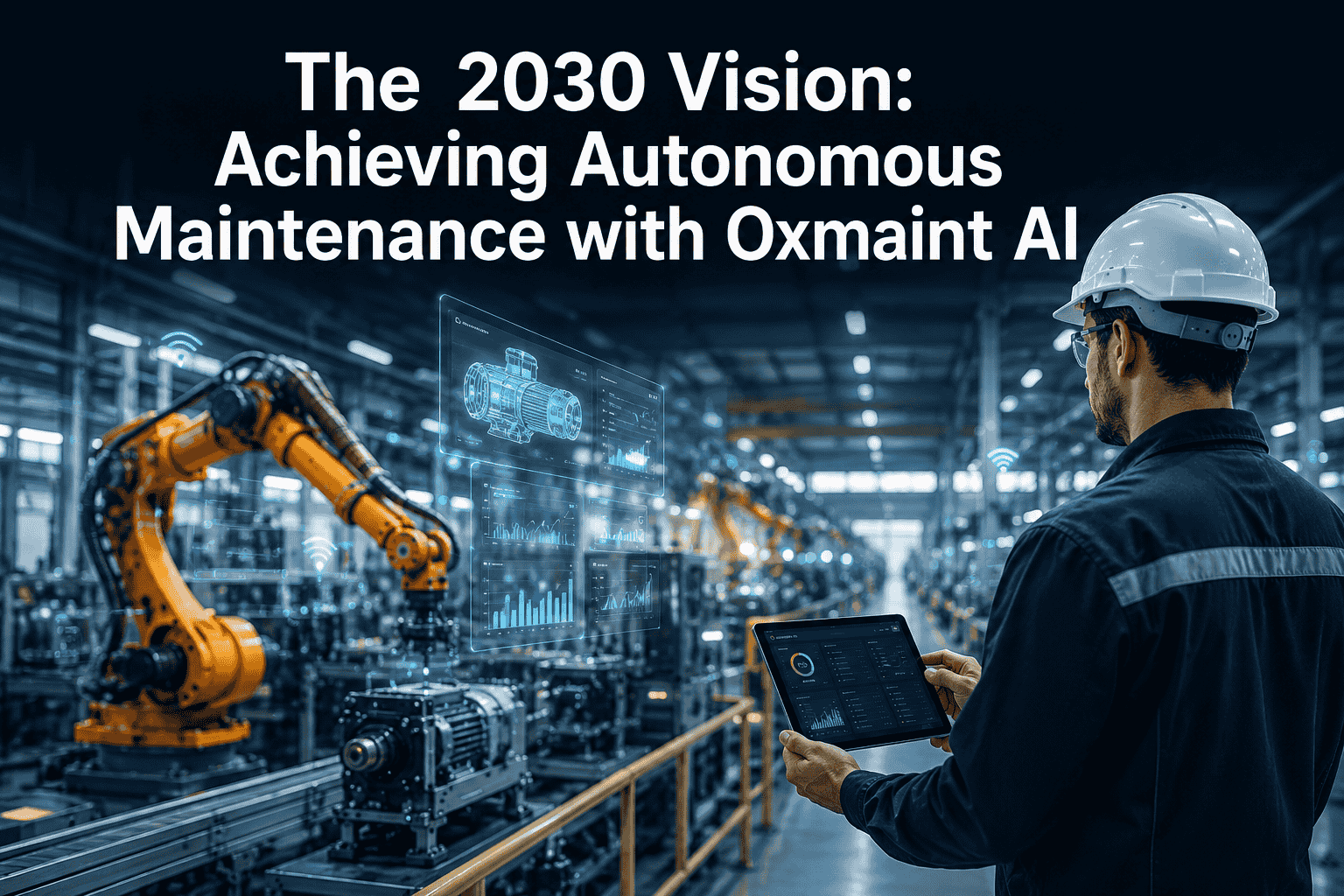
The 2030 Vision: Achieving Autonomous Maintenance with Oxmaint AI
Most maintenance departments in 2026 operate somewhere between Level 2 and Level 3 on the maintenance maturity scale — stuck in calendar-based PM schedules that over-maintain healthy assets and miss the failures that happen between scheduled tasks. The leaders are already at Level 4, where AI predicts failures and recommends the optimal action. By 2030, Level 4 will be the minimum standard for competitive manufacturing, and Level 5 — fully autonomous maintenance where machines self-diagnose, self-schedule, and self-optimize with human oversight on exceptions only — will separate the plants that thrive from the ones that struggle. OxMaint AI is the path from wherever you are today to Level 5 by 2030. Not as a distant roadmap. As a working platform that moves you up one level at a time, starting with the first 8-week pilot. Sign up free to assess your current maintenance maturity level.
Most Plants Are at Level 2. The 2030 Standard Is Level 5. OxMaint AI Closes the Gap.
The maintenance maturity staircase has five levels. Reactive maintenance costs 3-10× more than planned work. Calendar-based PM wastes parts and misses failures. Predictive AI cuts unplanned downtime by 50%. Prescriptive AI recommends the optimal action and timing. Autonomous maintenance — the 2030 target — self-diagnoses, self-schedules, and self-optimizes with human oversight only on exceptions. The leap from Level 2 to Level 5 does not require replacing your team. It requires augmenting them with AI that handles the pattern recognition, scheduling math, and parameter optimization that no human can do at machine speed.
The Five Levels of Maintenance Maturity · Where You Are and Where 2030 Takes You
The maturity staircase is not theoretical — it maps directly to measurable operational outcomes. Each level adds a capability that the previous level could not achieve. Most plants are at Level 2. The leaders are at Level 4. OxMaint AI is designed to move you up one level at a time, with each level delivering ROI before the next begins. Sign up free to map your current level and see the path to Level 5.
L1
REACTIVEThe default · where most legacy plants started
Fix it when it breaks. No sensors, no history, no prediction. Emergency repairs dominate. The most expensive maintenance model — 3 to 10× the cost of planned work.
DOWNTIME IMPACTMaximum unplanned downtime
L2
PREVENTIVEWhere most plants are in 2026
MOST PLANTS TODAY
Calendar-based PM schedules. Better than reactive — but services equipment that may not need it yet and still misses failures between scheduled tasks. Parts replaced on time, not on condition.
DOWNTIME IMPACT-20% vs reactive · still significant unplanned stops
L3
PREDICTIVEOxMaint AI entry point · 8-week pilot
Sensors + AI analyze real-time machine behavior. Vibration FFT, thermal imaging, motor current signature analysis. Failures detected 6-8 weeks before they happen. Maintain only what needs it, when it needs it. Work orders auto-generated in your CMMS.
PRESCRIPTIVEOxMaint AI + agentic workflows · 2027-2028
AI predicts the failure AND recommends the optimal corrective action, timing, technician, and spare part. Digital twin simulates the repair scenario before execution. Conversational AI lets technicians query equipment health in natural language. 80% of maintenance transactions automated.
Self-diagnosing, self-scheduling, self-optimizing. AI adjusts operating parameters to slow degradation. Machines coordinate spares, schedule technicians, and execute simple corrections without human prompts. Human oversight on capital decisions and exceptions only. 89% self-recovery rate in current early deployments.
DOWNTIME IMPACTNear-zero unplanned downtime · autonomous response in milliseconds
L2→L3
8-week pilot · first predictive alerts live
L3→L4
6-12 months · prescriptive workflows + digital twin
L4→L5
12-24 months · autonomous loop closes
2030
Level 4 = minimum competitive standard
The staircase is not a multi-year waiting game. Level 3 (predictive) goes live in 8 weeks and pays back in 4-6 months. Level 4 (prescriptive) layers on top of Level 3 within 6-12 months. Level 5 (autonomous) builds on the data and models from Levels 3 and 4 — the foundation you lay today is the intelligence layer that makes 2030 autonomous maintenance possible. Book a free demo to see which level your plant is at today and the fastest path to Level 4.
Two Real Maturity-Climb Scenarios
Two real scenarios from manufacturers who climbed the maintenance maturity staircase with OxMaint AI — from where they started to where they are now. Sign up free to start your own maturity climb.
SCENARIO 01
"We were a Level 2 plant running calendar-based PM on 200 assets. In 14 months we reached Level 4 — prescriptive AI now tells us what to fix, when, and with what part. Our maintenance budget dropped 23%."
STARTING POINT · LEVEL 2
Automotive parts manufacturer. 200 critical rotating assets. Calendar-based PM schedules in SAP PM — bearings replaced every 12 months regardless of condition. 40% of replaced bearings still had 6+ months of remaining life. Simultaneously, 8-12 unplanned failures per quarter from assets that failed between PM intervals. Maintenance budget: $4.2M/year. Unplanned downtime: 340 hours/year.
THE CLIMB · L2 → L3 → L4
Month 0-2 · Level 3 Entry
Jetson edge boxes deployed on top 40 critical assets. Vibration FFT, temperature, motor current streaming to RTX AI Brain. First predictive alerts within 6 weeks. SAP PM work orders auto-generated with failure mode and RUL attached.
Month 3-8 · Level 3 Full
Expanded to all 200 assets. AI models trained on 6+ months of plant-specific data. Unplanned failures dropped from 8-12/quarter to 2-3. Calendar-based PM schedules retired for monitored assets — replaced by condition-based triggers.
Month 9-14 · Level 4 Entry
Prescriptive workflows activated. AI not only predicts the failure but recommends: which technician (by skill match and proximity), which spare part (cross-referenced to SAP material master), which maintenance window (based on production schedule), and the estimated repair duration. 78% of maintenance transactions now flow without manual scheduling.
"Our food plant was at Level 1 — pure reactive. The board gave us 18 months to reach Level 3. We reached Level 4 in 16 months and the maintenance team went from firefighting to engineering."
STARTING POINT · LEVEL 1
Food processing plant. No PM program. No CMMS. Maintenance team of 12 operated in pure reactive mode — running from breakdown to breakdown. Emergency callout rate: 22 per month. Average MTTR: 4.6 hours. Parts inventory: uncontrolled — either out of stock or overstocked. Maintenance cost per unit produced was 3.4× the industry average. The board hired a new maintenance director and gave an 18-month mandate: reach predictive maintenance or outsource the department.
THE CLIMB · L1 → L2 → L3 → L4
Month 0-3 · Level 2 Foundation
OxMaint CMMS deployed. Asset register built. Basic PM schedules established for 80 critical assets. Parts inventory digitized. Emergency callouts dropped from 22/month to 14/month simply by introducing scheduled maintenance.
Month 4-10 · Level 3 Predictive
Jetson edge + RTX AI Brain deployed on top 30 assets. Vibration and thermal monitoring live. AI predicting failures 6+ weeks ahead. Calendar PM retired for monitored assets. Emergency callouts dropped to 4/month. MTTR dropped from 4.6 hr to 1.8 hr (because failures caught early = simpler repair).
Month 11-16 · Level 4 Prescriptive
Prescriptive layer activated. AI recommends technician, part, timing, and expected duration. Parts inventory auto-replenished based on predicted demand. Maintenance team shifted from firefighting to reliability engineering — analyzing root causes instead of chasing breakdowns.
THE RESULT · 16 MONTHS
Emergency callouts 22/mo → 4/mo. MTTR 4.6 hr → 1.8 hr. Cost per unit: 3.4× industry avg → 1.1×. Board target exceeded. Department saved. Team now engineers, not firefighters.
Frequently Asked Questions
The questions maintenance directors, plant managers, and CIOs ask when planning the path from calendar PM to autonomous maintenance by 2030. Book a free demo to map your maturity climb.
Do we have to go through every level sequentially?
Not necessarily. Plants at Level 1 (reactive) need to establish the Level 2 foundation (asset register, CMMS, basic PM schedules) before predictive AI has value — you need to know what assets you have before you can monitor them. But plants already at Level 2 can jump directly to Level 3 with an 8-week pilot. And the jump from Level 3 to Level 4 is a software activation, not a new infrastructure deployment — the same Jetson edge boxes and RTX AI Brain that run predictive models also run prescriptive workflows. Level 5 builds on the data and model maturity from Levels 3-4.
What does Level 5 autonomous actually look like in practice?
Not robots replacing technicians. Level 5 means the AI system detects the anomaly, classifies the failure mode, calculates remaining useful life, checks production schedule for the optimal maintenance window, confirms spare part availability, assigns the best-matched technician, generates the work order, and — for simple corrections like parameter adjustment, valve cycling, or lubrication top-up — executes the correction autonomously via DCS/PLC integration. Human maintenance engineers oversee exceptions, approve capital repairs, and focus on reliability improvement projects instead of daily scheduling. Current early deployments show 89% self-recovery rate on simple corrections.
How long does the full L2-to-L5 journey take?
Typical timeline: L2→L3 in 2-3 months (8-week pilot + expansion). L3→L4 in 6-12 months (prescriptive workflows, digital twin, conversational AI layered onto the existing predictive platform). L4→L5 in 12-24 months (autonomous loop closure, DCS integration for self-correction, model maturity on plant-specific data). Total: 20-39 months from Level 2 to Level 5 operational. Plants starting from Level 1 add 3-4 months for the CMMS and PM foundation. The key: each level delivers standalone ROI. You are not waiting 3 years for value — you are capturing value at every step.
Does autonomous maintenance mean fewer maintenance jobs?
It means different maintenance jobs. The number of emergency callouts drops dramatically (70-90% reduction). But the demand for reliability engineers, data analysts, and continuous-improvement specialists increases. The maintenance team shifts from reactive firefighting to proactive engineering. In practice, most plants redeploy rather than reduce: technicians who were running from breakdown to breakdown now analyze root causes, optimize operating parameters, and manage the AI models that prevent the breakdowns. The skillset evolves — OxMaint includes training modules for each maturity level transition.
What is the ROI at each level?
Level 3 (predictive): 50% unplanned downtime reduction, 18-25% maintenance cost reduction, 4-6 month payback. Level 4 (prescriptive): 70% unplanned downtime reduction, 80% transaction automation, 30-40% parts inventory optimization. Level 5 (autonomous): near-zero unplanned downtime, 89% self-recovery, maintenance team fully redeployed to reliability engineering. The financial case is front-loaded — Level 3 alone typically delivers $1M+ in avoided downtime within year one for a 200-asset plant. Each subsequent level adds incremental value on the same hardware investment.
Level 3 in 8 Weeks · Level 4 by Year-End · Level 5 by 2030
The 2030 Autonomous Maintenance Standard Starts with an 8-Week Pilot Today.
Book a 30-minute call with our deployment engineers. We will assess your current maturity level, identify the fastest path to Level 3, and show you the full staircase to Level 5 autonomous. Every step pays for itself. Perpetual license, source code included, $0/mo.