SAP Ariba AI Agents: The Future of Autonomous Procurement
SAP launched its Joule Bid Analysis Agent in Q1 2026, and by SAP Sapphire in May, the "Autonomous Enterprise" was no longer a roadmap item — it was a working architecture. Ninety-four percent of procurement leaders now use generative AI weekly. Eighty percent of CPOs name AI a top priority. But 78% of CIOs identify data control, security, and compliance as the primary barriers to scaling agent-based AI in procurement. The reason: procurement data is competitive intelligence. Supplier pricing, contract terms, spend patterns, and sourcing strategies reveal more about a company's cost structure than almost any other data set. Running procurement AI agents on cloud infrastructure where that data traverses multi-tenant hyperscaler regions is a sovereignty risk that most CIOs are no longer willing to accept. Sovereign AI agents — running on-premise, processing procurement data inside the enterprise perimeter, and integrating with SAP Ariba via standard APIs — deliver the autonomous procurement capability without the data-sovereignty exposure. Sign up free to evaluate sovereign procurement AI for your SAP Ariba environment.
SAP ARIBA · JOULE AGENTS · SOURCE-TO-PAY · SOVEREIGN AI
94% of Procurement Leaders Use AI Weekly. 78% of CIOs Say Data Sovereignty Is the Barrier. Sovereign Agents Solve Both.
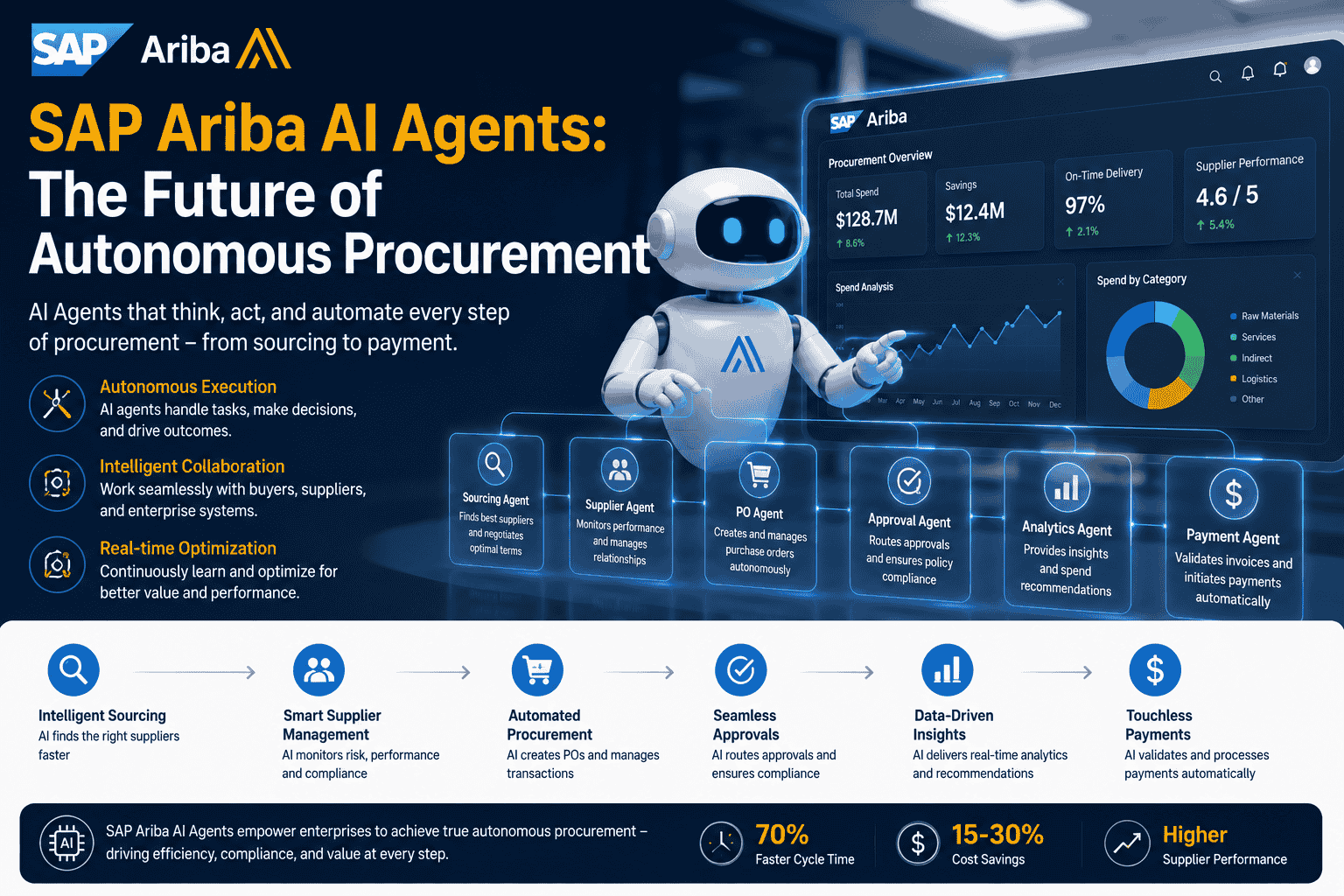
SAP Ariba's Joule agents automate bid analysis, intake management, guided buying, and invoice processing. OxMaint's sovereign AI agents extend that automation behind your firewall — running procurement analytics, supplier risk scoring, and spend optimization on-premise where supplier contracts and pricing data never leave the enterprise perimeter. The agents integrate with SAP Ariba via standard OData and BAPI interfaces. Your procurement team gets autonomous execution. Your CISO gets data sovereignty. Your CFO gets the cost savings.
Six Stages of Procure-to-Pay · Manual vs Autonomous Agent
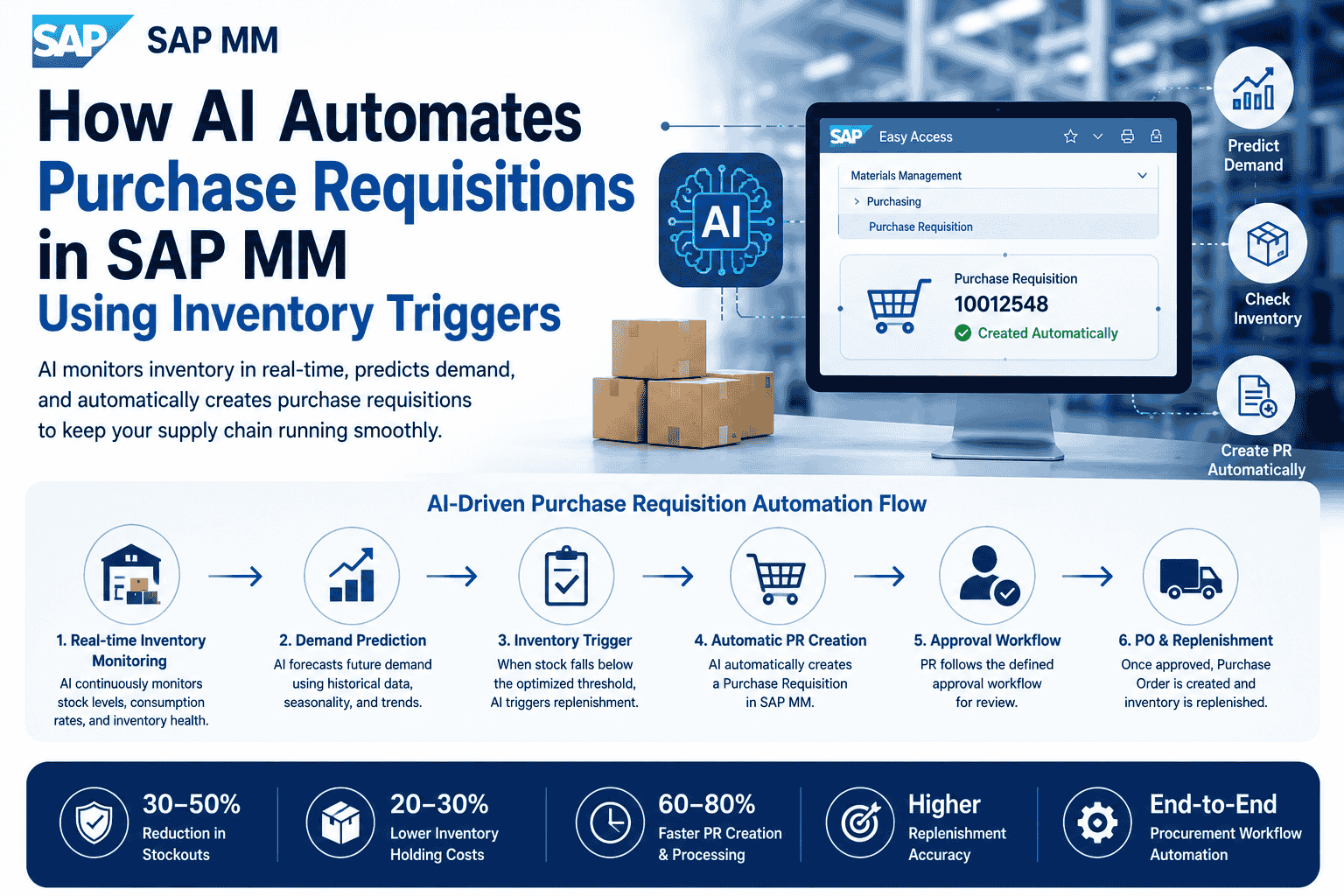
The procure-to-pay lifecycle has six stages. Today, each one involves manual handoffs, spreadsheet analysis, and email chains that stretch simple purchases into multi-day processes. Sovereign AI agents connected to SAP Ariba compress all six stages into minutes — while keeping supplier pricing and contract data inside the enterprise perimeter. Sign up free to map the six stages to your SAP Ariba procurement workflow.
01INTAKE & REQUISITION3.5 days → 2 min
MANUALRequester fills out a form (often wrong category, missing details). Procurement reviews, sends back for corrections. Average 1-2 round-trips before the requisition is accepted. Total: 1-3 days for a single PR.
AGENTRequester describes the need in natural language. The Intake Agent classifies the category, fills in specifications from the material master, checks budget availability, applies the correct approval workflow, and submits a complete PR. Two minutes.
02SOURCING & BID ANALYSIS5-7 days → 12 min
MANUALBuyer identifies potential suppliers, sends RFQs via email, waits for responses, enters bids into a spreadsheet, compares on price alone (ignoring shipping, payment terms, lead time). The spreadsheet-heavy workload takes 5-7 days for a complex category.
AGENTSAP Ariba's Joule Bid Analysis Agent sends RFQs to qualified suppliers on the Ariba Network, compares responses on total cost of ownership (unit price + shipping + payment terms + lead time), and generates a ranked shortlist with clear rationale. Sovereign AI runs the TCO model on-prem so supplier pricing never leaves the perimeter.
03SUPPLIER SELECTION & CONTRACT3-5 days → 15 min
MANUALBuyer evaluates supplier risk manually, checks references, reviews compliance certificates, negotiates terms via email, routes the contract for legal review. Multiple handoffs between procurement, legal, and the business owner.
AGENTAgent pulls the 360-degree supplier profile from SAP Ariba — risk score, performance history, compliance status, ESG rating. Suggests optimal contract clauses from the AI-powered clause library. Routes for approval only if the contract value exceeds the auto-approval threshold. Low-value contracts execute autonomously.
04PURCHASE ORDER CREATION1-2 days → 30 sec
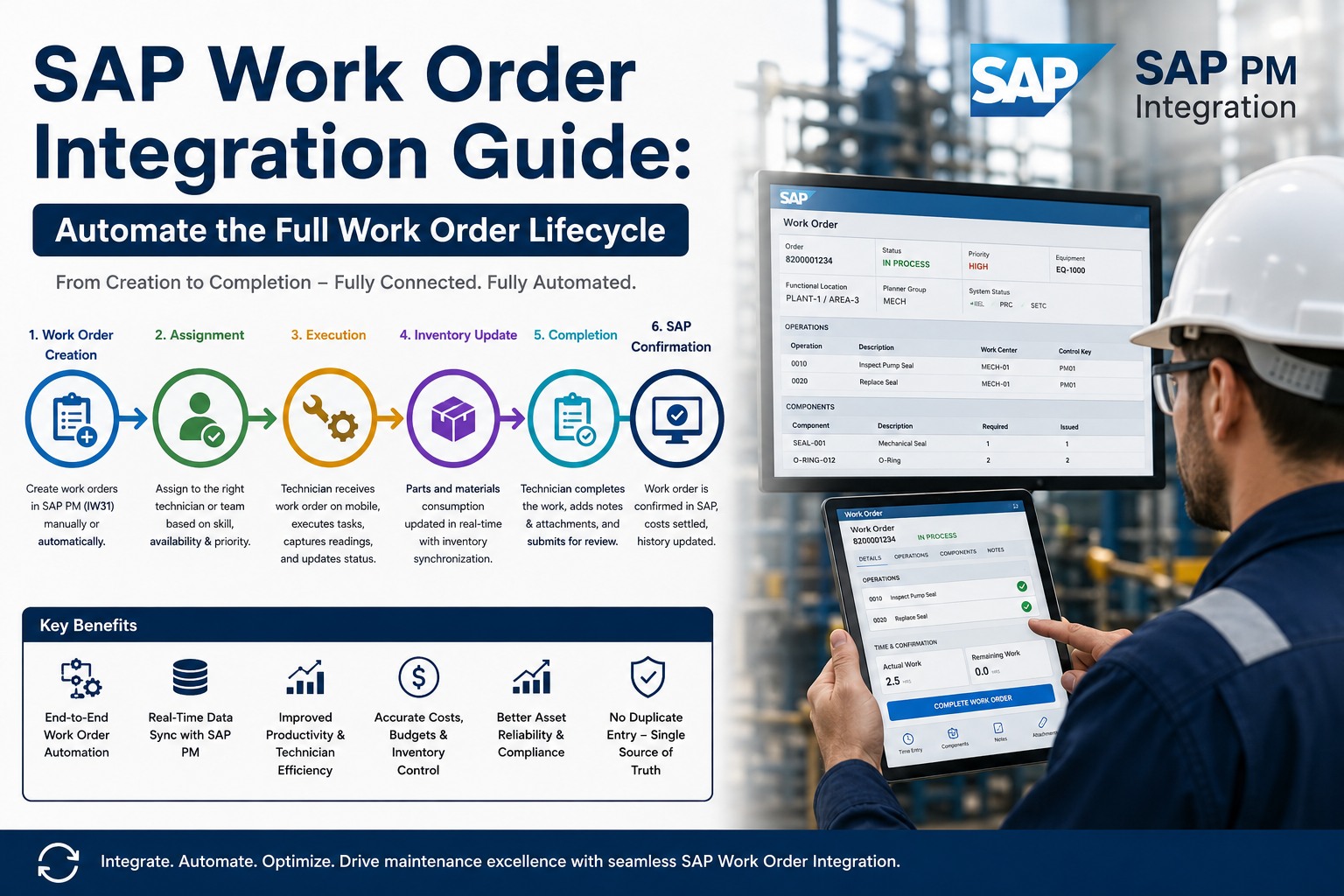
MANUALBuyer creates PO in SAP, enters line items, selects delivery address, applies tax codes, routes for approval. Approval chain: 1-3 approvers depending on value. Average cycle: 1-2 days including approval wait time.
AGENTAgent auto-generates the PO from the approved bid with all line items, delivery details, and tax codes pre-populated. Below-threshold POs auto-approve. Above-threshold POs route with full context attached — the approver sees the bid comparison, supplier risk score, and budget impact in one screen. Approval in one click, not one day.
05GOODS RECEIPT & INSPECTION2-4 hours → 5 min
MANUALWarehouse receives goods, manually checks quantities against the PO, inspects quality, enters the GR in SAP. Discrepancies require email chains with the buyer and supplier. Average resolution: 2-4 hours per discrepancy.
AGENTBarcode/RFID scan at receiving auto-matches quantities to the PO. AI vision inspection checks packaging integrity. Discrepancies flagged automatically with supplier notification sent in parallel. The agent creates the GR in SAP and triggers the three-way match before the warehouse team finishes unloading.
06INVOICE MATCH & PAYMENT3-5 days → 1 min
MANUALAP team receives invoice, manually matches to PO and GR (three-way match), identifies exceptions, resolves discrepancies via email, processes payment. Invoice exceptions can take 3-5 days each. Late payments damage supplier relationships and miss early-payment discounts.
AGENTSmart OCR extracts invoice data. Agent performs three-way match automatically. Clean matches auto-approve for payment. Exceptions flagged with root-cause classification (price variance, quantity mismatch, missing GR). Intelligent fraud detection catches duplicate invoices and anomalous patterns. Early-payment discounts captured automatically when cash flow permits.
"Our MRO procurement team processes 1,200 purchase requisitions per month. Each one averages 6 handoffs and 3.5 days. The agent reduced 80% of those to same-day — and our supplier pricing data never left the building."
THE PROBLEM
Manufacturing plant with 4 production halls. 1,200 MRO (maintenance, repair, operations) purchase requisitions per month. Each PR averaged 6 handoffs (requester → buyer → sourcing → approver → PO creator → receiver) and 3.5 days from request to PO. 40% of PRs had data-quality issues requiring correction round-trips. The procurement team of 8 spent 70% of their time on transactional processing and 30% on strategic work. Supplier pricing data for 2,400+ SKUs was uploaded to a cloud procurement analytics platform — the CISO flagged this as a competitive-intelligence risk after a competitor's pricing strategy appeared suspiciously aligned.
THE SOVEREIGN AGENT SOLUTION
Intake + Sourcing Agent
Requester describes the need. Agent classifies, fills specs from SAP material master, identifies 3 qualified suppliers from SAP Ariba, sends RFQs, compares bids on TCO. All supplier pricing analysis runs on-prem RTX server — pricing data never leaves the enterprise perimeter.
PO + Approval Agent
Below $5K: auto-approved PO created in SAP, supplier notified. Above $5K: routed to approver with full TCO comparison, supplier risk score, and budget impact — one-click approval. Handoffs reduced from 6 to 1 (approver only, and only when needed).
Spend Analytics On-Prem
DGX Station runs spend classification, supplier consolidation analysis, and price-trend models on 3 years of procurement history — entirely on-prem. Cloud analytics subscription cancelled. CISO's competitive-intelligence concern resolved.
THE RESULT
80% of PRs processed same-day (vs 3.5-day avg). Handoffs: 6 → 1. Data quality issues: 40% → 3%. Procurement team ratio flipped: 30% transactional / 70% strategic. Supplier pricing data: sovereign.
SCENARIO 02
"Our AP team was processing 800 invoices per month with a 12% exception rate. Each exception took 4.2 days to resolve. The agent cut exceptions to 2% and captured $340K in early-payment discounts we were missing."
THE PROBLEM
Chemical manufacturer. 800 supplier invoices per month. 12% exception rate (96 invoices/month) requiring manual investigation — price variances, quantity mismatches, missing goods receipts. Average resolution: 4.2 days per exception. Late payments triggered by unresolved exceptions cost $180K/year in missed 2% early-payment discounts. Three duplicate invoices paid in the last 12 months totaling $47K (recovered, but only after manual audit). AP team of 4 spent 60% of time on exception investigation.
THE SOVEREIGN AGENT SOLUTION
Invoice Processing Agent
Smart OCR extracts invoice line items on the RTX server (on-prem — invoice images never uploaded to cloud OCR service). Three-way match against PO and GR runs automatically. Clean matches (88% of volume) auto-approve for payment within the discount window.
Exception + Fraud Agent
Exceptions classified by root cause (price variance vs quantity vs missing GR) and routed to the right resolver with full context. Duplicate invoice detection catches matches on invoice number, amount, date, and supplier — zero duplicates paid since deployment. Anomaly detection flags unusual patterns (sudden amount increases, new bank accounts).
Payment Optimization
Agent monitors cash position and auto-schedules payments to capture early-payment discounts when cash flow permits. $340K/year in 2% discounts that were previously missed because invoices sat in exception queues past the discount deadline.
THE RESULT
Exception rate: 12% → 2%. Resolution time: 4.2 days → same-day. Duplicate payments: 3 → 0. $340K/yr in captured early-payment discounts. $47K/yr in prevented duplicate payments. AP team refocused on vendor management.
No — sovereign AI agents work alongside SAP Ariba, not instead of it. SAP Ariba remains the procurement platform of record: supplier network, catalog management, contract repository, and transaction processing. Sovereign AI agents extend Ariba's capabilities by running procurement analytics, bid-analysis models, spend-classification algorithms, and fraud-detection logic on-premise — where supplier pricing and contract data stay inside the enterprise perimeter. The integration uses standard SAP OData and BAPI interfaces. Ariba handles the workflow. The sovereign agent handles the intelligence.
Why does procurement data need sovereign AI?
Procurement data is competitive intelligence. Supplier pricing across 2,000+ SKUs reveals your cost structure. Contract terms reveal your negotiating leverage. Spend patterns reveal your strategic priorities. When this data is processed on a multi-tenant cloud AI platform, it sits on infrastructure you do not control alongside data from other enterprises — potentially including your competitors. Seventy-eight percent of CIOs cite data control and security as the primary barrier to scaling procurement AI. Sovereign agents remove that barrier: the intelligence runs on your hardware, the data stays in your perimeter, and the competitive advantage stays with you.
What procurement decisions can the agent make autonomously?
Configurable by value threshold and risk level. Typical autonomous authority: PR routing and classification (all values), supplier selection from approved lists (below $5K), PO creation and approval (below configurable threshold, typically $5K-$25K), three-way invoice match and payment approval (within tolerance), and early-payment discount capture. Above-threshold decisions route to human approvers with full agent-assembled context. The human reviews and approves in one click — not from scratch. Authority levels are configured per category, per business unit, and per risk profile.
How does the agent handle supplier negotiations?
The agent does not negotiate — it prepares the negotiator. It assembles the complete negotiation package: historical pricing trends for the category, supplier's price vs market benchmark, quality and delivery performance scores from SAP Ariba, alternative suppliers with comparable capability, and the TCO model showing where the incumbent wins and where they are over-market. The strategic buyer walks into the negotiation with a data package that previously took 2-3 days to assemble — delivered in minutes, with all analysis running on-prem.
How fast can we deploy procurement AI agents?
Eight to twelve weeks. Weeks 1-2 — procurement process audit: highest-volume categories, current cycle times, exception rates, SAP Ariba configuration review. Weeks 3-4 — RTX Procurement Brain deployed, SAP Ariba OData integration configured, material-master and supplier-master synchronized. Weeks 5-6 — intake and sourcing agents live on the top 3 MRO categories (typically highest volume, lowest complexity). Weeks 7-8 — invoice-match and payment-optimization agents activated, fraud-detection models loaded. Weeks 9-12 — expanded to all categories, spend-analytics models trained on historical data, procurement team trained on exception-management workflows.
Procurement Edition · SAP Ariba Integration · 8-Week Pilot
The Agent Processed 960 PRs This Month. Your Team Handled the 240 That Needed Judgment.
Book a 30-minute call with our procurement deployment engineers. Walk through your SAP Ariba configuration, your highest-volume categories, and your exception rates. See the sovereign procurement agent processing requisitions, analyzing bids, and matching invoices — all on-prem, all sovereign. Perpetual license, source code included, $0/mo.