The Great Decoupling: Why Industrial Giants Are Moving AI from Cloud to Edge in 2026
The edge AI market hit $24.9 billion in 2025 and is projected to reach $118.7 billion by 2033 — a 21.7% CAGR that makes it one of the fastest-growing infrastructure categories in enterprise technology. Manufacturing alone accounts for 20.8% of all edge computing adoption, the largest single sector after IT and telecom. The shift is not experimental. It is a structural migration driven by five forces that the cloud cannot overcome by getting better — because the forces are not about cloud capability. They are about physics, geography, regulation, economics, and operational reality. The round-trip latency to a cloud region cannot be reduced below the speed of light. The reliability of a connection you do not control cannot be guaranteed. The sovereignty of data that leaves your perimeter cannot be enforced. Industrial organizations are not abandoning the cloud. They are decoupling real-time AI from it — and running it where the data lives. Sign up free to evaluate the edge-first architecture for your operations.
$24.9B in 2025. $118.7B by 2033. Manufacturing Is Leading the Migration from Cloud to Edge.
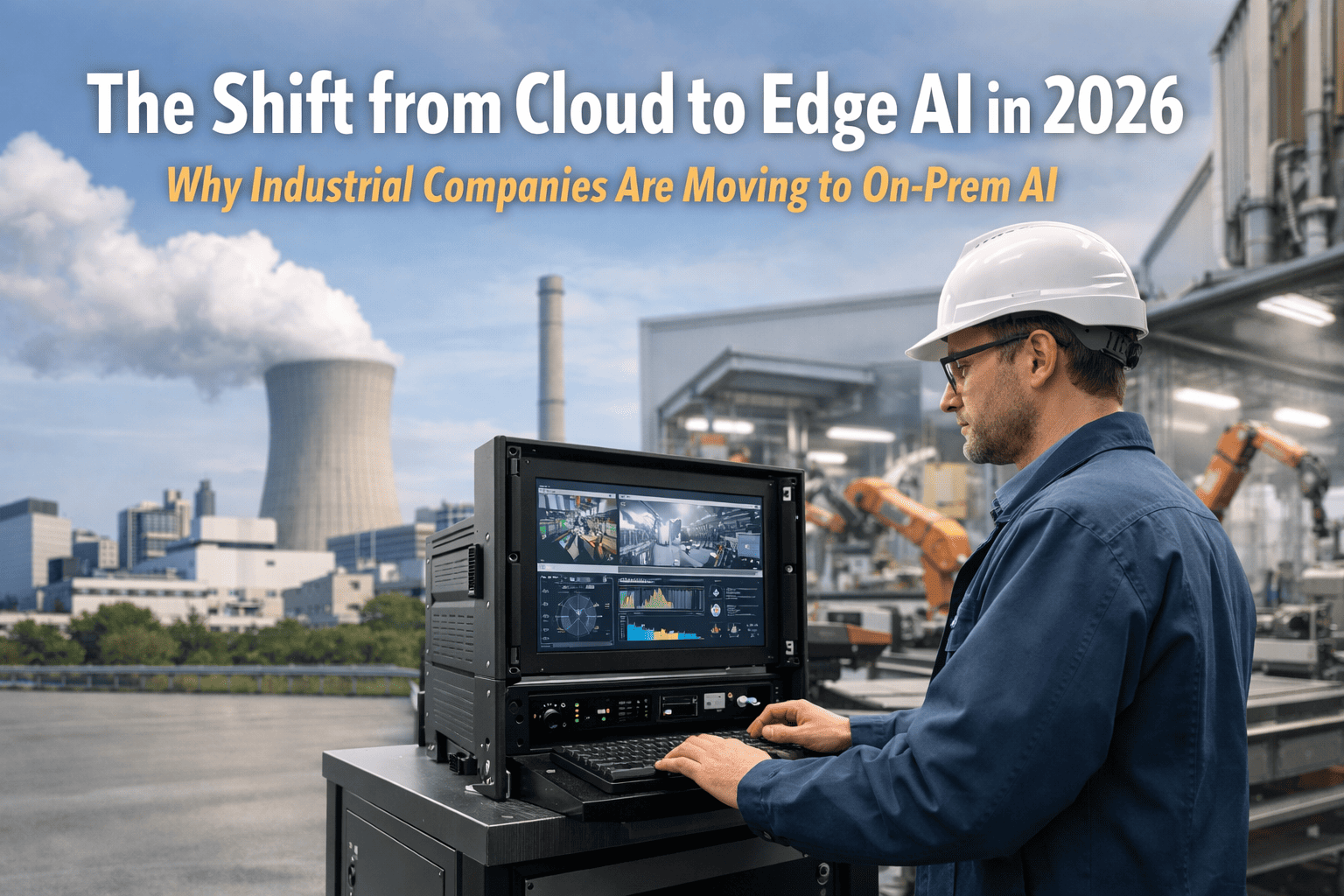
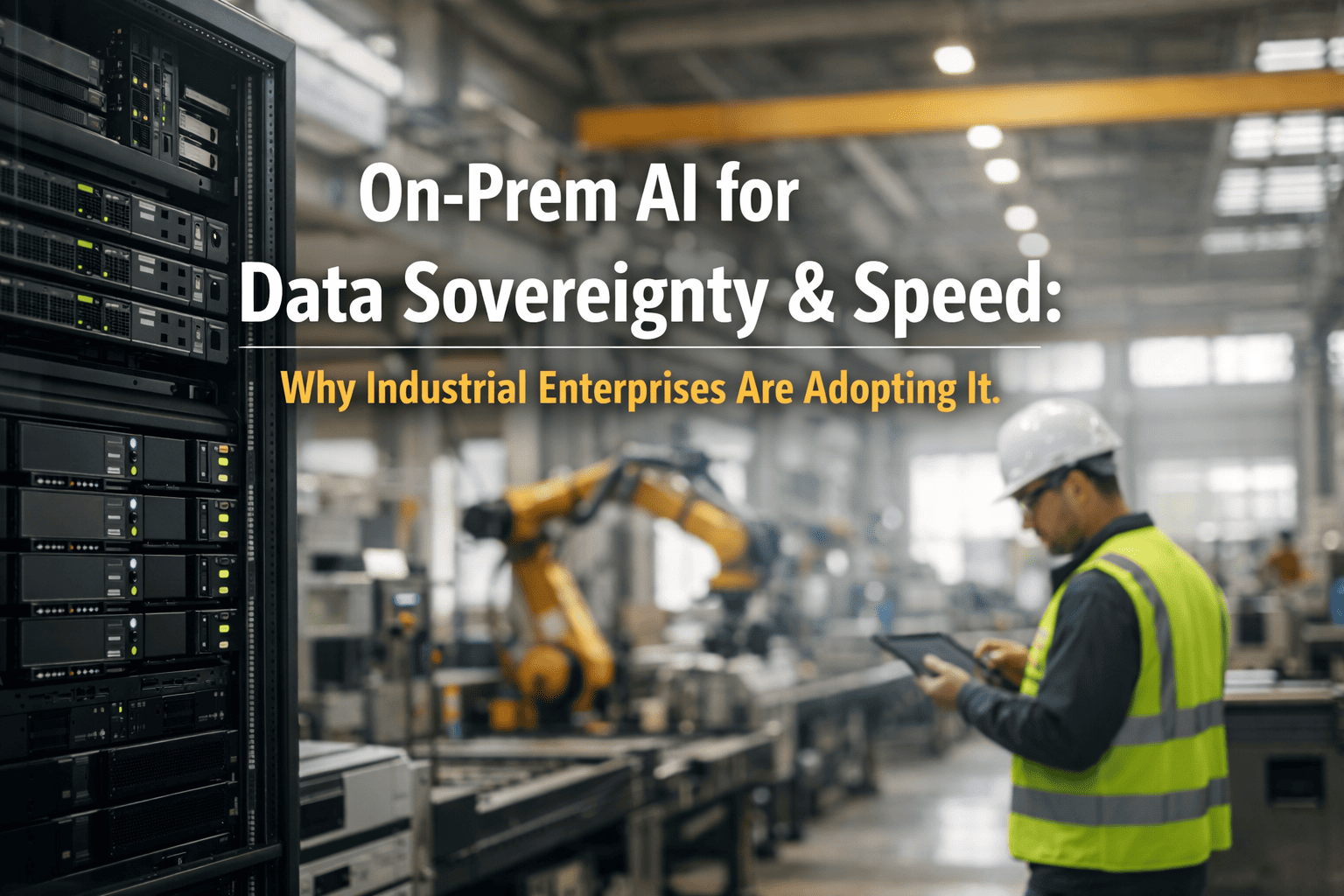
Industrial AI workloads are moving to the edge because the alternative stopped working. Cloud latency kills real-time inspection. Cloud outages halt predictive maintenance. Cloud tenancy violates data-sovereignty mandates. Cloud metering turns every inference into a recurring cost. Edge AI solves all four — processing data at the plant, at machine speed, with zero dependency on a connection, a hyperscaler, or a monthly invoice. The architecture is edge-first, cloud-optional: real-time decisions happen locally, cloud serves analytics when available.
The migration is not driven by a single factor. Five forces are converging simultaneously — and each one alone would be sufficient to justify the shift. Together, they make cloud-dependent industrial AI an architecture that does not survive contact with production reality. Sign up free to assess which forces apply to your operations.
01LATENCY IS PHYSICS, NOT ENGINEERING
CLOUDRound-trip to a cloud region: 100-500ms best case. For a bottling line at 1,200/min, the bottle has moved 10 positions before the cloud even begins processing the inspection image. Cloud cannot fix this — the speed of light to US-East-1 and back is a constant.
EDGESensor-to-decision in under 10ms. The Jetson edge box sits 3 meters from the camera. The RTX server sits in the plant control room on the same LAN. Physics is on your side — not working against you.
02RELIABILITY IS NOT AN SLA — IT IS A PLANT
CLOUDAWS, Azure, and Google Cloud logged 100+ outages in 12 months (Aug 2024-Aug 2025). The Oct 2025 AWS outage lasted 15 hours, affecting 3,500+ companies across 60+ countries. Manufacturing averaged 4.2 hours per incident — the longest of any sector.
EDGEEdge AI does not notice cloud outages. The AI runs on hardware inside your plant, on your power, on your network. Internet goes down? Nothing changes. Cloud region fails? Nothing changes. Your AI is as reliable as your own electrical supply.
03SOVEREIGNTY IS NOW REGULATION, NOT PREFERENCE
CLOUDCloud AI platforms send production data — sensor readings, supplier information, quality records, equipment specifications — to multi-tenant hyperscaler regions. Data-localization mandates in the EU, Germany, China, India, and defense-sector ITAR restrictions make this increasingly non-compliant.
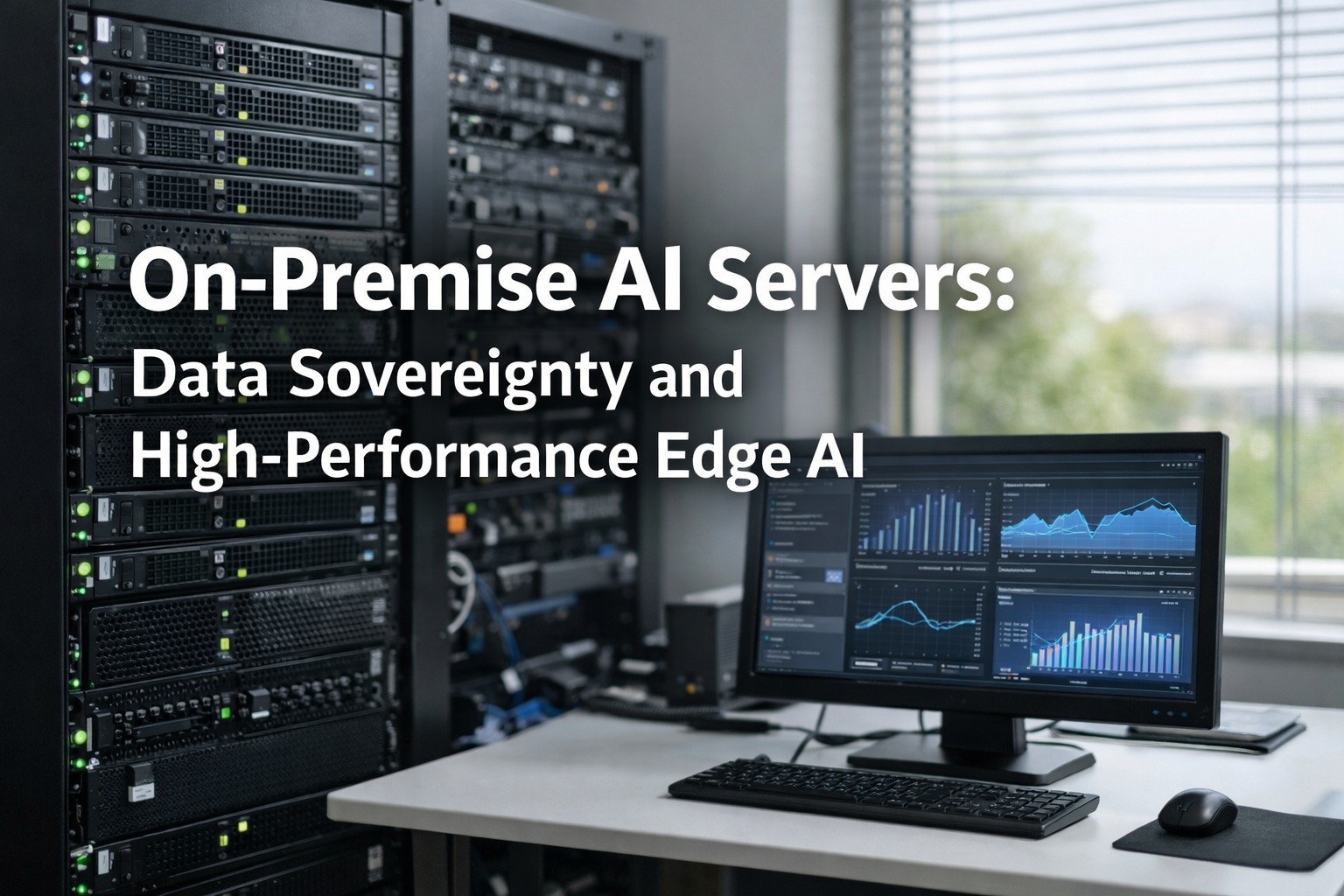
EDGEData never leaves the plant perimeter. Processing, models, results, audit trails — all on-prem. Compliant by architecture, not by policy. ITAR, GDPR, data-localization mandates, and competitive-intelligence protection all handled by where the hardware sits.
04CLOUD COSTS SCALE LINEARLY — EDGE DOES NOT
CLOUDCloud AI costs per inference, per API call, per GB stored, per month, forever. As sensor count grows, cloud bills grow proportionally. A 200-asset plant running 100+ sensor streams generates $15K-$40K/month in cloud AI costs — and the bill never stops.
EDGEOne-time CapEx with 5-7 year hardware life. After month 12-18, edge AI runs at near-zero marginal cost. Double the sensor count? Same hardware, same cost. The economics invert at scale — the more you process, the cheaper edge becomes per inference.
05DATA UTILIZATION REQUIRES PROXIMITY
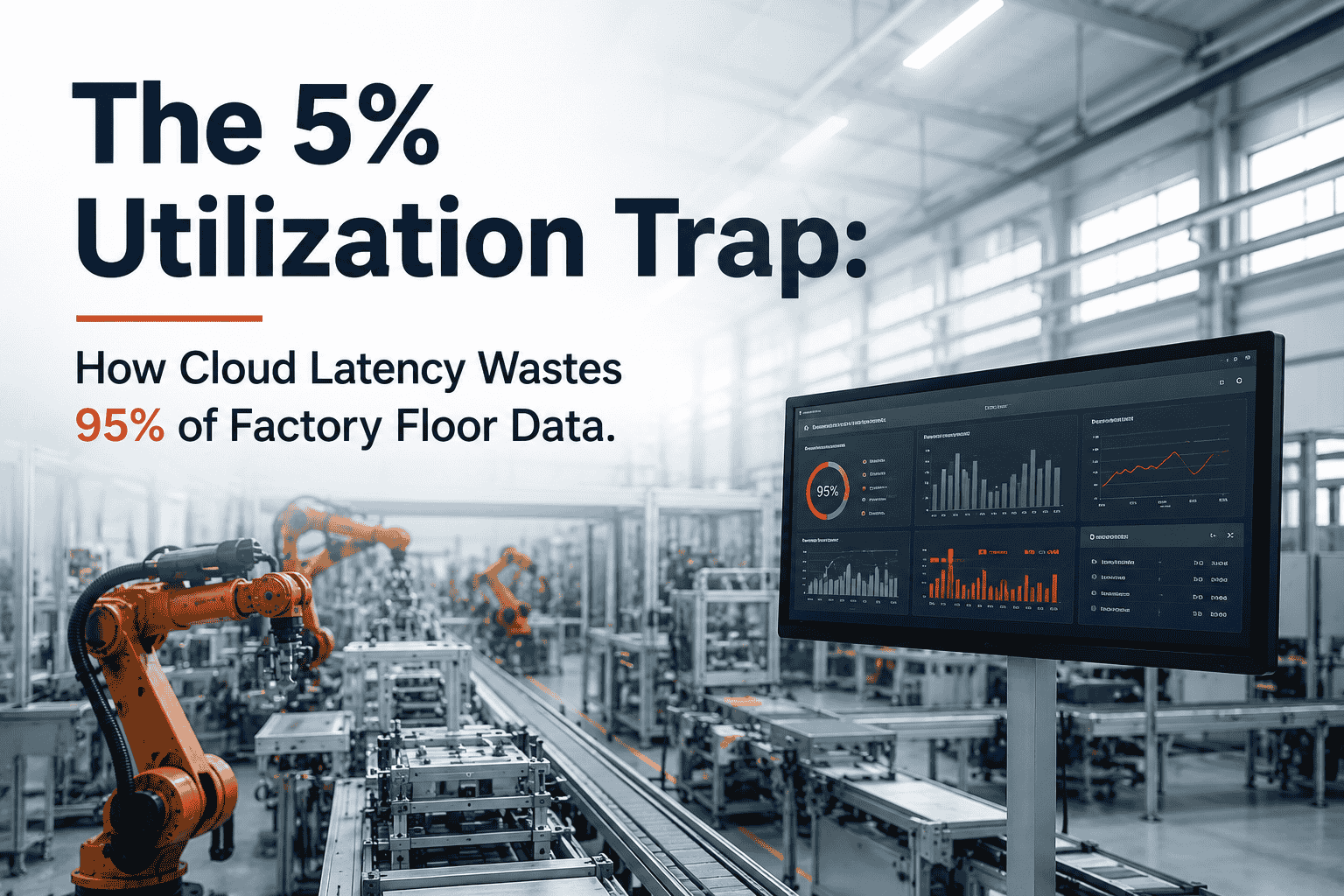
CLOUDOnly 5-20% of factory data reaches a decision through cloud analytics. Bandwidth throttling, upload batching, analysis queuing, and stale-data expiry filter out 80-95% of readings before they produce an actionable insight.
EDGE95% of readings reach a decision. Full-resolution data processed in real time. No upload, no batch, no queue, no expiry. The same sensors produce 19× more intelligence — not because the data changed, but because the processing moved closer.
$118.7B
Edge AI market by 2033
60%+
Organizations at edge analytics by 2027
5.8B
Edge-enabled IoT devices · 2026
19×
More intelligence from same sensors
None of these forces are temporary. Latency is constrained by physics. Outage frequency is increasing. Sovereignty regulation is tightening. Cloud costs only go up. Data generation is accelerating. The organizations that decouple real-time AI from the cloud in 2026 gain structural advantages that widen every year. Book a free demo to see the edge-first architecture running against your plant data.
"We were paying $32K/month for cloud-hosted predictive maintenance on 180 assets. Alert latency was 8-15 minutes. During the October 2025 AWS outage, the platform went dark for 11 hours. We moved to edge AI and the $32K/month stopped."
CLOUD STATUS QUO
Automotive parts manufacturer. 180 monitored assets across 3 production halls. Cloud PdM platform: $32K/month ($384K/year). Vibration data downsampled from 10kHz to 1Hz for upload. FFT run in the cloud on 15-minute batches. Alerts delivered 8-15 minutes after the event. During the Oct 2025 AWS outage: zero monitoring for 11 hours. One bearing degradation progressed unmonitored and required emergency parts at $48K premium. Platform renewal: $384K/year with a 12% annual price increase built into the contract.
THE DECOUPLING
Plant Floor Edge (Jetson)
Full 10kHz vibration data preserved — no downsampling. FFT computed on the edge box every 60 seconds. Alerts in under 1 minute. Zero dependency on internet. The Oct 2025 outage scenario: AI continues operating. The $48K emergency premium never happens.
Plant AI Brain (RTX)
Failure-mode classification, RUL prediction, auto work order generation — all on the plant LAN. Cloud gets a daily summary for the corporate dashboard. Cloud is optional, not operational.
Economics
One-time hardware investment: $94K. Perpetual software license: $45K. Total: $139K — paid once. Cloud cost eliminated: $384K/year (growing 12%/year). Year 1 savings: $245K. Year 2-7: $384K+ saved per year. Total 5-year savings: $1.8M+ vs cloud continuation.
THE RESULT
$384K/yr cloud cost → $0/yr. Alert latency 15 min → under 1 min. Outage resilience: total. $1.8M+ 5-year savings. Better performance. Zero dependency.
SCENARIO 02
"Our cloud vision-inspection AI was costing $0.004 per image. At 72,000 images per hour across 4 lines, that is $8,640/day. We moved inference to the edge and the per-image cost dropped to effectively zero."
CLOUD STATUS QUO
Beverage bottler. 4 packaging lines, 1,200 bottles/min each. Cloud AI vision-inspection platform charging $0.004 per inference. At 72,000 images/hour across 4 lines running 20 hours/day: $8,640/day, $216K/month, $2.59M/year. Latency: 200-400ms per image (images batch-uploaded). At line speed, bottles pass the reject point before the cloud verdict returns. Operational workaround: slow the line to 800 BPM to give the cloud time to respond — sacrificing 33% throughput to accommodate the cloud's latency.
THE DECOUPLING
Camera Edge (Jetson)
One Jetson per line. Camera connected via GigE Vision. Inference in under 30ms per bottle — verdict returned before the bottle leaves the camera station. Lines restored to full 1,200 BPM. 33% throughput recovered.
Quality Brain (RTX)
Root-cause tracing across all 4 lines. Shift quality reports generated locally. Cloud receives daily summary for corporate QC dashboard. Per-image cost on edge hardware: effectively $0 after the initial investment amortizes in 3 weeks.
Economics
Edge hardware + license: $125K total. Cloud cost eliminated: $2.59M/year. Payback: 18 days. Additional revenue from restoring 33% throughput (800→1,200 BPM): $1.4M/year in previously lost capacity.
THE RESULT
$2.59M/yr cloud cost → $0/yr. Line speed restored to 1,200 BPM (+33%). Payback in 18 days. $3.99M/yr total value captured (cloud savings + throughput recovery).
Does edge-first mean we abandon the cloud entirely?
No. Edge-first means real-time AI decisions happen at the plant — predictive maintenance alerts, quality inspection verdicts, process-control adjustments. Cloud remains useful for workloads that are not time-critical: fleet-wide analytics across multiple plants, long-term trend dashboards, corporate-level reporting, and model retraining on aggregated historical data. The architecture is "edge for operations, cloud for analytics." Operations never depend on the connection — but the connection is used when it exists for value-added analytics.
How does the total cost of ownership compare to cloud?
Cloud AI costs scale linearly — every additional sensor, every additional inference, every additional month adds cost. Edge AI is a one-time capital purchase with a 5-7 year hardware life. For a typical 200-asset plant running 100+ sensor streams, cloud PdM platforms cost $250K-$400K/year. The equivalent edge deployment (Jetson edge boxes + RTX server + perpetual license) costs $90K-$140K once. Breakeven: 4-6 months. Year 2-7: the cloud path continues paying $250K-$400K/year while the edge path runs at near-zero marginal cost. Over 5 years, the TCO difference typically exceeds $1M.
How do we handle model updates without cloud?
Model updates are versioned packages, not live cloud deployments. New model versions are trained on the DGX Station (on-prem) or downloaded during connectivity windows, validated on a staging instance, and deployed to production during a controlled maintenance window. The same update process used for PLC firmware and DCS logic. Updates happen on your schedule — not the vendor's automatic push. For multi-plant fleets, a corporate DGX trains fleet models centrally and pushes versioned updates to each plant's RTX server via the internal WAN or VPN.
What about scaling — can edge handle plant expansion?
Edge scales horizontally. Each additional asset cluster gets a Jetson edge box ($4,000). Each additional plant gets an RTX server ($19,000). The scaling cost is linear but one-time — not recurring. A 4-plant rollout with 800 assets total runs $420K-$520K in total hardware + software, paid once. The equivalent cloud deployment at scale costs $1M-$1.6M/year, every year, with annual price increases. Edge scaling is slower to deploy (8 weeks per plant vs cloud's instant spin-up) but dramatically cheaper over any time horizon beyond 12 months.
How fast can we migrate from cloud to edge?
Eight to twelve weeks for a single-plant deployment. Weeks 1-2 — site survey, critical workloads identified, existing cloud platform audit. Weeks 3-4 — Jetson edge boxes deployed at asset clusters, RTX server installed, sensor connections validated. Weeks 5-6 — AI models migrated from cloud to edge, first alerts flowing on the plant LAN, cloud platform running in parallel for validation. Weeks 7-8 — edge production confirmed, cloud subscription cancellation scheduled, operator training complete. The migration is not a cutover — it is a parallel run where edge proves itself before cloud is decommissioned.
Edge-First · Cloud-Optional · 8-Week Migration
The Cloud Bill Stops. The Latency Stops. The Outage Risk Stops. The AI Does Not.
Book a 30-minute call with our deployment engineers. Walk through your current cloud AI costs, your latency constraints, and your sovereignty requirements. See exactly what the edge-first architecture looks like for your plant — and how fast the cloud bill goes to zero. Perpetual license, source code included, $0/mo.