The 5% Utilization Trap: How Cloud Latency Wastes 95% of Factory Floor Data
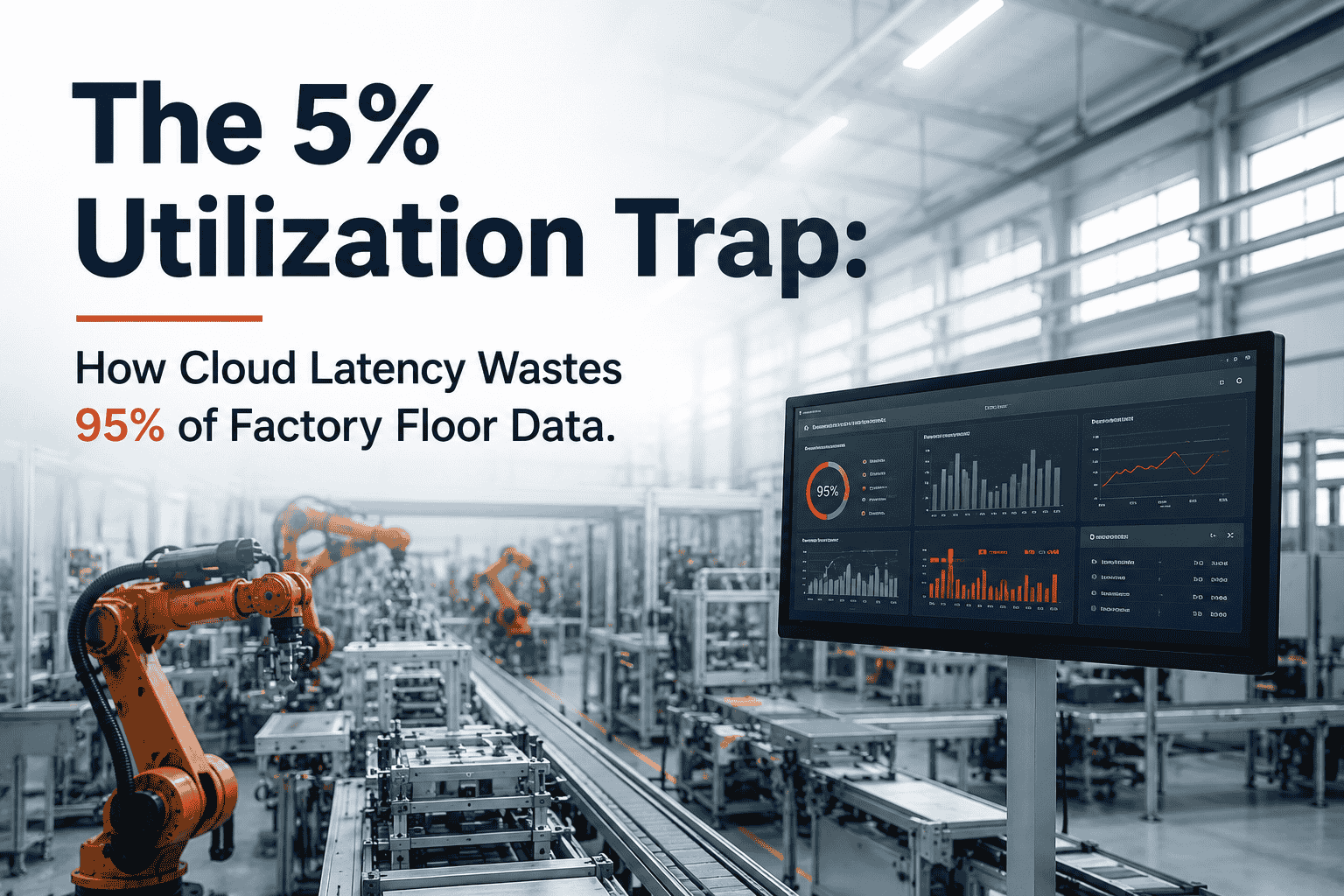
Your factory floor generates thousands of data points every second — vibration readings, motor temperatures, quality measurements, production counts, energy draws. You paid for the sensors. You paid for the connectivity. You paid for the cloud platform. And according to research from McKinsey and IIoT World, somewhere between 80% and 95% of that data never produces a single actionable decision. Not because the data is bad. Not because the AI models are wrong. Because by the time the data makes the round trip to the cloud and back, the moment it was relevant has already passed. The machine that was vibrating oddly at 10:14:03 has already seized by the time the cloud-analyzed alert arrives at 10:14:47. That 44-second gap is the 5% utilization trap — and it is the most expensive inefficiency most manufacturers do not know they have. Sign up free to see how much of your factory data is actually reaching a decision.
EDGE AI · SUB-10ms · ZERO DATA WASTE
Your Factory Generates 100 Data Points per Second. Only 5 Reach a Decision. Edge AI Fixes the Other 95.
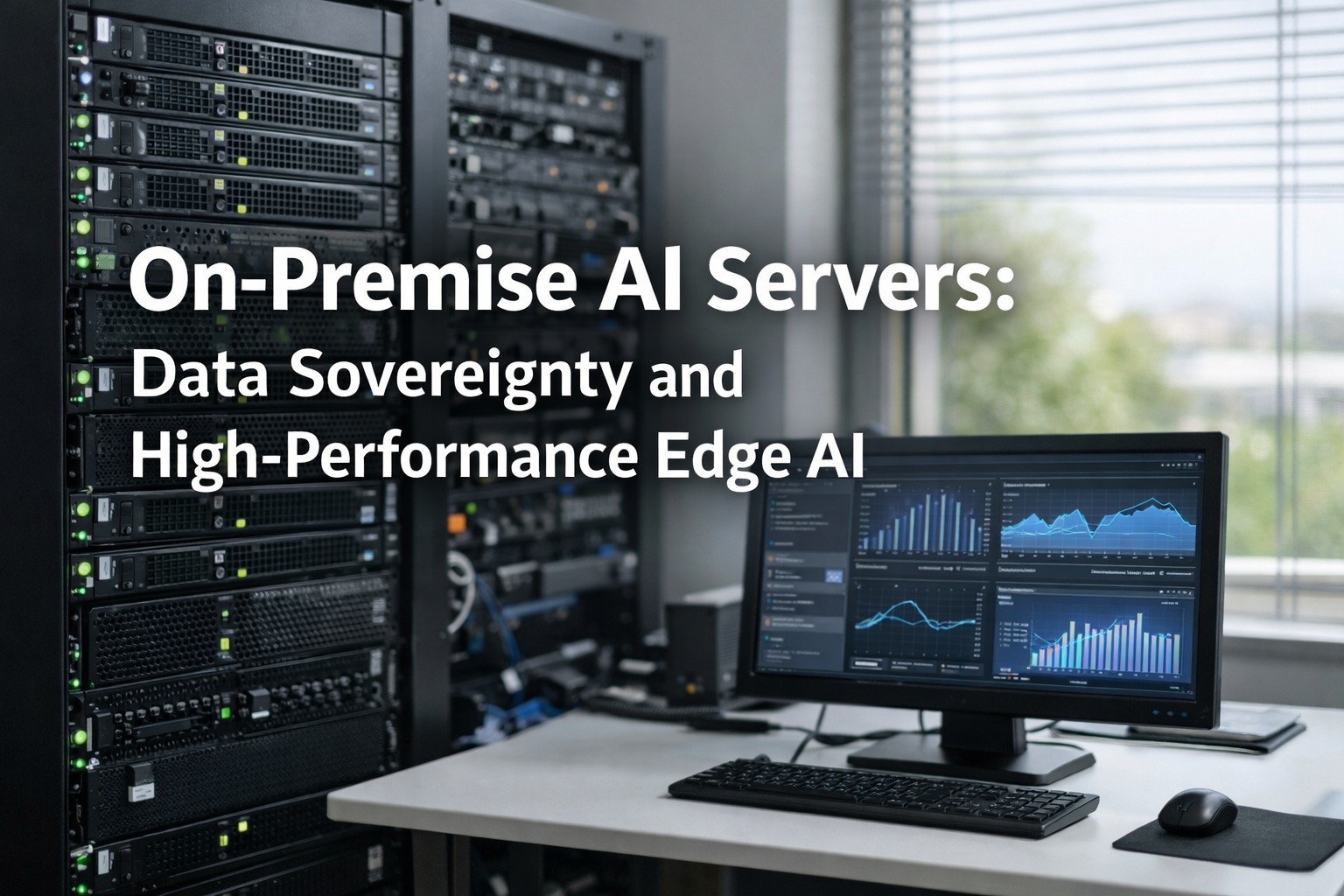
Cloud-based analytics require a round trip — sensor to network to internet to cloud region to analysis queue to model to response to plant. That round trip takes 100-500ms on a good day, seconds to minutes when the queue backs up, and infinity when the connection drops. Edge AI processes data at the source in under 10ms. The vibration spike, the quality defect, the temperature anomaly — all caught and acted on before a cloud upload would have even started. Manufacturing generates the most data of any industry. Edge AI is the only architecture that uses it.
Where Your Factory Data Goes to Die · The Five Decay Stages
The data does not vanish instantly. It decays through five stages — each one shaving off another chunk of readings that will never contribute to a decision. The problem is not collection. The problem is the architecture between collection and action. Sign up free to audit your data decay rate.
01BANDWIDTH THROTTLE-20%
CLOUDSensor data exceeds upload bandwidth. Network buffers fill. Oldest readings are dropped or downsampled from 1kHz to 1Hz — losing the high-frequency signatures that vibration analysis and quality inspection need.
EDGE AIData processed at the sensor cluster. No upload required. Full 1kHz-25kHz signal preserved for FFT and anomaly detection. Zero bandwidth constraint.
02UPLOAD QUEUE BATCHING-50%
CLOUDTo reduce API costs, data is batched into 5-minute or 15-minute windows before upload. Individual sub-second readings are averaged into single summary values. The transient vibration spike that lasted 0.3 seconds is averaged into nothing.
EDGE AINo batching. Every reading processed individually at full resolution. The 0.3-second spike is captured, classified, and flagged within 10ms of occurrence.
03CLOUD ANALYSIS QUEUE-63%
CLOUDData arrives at the cloud analytics service and enters a processing queue. During peak hours or multi-tenant congestion, queue depth grows. Readings from 10:00 are analyzed at 10:14. The bearing that started failing at 10:00 does not appear in the dashboard until 10:14.
EDGE AINo queue. RTX engine processes each reading on arrival. The bearing failure appears on the operator dashboard within 200ms of the first anomalous reading.
04STALE DATA EXPIRY-85%
CLOUDBy the time analysis completes, many readings are too old to act on. McKinsey found that 90% of MES data is purged every 30 days. Most process-control decisions have a useful life of seconds, not minutes. Cloud latency makes most of them arrive after the window has closed.
EDGE AIData never goes stale. Analysis happens in real time. The decision window is always open because the processing is co-located with the sensor — under 10ms from reading to insight.
05ACTION GAP-95%
CLOUDThe alert arrives. The operator checks the dashboard. The shift supervisor reviews the trend. By the time the work order is created, the event that triggered it is 15-30 minutes old. Only 5 out of every 100 readings contribute to a decision that changes an outcome.
EDGE AIAlert, classification, work-order creation, and operator notification happen in the same sub-second window. 95 out of 100 readings contribute to operational decisions. The sensor investment finally pays for itself.
"Our cloud predictive maintenance platform sends vibration alerts 12-18 minutes after the event. By the time the operator reads the alert, the bearing has already progressed from early-stage to mid-stage degradation. We are always chasing the failure instead of preventing it."
THE PROBLEM
Automotive parts manufacturer. 340 CNC machines across 3 production halls. Cloud-hosted predictive maintenance SaaS platform. Vibration sensors sample at 10 kHz but the cloud platform downsamples to 1 Hz for upload (bandwidth cost). FFT runs in the cloud on 15-minute batches. Alert delivery: 12-18 minutes after the vibration event. By the time the alert fires, the bearing has progressed through 15+ minutes of unsupervised degradation. Three spindle failures in 6 months traced to alerts that arrived too late to prevent the cascade.
HOW EDGE AI SOLVES IT
Plant Floor Edge (Jetson)
10 kHz signal preserved in full. 2,048-line FFT computed on the edge box every 60 seconds — no downsampling, no batching, no cloud round-trip. Bearing fault frequency (BPFO/BPFI) detected in the first anomalous cycle.
Plant AI Brain (RTX)
Failure-mode classification in under 200ms. Alert fires on the operator's HMI within the same production cycle the anomaly occurred. Work order auto-generated in the plant CMMS before the spindle completes its next part.
Operator Action
Operator sees the alert within 1 minute of the event, not 15. Spindle unloaded, bearing inspected, replacement scheduled. Early-stage degradation caught — not mid-stage. Cascade prevented.
THE RESULT
Alert latency from 15 min to under 1 min. Full-resolution FFT at 10 kHz preserved. 3 spindle failures prevented in next 6 months. $420K avoided.
SCENARIO 02
"Our cloud vision-inspection AI rejects 3.2% of good parts because the model runs on 5-minute-old batch images. By the time it flags a defect, the line has moved on and the rework decision is based on stale data."
THE PROBLEM
Food packaging manufacturer. Vision-based quality inspection on 4 packaging lines. Cloud AI platform captures images, uploads in 5-minute batches, runs inference in the cloud, returns pass/fail verdicts. By the time the verdict arrives, the part is already 200 meters down the line. False-positive reject rate: 3.2% — because the model is comparing a 5-minute-old image to current line conditions that have already changed. Cost of unnecessary rework: $340K/year. Operators have started ignoring cloud alerts because they trust their own eyes more than a 5-minute-old AI verdict.
HOW EDGE AI SOLVES IT
Plant Floor Edge (Jetson)
Camera connected directly to Jetson via GigE Vision. Image captured, inference run, and pass/fail verdict returned in under 30ms — while the part is still under the camera. No upload. No batch. No cloud queue.
Plant AI Brain (RTX)
Real-time line-condition context — temperature, humidity, speed — factored into the quality model. The model sees the part and the conditions simultaneously, not the part now and the conditions from 5 minutes ago. False-positive rate drops because context is current.
Inline Reject
Reject signal sent to the diverter within 30ms. Part ejected at the inspection station, not 200 meters downstream. Operators trust the system because the verdict is immediate and accurate.
THE RESULT
False-positive rate 3.2% → 0.4%. Verdict in 30ms instead of 5 minutes. $340K/yr unnecessary rework eliminated. Operators trust the system again.
No. Edge AI handles real-time processing — the decisions that need to happen in milliseconds (predictive alerts, quality inspection, process control). Cloud remains useful for historical analytics, corporate dashboards, and long-term data archival. The architecture is "edge-first, cloud-optional" — real-time decisions happen locally; cloud gets a summarized feed for reporting. You keep your cloud investment but stop depending on it for time-critical operations.
Do we need to replace our sensors?
Almost never. The sensors are fine — the problem is where the data goes after the sensor. Jetson edge boxes connect to existing vibration sensors, cameras, temperature probes, and motor current transformers via standard protocols (4-20 mA, IEPE, Modbus, OPC-UA, GigE Vision). The same sensors that were sending 1 Hz downsampled data to the cloud now send full-resolution 10-25 kHz data to the edge box three feet away. No new wiring. No new sensors. Just a new destination.
What is the actual latency difference?
Cloud round-trip latency (sensor → internet → cloud region → analysis → response → plant): 100-500ms best case, 5-30 seconds typical with queue depth, minutes during cloud congestion, infinite during outage. Edge AI latency (sensor → Jetson → RTX → operator dashboard): under 10ms. For a 1,000 RPM spindle, 500ms of cloud latency means the spindle has completed 8 full rotations before the cloud even begins processing the reading. Edge AI processes the reading before the spindle completes a single rotation.
How does edge AI improve the data utilization rate?
Cloud architecture creates five decay stages — bandwidth throttle, upload batching, analysis queue, stale-data expiry, and action gap — that collectively reduce 100 raw readings to about 5 actionable decisions. Edge AI eliminates all five stages because the data never leaves the plant. Full-resolution data is processed in real time, classified immediately, and acted on within milliseconds. The result: 95 out of 100 readings contribute to operational decisions versus 5. The same sensors, the same data, 19× more intelligence.
How fast can we deploy edge AI?
Eight weeks for a 20-asset pilot. Weeks 1-2 — site survey, highest-value data streams identified, existing sensor inventory confirmed. Weeks 3-4 — Jetson edge boxes deployed near asset clusters, RTX server installed in the plant control room, sensor connections validated. Weeks 5-6 — AI models loaded, first real-time alerts flowing on the plant LAN, CMMS integration tested. Weeks 7-8 — operator training, dashboard configuration, resilience tested. From week 8: 19× more intelligence from the same sensors, same wiring, same investment.
Edge AI · Sub-10ms · Same Sensors, 19× More Intelligence
You Already Paid for the Data. Stop Wasting 95% of It.
Book a 30-minute call with our edge AI deployment engineers. Walk through your highest-value data streams — vibration, vision, temperature, motor current — and see what 19× more intelligence looks like against your actual factory data. Perpetual license, source code included, $0/mo.