Construction Equipment Tracking: Heavy Asset Management Across Job Sites
By Riley Quinn on May 7, 2026
Equipment in a factory stays where you put it. Equipment on a construction project doesn't. A bulldozer that was on Site A Tuesday is on Site B by Wednesday, in the yard for service Thursday, then back to Site A Friday. Multiply across 50–500 mixed-fleet assets moving daily and the question stops being "how do we maintain it" and starts being "do we even know where it is?" That's where construction CMMS diverges from factory CMMS. Sign up free to track your full mixed fleet across every jobsite from one console.
MAY 12, 2026 5:30 PM EST , Orlando
Upcoming OxMaint AI Live Webinar — Construction Equipment Tracking
Live session for equipment managers, fleet supervisors, mechanic shop leads, and project executives running heavy fleets across multiple jobsites. We'll walk through the mixed-fleet tracking architecture, demonstrate the live jobsite map view with geofence alerts, show runtime-based PM triggers connected to OEM telematics from Caterpillar / Komatsu / John Deere / Volvo, and walk through the OxMaint deployment that ships pre-configured with construction templates in 6–12 weeks.
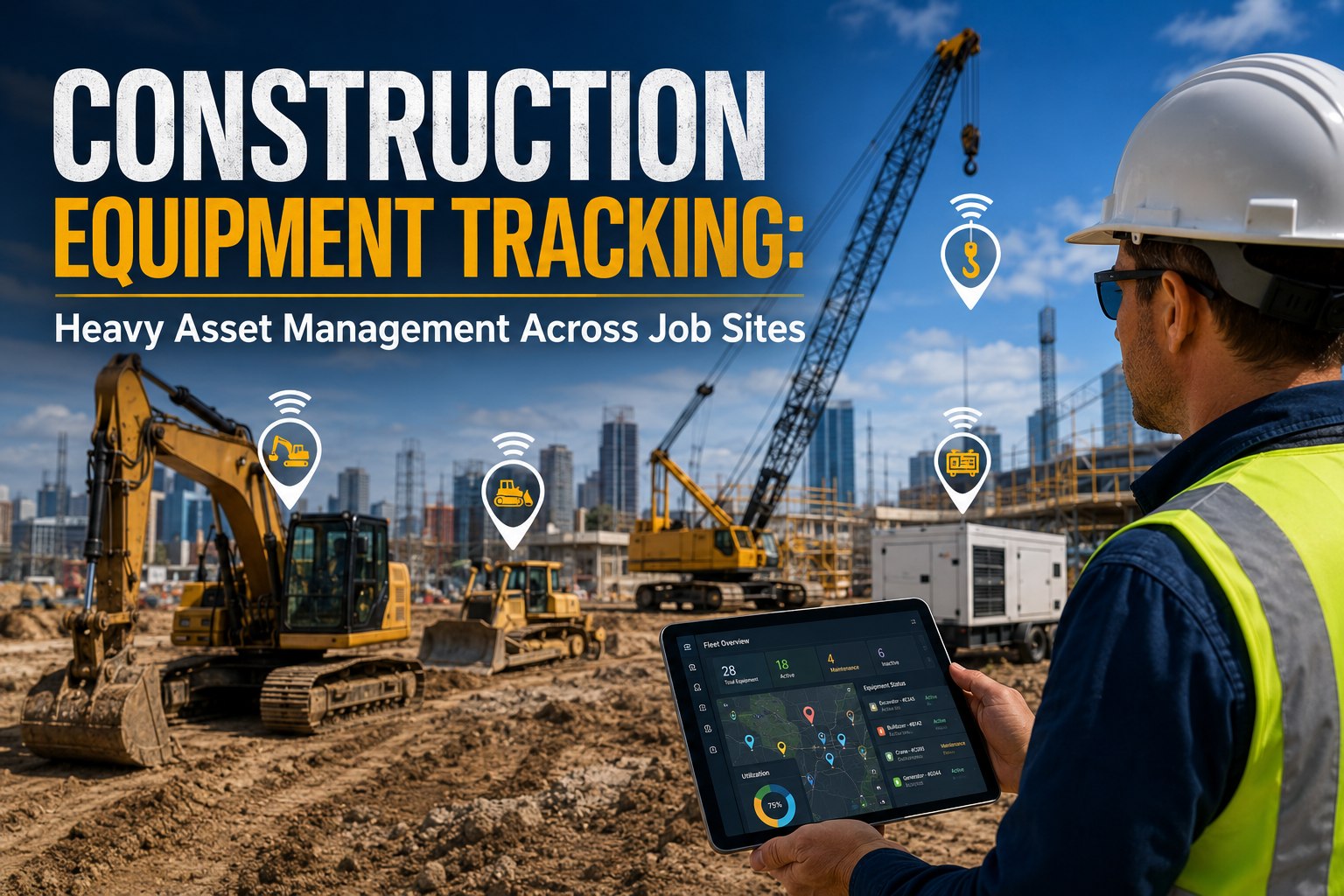
This is what construction equipment management looks like when the visibility problem is solved. One map, all your jobsites, every active asset, and the yard where idle equipment, rentals, and out-of-service items live. Geofences around each site trigger alerts the moment something leaves outside business hours. Theft has cost the US construction industry roughly $1 billion per year — recovery rates without GPS hover around 22%; with active GPS tracking and instant geofence alerts, recovery rates climb above 90%.
Active · running, in geofence, telematics live
Idle · on-site but not running · candidate for redeploy
Every construction equipment manager wakes up to the same five problems. Most don't know what each one actually costs them annually because the data is scattered across spreadsheets, OEM portals, paper inspection forms, and the dispatcher's head. The list below puts a number on each. The numbers are conservative midpoint estimates from public industry data and Tenna / EquipmentShare / HCSS customer studies — your actual exposure may be higher. Sign up free to size each pain against your own fleet exposure.
01
Equipment Theft & Loss
$1B annual industry loss · avg $30K per stolen asset · <25% recovery rate without GPS · spikes during holidays and long weekends
~$60K/yr typical mid-fleet
02
Idle Time Bleeding Cash
Average construction equipment runs 35–45% of clocked-on hours · the rest is paid idle · fuel + operator + capital depreciation continuing
~$140K/yr per 50-asset fleet
03
Missed PMs & Premature Failure
Engine-hour PMs missed because runtime data lives on the OEM portal · catastrophic engine rebuild $25K–$80K per occurrence
~$45K/yr expected
04
Double-Booked & Idle Rentals
Equipment rented while owned units sit idle · or two crews planning the same asset for the same window · weekly $400–$2,800/asset rental rates
~$85K/yr typical
05
Lost & Misallocated Tools
Small tools, attachments, and consumables vanish between jobsites · no chain-of-custody · replacement budget creeps annually
~$20K/yr per crew
Combined annual exposure · typical 50-asset construction fleet
~$350K
Engine Hours, Not Calendar Days — Why Runtime PM Wins
This is the foundational shift construction CMMS demands. A factory motor runs predictably eight hours a day, five days a week, and calendar-based PM schedules work fine. A bulldozer might run 14 hours one week and 0 hours the next; an excavator on a critical path is putting in 80 hours per week, the spare unit is putting in 5. Calendar-based PM either over-services the idle assets (wasting money) or under-services the busy ones (causing failures). Runtime-based PM, driven by live OEM telematics meter data, fixes both. Book a demo to see runtime PM running on your fleet's actual usage.
CALENDAR-BASED PM
Service every 90 days
EX-04 · busy unit
Did 1,120 engine hrs in 90 days · oil breakdown at 750 hrs · catastrophic failure week 11
EX-12 · backup unit
Did 165 engine hrs in 90 days · serviced anyway · $1,800 wasted parts + labor
Both cases lose money — different reasons
RUNTIME-BASED PM
Service every 500 engine hrs
EX-04 · busy unit
Service triggered at 500 hrs (~Day 40) · second service at 1,000 hrs (~Day 80) · no failure
EX-12 · backup unit
No service triggered · still under threshold · $1,800 parts + labor preserved
Service when usage demands · not when the calendar demands
The Mobile Work Order Flow — What the Mechanic Actually Does
Construction mechanics work in dirt, rain, and bad cell coverage. The mobile work order experience has to survive all three. The flow below shows the four steps of how a field mechanic handles a runtime-triggered PM on an excavator at Site B — including offline mode for when the site has no signal, syncing back to the central server when connectivity returns. Sign up free to try the mobile mechanic flow on your phone.
01
9:14● ● ●
RECEIVE
WO-2841 · NEW
EX-04 · 500-hr PM
Site B · 8.4 mi
Push notification when WO assigned · GPS gives drive time
02
9:42● ● ●
SCAN
EX-04 · CONFIRMED
QR confirms right asset · prevents wrong-machine service
03
11:08OFFLINE
CHECKLIST
✓Engine oil + filter
✓Hydraulic oil sample
✓Air filter
!Track tension out of spec
✓Greasing complete
Works offline · syncs when signal returns · finds related issues
04
11:32SYNCED
CLOSE
2.4 hrs labor
$340 parts
+1 follow-up WO
CLOSED
Auto-creates follow-up WO for track tension · cost-codes to job
Owned, Not Rented — The OxMaint Construction Equipment Stack
The OxMaint Construction Equipment deployment isn't a SaaS subscription you pay every month forever. It's a pre-configured AI server bundled with the unified jobsite map, multi-OEM telematics ingestion, runtime-based PM engine, mobile mechanic app with offline sync, geofencing engine, and the OxMaint dashboard tying it all to your live fleet. Get a quote and order it like the hardware it is — pre-configured, pre-tested, ready to ingest your fleet register and OEM telematics feeds within days, and owned outright the day delivery completes.
Perpetual License
No monthly fees, no per-asset device charges, no per-user billing. Future costs are entirely optional and at your discretion.
Data Sovereignty
Telematics streams, GPS history, work orders, and inspection records — all live on your server, behind your firewall.
Source Access
Source code and modification rights included. Customize PM templates, add OEM connectors, build crew-specific workflows.
AI-Native Core
Predictive maintenance, anomaly detection, NLP work orders — built around heavy-equipment workflows, not bolted on.
Pre-Configured · OEM-Connected · Ships in 6–12 Weeks
Order an OxMaint Construction Equipment Stack — Pre-Loaded, Owned
A complete on-prem construction equipment management deployment. AGX Orin appliances at your central yard running multi-OEM telematics ingestion (Caterpillar, John Deere, Komatsu, Volvo via AEMP), GPS aggregation, and offline mobile sync. RTX PRO 6000 Blackwell central server running the unified jobsite map, runtime PM engine, geofencing rules, and the OxMaint dashboard. Pre-loaded with construction-fleet templates, OEM-specific PM schedules, and mobile mechanic app. NeMo fine-tuning toolchain included for fleet-specific anomaly adaptation.
The OxMaint Construction Equipment Stack uses a yard-centric architecture: central RTX PRO 6000 Blackwell server at your main yard plus two AGX Orin edge appliances handling telematics ingestion and offline mobile sync. Multi-OEM telematics, runtime PM engine, jobsite map, geofencing, and CMMS connectors all included in the OxMaint AI Software + Integration line. Book a demo to walk through pricing for your fleet size and yard footprint.
Swipe to see breakdown
Component
Unit Cost
Per Yard
Notes
RTX PRO 6000 Blackwell 96GB Server
$19,000
$19,000
Map view + runtime PM + dashboard
NVIDIA AGX Orin #1 (Telematics Ingest)
$4,000
$4,000
Multi-OEM AEMP + GPS aggregation
NVIDIA AGX Orin #2 (Mobile Sync)
$4,000
$4,000
Offline app sync + push notification
Industrial Ethernet Switch + Cabling
~$2,500
~$2,500
Yard-office switch, cabling, SFP modules
GPS Hardware / QR Tag / Setup
$8,000–$12,000
~$10,000
Trackers for non-OEM, QR tags, install
OxMaint AI Software + Integration
$35,000–$55,000
$45,000 avg
Map, runtime PM, geofence, training
Per-Yard Total
$72,500–$94,500
~$84,500 avg
4-month delivery per yard
4-Yard Full Rollout (with Enterprise AI)
~$420,000–$520,000
Total programme
Parallel delivery + DGX Station GB300 Ultra
$84.5K
Avg per yard
4 mo
Delivery
$0
Recurring fees
∞
Perpetual
Perpetual · Owned · Source Access · Data Sovereignty
Stop Logging into Five OEM Portals — Own One Console
Unified jobsite map. Multi-OEM telematics. Runtime-based PM. Geofence theft alerts. Offline mobile mechanic app. Your team owns the platform, the AI models, and the source code outright. The architecture every modern construction equipment program is converging on as fleet sizes grow and OEM portal fragmentation gets worse.
How does this work with our mixed fleet — Caterpillar, Komatsu, John Deere, Volvo, plus older non-telematics equipment?
The honest answer: in three layers. Layer 1 — modern OEM telematics integrate via the AEMP standard (the industry data exchange most major OEMs adopted to make their telematics interoperable); the OxMaint stack ingests Caterpillar Product Link, John Deere JDLink, Komatsu KOMTRAX, Volvo CareTrack, plus Geotab and Samsara aftermarket feeds in one unified data model. Layer 2 — older equipment without OEM telematics gets a third-party GPS tracker (typical install $200-$600 per asset including hardware + labor) that broadcasts location, engine hours via a CAN-bus reader, and alerts. Layer 3 — non-powered assets like attachments, generators on standby, and tools get QR/BLE tags scanned by the mobile app at issue/return. Most fleets we deploy with end up with 60-70% of value covered by OEM telematics, 20-30% by aftermarket GPS, and the long tail of small equipment by tags. The OxMaint dashboard treats all three sources identically once they're ingested — the foreman doesn't know or care which layer is feeding the data.
What about jobsites with no cell coverage — does the mobile app work offline?
Yes — and this is one of the make-or-break features for construction CMMS specifically. The OxMaint mobile app caches every work order, asset record, inspection form, and photo locally on the device when the mechanic logs in at the start of shift. While at a no-signal jobsite, the mechanic can scan QR codes, complete inspection checklists, log labor hours, attach photos, capture meter readings, create follow-up work orders, and even draft new inspection findings — all stored locally. When connectivity returns (driving back to the yard, hitting Wi-Fi, or a stronger cell signal), the app syncs everything back to the central server in the order it was performed, with timestamps preserved. Conflicts are extremely rare because work orders are typically assigned to a specific mechanic for a specific window, but the platform handles them with last-write-wins plus a conflict log that the dispatcher reviews. The deployment includes a brief training segment specifically on offline-mode etiquette so crews know what to expect.
How quickly can theft be recovered with active GPS tracking?
Industry data and customer case studies converge on a clear pattern. Without GPS tracking, recovery rates for stolen heavy equipment hover around 22% nationally — the equipment effectively becomes a write-off plus a lengthy insurance claim. With active GPS and instant geofence alerts, recovery rates reported by major construction telematics platforms (Tenna, Teletrac Navman, HCSS, Samsara) climb above 90% when the alert is responded to within the first 4-6 hours. Concrete published case studies: Sherwood Construction recovered a stolen loader backhoe and a skid steer worth $160K combined directly from the GPS trace; Nor-Cal Pipeline recovered $500K in stolen assets across multiple incidents. The OxMaint geofencing engine triggers alerts the moment an asset crosses a defined boundary outside permitted hours — push notification to the equipment manager's phone plus an automatic email to local law enforcement liaisons (in jurisdictions where pre-arrangement is established). Most thefts happen during long weekends and the early-morning hours of major holidays; automated alerts dramatically compress the response window.
How long until our team is productive on the platform?
Most teams reach productive operation within 30-45 days of deployment and full operational fluency within 3-4 months. The deployment includes structured training sequenced for construction roles: weeks 1-2 cover the unified dashboard, the jobsite map view, mobile app onboarding for foremen and mechanics, and basic work order creation; weeks 3-4 cover OEM telematics interpretation, runtime PM trigger configuration, geofence setup per jobsite, and inspection form customization (DVIR, OSHA pre-starts, daily walk-arounds); weeks 5-12 cover advanced topics including utilization analytics, rental-vs-own decision support, multi-yard reporting, and integration with project management systems (Procore, HCSS HeavyJob, Viewpoint Vista). The fastest signal of operational fluency is when foremen start checking the map view before requesting rentals — that's when the platform has earned trust as the source of truth on what's available where. Most fleets hit that mark in the second month.
What's the realistic ROI math for a typical mid-size construction fleet?
For a typical 50-asset construction fleet, the integrated stack delivers $300K-$500K/year in measurable savings against the $84.5K per-yard capex. Breakdown at the midpoint: theft prevention saves $30K-$80K/year (probability-weighted across a typical fleet's exposure); idle-time reduction through better deployment visibility saves $80K-$180K/year (typical fleets reclaim 15-30% of paid idle hours within the first six months); runtime-based PM prevents $25K-$60K/year in catastrophic failures while saving $15K-$30K/year in over-serviced backup equipment; rental optimization (knowing what's idle before renting more) saves $40K-$120K/year for fleets with active rental spend; tool and small-equipment shrinkage drops $15K-$30K/year with chain-of-custody scanning. Most fleets reach positive ROI inside 6-9 months. After that, savings continue compounding as utilization data informs better capex decisions on the next truck or excavator purchase.