On-Premise vs Cloud AI for Maintenance: TCO, Latency, and Data Privacy Compared
By Riley Quinn on May 7, 2026
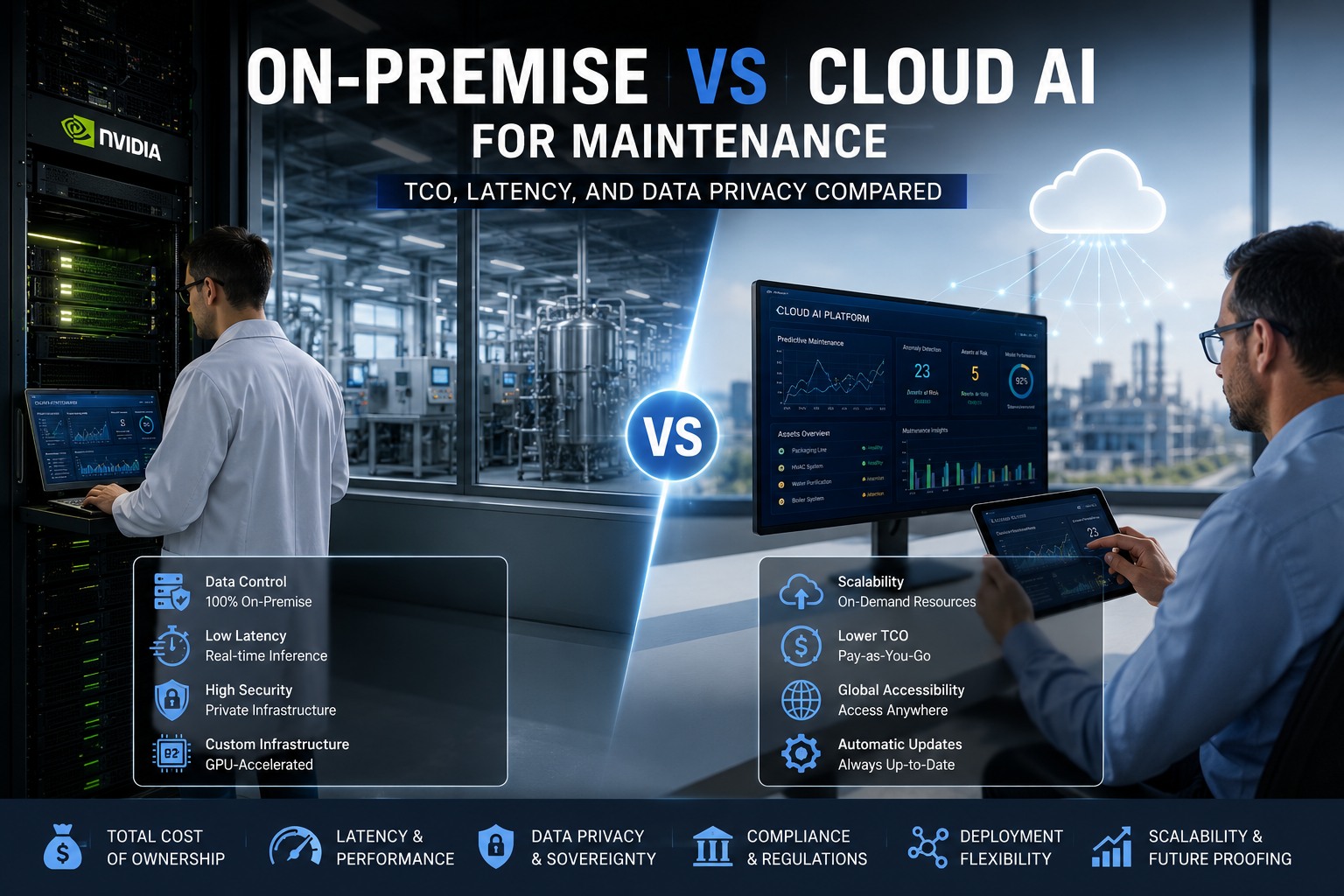
For pharmaceutical maintenance, "on-prem vs cloud AI" isn't a philosophical debate — it's a decision with FDA inspectors on one side and CFOs on the other. Lenovo's 2026 TCO analysis showed sustained inference workloads hit an 18× cost advantage on-prem; Deloitte's threshold puts the breakeven at 60-70% of equivalent cloud spend; FDA CSA + Jan 2026 AI framework + EU Annex 22 reshape what "validated AI system" even means. Six deployment scenarios, four decision dimensions, one defensible answer per workload. Sign up free to see how on-prem AI runs on your validated GxP infrastructure.
MAY 12, 2026 5:30 PM EST , Orlando
Upcoming OxMaint AI Live Webinar — On-Premise vs Cloud AI for Pharma Maintenance
Live session for pharma plant CIOs, validation leads, IT security directors, maintenance VPs, and regulatory affairs teams evaluating AI deployment models. We'll walk through the six deployment scenarios, the 5-year TCO crossover math, the 21 CFR Part 11 / ALCOA+ / FDA AI framework / EU Annex 22 compliance stack, and the OxMaint deployment that ships GxP-validatable in 6–12 weeks.
Six Scenarios — One Answer Each, No Universal Winner
Anyone who tells you "on-prem always wins" or "cloud always wins" hasn't read the workload. Real deployment decisions break down into six common scenarios, and the right answer changes across them. The grid below maps each scenario to its technical drivers and its winning deployment model — cloud, on-prem, or hybrid. For pharma maintenance specifically, scenarios 03, 05, and 06 are where most regulated workloads land, and on-prem is the structural answer for two of those three. Book a demo to map your specific maintenance workload to the right scenario.
SCENARIO 01
Bursty Pilot Workload
One-off PoC · 2-4 weeks · <100M tokens
DriversSpeed-to-value · no capex appetite · throwaway models
The single most consequential chart in any cloud-vs-on-prem decision. Cloud cost climbs linearly with usage — every month roughly the same bill, no amortization, no efficiency payoff over time. On-prem carries a high Year-0 capex but flattens hard after that, with electricity, cooling, and refresh cycles as the only ongoing line items. The point where the cloud line crosses above the on-prem line is the breakeven. For sustained pharma maintenance workloads, Lenovo's 2026 analysis puts that crossover under 4 months for high-utilization deployments.
Cloud subscription · linear growth · no amortization
5-year savings: ~$1.8M for sustained pharma PdM workload
The Pharma Compliance Stack — What Each Layer Demands
The regulatory ground beneath pharma AI keeps shifting. 21 CFR Part 11 became the foundation in 1997. ALCOA+ data integrity layered on top. The FDA Computer Software Assurance guidance landed September 2025. The FDA AI framework guidance Jan 2025 was joined by FDA-EMA "Guiding Principles of Good AI Practice" in January 2026. EU Annex 22 for AI systems is finalizing now. The QMSR replaced 21 CFR Part 820 for medical devices in February 2026. Here's the stack as it stands — and where each layer favors on-prem deployment because data sovereignty, full audit-trail control, and validated state lock-down are structurally easier when the data and models live behind your firewall. Sign up free to walk through the compliance stack on a validated demo environment.
06 / NEWEST
FDA / EMA AI Principles + EU Annex 22
Jan 2026 · 10 principles · risk-based AI validation · finalizing 2026
Computerized systems · supplier mgmt · business continuity · data migration
On-prem favored — supplier risk reduces to zero
02 / DATA
ALCOA+ Data Integrity
Attributable · Legible · Contemporaneous · Original · Accurate · plus enduring + available
On-prem favored — full chain of custody on-server
01 / FOUNDATION
21 CFR Part 11
1997 · electronic records · e-signatures · validated systems · audit trails
Either viable — but cloud adds vendor-validation burden
The Latency Decision — Where Milliseconds Actually Matter
Latency is invisible until it isn't. For pharma maintenance workflows, millisecond-level latency rarely matters in absolute terms — a sensor reading that gets to a model 50 ms late is operationally identical to one that arrives in 5 ms. But when AI inference becomes part of a closed-loop control system, batch release decision, or real-time anomaly response, the latency budget closes fast. Here's the same maintenance event traced through both deployment paths, with each step's latency contribution shown. The difference compounds when the loop runs thousands of times per shift. Sign up free to benchmark on-prem latency against your current cloud AI workflow.
Sensor event at T=0
Action complete
ON-PREM AI
Edge ingest 4 ms
Local inference 9 ms
Decision 3 ms
Work order push 5 ms
~21 ms total
CLOUD AI
Edge ingest 4 ms
WAN to cloud 45 ms
Cloud inference 22 ms
WAN return 45 ms
Work order 5 ms
~280 ms+ total
~13×
faster end-to-end on-prem · sub-50ms vs ~280-300ms cloud (matches Lenovo / AWS published benchmarks for industrial inference workloads)
Owned, Not Rented — The OxMaint On-Prem AI Stack
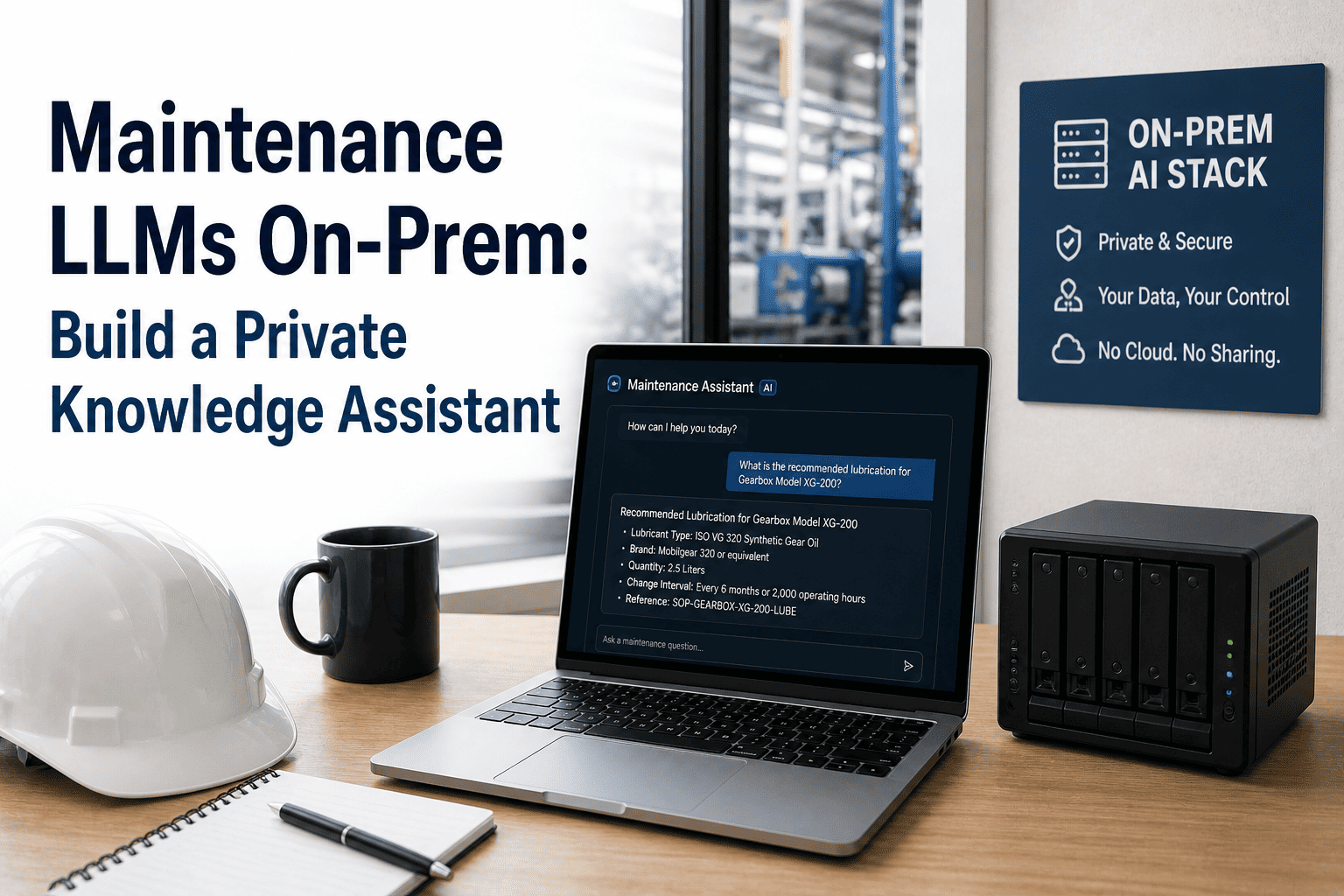
The OxMaint deployment isn't a SaaS subscription you pay every month forever. It's a pre-configured AI server bundled with the validated maintenance runtime, the predictive maintenance pipeline, the local LLM copilot, the digital twin engine, and the OxMaint dashboard. Get a quote and order it like the hardware it is — pre-configured, pre-tested, GxP-validatable, ready to ingest your asset register and CMMS history within days, and owned outright the day delivery completes.
Perpetual License
No monthly fees, no per-seat charges, no per-token billing. Future costs are entirely optional and at your discretion.
Data Sovereignty
Validated records, training corpora, model weights, audit trails — all live on your server, behind your firewall.
Source Access
Source code and modification rights included. Customize validation suites, extend connectors, build site-specific copilots.
AI-Native Core
Predictive maintenance, anomaly detection, NLP work orders — built around GxP-validatable workflows, not bolted on.
Pre-Configured · GxP-Validatable · Ships in 6–12 Weeks
Order an OxMaint On-Prem AI Stack — Pre-Loaded, Owned
A complete on-prem pharma maintenance AI deployment. AGX Orin appliances running edge inference at 9 ms median latency. RTX PRO 6000 Blackwell central server running the predictive maintenance pipeline, local LLM copilot grounded in your equipment manuals, digital twin runtime, and the OxMaint dashboard with full 21 CFR Part 11 audit trails. Pre-loaded with GxP validation templates, ALCOA+ chain-of-custody logging, FDA CSA-aligned change control workflows. NeMo fine-tuning toolchain included for site-specific model adaptation under controlled change management.
The OxMaint On-Prem AI Stack uses the standard per-plant architecture: central RTX PRO 6000 Blackwell server plus two AGX Orin edge appliances. Predictive maintenance, local LLM copilot, digital twin runtime, GxP audit trail, and CMMS connectors all included in the OxMaint AI Software + Integration line. Book a demo to walk through per-plant pricing for your validated environment.
Swipe to see breakdown
Component
Unit Cost
Per Plant
Notes
RTX PRO 6000 Blackwell 96GB Server
$19,000
$19,000
PdM + LLM copilot + dashboard
NVIDIA AGX Orin #1 (Sensor Edge)
$4,000
$4,000
Real-time vibration + thermal · 9 ms inference
NVIDIA AGX Orin #2 (Inference Edge)
$4,000
$4,000
Local LLM serving · model failover
Industrial Ethernet Switch + Cabling
~$2,500
~$2,500
Plant-floor switch, Cat6A, SFP modules
Local Electrical / Instrumentation
$8,000–$12,000
~$10,000
Sensor mounts, gateways, sub-meters
OxMaint AI Software + Integration
$35,000–$55,000
$45,000 avg
PdM, copilot, twin, GxP audit, training
Per-Plant Total
$72,500–$94,500
~$84,500 avg
4-month delivery per plant
4-Plant Full Rollout (with Enterprise AI)
~$420,000–$520,000
Total programme
Parallel delivery + DGX Station GB300 Ultra
$84.5K
Avg per plant
4 mo
Delivery
$0
Recurring fees
∞
Perpetual
Perpetual · Owned · Source Access · Data Sovereignty
Stop Sending GxP Data to Third-Party Servers — Own the Stack
21 CFR Part 11 + ALCOA+ + FDA CSA + AI framework + EU Annex 22 + QMSR — all easier when the data and models live behind your firewall. 18× cost advantage on sustained inference workloads. Sub-25 ms inference latency. Your team owns the platform, the AI models, and the source code outright. The architecture every regulated pharma manufacturer is converging on as AI moves into validated production environments.
For a regulated pharma plant, is on-prem actually mandatory or just preferred?
Strictly speaking, neither 21 CFR Part 11 nor EU Annex 11 mandates on-prem deployment — both apply equally to on-prem and cloud systems. What changes is the operational burden of compliance. With cloud, every regulatory layer (Part 11, CSA, AI framework, Annex 22) requires you to validate not just your application but also your supplier's infrastructure, data centers, change management, sub-processors, and incident response. This is the supplier-management burden that EU Annex 11 specifically codifies. With on-prem, that burden shrinks dramatically because you control the validated state end-to-end. Most large pharma manufacturers we work with end up running mixed architectures — non-GxP exploration in cloud, validated GxP production on-prem — because that's where the math and the audit logic both land. The Jan 2026 FDA/EMA Guiding Principles on Good AI Practice further tightened expectations around adaptive AI in GxP, making model lock-down + change control easier to demonstrate when the model lives on your hardware.
How does the 18× cost advantage actually work — is that realistic for our workload?
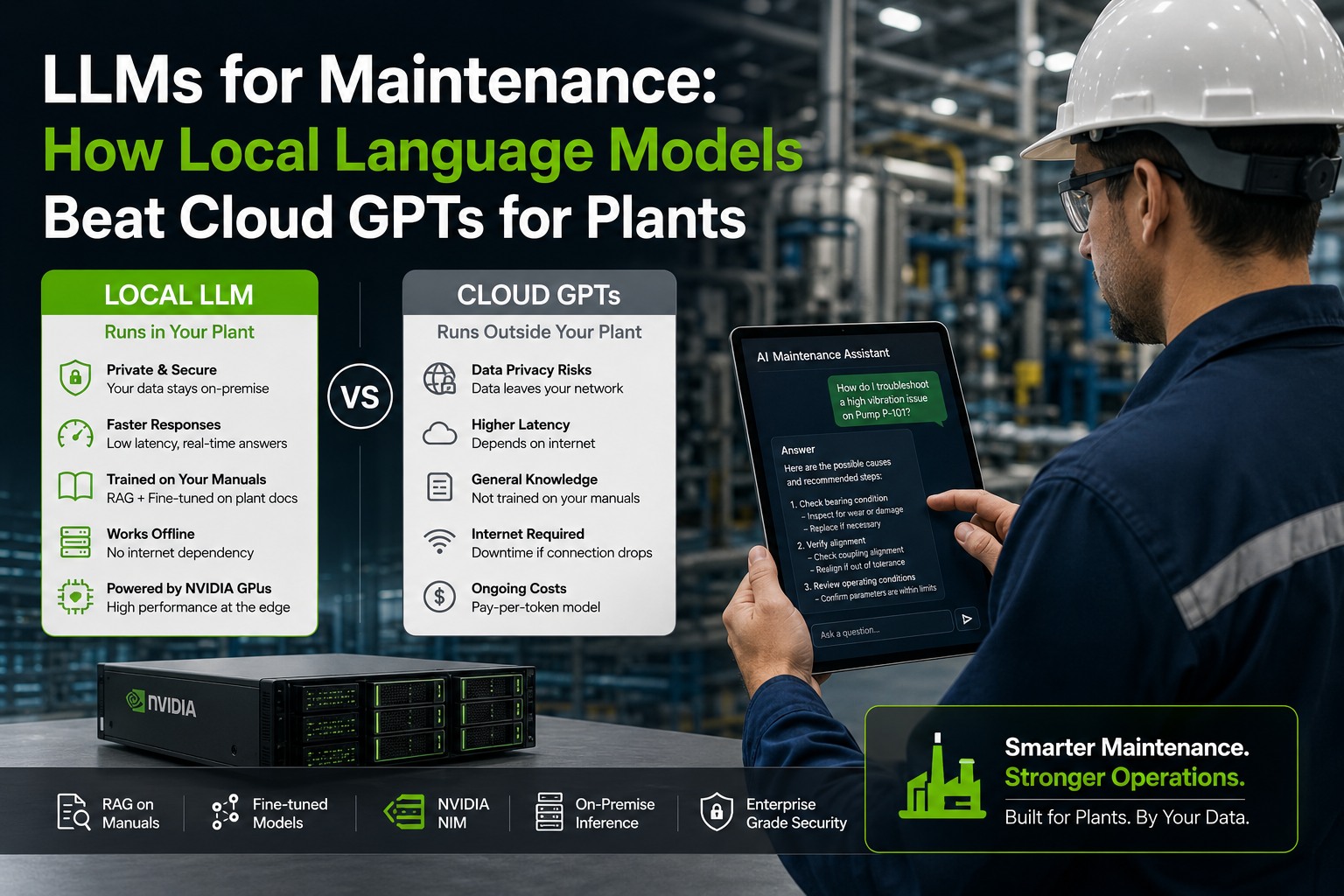
The 18× figure comes from Lenovo's 2026 Token Economics framework comparing 5-year amortized cost-per-million-tokens of owned NVIDIA Hopper/Blackwell infrastructure against equivalent Model-as-a-Service API pricing. It's most pronounced for sustained, high-utilization inference workloads — exactly the pattern of 24/7 predictive maintenance running on a manufacturing floor. The advantage compresses to 3-5× for moderate workloads (200M-1B tokens/month) and disappears or inverts for bursty workloads under 100M tokens/month. The Deloitte threshold is more conservative: on-prem becomes economically viable at the point where total costs reach 60-70% of equivalent cloud spend. Concretely, for a typical mid-size pharma plant running PdM + LLM copilot + digital twin queries, sustained workloads hit the breakeven inside the first year and on-prem savings compound from there. Bursty workloads (one-off PoCs, periodic fine-tuning) genuinely belong in cloud — that's why hybrid architectures dominate by year three of most deployments.
What about validation? Doesn't on-prem AI mean we have to validate everything ourselves?
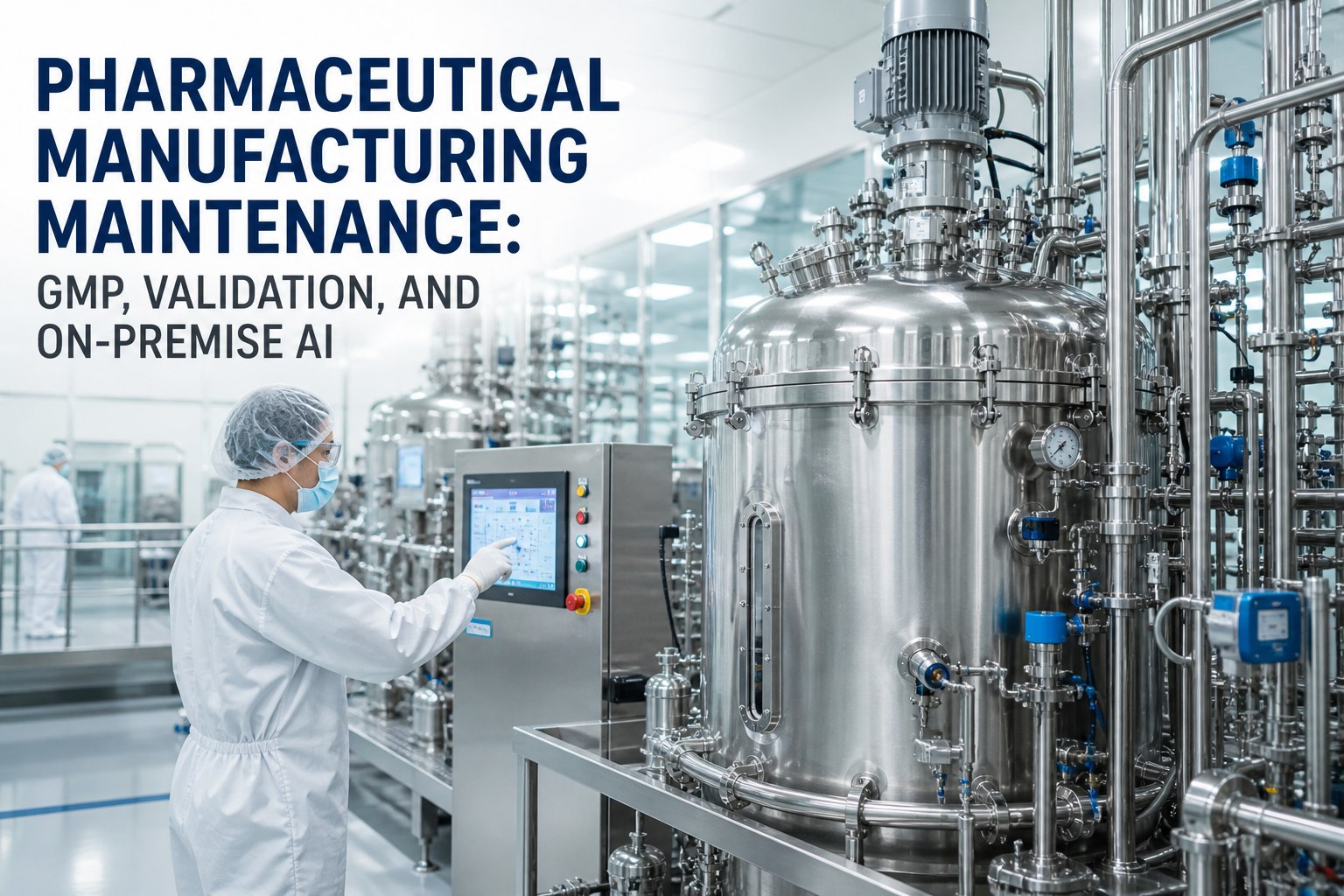
This is the most common objection — and it's largely outdated. The OxMaint deployment ships with a pre-validated infrastructure baseline (NVIDIA-certified hardware, Linux OS hardened to standard CIS benchmarks, Kubernetes runtime with documented validation evidence) plus the FDA CSA-aligned validation toolkit specifically for the OxMaint application layer. Your team's validation work is scoped to the GxP-relevant configuration (which user roles can approve which work orders, which audit trail events get logged, which model decisions trigger which review workflows) — not the underlying infrastructure. In practice, our pharma deployments hit IQ/OQ/PQ qualification readiness in 6-10 weeks; an experienced validation lead typically signs off the package in another 2-4 weeks. Compare that to validating a cloud SaaS deployment, where the supplier-management package itself often takes 6-12 weeks of vendor diligence, contract negotiation, and SOC 2 / ISO 27001 review before validation work even begins. ISPE GAMP 5 Second Edition is moving exactly toward this risk-based, infrastructure-pre-validated model.
What's the actual latency impact — does 280 ms vs 21 ms matter for predictive maintenance?
It matters for some workflows and is invisible for others. Pure batch PdM (overnight runs of vibration data, weekly equipment health reports) is functionally identical at any latency under 1 second. Real-time anomaly response — where sensor data drives an automated work-order creation, an alarm escalation, or a closed-loop control adjustment — starts to feel the difference at 100ms+, and breaks down at 500ms+. For pharma specifically, three workflows have hard latency budgets: real-time process anomaly detection during a batch run (every second of delayed response widens the deviation), vision-based aseptic environment monitoring (frame-rate dependent), and closed-loop HVAC for cleanrooms (which the FDA inspector will ask about). For these, on-prem at 9-25ms inference is structurally required; cloud at 280ms+ either fails outright or requires a complex edge-cloud hybrid that adds complexity rather than removing it.
How does the OxMaint deployment handle hybrid scenarios where some workloads belong in cloud?
The deployment supports an explicit hybrid architecture out of the box. The on-prem stack is the validated GxP boundary — all production inference, sensor data, work orders, audit trails, and model serving live there. For non-GxP workloads where cloud genuinely makes sense (bursty fine-tuning runs, one-off model exploration, executive dashboards over de-identified data, supplier benchmarking), the platform exposes a clear data-classification gate: data tagged as GxP cannot leave the on-prem boundary; data tagged as non-GxP can flow to your designated cloud (AWS, Azure, GCP) under your existing supplier validation. The boundary is auditable, logged, and the data-classification rules are part of your validated configuration. Most pharma deployments end up with 70-80% of compute on-prem (sustained PdM, validated LLM copilot, digital twin) and 20-30% in cloud (periodic model retraining, R&D-adjacent exploration, executive analytics). This isn't a compromise — it's the architecture that's been quietly becoming standard across regulated industries since 2024.