Motion Amplification Technology for Machine Diagnostics
By Riley Quinn on May 5, 2026
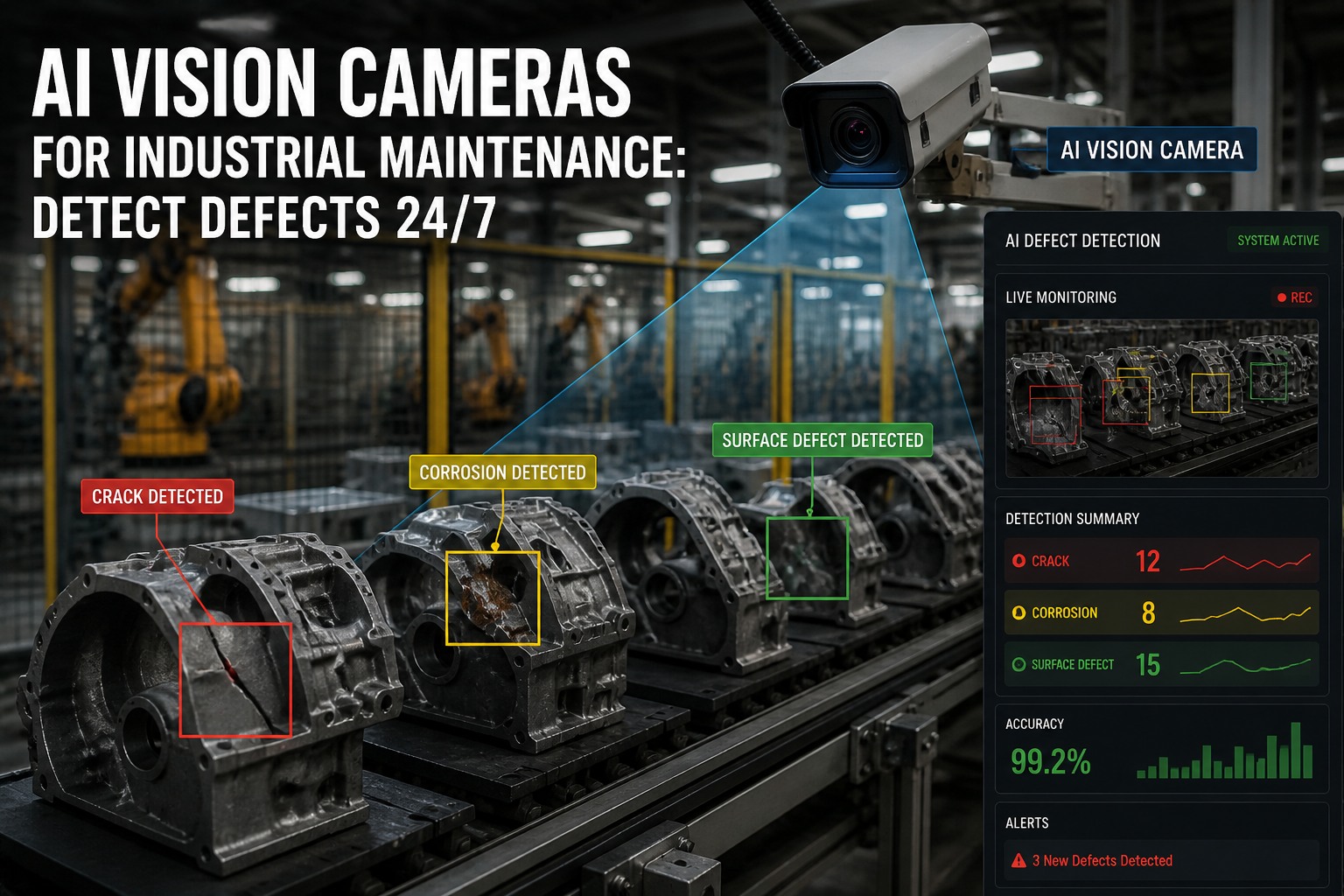
The pump on Line 4 has a 0.7 mil deflection at 24 Hz. Your accelerometer caught the vibration spike but not where it lives — is it the bearing, the motor pedestal, the discharge piping resonating in sympathy, or the structural steel under the whole skid amplifying it? Each root cause has a different fix, ranging from $400 to $40,000. Traditional vibration analysis answers "how much" and "what frequency" but not "what's actually moving." Motion amplification answers all three at once. By turning every pixel in a high-speed video frame into a virtual sub-pixel sensor — millions of measurement points per frame — and using phase-based decomposition to extract motion that's literally invisible to the human eye, motion amplification turns the diagnostic question from spectral guessing into "watch what's actually happening." The OxMaint AI Vision Camera deployment runs the full motion amplification pipeline on-prem, with cuFFT-accelerated phase analysis on Blackwell hardware, and integrates the output directly into your CMMS and predictive maintenance models. Sign up free to see the AI Vision Camera deployment for your specific assets.
MAY 12, 2026 5:30 PM EST , Orlando
Upcoming OxMaint AI Live Webinar — Motion Amplification + AI Vision Camera for Machine Diagnostics
Live session for reliability engineers, vibration analysts, plant CIOs, and anyone responsible for catching mechanical faults before they cause downtime. We'll walk through phase-based motion amplification, cuFFT-accelerated GPU processing, sub-pixel measurement accuracy, the fault library that motion analysis catches before contact sensors do, and the OxMaint AI Vision Camera deployment that integrates motion data directly into your CMMS and predictive maintenance pipelines.
The fundamental promise of motion amplification is visual: make invisible motion visible. A pump running 1,800 RPM produces vibration with displacement on the order of 1-30 thousandths of an inch (25-750 microns). At any normal viewing distance, the human eye can't resolve motion below ~0.5 mm — meaning bearing wobble, pipe sympathetic resonance, motor pedestal flex, and structural amplification are all happening invisibly to the maintenance engineer standing five feet away. Motion amplification multiplies the motion by 5-100× and renders it visibly, while preserving the actual measurement.
HUMAN EYE / STANDARD VIDEO
CH 1 · 30 sec capture
Pump bearing housing displacement
Sub-pixel motion falls below the camera's pixel quantization floor. Naked-eye and standard video both register zero displacement. Diagnosis depends on contact sensors and operator experience.
MOTION-AMPLIFIED VIDEO
CH 1 · phase-decoded · 30× mag
Same bearing housing · soft foot revealed
Phase-based decoding recovers the same vibration waveform from sub-pixel motion in the video. Peak displacement 2.4 mil at 30 Hz indicates soft-foot condition on the pump base — diagnosable in the time-domain trace.
The Phase-Based Pipeline — How Sub-Pixel Motion Becomes Visible
Motion amplification isn't naive video processing. The technique is built on phase-based motion analysis — pioneered by MIT researchers in 2013 — which exploits the fact that motion in an image creates a measurable phase shift in spatial frequency components. That phase shift can be detected at fractions of a pixel, which is why the technology achieves sub-pixel accuracy down to micron-scale displacement. Book a demo to walk through the cuFFT-accelerated pipeline running on Blackwell hardware.
01
High-Speed Capture
240–1,000+ fps · 1080p / 720p
High-frame-rate camera captures the asset. Frame rate sets the Nyquist frequency limit (240 fps → 120 Hz max measurable). 15-60 second capture window per measurement.
02
Spatial Decomposition
Steerable pyramid · cuFFT
Each frame decomposed into spatial frequency bands using a complex steerable pyramid. cuFFT (CUDA FFT library) accelerates the decomposition on Blackwell GPU — millions of pixels processed in milliseconds.
03
Phase Extraction
Per-pixel phase signal
Every pixel's local phase is extracted from each frequency band. The temporal sequence of phase values at each pixel becomes a per-pixel motion signal — sub-pixel accuracy comes from phase resolution being finer than pixel grid.
04
Temporal Filtering
Bandpass: 1–500 Hz
Bandpass filter isolates the frequency range of interest — operator selects "show me motion at 24 Hz ± 2 Hz" and only motion in that band is analyzed. Targets specific fault frequencies (1× RPM, 2× RPM, blade-pass, etc.).
05
Amplification + Reconstruction
5×–100× magnification
Phase changes in the band of interest are multiplied by amplification factor (typically 10-30× for industrial diagnostics). Inverse pyramid reconstruction produces the amplified video. Original frame structure preserved; only target motion is exaggerated.
The technical claim that surprises every reliability engineer who first encounters motion amplification: the technology measures motion smaller than a single pixel. A pump 5 meters from the camera at 1080p resolution gives roughly 1 mm per pixel — meaning if motion were measured by pixel-counting, no displacement under 1 mm would register. Phase-based analysis routinely measures motion at 1/1000th of a pixel — about 1 micron at 5 meter standoff. The math is not magic; it's the consequence of phase shift in spatial frequency components being a continuous quantity, not a discrete pixel hop.
PIXEL-COUNTING METHOD
1.0 px
Vibration below pixel threshold registers as zero motion · ≈1 mm minimum at 5m standoff
PHASE-BASED METHOD
0.001 px
Phase shift in spatial frequency captured at fractions of a pixel · ≈1 μm at 5m standoff
1,000×
Better resolution than pixel-counting
~1 μm
Typical displacement floor at 5m standoff
~10⁶
Virtual sensors per 1080p frame
The Fault Library — What Motion Amplification Catches That Sensors Miss
Contact accelerometers measure vibration at one point. Motion amplification measures motion at every pixel in the camera's view — which means a single video can capture the entire system's behavior simultaneously. That's the diagnostic difference. Where contact sensors tell you "this point is vibrating at 24 Hz with 3 mil amplitude," motion amplification shows you the pump body, the discharge piping, the structural steel, and the foundation all moving together — and reveals which one is driving the others. Here are the fault categories where motion amplification produces diagnostic insight that contact sensors structurally cannot. Sign up free to access the full fault library pre-loaded on the OxMaint AI Vision Camera.
Soft Foot
Machine base flexes asymmetrically under torque. Visible as differential motion between feet — invisible to single-point sensors mounted on bearings.
Pipe Sympathetic Resonance
Discharge piping vibrating at machine 1× RPM not because of pump fault but because pipe natural frequency matches. Camera sees the pipe whip — sensor sees only excessive amplitude.
Structural Resonance
Support steel or platform amplifies machine vibration when natural frequency matches operating speed. Multi-point camera view exposes which structural member is the resonator.
Belt Drive Issues
Belt whip patterns, sheave wobble, idler misalignment all appear as visible motion choreography across the drive system — diagnosable in seconds vs hours of single-point spectral analysis.
Loose Anchor Bolts
Bearing housing motion much larger than bearing spectral signature suggests — usually a loose foundation bolt. Visible to camera, ambiguous to vibration data alone.
Coupling Misalignment
Phase relationship between motor shaft and driven shaft visible in camera view. Angular vs parallel misalignment distinguishable from motion pattern, not just frequency content.
The Camera + AI Pipeline — From Capture to Work Order
A motion amplification camera by itself produces beautiful diagnostic videos. The OxMaint AI Vision Camera deployment adds the layer that turns those videos into actionable maintenance decisions: AI-driven fault classification, baseline drift detection, automated work order generation, and integration with the predictive maintenance pipeline. Same physics, but instead of an expert reviewing each video manually, the AI flags anomalies against your asset baseline and routes them through the CMMS.
Vision Camera
Mounted on tripod or fixed gantry at the asset. Captures 15-60s clip on schedule or trigger.
→
AGX Orin Edge
Local edge unit ingests video, runs phase-based motion analysis with cuFFT, produces amplified video + frequency data.
→
RTX PRO Server
Central server runs AI fault classifier, compares to asset baseline, calculates drift, generates diagnostic narrative via LLM.
→
CMMS Work Order
Auto-generated work order with diagnostic narrative, amplified video link, recommended action, parts list, and target window.
Pre-Configured · Vision-Camera-Ready · Ships in 6–12 Weeks
Order an OxMaint AI Vision Camera With Motion Amplification Pre-Loaded
OxMaint's AI Vision Camera deployment arrives pre-configured with the full motion amplification pipeline: high-speed industrial camera, AGX Orin edge processing with cuFFT phase analysis, RTX PRO Blackwell central server for AI fault classification, baseline drift monitoring, automated CMMS work-order generation, and the full OxMaint software stack. Compatible with standard tripod mounting or fixed gantry installations. No SaaS lock-in. Source code and modification rights included for full customization control.
Investment Summary — Per-Plant Rollout + Enterprise AI
The OxMaint AI Vision Camera deployment uses the same per-plant architecture as other industries — central RTX PRO 6000 Blackwell server plus two AGX Orin edge appliances — with the motion amplification pipeline, cuFFT GPU kernels, fault classification models, and CMMS integration in the OxMaint AI Software + Integration line item. The vision camera itself is included in the per-plant edge tier when the customer specifies the AI Vision Camera package. Book a demo to walk through the per-plant pricing for your specific footprint.
Swipe to see breakdown
Component
Unit Cost
Per Plant (4 mo)
Notes
RTX PRO 6000 Blackwell 96GB Server (Omniverse)
$19,000
$19,000
cuFFT phase analysis, AI fault classifier, baseline drift
Stop Guessing at Root Cause — See the Vibration, Owned
A complete on-prem AI Vision Camera deployment with motion amplification pre-built. Sub-pixel measurement, cuFFT GPU acceleration on Blackwell hardware, AI fault classification, automated CMMS work order generation, and the full OxMaint software stack. Source code included. Your team owns the platform, the AI models, and the diagnostic library outright. The architecture every modern reliability program is converging on as motion amplification moves from expert services to in-house capability.
How does motion amplification compare to traditional contact accelerometers?
They're complementary, not competing. Contact accelerometers (typically PCB Piezotronics, IMI, SKF, Wilcoxon) provide high-frequency-resolution single-point measurement — they're unmatched for bearing fault detection at high frequencies (5-10 kHz), modulation analysis, and continuous online monitoring on a single point. Motion amplification provides spatial-resolution multi-point measurement — every pixel is a sensor, but the frequency range is bounded by camera frame rate (Nyquist limit at half the fps). For a typical 240 fps camera you can measure up to 120 Hz; with high-end 1,000+ fps cameras you reach 500 Hz. The diagnostic sweet spot for motion amplification is 0-500 Hz where most rotating-equipment 1×, 2×, 3× RPM frequencies live and where structural resonances dominate. Best practice combines both: contact sensors for continuous online trending and high-frequency bearing fault detection; motion amplification for periodic walk-around diagnostics, root cause investigation when a sensor flags an anomaly, and capturing the full system motion picture that single-point sensors structurally cannot provide.
What hardware does the OxMaint AI Vision Camera package actually include?
The deployment includes: (1) High-speed industrial camera — typically a 1080p or 720p machine vision camera capable of 240-1,000 fps depending on the diagnostic requirement, with global shutter, GigE Vision or USB3 Vision interface, C-mount or F-mount lens compatibility. Specific camera models vary by deployment scope (FLIR Blackfly S, Basler ace 2, Allied Vision Alvium, Teledyne Genie Nano are common partners). (2) Lighting kit — high-intensity LED panels for consistent illumination during high-frame-rate capture; flicker-free at the camera frame rate. (3) Tripod or fixed gantry mount — for portable diagnostic walk-arounds or permanent fixed-asset monitoring. (4) Edge processing on AGX Orin — handles ingest, raw video buffering, initial phase decomposition. (5) Central inference on RTX PRO 6000 Blackwell — runs cuFFT acceleration, AI fault classifier, baseline comparison, LLM-driven diagnostic narrative. (6) OxMaint software stack — the motion amplification pipeline, fault library, CMMS connectors, baseline management, and reporting layer. Bill of materials is customized to the specific assets being monitored — a brewery deployment looks different from a coal-fired generation deployment.
What's the diagnostic accuracy — does it actually catch real faults?
The technology is well-validated in industrial reliability practice. Motion amplification has been deployed by major reliability service providers (RDI Technologies, IBT Industrial Solutions, IVC Technologies, IRISS, and others) across utilities, oil & gas, pulp & paper, chemicals, automotive, and food & beverage since the early 2010s. Documented diagnostic capabilities include: soft foot detection (1-2 mil differential motion between machine feet under torque), structural resonance identification (frequency match between operating speed and structural natural frequency), pipe sympathetic resonance, belt drive whip patterns, bearing housing motion vs bearing-internal vibration distinction, coupling misalignment phase analysis, and intermittent fault capture under variable load. Sub-pixel accuracy down to ~1 micron at 5-meter standoff is the consensus number — meaning bearing wobble, motor pedestal flex, and structural amplification at sub-millimeter scale are all detectable. The technology has been field-validated against contacting displacement sensors with accuracies that "rival contacting displacement sensors" (RDI's published claim). The OxMaint AI Vision Camera deployment uses the same underlying physics with the addition of AI-driven automated fault classification, baseline drift detection, and CMMS work-order generation.
Why on-prem GPU processing instead of cloud?
Three reasons make cloud impractical for production motion amplification deployments. (1) Data volume — high-frame-rate video is enormous. A 60-second 1080p clip at 480 fps generates ~30 GB raw or ~3 GB compressed; a plant doing 50 measurements per week generates ~150 GB/week of raw video that would need to traverse the WAN to a cloud processor and back. WAN cost and latency make this impractical at scale. (2) Operational data sensitivity — motion amplification reveals operating signatures (RPM, belt drive ratios, fan-blade pass frequencies, structural natural frequencies) that constitute proprietary process IP. Cloud processing means transmitting that signature off-prem to a third party. (3) Latency for closed-loop diagnostics — when an operator points the camera at a problem asset and wants the amplified video back in seconds, on-prem GPU processing on Blackwell hardware delivers 30-60 second turnaround vs minutes-to-hours for cloud round-trip. The OxMaint architecture keeps the entire pipeline local: ingest on the AGX Orin edge unit, cuFFT phase analysis on the RTX PRO 6000 Blackwell central server, AI fault classification on the same server, output to plant CMMS via local network. Air-gap option supported for facilities that require zero outbound connectivity.
How long from sign-up to first diagnostic capture?
Six to twelve weeks from sign-up to first production diagnostic capture is typical, with first internal validation captures possible at week 8-10 in many deployments. Standard timeline: weeks 1-6 — hardware configured, integrated, and pre-tested in OxMaint factory (camera + AGX Orin + RTX PRO server + lighting + mounting hardware), motion amplification pipeline validated against synthetic vibration data, baseline fault library installed; weeks 6-8 — on-site installation, network integration, lighting positioning, camera calibration on first asset; weeks 8-10 — first internal diagnostic captures on validation assets, baseline measurements established, OxMaint reliability engineer trains plant team on operation; weeks 10-14 — plant team takes over operation, baseline library expands across plant assets, AI fault classifier fine-tunes against plant-specific motion signatures. By month 4, the plant team is independently operating the AI Vision Camera with motion amplification pipeline running locally and CMMS work orders auto-generating from detected anomalies. Most plants start with one critical asset class (typically critical pumps, fans, or motors) and expand coverage as the team builds confidence.