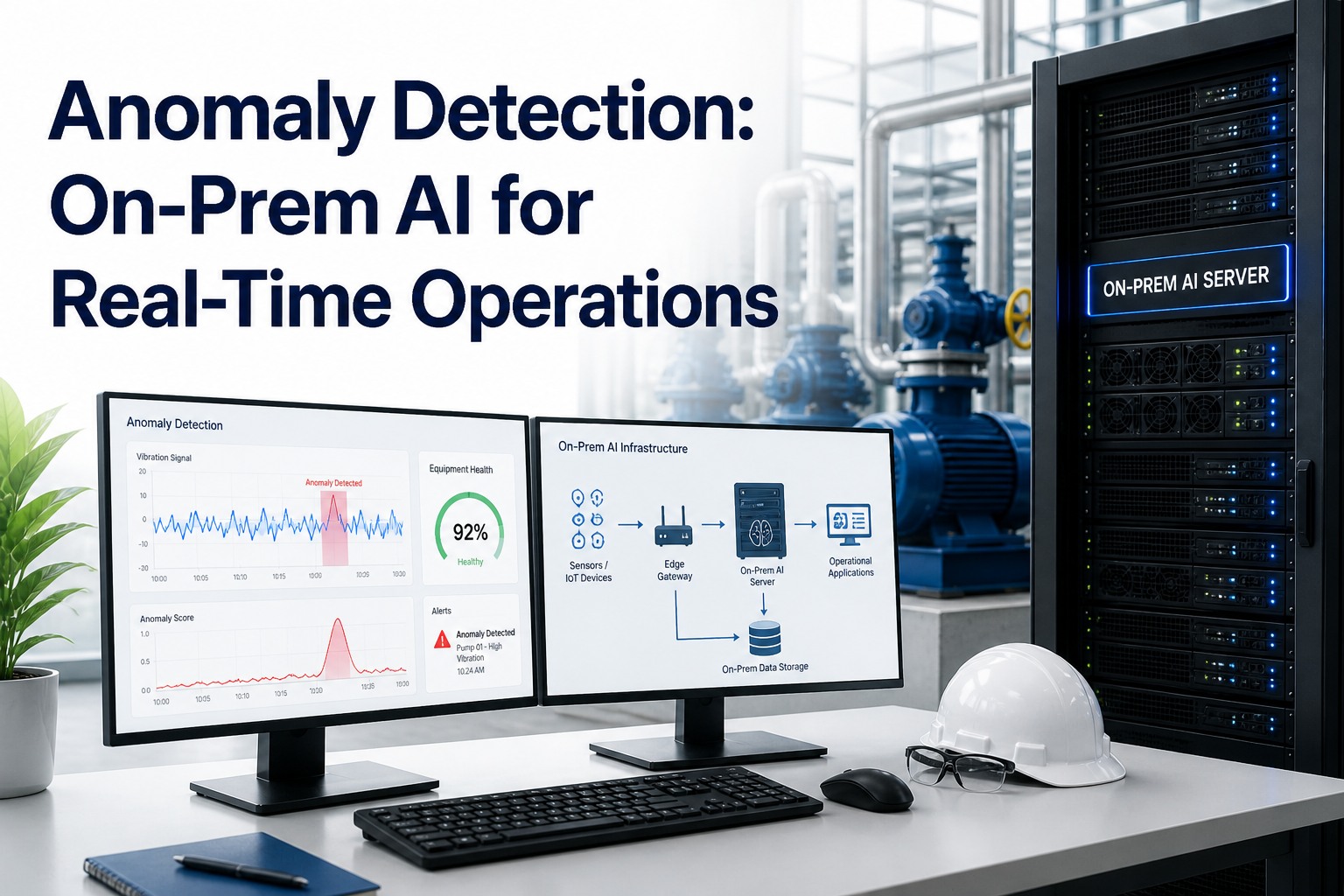
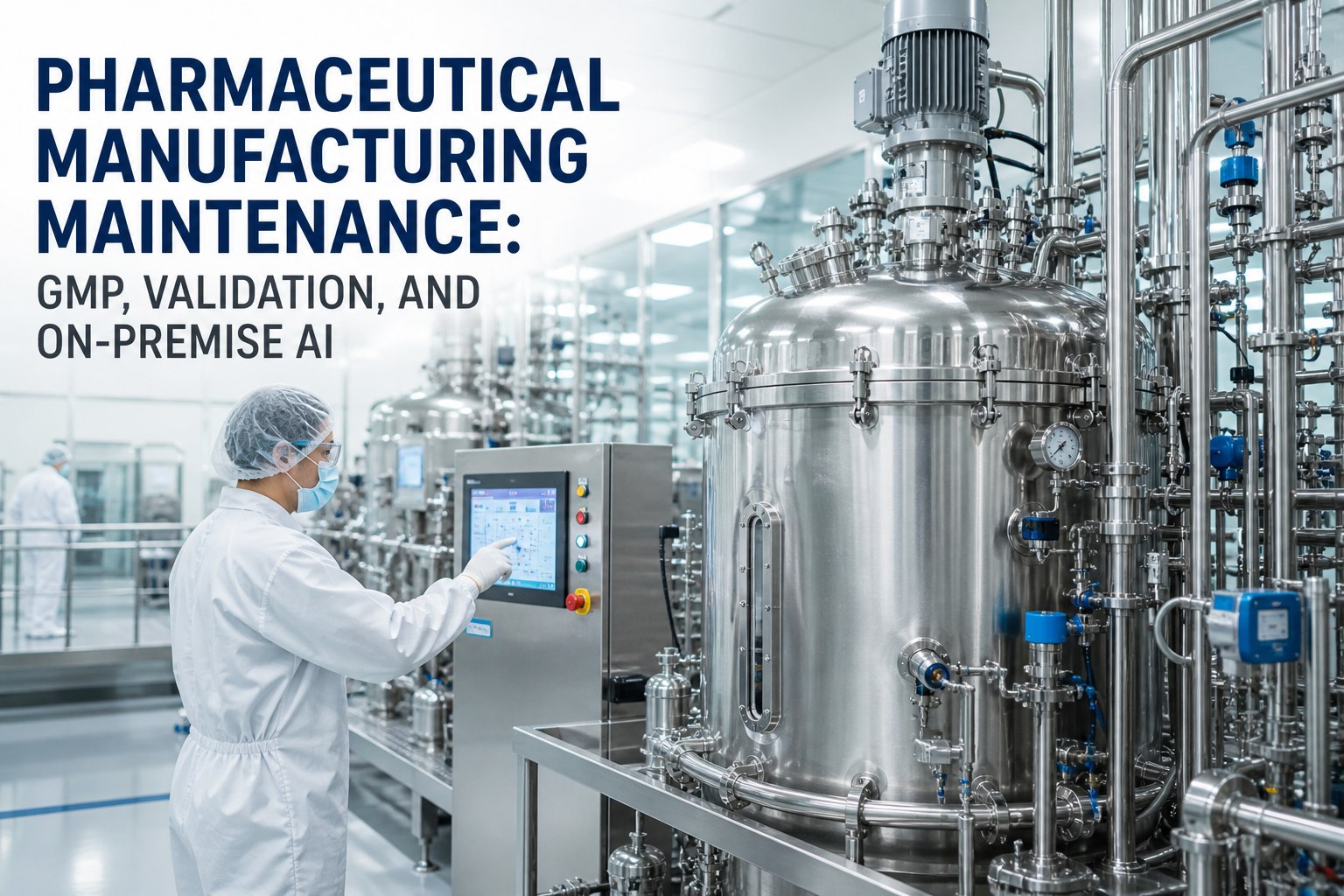
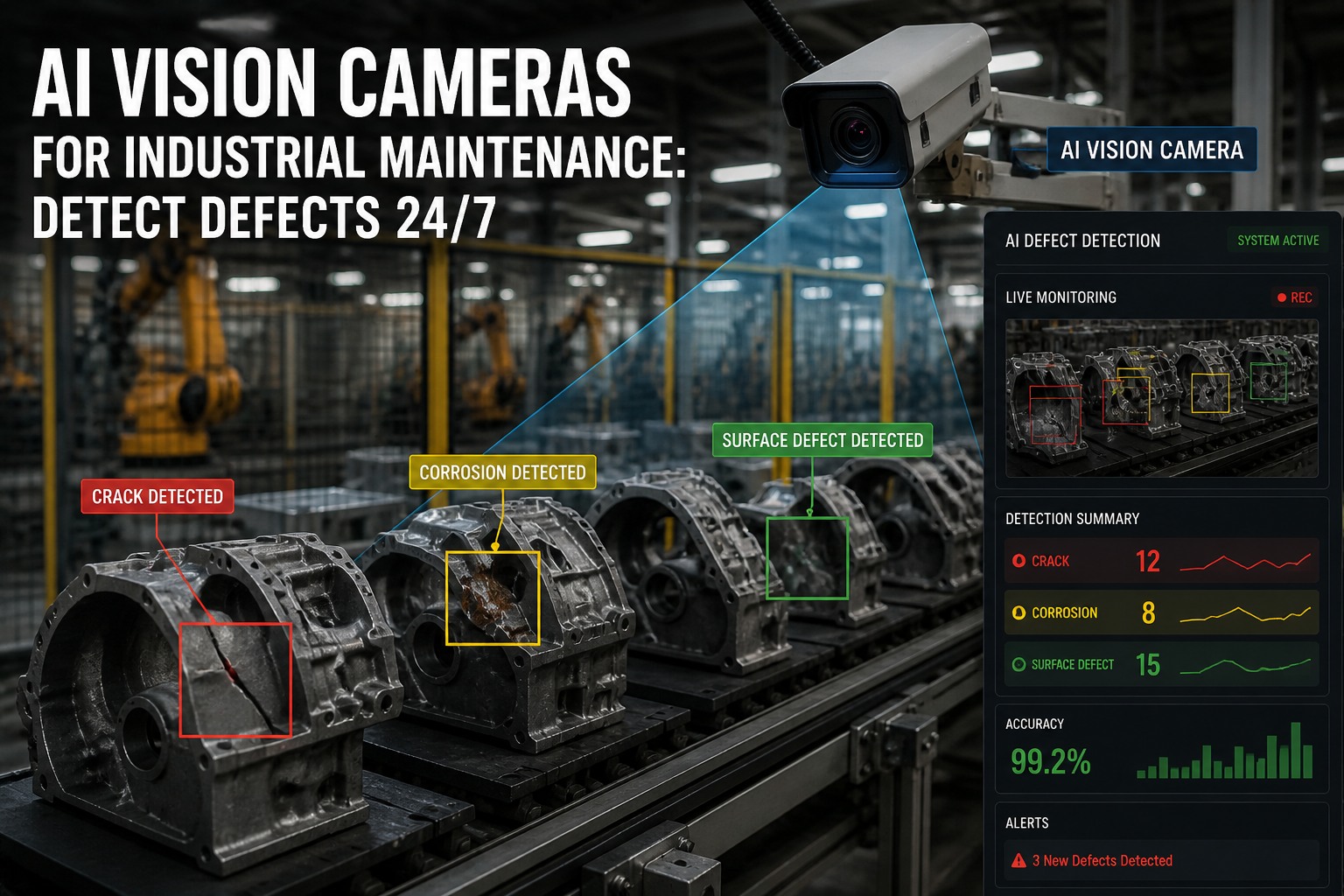
On-Premises AI for Pharmaceutical Predictive Maintenance
By Riley Quinn on May 5, 2026
Your bioreactor monitoring AI just flagged an anomaly at 03:47 on a Sunday. The model predicted a seal failure 11 days before the actual event, with 94% confidence. The notification fired into your CMMS, generated a work order, and notified the second-shift maintenance lead. Now the FDA inspector arrives Tuesday morning and asks the question every pharma quality team has been preparing for: "Show me the validated audit trail for that AI prediction." If your AI model lives in someone else's cloud — with weights that update without your knowledge, training data that crosses borders, and inference logs you can't fully retrieve — that question becomes a Form 483. If it lives on-prem, behind your firewall, validated under GAMP 5 with full 21 CFR Part 11 audit trails, the answer is a binder. The deployment architecture is the difference between "compliant" and "explaining yourself to a regulator." Sign up free to see the GMP-validated on-prem AI architecture for pharma predictive maintenance.
MAY 12, 2026 5:30 PM EST , Orlando
Upcoming OxMaint AI Live Webinar — On-Premises AI for Pharmaceutical Predictive Maintenance Under FDA Part 11
Live session for pharma quality directors, validation leads, plant CIOs, and reliability engineers running GMP-regulated facilities. We'll walk through the on-prem AI architecture for predictive maintenance under 21 CFR Part 11, GAMP 5, EU Annex 11, and the incoming Annex 22 — including the full validation lifecycle (IQ/OQ/PQ), ALCOA+ data integrity mapping, and the audit defensibility patterns that hold up to FDA 483 and EMA inspections.
The Five Regulatory Frameworks an AI Deployment Must Satisfy Simultaneously
Pharmaceutical AI doesn't get to pick one regulatory regime — it gets to satisfy all of them at once. A single predictive maintenance model on a bioreactor, lyophilizer, or fill-finish line is subject to FDA 21 CFR Part 11 (electronic records), GAMP 5 (computerized system validation), EU GMP Annex 11 (computerised systems), the incoming EU Annex 22 (AI/ML in GMP), and the FDA's 2025 AI credibility framework. Cloud-first architectures struggle with all five; on-prem architectures were designed for them.
FDA · USA
21 CFR Part 11
Electronic records and signatures
Audit trails, access controls, system validation, electronic signatures equivalent to paper records.
On-prem fit: every model decision logged to validated record system inside your firewall, no cloud-side log retention dependencies.
ISPE · GLOBAL
GAMP 5 (2nd Ed., 2022)
Computerized system validation lifecycle
Risk-based validation, supplier documentation leverage, lifecycle management. The how-to manual for satisfying Part 11 and Annex 11.
On-prem fit: full IQ/OQ/PQ lifecycle on dedicated hardware, validated against frozen model versions you control.
EU · EMA
EU GMP Annex 11
Computerised systems in GMP
Risk management, change control, electronic signatures, archival, business continuity. EMA revising for cloud + cybersecurity + AI/ML in 2026.
On-prem fit: data residency satisfied by default, change control under your direct authority, no third-party model drift.
EU · PIC/S
EU GMP Annex 22 (Draft)
AI/ML in GMP — finalization 2026
Static deterministic models for critical use, oversight committees, risk management for AI changes, explainability requirements.
On-prem fit: model version pinning, no surprise updates, full explainability infrastructure under direct control.
FDA · USA
FDA AI Credibility (Jan 2025)
Risk-based AI model credibility framework
Model trustworthiness for intended use, context-specific validation, transparency, documented credibility assessment.
On-prem fit: full training data lineage, validated model artifacts, transparent inference logs — all defensible to FDA inspectors.
The ALCOA+ Data Integrity Matrix — On-Prem AI by Design
ALCOA+ is the data integrity standard inspectors apply to every GMP-relevant data point: each attribute represents an audit checkpoint. For predictive maintenance AI, every sensor reading, model inference, and work-order generation must satisfy all nine attributes. On-prem architecture earns each one structurally — the data never leaves your validated environment, so attribution, timestamps, and authenticity are inherently defensible.
A
Attributable
Every model inference traceable to specific user, model version, and input data. On-prem audit logs are first-class citizens.
✓ STRUCTURAL
L
Legible
Inference outputs and audit trails human-readable, queryable, and exportable in inspector-friendly formats.
✓ STRUCTURAL
C
Contemporaneous
Each prediction logged at the moment of inference with cryptographic timestamp tied to validated time source (NTP, GPS).
✓ STRUCTURAL
O
Original
Raw sensor data + model inputs + outputs preserved without modification. WORM (Write Once Read Many) storage on-prem.
✓ STRUCTURAL
A
Accurate
Model validated against reference dataset, accuracy metrics retained, drift monitored against frozen baseline version.
✓ STRUCTURAL
+
Complete · Consistent · Enduring · Available
Full lifecycle data retention (typically 10+ years), consistent format across batches, durable storage with redundancy, accessible during inspection within minutes.
✓ STRUCTURAL
The IQ/OQ/PQ Validation Lifecycle — How AI Becomes "Validated"
Every GMP-relevant computerized system goes through three validation stages: Installation Qualification (does the system match the design spec?), Operational Qualification (does it function within design limits?), and Performance Qualification (does it perform reliably under live production?). For predictive maintenance AI, each stage has specific deliverables that an FDA or EMA inspector will request by name. Book a demo to walk through the IQ/OQ/PQ deliverables for a pharma AI deployment.
STAGE 1
IQ — Installation Qualification
Pre-go-live · 1-2 weeks
Hardware install verified against URS
OS + software versions documented
Model artifacts checksummed + sealed
Network isolation verified
Initial audit trail enabled
STAGE 2
OQ — Operational Qualification
Pre-production · 2-4 weeks
Test cases at design limits
Inference latency measured
Failure mode testing
Audit trail integrity verified
User access controls tested
STAGE 3
PQ — Performance Qualification
Production · 4-8 weeks
Live production data validation
QA sign-off on accuracy metrics
Model drift monitoring active
Change control procedure live
Inspector-ready binder complete
Pharma Equipment Routing — Which AI Workload for Which Asset Class
Pharma manufacturing has distinct equipment categories with different failure modes, criticality levels, and AI workload fit. The on-prem AI server handles them all from a single deployment, but each asset class has its own predictive maintenance pattern. Here's the routing across the equipment that matters in GMP-regulated facilities. Sign up free to see the equipment-class library pre-configured for your asset inventory.
Pump pulsation patterns, column degradation prediction, detector lamp health
Centrifuges & Separators
STANDARD
Bowl imbalance detection, bearing wear, drive belt slippage
Cloud vs On-Prem Audit Defensibility — The Question Inspectors Ask
The single most consequential architectural decision for pharma AI is where the model lives. The same FDA inspector who waves through an on-prem deployment can spend two days asking questions about a cloud-hosted equivalent — not because cloud is non-compliant, but because the audit surface is larger and harder to demonstrate from a single facility. Here's how the conversation goes for each approach. Sign up free to see the on-prem audit defensibility checklist for your facility.
Swipe to compare cloud vs on-prem
Inspector Question
Cloud Architecture
On-Prem Architecture
"Show me the audit trail for this prediction"
Multi-tenant cloud — depends on provider's log retention SLA, must request from third party, may take days
On-prem WORM storage — query returns full chain in seconds, stays on-site
"Where does the training data physically reside?"
Cloud region(s) — possibly multiple, possibly across borders, depends on provider
Inside the validated environment — single answer, single facility, single jurisdiction
"Has the model been updated since validation?"
Provider may update underlying serving infrastructure; weights may be re-quantized; difficult to attest definitively
Frozen model weights with cryptographic checksums — deterministic answer, full version history
"Demonstrate change control for the AI system"
Cloud SLA covers infrastructure but not model lifecycle — must overlay your own controls on top
Single change control system covers hardware + software + model — your team owns every change
"What happens if the cloud provider has an outage?"
Production AI offline; predictions stop; manual fallback procedures activate; documented impact
Air-gapped option keeps AI running regardless of WAN status; business continuity by design
The U.S. Reshoring Wave — Why Now Is the Window for Pharma AI
The May 2025 executive order made domestic pharmaceutical manufacturing a national priority. The FDA's PreCheck pilot program (launched February 2026) streamlines facility assessments before product applications — explicitly designed to reduce barriers for U.S. manufacturing. Fourteen-plus pharma companies have publicly pledged for U.S. domestic manufacturing. For pharma teams designing greenfield plants or retrofitting brownfield facilities, the timing favors validated, defensible architectures over experimental cloud-first approaches. Book a demo to discuss greenfield vs brownfield deployment timelines for your facility.
11%
U.S.-based API manufacturers — vast majority of pharma still produced overseas
14+
Major pharma companies pledging U.S. domestic manufacturing investment
2026
FDA PreCheck program launched — streamlined facility assessment pathway
10+ yr
GMP record retention requirement — on-prem WORM storage handles natively
2026
EU Annex 22 finalization — explicit AI/ML in GMP framework expected
94%
Predictive maintenance accuracy at 3-5 weeks pre-failure on validated models
Pre-Configured · Validation-Ready · Ships in 6–12 Weeks
Order an OxMaint AI Server With GMP Validation Package Pre-Built
OxMaint's pharma AI server arrives pre-configured with the validation package every GMP facility needs: 21 CFR Part 11 audit trail infrastructure, GAMP 5-aligned IQ/OQ/PQ documentation templates, ALCOA+ data integrity controls, frozen model weights with cryptographic checksums, WORM audit storage, and the OxMaint software stack on Blackwell-class on-prem hardware. No SaaS lock-in. No cloud egress dependencies. Source code and modification rights included for full validation control.
Investment Summary — Per-Plant Rollout + Enterprise AI
The OxMaint pharma AI deployment uses the same per-plant architecture as other industries — central RTX PRO 6000 Blackwell server plus two AGX Orin edge appliances — with the validation package layered into the OxMaint AI Software + Integration line item. Greenfield pharma plants typically include the Enterprise AI tier for multi-site fleet validation; brownfield facilities often start with single-plant deployment. Here's the actual cost breakdown OxMaint deploys at GMP-regulated customer sites.
Swipe to see breakdown
Component
Unit Cost
Per Plant (4 mo)
Notes
RTX PRO 6000 Blackwell 96GB Server (Omniverse)
$19,000
$19,000
Digital Twin rendering & bioreactor simulation per plant
NVIDIA AGX Orin #1 (PLC Edge AI)
$4,000
$4,000
All Allen-Bradley + Siemens PLCs → OPC-UA → real-time sync
NVIDIA AGX Orin #2 (CCTV + Vision Edge AI)
$4,000
$4,000
Vision fill verification, isolator monitoring, vial inspection
Industrial Ethernet Switch + Cabling
~$2,500
~$2,500
Plant-floor switch, Cat6A, SFP modules
Local Electrical/Instrumentation Vendor
$8,000–$12,000
~$10,000 est
PLC wiring, conduit, panel work, patch cabling
OxMaint AI Software + GMP Validation Package
$35,000–$55,000
$45,000 avg
21 CFR Part 11, GAMP 5 IQ/OQ/PQ docs, AI models, dashboards
Per-Plant Total (hardware + software)
$72,500–$94,500
~$84,500 avg
4-month delivery per plant
Enterprise AI DGX Station (GB300 Ultra, 768GB RAM, 400GbE)
$85,000–$100,000
One-time shared
All 4 plants: physics, simulation, LLM, analytics
Enterprise AI Delivery (3 months)
$45,000–$65,000
One-time
Corporate rollout, LLM fine-tuning, integration
4-Plant Full Rollout (parallel deployment)
~$420,000–$520,000
Total programme
Parallel delivery: all 4 plants + Enterprise AI
$84.5K
Avg per plant
4 mo
Delivery
$0
Recurring fees
∞
Perpetual
Perpetual · Owned · GMP-Validated · Source Access Included
Stop Choosing Between AI and Audit Defensibility — Run Both, Owned
A complete on-prem AI platform engineered for 21 CFR Part 11, GAMP 5, EU Annex 11, and Annex 22 simultaneously. Validation package included. Frozen model weights, ALCOA+ data integrity, WORM audit storage, IQ/OQ/PQ documentation pre-built. Your team owns the platform, the AI models, and the source code outright. Your data never leaves your validated environment. The architecture every modern pharma facility is converging on as cloud-only AI runs into Annex 22.
Does the OxMaint AI server come with the IQ/OQ/PQ validation package included?
Yes — the GMP Validation Package is bundled into the OxMaint AI Software + Integration line item ($35,000-$55,000 per plant). The package includes pre-written IQ documentation templates aligned with GAMP 5 (hardware install verification, OS + software version capture, model artifact checksumming, network isolation verification), OQ test scripts (design-limit testing, inference latency benchmarks, failure mode testing, audit trail integrity verification, RBAC user access tests), and PQ acceptance criteria templates (live production data validation, model accuracy metrics, drift monitoring thresholds, change control procedure activation). Your QA team customizes the templates against your facility-specific URS (User Requirements Specification) and FDS (Functional Design Specification) — typical effort is 2-3 weeks of QA review for the package to reach inspection-ready state. The OxMaint integration team includes GAMP-certified validation engineers who can execute the package on-site for an additional engagement, or guide your internal validation team through self-execution. Most pharma customers complete IQ within the first 2 weeks of installation, OQ in weeks 3-6, and PQ over weeks 6-14, with full inspection readiness at month 4.
How does this satisfy the incoming EU GMP Annex 22 requirements for AI/ML?
EU Annex 22 (drafted by PIC/S, expected finalization 2026) introduces three primary requirements that the OxMaint architecture is designed for. (1) Static, deterministic models for critical use: OxMaint's models are version-pinned with cryptographic checksums — the model that passes PQ today produces bit-identical inference outputs tomorrow unless your team explicitly re-validates a new version. No silent updates, no auto-retraining without your approval. (2) Oversight committees and risk management: the platform includes change control workflows that require multi-party approval for any model update, dataset modification, or hyperparameter change, with full audit trail of who approved what when. (3) Explainability requirements: every prediction surfaces the contributing input signals (which sensor readings drove the score, which features were most influential, confidence intervals), and the platform exposes SHAP-class feature attribution for inspector queries. The cloud-first vendors are scrambling to retrofit these capabilities; the on-prem architecture has them by structural design.
What happens during an FDA 483 or EMA inspection — what does the inspector see?
Inspector sees four things in sequence. (1) The validation binder: physical or electronic, containing IQ/OQ/PQ deliverables, URS, FDS, risk assessments, and the QA sign-off signatures. The OxMaint Validation Package gives you 80-90% of this content pre-written. (2) The system in operation: real-time dashboard showing predictions, audit trail queries, model version pins. The inspector can ask "show me the prediction from batch L24-0712 at 03:47" and the platform returns the full chain (input data, model version, output, downstream actions) in seconds from the on-prem WORM store. (3) The change control history: every modification to hardware, software, model, or dataset since validation, with approver names and rationale. Standard request for inspectors during 21 CFR Part 11 deep-dives. (4) Personnel training records: who is authorized to use the system, who has admin rights, and when each user completed their training. The OxMaint platform integrates with LMS systems for this. The on-prem architecture is what makes all four queries answerable from a single facility within the inspection window — cloud-hosted equivalents require provider escalation that doesn't fit a 2-day inspection visit.
Can the AI model be retrained on new data, and how does that affect validation?
Yes — model retraining is supported as a controlled, validated process. The pattern is: model in production is frozen and validated; a parallel "candidate" model is trained on accumulated production data; candidate model is validated against the same acceptance criteria as the original PQ (accuracy thresholds, drift bounds, failure mode tests); QA approves the candidate; cutover to candidate happens through change control with the prior model archived for rollback. Under GAMP 5 and the incoming Annex 22, this counts as a controlled change, not a continuous learning system — which is what regulators currently require for critical-use AI. Retraining cadence varies: typically every 6-12 months for predictive maintenance models against new failure data, or triggered by drift detection thresholds. The OxMaint platform handles the retraining-validation-cutover pipeline natively, with audit trail capturing every step. Continuous-learning systems where the model updates without explicit revalidation are not acceptable for critical GMP use under Annex 22; the OxMaint architecture is designed around this constraint, not against it.
How long from sign-up to inspection-ready operation in a pharma facility?
Six to twelve weeks from sign-up to live operation, plus 4-month total to inspection-ready state. The hardware shipping and on-site installation timeline is the same as other industries (6-12 weeks), but pharma deployments include additional validation work that runs in parallel with go-live. Standard timeline: weeks 1-8 — hardware configured, integrated, and pre-tested in OxMaint factory with synthetic pharma data; weeks 8-10 — on-site installation, network isolation verified, IQ executed; weeks 10-14 — OQ test cases executed against design limits; weeks 14-22 — PQ live production data validation; week 22 — QA sign-off and inspection-ready state achieved. Total ~22 weeks from sign-up to inspector-defensible operation, with the AI predictions actively running and being logged from week 10 onward (in advisory mode during OQ/PQ, then production-mode after PQ sign-off). For greenfield plants designing GMP architecture from scratch, the OxMaint deployment can be sequenced into the broader CSV (Computer System Validation) plan so AI validation completes in parallel with the rest of plant commissioning, often saving 2-4 weeks vs sequential validation.