RTX 6000 Ada vs EGX: Choosing the Right Edge Hardware
By Riley Quinn on May 5, 2026
"RTX 6000 Ada vs EGX" is the question every plant CIO eventually types into a search bar — and it's a slightly mis-framed one. NVIDIA retired the EGX brand in 2023; the platform evolved into NVIDIA IGX for industrial edge and the broader NVIDIA AI Enterprise software stack. So the real question isn't between two competing products. It's between two tiers of hardware that solve different problems in the same plant: the RTX 6000 Ada (a 48 GB ECC central GPU card that lives in your IT-room server) and an edge appliance (IGX Orin, IGX Thor, or Jetson AGX-class hardware that lives at the production line, in camera boxes, on robots and AGVs). Most industrial AI deployments need both — but in different proportions, depending on whether your bottleneck is latency, ruggedization, model size, or sensor density. Here's how to choose. Sign up free to spec the right central + edge mix for your plant footprint.
MAY 12, 2026 5:30 PM EST , Orlando
Upcoming OxMaint AI Live Webinar — RTX 6000 Ada vs Edge Appliances: Choosing the Right Industrial AI Hardware Mix
Live session for plant CIOs, OT/IT architects, reliability engineers, and anyone spec'ing edge AI hardware for industrial deployment. We'll walk through the central GPU server vs ruggedized edge appliance trade-off — where each tier lives in a plant, which workloads require ruggedization vs which can stay centralized, and the full bill of materials for the OxMaint per-plant deployment that uses both tiers together.
Two Tiers, One Plant — Where Each Hardware Class Belongs
The cleanest way to think about RTX 6000 Ada vs edge appliances is as two layers of an architecture, not two products in a head-to-head. The central GPU card lives in a server in your IT room or air-conditioned cabinet, handling heavy inference, fine-tuning, model serving, and analytics. The edge appliance lives at the source of data — bolted to a production line, mounted in a camera box, embedded in a robot — handling sensor processing, real-time vision, and the millisecond-budget decisions that can't wait for a network round-trip.
CENTRAL TIER
RTX 6000 Ada Server
Lives in: IT room, climate-controlled cabinet, central rack
Heavy LLM inference (up to 70B at 4-bit, 30B at FP16)
Model fine-tuning (LoRA, QLoRA, full SFT on plant data)
Multi-camera analytics aggregation
Asset health scoring + RUL estimation across hundreds of assets
CMMS work-order generation + NLP over technician notes
Plant Network · OPC-UA · MQTT · gRPC
EDGE TIER
IGX Orin / Jetson AGX
Lives in: production line, camera box, robot, AGV, control panel
Real-time vision: line-speed defect inspection at <100ms
Sensor fusion at the source (vibration + thermal + acoustic)
Robot/AGV perception and obstacle avoidance
Functional safety control loops (ISO 26262, IEC 61508)
RTSP stream ingest from existing CCTV without GPU offload
The Specs That Matter — Side-by-Side
Both tiers run NVIDIA silicon; both ship with CUDA-X libraries; both speak the same model formats. The differences are in capacity, ruggedization, and where the silicon physically sits. Here's the spec breakdown — RTX 6000 Ada vs the most common edge appliance class (IGX Orin / Jetson AGX Orin) for industrial AI.
Swipe to see all columns
Specification
RTX 6000 Ada
IGX Orin / Jetson AGX
Winner
Architecture
Ada Lovelace (4nm)
Ampere Orin (8nm) / Thor (Blackwell)
Different gen
Memory
48 GB GDDR6 ECC
64 GB LPDDR5 (unified)
Edge (capacity)
Memory bandwidth
960 GB/s
204 GB/s
RTX 6000 Ada
CUDA cores
18,176
2,048
RTX 6000 Ada
Tensor Cores
568 (4th gen)
64 (3rd gen) + 2× DLA
RTX 6000 Ada
FP32 throughput
91.1 TFLOPS
5.3 TFLOPS
RTX 6000 Ada
AI compute (peak)
1,457 TFLOPS FP8 (sparse)
275 TOPS INT8
RTX 6000 Ada
Power (TDP)
300 W
15–60 W
Edge (efficiency)
Form factor
Dual-slot PCIe card
Fanless rugged appliance
Edge (placement)
Operating temp
0°C to 35°C (server-grade)
−40°C to +85°C (industrial)
Edge (rugged)
Functional safety
Not certified
ISO 26262, IEC 61508 (IGX)
Edge (safety)
AV1 video encoding (NVENC)
8th-gen, 40% more efficient than H.264
Hardware H.265 + AV1 (Thor)
Both capable
Lifecycle support
5 years
10 years (IGX)
Edge (longevity)
Five Questions That Decide Central vs Edge
The right tier for any specific workload comes down to five practical questions. The first one that lands on "edge" usually settles the matter — but for most industrial deployments, the answer is "both," with each tier handling the workloads where it has structural advantages. Book a demo to walk through these questions for your specific plant.
01
What's your latency budget?
Under 50ms? Edge tier — network round-trip alone eats the budget. 200ms+ acceptable? Central RTX 6000 Ada handles it comfortably with room for batching.
02
Where does the data physically live?
RTSP cameras, line sensors, robot telemetry? Process at the source on edge appliances — moving raw video and sensor streams across the plant network is wasteful. Already in your historian or PLC? Send to central.
03
How big is the model?
Under 10B parameters (vision, anomaly, defect)? Both tiers handle it — choose by latency and placement. 30B+ LLM, fine-tuning, or multi-modal reasoning? Central RTX 6000 Ada — 48 GB ECC and 960 GB/s bandwidth matter.
04
What's the operating environment?
Heat, vibration, dust, humidity, shock? Edge appliance with fanless rugged form factor (-40°C to +85°C). Climate-controlled IT room? RTX 6000 Ada workstation/server is fine.
05
Is functional safety in scope?
Robot safety, medical device, fail-safe control? IGX Orin/Thor with ISO 26262 + IEC 61508 certification. Advisory analytics, no safety-critical path? Central server is sufficient.
Real Workload Routing — What Actually Goes Where
The framework is useful, but seeing it applied to actual industrial workloads makes the central-vs-edge split concrete. Here's how nine common AI workloads route across the OxMaint two-tier architecture in production deployments. Book a demo to see workload routing for your specific plant operations.
Line-speed defect inspection
EDGE
<100ms latency, vision per part, runs on DLA on AGX Orin
CCTV anomaly detection
EDGE
8-16 RTSP streams, hardware H.265 decode, zero GPU load
RTX Mega Geometry, photorealistic plant simulation
Predictive maintenance forecasting
CENTRAL
LSTM/transformer on aggregated sensor history, 3-5 week horizon
The OxMaint Per-Plant Architecture — Both Tiers, One Deployment
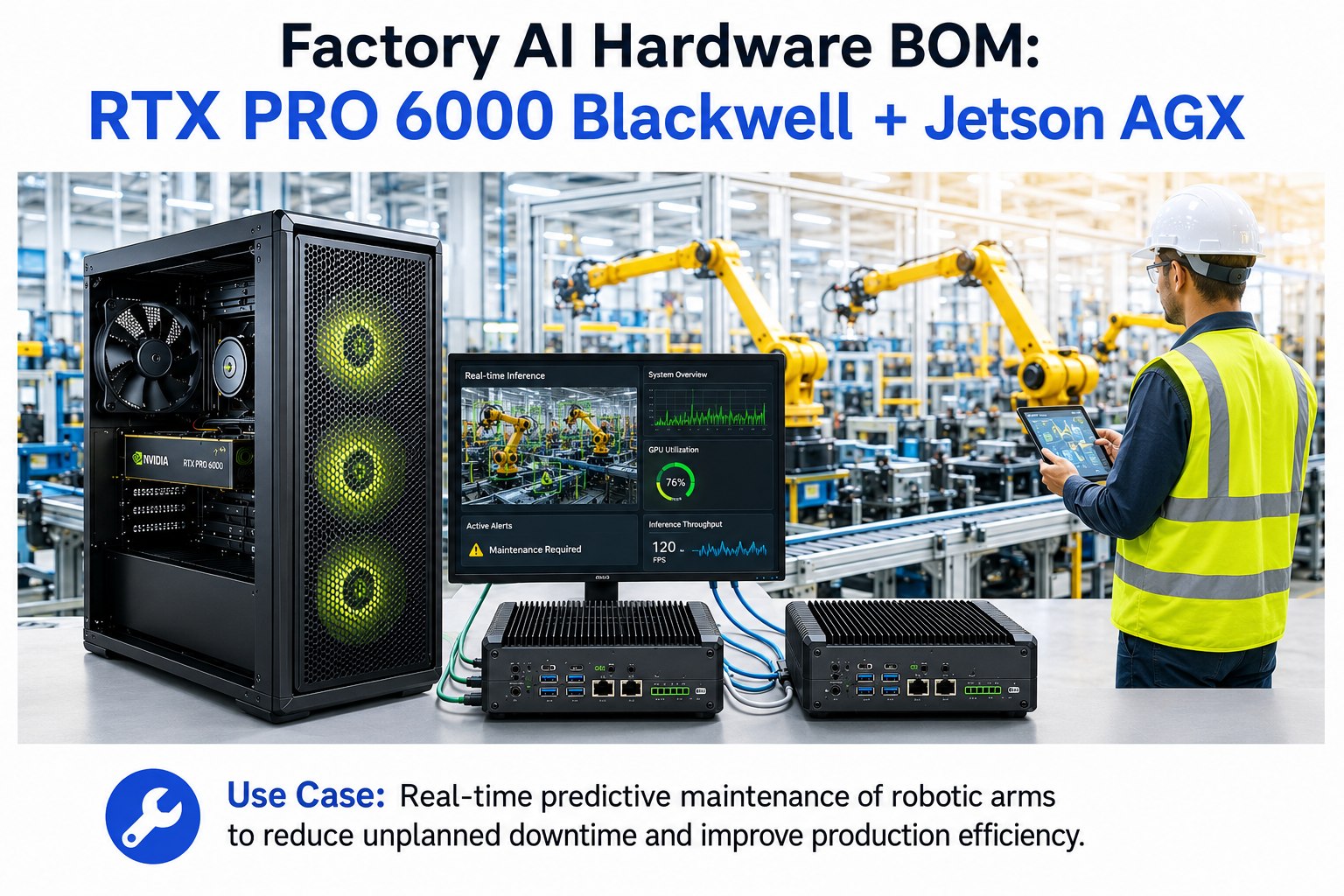
OxMaint's per-plant deployment uses both tiers together in a deliberate architecture. The central tier runs an RTX PRO 6000 Blackwell server (the Ada Lovelace successor) for Digital Twin rendering, multi-camera aggregation, and CMMS work-order generation. Two edge tier units — NVIDIA AGX Orin appliances — handle the latency-sensitive workloads at the source: PLC tag synchronization and CCTV vision. This split is what makes the per-plant build come in at $72.5K-$94.5K with both tiers covered. Sign up free to see the OxMaint per-plant deployment architecture in detail.
CENTRAL
RTX PRO 6000 Blackwell 96GB Server
96 GB GDDR7 · 24,064 CUDA cores · 600W
Digital Twin, LLM, multi-asset analytics, CMMS work-order routing
Real-time PLC tag sync <10ms, historian write 500ms interval
$4,000
EDGE 2
NVIDIA AGX Orin (CCTV Edge AI)
8–16 RTSP streams · DLA inference · <100ms anomaly alerts
Hardware-accelerated H.265 decode, CNN/vision models on DLA engine
$4,000
Pre-Configured · Both Tiers Included · Ships in 6–12 Weeks
Order an OxMaint AI Server With Central + Edge Hardware Pre-Integrated
OxMaint's per-plant deployment ships with the RTX PRO 6000 Blackwell central server (the Ada Lovelace successor for AI workloads) plus two NVIDIA AGX Orin edge appliances for PLC and CCTV ingestion — pre-configured, integration-tested, ready to plug into your plant network within days. Fully integrated with the OxMaint AI software stack, Digital Twin, CMMS, and SAP/Maximo connectors. Source code and modification rights included.
Investment Summary — Per-Plant Rollout + Enterprise AI
The OxMaint per-plant deployment combines central and edge tiers in one bill of materials. The $19,000 central server is the Blackwell-generation successor to the RTX 6000 Ada — same workstation-class form factor, doubled VRAM (96 GB vs 48 GB), and FP4 Tensor support. The two $4,000 AGX Orin edge units handle the latency-sensitive plant floor workloads. Sign up free to see the full per-plant pricing tailored to your footprint.
Swipe to see breakdown
Component
Unit Cost
Per Plant (4 mo)
Notes
RTX PRO 6000 Blackwell 96GB Server (Omniverse)
$19,000
$19,000
Digital Twin rendering & simulation per plant
NVIDIA AGX Orin #1 (PLC Edge AI)
$4,000
$4,000
All Allen-Bradley PLCs → OPC-UA → real-time sync
NVIDIA AGX Orin #2 (CCTV Edge AI)
$4,000
$4,000
All CCTV RTSP streams → DLA inference
Industrial Ethernet Switch + Cabling
~$2,500
~$2,500
Plant-floor switch, Cat6A, SFP modules
Local Electrical/Instrumentation Vendor
$8,000–$12,000
~$10,000 est
PLC wiring, conduit, panel work, patch cabling
OxMaint AI Software + Integration (per plant)
$35,000–$55,000
$45,000 avg
Digital Twin build, AI models, LLM, dashboards
Per-Plant Total (hardware + software)
$72,500–$94,500
~$84,500 avg
4-month delivery per plant
Enterprise AI DGX Station (GB300 Ultra, 768GB RAM, 400GbE)
$85,000–$100,000
One-time shared
All 4 plants: physics, simulation, LLM, analytics
Enterprise AI Delivery (3 months)
$45,000–$65,000
One-time
Corporate rollout, LLM fine-tuning, integration
4-Plant Full Rollout (parallel deployment)
~$420,000–$520,000
Total programme
Parallel delivery: all 4 plants + Enterprise AI
$84.5K
Avg per plant
4 mo
Delivery
$0
Recurring fees
∞
Perpetual
Perpetual · Owned · Central + Edge · Source Access Included
Stop Choosing Between Central and Edge — Run Both, Owned
A complete on-prem AI hardware stack on enterprise-grade hardware in your plant. Central RTX PRO 6000 Blackwell server for Digital Twin, LLM, and analytics. Two NVIDIA AGX Orin edge appliances for PLC and CCTV processing at the line. All pre-installed, all owned, source code included, full data sovereignty. No SaaS lock-in. No per-token recurring fees. The architecture every modern industrial AI deployment is converging on.
Why does the OxMaint deployment use the RTX PRO 6000 Blackwell instead of the RTX 6000 Ada?
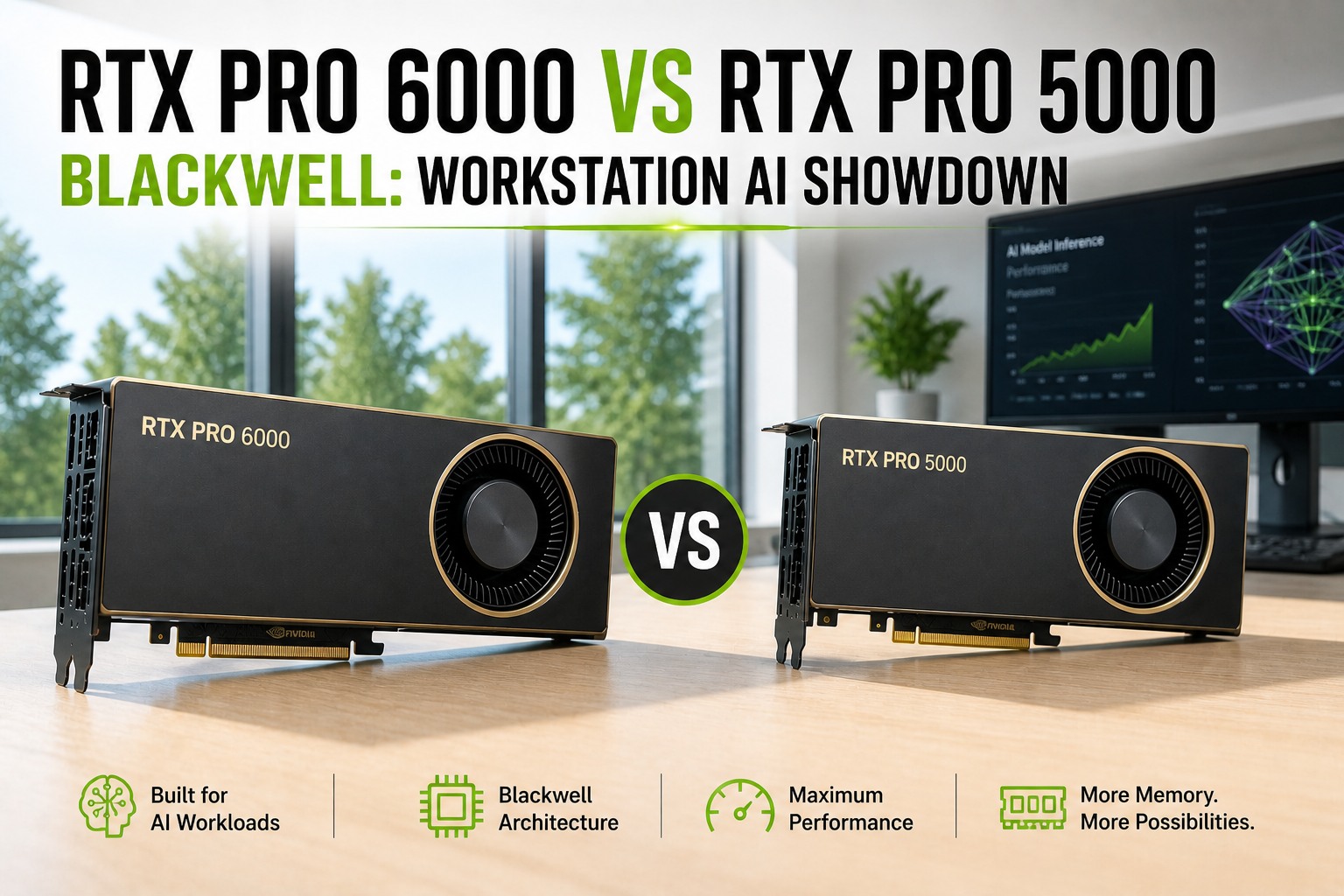
The RTX 6000 Ada (2022, Ada Lovelace, 48 GB GDDR6) was an excellent workstation-class GPU for AI in its time, but the RTX PRO 6000 Blackwell (2024-2025, Blackwell architecture, 96 GB GDDR7) is its direct successor with substantially better specs for industrial AI workloads. The Blackwell card doubles VRAM from 48 GB to 96 GB — meaning entire 70B-class LLMs can fit at FP8 with full context window. It adds 5th-gen Tensor Cores with native FP4 precision support (1.7× the FP8 performance of Ada Tensor Cores). It uses GDDR7 memory at 1,792 GB/s vs 960 GB/s on Ada (87% more bandwidth). And it ships with the same 4× DisplayPort 2.1b form factor and ECC memory that made the Ada card a workstation-grade option. For a customer specifying an on-prem AI server in 2026, the Blackwell card is simply the better buy. The Ada card remains a valid option if you've already invested in Ada-generation infrastructure or have ISV-certification requirements that haven't yet validated against Blackwell, but for new deployments OxMaint defaults to the Blackwell server.
When does my plant actually need the edge tier vs just running everything centrally?
Three concrete signals tell you to add edge appliances. (1) Latency budget under 100ms for any inference path — line-speed defect inspection, robot perception, real-time control loops. Network round-trip from line to central server consumes 30-80ms by itself, leaving no budget for the inference. (2) Sensor density at the source — if you have 8+ RTSP cameras feeding from one production cell, decoding all of them centrally wastes GPU time on H.265 decoding that DLA engines on Jetson handle for free. Better to process at the source and forward only the alert/metadata. (3) Functional safety in scope — robots, medical devices, fail-safe controllers need ISO 26262 / IEC 61508-certified hardware (IGX Orin/Thor), and that's only available at the edge tier. If none of those three apply (purely advisory analytics, asset health scoring, work-order prioritization, NLP over technician notes), a central RTX PRO 6000 Blackwell server alone covers the workload. Most industrial customers find that even small deployments hit at least one of those three, which is why OxMaint per-plant builds include both tiers.
What's the difference between IGX Orin, Jetson AGX Orin, and the upcoming IGX Thor?
All three share the same NVIDIA Orin or Thor SoC — the differences are in productization. Jetson AGX Orin is the embedded module form factor (or developer kit); used by OEMs to build their own products. Up to 275 TOPS INT8, 64 GB unified memory, ~60W. Designed for "custom and flexible designs." IGX Orin is the same SoC packaged as an enterprise-ready industrial AI platform — adds ConnectX-7 networking, BMC, certified industrial-grade hardware, ISO 26262/IEC 61508 functional safety certification, 10-year lifecycle. Designed to "accelerate development time and reduce software maintenance costs" for industrial OEMs. IGX Thor (announced 2025) is the next-generation IGX based on Blackwell architecture — significantly more AI compute, dual 200 GbE networking with RDMA, hardware-based functional safety. Available as IGX T5000 SoM and IGX T7000 Board Kit for industrial OEMs. The OxMaint per-plant deployment uses Jetson AGX Orin for the standard plant floor edge units (cost-optimized at $4K each); for safety-critical robot or medical-adjacent deployments, customers can specify IGX Orin/Thor variants at higher unit cost.
Does the RTX 6000 Ada handle real-time AV1 video encoding for plant CCTV?
Yes — the RTX 6000 Ada includes 8th-generation NVENC with hardware AV1 encoding, 40% more efficient than H.264, which means a plant streaming at 1080p can move to 1440p at the same bitrate, or maintain 1080p at 60% the network bandwidth. For OxMaint deployments, this matters when you're aggregating video from 16-32 plant cameras to a central archive or analytics pipeline. However, even with AV1 efficiency, decoding 16+ RTSP streams centrally still consumes meaningful GPU time on the central server — time that could be spent on inference. The OxMaint architecture instead does H.265 decode and CNN/vision inference on the AGX Orin edge unit's DLA engines (which handle 8-16 simultaneous streams with zero load on the GPU), and forwards only the alert metadata + bookmark frames to the central server for archival and aggregation. This is the architectural pattern that makes "central RTX PRO + edge AGX Orin" deliver better TCO than "everything central with more GPU."
How long from sign-up to live operation with both tiers deployed?
Six to twelve weeks from sign-up to live operation is typical for the full per-plant deployment including both central and edge tiers. The compressed timeline works because the central server (RTX PRO 6000 Blackwell, 96 GB), both edge units (NVIDIA AGX Orin × 2), industrial Ethernet switch, and OxMaint AI software stack are pre-configured, integrated, and pre-tested in the OxMaint factory before shipping — Omniverse for Digital Twin, vision defect models on edge DLA, anomaly detection models, predictive maintenance LSTM, OPC-UA/Modbus connectors, and CMMS integration are all installed and validated against synthetic plant data before the units ship. On-site work then collapses to: rack the central server in your plant IT room (1 day), mount the edge appliances at the line and CCTV aggregation points (2-3 days), connect to your SCADA/historian/PLCs (3-5 days), connect cameras to the CCTV edge unit (1-2 days), pre-train models against your existing healthy-operation data (2-4 weeks running in parallel), validate alerts in shadow mode (2-4 weeks), then production cutover. Most plants start with one production line or one critical asset class and expand from there.