SAP APM vs On-Prem Predictive Maintenance: Sapphire 2026 Compared
By James Smith on May 2, 2026
In 2026, the question maintenance directors keep asking at Sapphire and every other enterprise conference is not whether to adopt predictive maintenance — it is whether to run it through SAP Asset Performance Management on SAP BTP or deploy an independent on-prem stack that keeps your asset data, your ML models, and your failure history inside your own infrastructure. This comparison gives you the real numbers: implementation cost, prediction accuracy, integration depth, SAP Joule's role at Sapphire 2026, and the scenarios where each path wins — so you can bring a defensible decision to your next capital review.
MAY 12, 2026 5:30 PM EST , Orlando
Upcoming Oxmaint AI Live Webinar — SAP APM vs On-Prem PdM: Live Architecture Breakdown at Sapphire 2026
Join the OxMaint team in Orlando for a live side-by-side architecture walkthrough — SAP APM on BTP versus a sovereign on-prem predictive maintenance stack — mapped to real asset data, real integration patterns, and real TCO numbers.
Live SAP APM vs on-prem accuracy benchmark
TCO calculator walkthrough — year 1 through year 5
SAP Joule integration vs independent AI stack
Data sovereignty and compliance decision framework
The 2026 Decision: SAP APM vs On-Prem Predictive Maintenance at a Glance
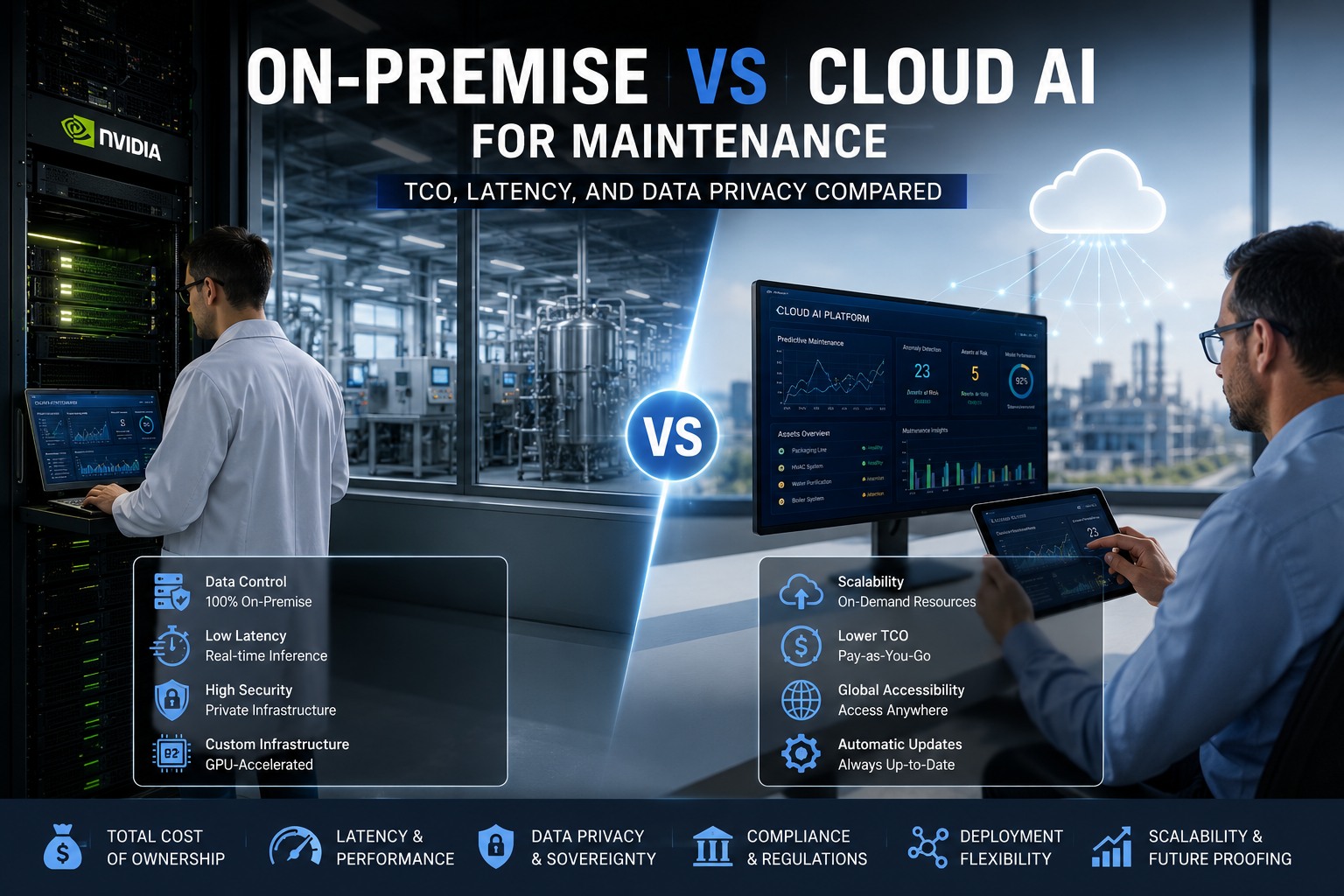
SAP APM runs exclusively on SAP Business Technology Platform — a cloud-only deployment that tightly integrates with S/4HANA maintenance workflows, procurement, and now SAP Joule, the generative AI copilot unveiled at Sapphire 2026. On-prem predictive maintenance keeps your sensor data, trained ML models, historian, and failure history behind your own firewall — with no BTP dependency and no per-asset cloud licensing. Both approaches can predict equipment failures. The deciding factors are data residency, integration architecture, total cost at scale, and how much of your maintenance intelligence you are willing to hand to a cloud vendor.
Hardware + software stack; no per-asset recurring cloud fee
Implementation Time
6–18 months (SAP project complexity)
30–90 days for first predictive signal
S/4HANA Integration
Native — best-in-class for SAP-centric shops
API-based — OPC-UA, MQTT, SAP RFC connectors
Data Sovereignty
Sensor and failure data lives on BTP — SAP's infrastructure
All asset data stays inside your perimeter — full sovereignty
ML Model Ownership
SAP-managed models — limited custom fine-tuning
You own, train, and version every model against your assets
Prediction Accuracy
Good on SAP-instrumented assets; weaker on OT/SCADA-heavy environments
Higher on brownfield OT environments with direct historian access
SAP Joule (Gen AI)
Native integration announced Sapphire 2026
Independent LLM or open-source alternative — your choice
Compliance / Air-Gap
Not suitable for air-gapped or regulated environments
Full air-gap support — critical infrastructure, defense, pharma
5-Year TCO (500 assets)
$2.1M–$4.8M (licensing + BTP + SI fees + SAP consulting)
$800K–$1.6M (hardware amortized + internal IT + software)
TCO Breakdown — Year by Year, Side by Side
The license comparison is only part of the story. SAP APM's true cost compounds through BTP consumption fees, S/4HANA upgrade dependencies, SAP SI partner fees, and ongoing consulting. On-prem costs peak in year one with hardware and deployment, then flatten sharply. Here is how the five-year curve looks for a mid-size plant running 500 monitored assets.
Year 1
SAP APM $1.2M
On-Prem $590K
Year 2
SAP APM $870K
On-Prem $310K
Year 3
SAP APM $840K
On-Prem $280K
Year 4
SAP APM $820K
On-Prem $295K
Year 5
SAP APM $775K
On-Prem $310K
SAP APM (5-yr total: ~$4.5M)
On-Prem PdM (5-yr total: ~$1.8M)
Cost model: 500 monitored assets, mid-size manufacturing plant, includes licensing, BTP consumption, SI fees, hardware amortization, internal IT, and support. SAP APM implementation assumes existing S/4HANA footprint; without it, add $300K–$800K upgrade cost.
SAP Joule at Sapphire 2026 — What It Changes (and What It Doesn't)
The biggest APM story at Sapphire 2026 was SAP's deep integration of Joule — its generative AI copilot — into Asset Performance Management. Maintenance teams can now ask natural-language questions against asset health data, generate failure mode summaries, and draft PM recommendations from within the SAP interface. It is genuinely useful for SAP-native shops. But the Joule integration has a hard constraint: it works on data that lives in BTP. Sensor histories, OT historian data, and proprietary failure datasets that are not already in SAP's cloud remain outside Joule's reach unless migrated — which is the core tension for plants running brownfield OT environments.
SAP Joule Wins When
Your asset master data, work order history, and PM schedules are already in S/4HANA
Your team wants natural-language maintenance queries without a separate AI tool
You need Joule's recommendations to flow directly into SAP PM work orders
Your data governance policy permits asset health data on BTP infrastructure
On-Prem AI Wins When
Your OT historian, SCADA, and sensor feeds live outside SAP and migration is not viable
Regulatory, defense, or pharma compliance requires data to stay air-gapped
You want to fine-tune failure prediction models on your specific asset failure history
You need predictive maintenance independent of SAP licensing, upgrades, or BTP uptime
Prediction Accuracy — Where Each Approach Actually Performs
Prediction accuracy is not a single number — it depends on the quality and location of your sensor data, the depth of your failure history, and how well the ML model is trained on your specific assets. SAP APM applies generalized models calibrated on SAP's broad customer base; on-prem stacks let you train narrowly on your own equipment failure patterns, which produces higher accuracy on the assets you have instrumented most deeply.
Asset / Environment Type
SAP APM Accuracy
On-Prem (Custom Model)
Edge Advantage
S/4HANA-instrumented assets
87–91%
82–88%
SAP APM
Brownfield OT / SCADA-heavy plant
61–72%
84–93%
On-Prem
Rotating equipment (pumps, compressors)
75–83%
88–95%
On-Prem
Multi-site, SAP-standardized fleet
85–90%
79–86%
SAP APM
Air-gapped / regulated environment
Not deployable
Full capability
On-Prem only
Integration Architecture — How Each Stack Connects to Your Plant
Integration is where the theoretical feature comparison meets reality. SAP APM has a genuine advantage inside the SAP ecosystem: asset health signals flow natively into PM work orders, materials management, and financial cost objects — no middleware required. Outside the SAP boundary — at the OPC-UA layer, DCS, third-party historians, and independent CMMS systems — that native advantage disappears and both approaches require integration engineering.
SAP APM Integration Path
01
Sensor data ingested via SAP IoT or Cumulocity IoT into BTP data lake
02
SAP APM runs ML anomaly detection on BTP — SAP-managed models
03
Failure alert triggers PM notification natively in S/4HANA — zero middleware
04
Joule generates natural-language maintenance recommendations in SAP UI
Constraint: All data must transit BTP. On-prem OT data requires extraction, transformation, and upload — adding latency and compliance risk for regulated industries.
On-Prem PdM Integration Path
01
Historian, SCADA, and sensor feeds ingested directly via OPC-UA / MQTT — no cloud hop
02
Custom ML models trained on your asset failure history — fine-tuned per equipment class
03
Failure prediction triggers work order in CMMS or SAP PM via API — configurable routing
04
On-prem LLM or open-source AI generates technician guidance — data never leaves perimeter
Constraint: S/4HANA native write-back requires RFC or REST API configuration. No Joule integration — organizations using Joule elsewhere run two separate AI interfaces.
Expert Review — What Reliability Engineers Say in 2026
The Sapphire 2026 conversation around SAP APM and Joule was genuinely exciting — and for certain SAP-centric organizations, it represents a meaningful step forward. But the question I keep asking maintenance directors is: where does your failure data actually live? In most brownfield manufacturing plants I work with, 60 to 75 percent of the sensor data that matters most for predicting failures sits in OSIsoft PI historians, Wonderware, or proprietary DCS databases that have never been touched by SAP. Migrating that data to BTP to unlock APM's full capability is a 12 to 18 month integration project before the predictive maintenance work even begins. For those organizations, an on-prem stack that ingests directly from the historian layer starts producing failure predictions in weeks — not years. The real comparison is not SAP APM versus on-prem in terms of feature sets. It is time-to-first-prediction and total cost over five years. On both measures, purpose-built on-prem PdM has a structural advantage in brownfield OT environments — and the organizations that recognize this early are the ones getting ROI in the first year rather than the third.
60–75% of Failure Data Sits Outside SAP
In most brownfield plants, the historian, DCS, and SCADA data that drives the highest-accuracy predictions is not in S/4HANA. Migrating it to BTP before APM can analyze it adds 12–18 months before the first prediction fires — a project before the project.
On-Prem: First Prediction in Weeks, Not Years
Purpose-built on-prem PdM stacks that connect directly at the OPC-UA / historian layer typically produce the first failure predictions within 30–60 days of deployment. The same outcome via SAP APM implementation averages 9–18 months to full production.
5-Year TCO Delta: $2M+ for Mid-Size Plants
Across a 500-asset plant, the five-year total cost of ownership gap between SAP APM and a purpose-built on-prem PdM stack typically runs $2M to $3M — driven by BTP consumption fees, SAP SI rates, and mandatory S/4HANA upgrade dependencies.
Decision Framework — Which Path Wins for Your Organization
There is no universal winner. The right answer depends on three variables: how deep your SAP footprint runs, where your asset data actually lives, and whether your regulatory environment permits cloud-resident operational technology data. Use this framework to map your situation to the right deployment model before engaging either vendor.
Choose SAP APM If
S/4HANA is your system of record for assets, work orders, and materials — and you want native integration without middleware
More than 70% of your monitored assets are already instrumented through SAP IoT or Cumulocity
Your IT governance requires a single-vendor ERP + APM stack and your security team approves BTP for OT data
You have a 12–18 month implementation runway and the budget for SAP SI partner fees
SAP Joule's natural-language maintenance interface aligns with your digital transformation roadmap
Choose On-Prem PdM If
Your failure history, sensor data, and historian feeds live outside SAP — in OSIsoft PI, Wonderware, or proprietary DCS databases
Data sovereignty, air-gap requirements, or regulated industry compliance (pharma, defense, critical infrastructure) prohibit cloud-resident OT data
You need predictive signals in 30–90 days, not 12–18 months — and your capital cycle requires early ROI demonstration
Your 5-year IT budget cannot absorb $2M–$4.8M in combined licensing, BTP, and SI costs for a 500-asset deployment
You want full control over ML model training, versioning, and fine-tuning on your specific equipment failure patterns
Frequently Asked Questions
Is SAP APM cloud-only, or can it be deployed on-premises?
SAP Asset Performance Management runs exclusively on SAP Business Technology Platform — it is a cloud-only solution with no supported on-premises deployment option as of 2026. This is a fundamental architectural decision by SAP, not a configuration choice. Organizations in regulated industries, defense, critical infrastructure, or those subject to data residency laws that restrict where operational technology data can be processed will find SAP APM architecturally incompatible with their requirements. In these cases, an independent on-prem predictive maintenance stack — which runs inside your own data center or private cloud with no BTP dependency — is the only viable path. See how OxMaint's on-prem deployment works for your environment.
What did SAP announce about APM and Joule at Sapphire 2026?
At Sapphire 2026, SAP announced deeper integration between SAP Asset Performance Management and SAP Joule, its generative AI copilot embedded across the S/4HANA suite. The integration enables maintenance teams to query asset health data in natural language, receive Joule-generated failure mode summaries, and draft PM strategy recommendations from within the SAP interface — without switching to a separate analytics tool. The practical limitation is that Joule's APM capabilities operate on data that lives in BTP. Asset health signals, sensor histories, and failure records that have not been migrated into SAP's cloud environment remain outside Joule's analytical reach. For organizations with significant brownfield OT data outside SAP, the Sapphire announcement represents a compelling future state — contingent on a data migration project that typically runs 12 to 18 months before APM+Joule can operate at full capability.
How long does SAP APM actually take to implement versus on-prem predictive maintenance?
SAP APM implementation timelines in brownfield environments consistently run 9 to 18 months from contract to first production failure predictions — driven by BTP environment provisioning, Cumulocity or SAP IoT sensor integration, data modeling to align historian and SCADA feeds with SAP's asset data model, and SAP SI partner project execution. Organizations without an existing S/4HANA footprint add 6 to 12 months for ERP preparation before APM work begins. Purpose-built on-prem predictive maintenance platforms that connect directly at the OPC-UA and historian layer typically deliver the first anomaly detection and failure predictions within 30 to 90 days of deployment. The gap is not marketing — it reflects the architectural difference between a platform that must move your data to the cloud before analyzing it versus one that processes data at the source. Book a demo to see OxMaint's 30-day deployment path.
Can on-prem predictive maintenance integrate with SAP S/4HANA for work order creation?
Yes — modern on-prem predictive maintenance platforms integrate with SAP S/4HANA for maintenance notification and work order creation via SAP RFC (Remote Function Call), REST API, or SAP's standard integration middleware including SAP Integration Suite. When the on-prem AI detects a failure pattern and generates a maintenance alert, it can create an SAP PM notification or work order directly in S/4HANA — pre-populated with asset ID, fault classification, priority, and recommended task list. This gives organizations the data sovereignty and prediction accuracy advantages of on-prem AI while preserving SAP as the maintenance execution system of record. The integration adds configuration effort that SAP APM's native path avoids — but it does not require BTP, Cumulocity, or any cloud dependency on the predictive analytics side.
What is the realistic 5-year total cost of ownership comparison between SAP APM and on-prem PdM?
For a mid-size manufacturing plant monitoring 500 assets, the five-year TCO difference between SAP APM and a purpose-built on-prem predictive maintenance stack typically runs $2M to $3M in favor of on-prem. SAP APM's cost accumulates across BTP consumption licensing (approximately $25 per asset per year at baseline), SAP EAM/S/4HANA dependencies, SAP SI partner implementation fees ranging from $500K to $3M depending on complexity, annual SAP support at 15 to 22 percent of license value, and ongoing consulting for model updates and integration changes. On-prem costs are front-loaded in year one with hardware and deployment, then flatten to internal IT support and software maintenance — typically $280K to $310K annually after the initial deployment. The crossover point where cumulative on-prem costs exceed SAP APM is rarely reached before year seven even in generous SAP APM cost scenarios. Start your free OxMaint trial and run your own TCO comparison.
Not Ready to Commit to 18 Months and $4M? There Is a Faster Path.
OxMaint's on-prem AI connects directly to your historian, SCADA, and IoT feeds — no BTP, no cloud dependency, no SAP licensing required. First predictive signal in 30 days. Data stays inside your perimeter. Live in weeks, not years.