Air Preheater Leakage Detection: AI Catches APH Drift
By Riley Quinn on May 8, 2026
Air Pre-Heater leakage at your plant probably crossed the 10% OEM band weeks before anyone noticed. It crept up at 0.14% per day. The O₂ balance didn't catch it. The dashboard showed everything green. But the ID Fan B-side current was already pulling an extra 14 amps. By day 30, leakage hit 12.4% and heat rate was 6 kcal/kWh worse — quietly burning $336K of extra fuel a year. The APH Performance Twin would have flagged it on day 9. Register for the event to see the APH twin running on real plant data.
MAY 12, 2026 5:30 PM EST , Orlando
Upcoming OxMaint AI Live Webinar — APH Leakage Detection Live Demo
Live session for boiler performance engineers, maintenance heads, plant managers, and reliability directors running coal-fired and combined-cycle thermal plants. We'll have the APH Performance Twin running live on the actual on-prem stack — RTX PRO 6000 Blackwell central server plus dual Jetson AGX edge boxes — showing the 30-day drift detection on real plant data: leakage % trace, ID fan loading anomaly, OEM band crossover, and the day the AI fired the alert. Hands-on time at the screens, walkthrough of the 6–12 week pilot-to-deployment timeline, and on-the-spot quotes.
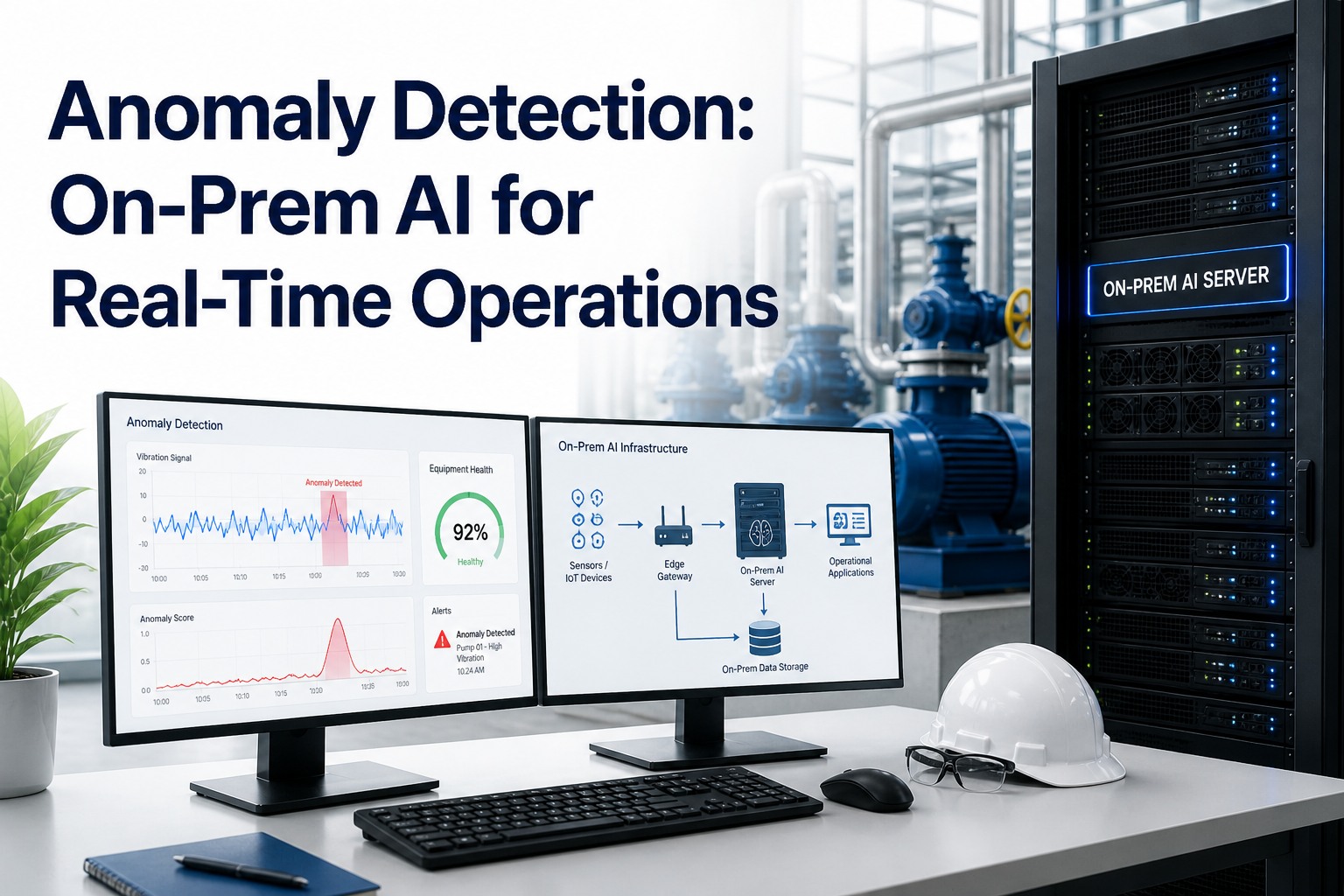
A single rack-mount server that sits in your IT room. 96 GB GDDR7 ECC. Runs the APH Performance Twin, the multivariate residual scoring, and the rotor-thermal model — all on the same box, all in under 50 ms. This is what fires the alert when ID Fan B-side current pulls +14A.
JOB FOR APH DETECTION
Runs the APH Twin model. Compares live PI streams against the learned normal-behavior model. Calculates the residual. Fires the alert when confidence crosses 88%.
EDGE · 01 · ~$4K
Jetson AGX · Boiler Island
Streams the boiler-side data.
A small edge box mounted near the boiler island. 64 GB unified memory, 275 TOPS. Pulls flue gas flow, APH inlet/outlet temps, rotor speed, FD fan loading, and combustion air flow from the PI Historian every second.
JOB FOR APH DETECTION
Pre-processes the 40+ PI tags into model windows. Strips noise. Hands clean time-series to the RTX PRO 6000 server over the 10 GbE backplane.
EDGE · 02 · ~$4K
Jetson AGX · Fan + MCC
Streams the electrical data.
A second edge box mounted at the motor control center. Pulls ID Fan A-side and B-side current, voltage, motor temperature, and FD fan electrical data. This is where the +14A signal that proves APH leakage actually comes from.
JOB FOR APH DETECTION
Watches ID Fan loading second by second. Spots the small current rises that the operator dashboard never shows. Feeds the trend to the RTX PRO 6000 for residual analysis.
~$84.5K
Total per-plant capex including the three boxes, switch, electrical, and the OxMaint AI software stack with the APH Performance Twin pre-loaded. No subscriptions. No per-tag billing. Optional NVIDIA DGX Station GB300 Ultra at corporate tier (~$85K) shared across plants for fleet-wide twin training. Buy once, own forever.
Why APH Leakage Detection Has to Run On-Prem
Now that you've seen the three boxes, the question is why they have to sit inside your plant — not in a cloud region. APH drift is a slow signal hidden inside fast data. The Performance Twin needs continuous flue gas flow, oxygen, ID fan amperage, FD fan loading, APH inlet/outlet temps, and rotor speed — 40+ PI tags sampled every second. Sending that to a hyperscaler adds latency you don't have, exposes proprietary fuel and emission data, and breaks the moment your WAN flickers. On-prem inference runs in under 50 ms. Your DCS data never leaves the plant. Register for the event to see the on-prem stack running the APH twin live.
8.2→12.4%
leakage drift over 30 days — well past the 10% OEM band by week 3
+14A
ID Fan B-side current rise — the leading indicator the APH Twin actually watches
6 kcal
heat rate impact per kWh — invisible on dashboards, brutal on the fuel bill
$336K
avoidable fuel cost per year on a single 500 MW unit
The 30-Day APH Drift Forensic — What the Twin Caught
Below is the actual signal pattern from a real APH leakage event, reconstructed by the APH Performance Twin. The leakage % trace climbs slowly. The ID Fan B-side current trace climbs in lockstep. On day 9, the twin's residual exceeds the 88% confidence threshold and the model fires its alert — three weeks before performance staff would have caught it during the next monthly review. Register for the event to walk through this exact forensic on the webinar screen.
MODELAPH Performance Twin
OEM BAND< 10% leakage
CONFIDENCE88%
UNIT500 MW · supercritical
APH Leakage % & ID Fan B-Side Current · 30-Day Trace
APH leakage % (left axis)
ID Fan B-side current (right axis)
10% OEM leakage band
AI alert fires
DAY 1
Leakage 8.2% · ID Fan B 290A · everything green on the operator dashboard
DAY 9
APH Twin fires alert. Multivariate residual crosses 88% threshold. ID Fan B-side current pulling +6A vs baseline. Recommended: inspect cold-end seals on B-side rotor.
DAY 15
Leakage crosses 10% OEM band. ID Fan B-side current +9A. Heat rate degraded 3 kcal/kWh.
DAY 30
Leakage 12.4% · ID Fan B-side +14A · heat rate 6 kcal/kWh worse · burning $336K/yr extra fuel — and nobody on the floor knows yet.
LIVE AT THE WEBINAR · MAY 12 ORLANDO
Watch the APH Twin Catch Drift on Day 9. Not Day 30.
No slides. No marketing pitch. Real PI tag streams flowing into the RTX PRO 6000 server, the APH Performance Twin firing alerts on the Live AI Insights feed, the 30-day drift trace updating in real time. Walk away with a quote you can take to your CFO and a free APH AI assessment for your plant. Pilot to fully running in 6–12 weeks.
Heat Rate Drifts +6 kcal/kWh and the Performance Engineer Can't Pin Down Why
PROBLEM
Monthly performance review shows heat rate has crept up 6 kcal/kWh. Three teams suspect three different root causes — combustion drift, condenser fouling, sensor calibration. Nobody points at the APH because the O₂ balance "looks fine." Meanwhile the unit is bleeding $336,000 a year in extra fuel. Six months pass before a manual seal inspection finally confirms it's APH leakage all along.
ON-PREM SOLUTION
The Jetson AGX edge box on the boiler island streams ID Fan loading, FD Fan loading, flue gas flow, APH inlet/outlet temperatures, and rotor speed every second. The RTX PRO 6000 Blackwell server runs the APH Performance Twin (88%) on those streams in under 50 ms — correlating all variables against a learned normal-behavior model. When ID Fan B-side current pulls +14A while FD Fan loading also rises, the twin attributes the heat-rate drift to APH leakage — not condenser, not combustion, not calibration.
RESULT
Cold-end seal inspection scheduled for the next planned outage. Seals replaced. Leakage drops back to 7.8%. ID Fan loading drops 23% — same range as the AEP Welch Station Unit 3 result documented in industry literature. Heat rate recovers within one shift after the outage. CFO gets defensible attribution numbers.
~$336K/yr fuel cost recovered on a 500 MW unit
02
"Running Out of Fan" — The Plant Can't Hit Full Load Anymore
PROBLEM
The unit used to hit 510 MW comfortably. Now it tops out at 487 MW because the ID fans are maxed. Dispatch is asking why generation capacity is down. Operations blames "fan margin" — a vague way of saying nobody knows exactly what's eating the headroom. The plant is losing dispatch revenue every peak hour.
ON-PREM SOLUTION
"Running out of fan" is a textbook symptom of excess APH leakage. The second Jetson AGX edge box pulls ID and FD fan electrical data — current, voltage, motor temperature — directly from the MCC. The RTX PRO 6000 runs the APH Twin's fan-margin attribution model on those streams, quantifying exactly how much fan headroom the leakage is consuming and breaking it down between primary and secondary leakage paths. The output: which seals to replace and how much MW capacity is recoverable.
RESULT
After targeted seal replacement during the next outage, ID fan margin recovers. Plant returns to its design 510 MW peak capacity. The 23 MW of recovered headroom turns directly into dispatch revenue every hour the unit is called for full load.
APC Equipment Trips on High Flow — and Nobody Saw It Coming
PROBLEM
The ESP starts showing pressure drop excursions. The SCR operates outside its design flow range. The bag filter house shows accelerated fabric wear. Each emissions-control system gets diagnosed in isolation. Nobody connects the dots — every one of those symptoms is downstream of an APH that's leaking 14% air directly into the flue gas path.
ON-PREM SOLUTION
Both Jetson AGX edge boxes stream the full downstream flow chain — ESP pressure drop, SCR inlet flow, bag filter ΔP — into the RTX PRO 6000 server. The APH Twin runs a single root-cause attribution model across all three downstream subsystems. When leaked air increases volumetric flow at ESP, SCR, and bag filter inlet simultaneously, the twin attributes the load increase upstream — to the APH — and surfaces the connection on a single screen. One root cause, three symptoms explained, all on-prem.
RESULT
Maintenance team stops chasing three separate failures. APH seal replacement fixes the upstream root cause. ESP pressure normalizes. SCR returns to design flow. Bag wear rate drops back to baseline. Compliance margin restored.
~$180K/yr saved in APC parts & compliance margin
~$1.7M+
Combined yearly savings on a typical 500 MW unit across the three use cases — against a one-time on-prem hardware capex of around $84,500 and zero monthly subscription fees. The first prevented "running out of fan" event alone pays for the entire stack.
Why Boiler Performance Teams Buy This Stack Instead of Anything Else
Four reasons a boiler performance engineer or maintenance head picks the OxMaint APH twin over O₂-balance methods, generic CMMS bolt-ons, or DCS-vendor add-ons. Plain English. Real outcomes. Sign up free to start an APH twin trial.
01
Catches drift on day 9, not day 90.
O₂ balance methods are inherently noisy and confounded by duct leaks. The Performance Twin uses multivariate residuals across ID Fan loading, flue gas flow, and APH thermal performance — flagging drift weeks before any single-variable threshold trips.
~21 days earlier than monthly performance review
02
Splits primary vs secondary leakage paths.
The twin doesn't just say "you have leakage." It tells you whether it's radial seals, axial seals, circumferential seals, or hot-end vs cold-end. Maintenance team walks into the outage knowing which seals to replace — not running every possible inspection.
Targeted repair · half the outage scope
03
Connects APH to the real fuel-cost number.
Every alert ships with a heat-rate impact in kcal/kWh and a dollar bleed in $/day at current fuel cost. CFO sees fuel dollars, not engineering anomalies. Maintenance prioritization becomes obvious.
$/day quantified at current fuel price
04
Your data never leaves the plant.
PI tags, ID fan electrical data, fuel contracts, emission readings — all stay on your on-prem RTX PRO 6000 server, behind your firewall. No cloud egress. Compliance and security teams approve in days.
100% on-prem · zero data egress
Expert Review — The Engineering Behind the Twin
APH leakage is one of the most studied — and most underestimated — efficiency losses in coal-fired generation. The OxMaint APH Performance Twin is built on the same engineering principles validated in EPRI, Power magazine, and industry case studies. Here's what the literature already proved.
"After full-contact radial seals replaced standard rigid seals at AEP's 500 MW Welch Station Unit 3, ID fan amperage decreased by over 23%. A 1% boiler efficiency improvement at a 500 MW plant operating at 85% capacity factor saves nearly $1.5 million in annual fuel cost. Yet APH leakage is routinely viewed as a low-priority issue — leakage rates approaching 50% have been measured in some air heaters, and 20% leakage is commonly accepted as 'the best we can do' by many performance engineers."
— Industry findings published in Power Magazine, Power Engineering International, and EPRI Assessment 1018472
O₂ balance alone is misleading
EPRI explicitly notes O₂ measurements are confounded by duct leaks and can't discriminate radial/axial from circumferential leakage. Multivariate AI changes that.
ID fan amperage is the cleanest leading signal
Welch Station's 23% amperage drop after seal replacement is the canonical proof that ID fan loading tracks APH leakage almost linearly — exactly the signal the twin keys on.
A 1% efficiency improvement is huge
~$1.5M/yr at 500 MW. Most plants are leaking 12–14% when the OEM design is <10%. The recoverable efficiency is sitting right there on the floor.
Implementation — Pilot to Full Deployment in 6–12 Weeks
RTX PRO 6000 Blackwell server racks in your IT room. Two Jetson AGX edge boxes mount near the boiler island. PI Historian / OPC-UA connection live. APH and fan tags flowing in.
WEEKS 3–5
Baseline Capture · APH Twin Trains
Twin learns your specific APH's normal-behavior model — load points, ambient swings, fuel quality variations, rotor speed envelope. Establishes the leakage baseline against OEM band.
WEEKS 6–9
Shadow Mode + Performance Validation
Twin runs silently. Performance engineers validate every drift detection against ground truth. Confidence threshold tunes to your unit. ID Fan signature signature captured across operating envelope.
WEEKS 10–12
Live Alerts to Operator Screens
APH alerts publish to operator screens, mobile, and CMMS work-order automation. Each alert ships with the leakage trace, ID fan trend, heat-rate impact, and recommended seal-inspection scope. ROI starts compounding.
What You Get When You Walk Into the Webinar
Hands-on time at every screen. Real plant data flowing. The engineers who built the APH twin, ready to answer anything. Walk in curious, walk out with a free APH AI assessment for your plant, a quote, and an order date. Register for the event to lock your seat.
Live walkthrough of the APH Performance Twin on the actual on-prem hardware — 30-day drift trace, ID fan loading anomaly, OEM band crossover, alert firing in real time.
Hands-on at the RTX PRO 6000 server with both Jetson AGX edge boxes connected — touch the hardware, ask anything.
Free APH AI assessment for your specific plant — bring your APH spec sheet and recent performance data, leave with a tailored leakage and heat-rate analysis.
On-the-spot price quote with deployment timeline (6–12 weeks pilot to full).
DCS & PI integration walkthrough for ABB, Emerson, Siemens, Yokogawa via PI Historian, OPC-UA, or direct API.
SEATS LIMITED · MAY 12 ORLANDO
See the APH Twin Catch Drift Live on May 12
Walk into the webinar. Watch the 30-day drift trace climb past 10%. See the ID fan B-side current pull +14A. Get a free APH AI assessment for your plant. Touch the RTX PRO 6000 server. Ask the engineers who built the twin anything you want. Leave with a quote and an order date. Pilot to fully running in 6–12 weeks. You buy it once, you own it forever.
How does the APH Performance Twin actually detect leakage drift this early?
The twin doesn't rely on the O₂ balance alone — that signal is too noisy and confounded by duct leaks. It runs a multivariate residual model over ID fan loading, FD fan loading, flue gas flow, APH inlet/outlet temperatures, rotor speed, and combustion air flow. When the joint pattern of these tags drifts away from the unit's learned normal-behavior model, the twin's residual exceeds the 88% confidence threshold and fires the alert. In the documented forensic case, that happened on day 9 — three weeks before performance staff would have caught it during the next monthly review.
Can the twin distinguish radial leakage from circumferential leakage?
Yes. The twin separates leakage by signature — radial seal leakage shows up first as ID fan loading increase with relatively stable flue gas exit temperature, axial seal leakage adds a temperature signature, and circumferential leakage shows up as a thermal performance loss without proportional fan loading. EPRI Assessment 1018472 documents that O₂ balance methods can't make these distinctions. The twin's multivariate approach can — and that means the maintenance team walks into the outage knowing which seals to replace.
What does the +14A ID fan B-side current actually mean financially?
The +14A signal at the documented operating point translates to roughly 6 kcal/kWh extra heat rate. On a 500 MW unit running at 75% capacity factor with a delivered coal cost typical of US thermal plants, that's about $336,000 per year in extra fuel — burned silently, with everything green on the operator dashboard. The twin gives you the dollar number alongside the alert so the maintenance prioritization conversation with the CFO is over in five minutes, not five months.
Does any of our plant data leave the perimeter?
No. The reference deployment runs entirely on-prem on the RTX PRO 6000 Blackwell server inside your plant network. PI tags, ID fan electrical data, fuel contracts, emission readings, and twin outputs never leave your firewall. There is no hyperscaler involvement. There is no cloud dependency. The system can run completely cut off from the internet if your security team requires it. This is the architectural pattern thermal plants under regulatory scrutiny default to in 2026.
What's the total cost and what's actually included?
A typical per-plant deployment is around $84,500 — including the RTX PRO 6000 Blackwell server (~$19K), two Jetson AGX edge boxes (~$8K), industrial Ethernet switch and cabling (~$2.5K), local electrical work (~$10K), and the OxMaint AI software stack with the APH Performance Twin, integration, and 6–12 week pilot-to-production deployment (~$45K). For multi-plant performance programs, an optional NVIDIA DGX Station GB300 Ultra at the corporate level adds $85K–$100K shared across plants for fleet-wide twin training. No monthly subscriptions. No per-tag billing. Source code and modification rights included. You buy once, you own forever.