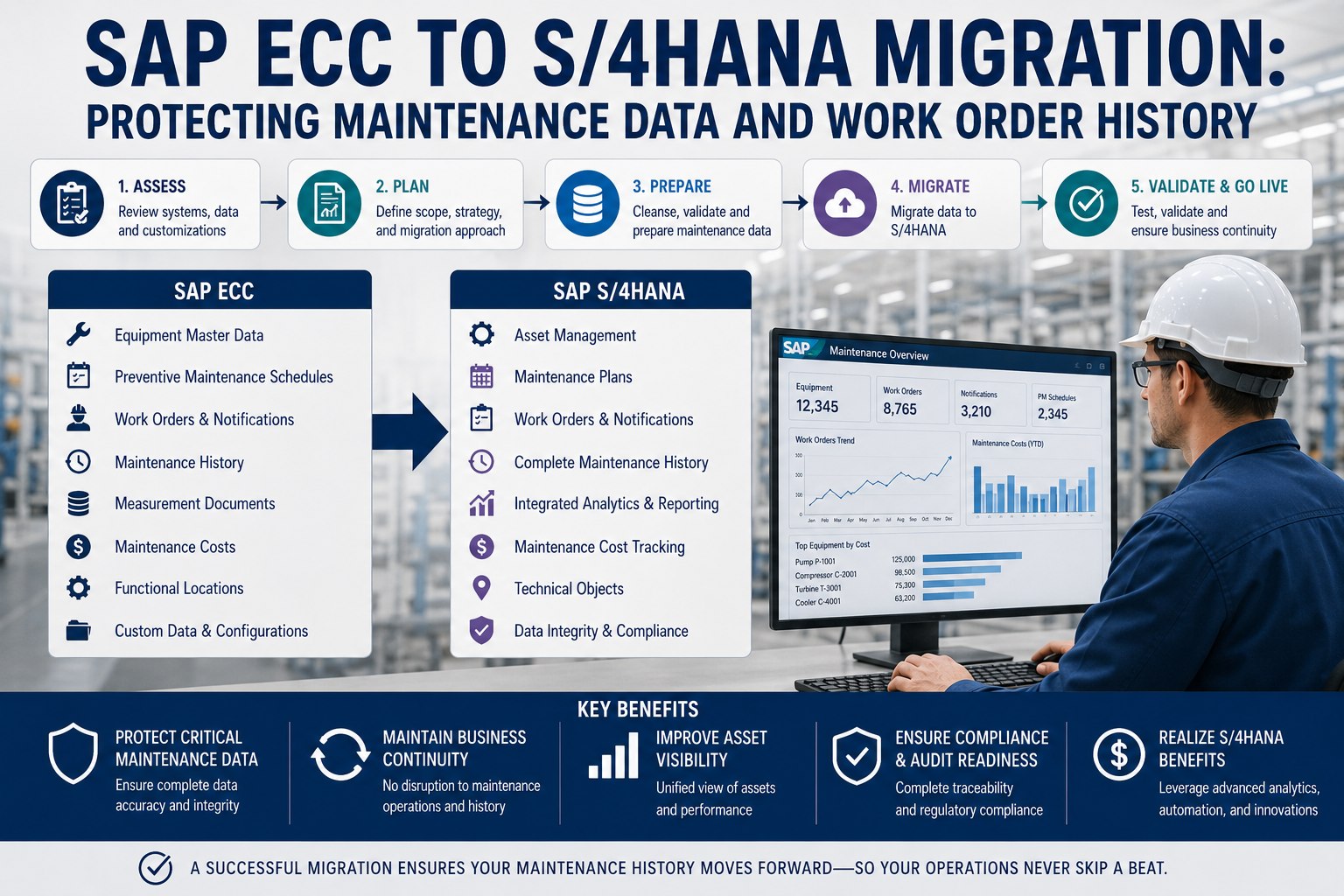
SAP's official deadline for ECC maintenance support is December 31, 2027. After that, organizations still running ECC move to extended support pricing — or lose vendor support entirely. For the thousands of industrial enterprises still on ECC, the question is no longer whether to move to S/4HANA but how to migrate without breaking years of carefully built AI-driven maintenance workflows, predictive models, and real-time integrations. AI continuity during SAP migration is the difference between a 6-month productivity crater and a clean cut-over where maintenance operations never miss a beat. Start your free Oxmaint trial — our platform supports both ECC and S/4HANA, giving you migration safety from day one. Or book a demo to see how Oxmaint keeps your AI maintenance models running through the entire ECC-to-S/4HANA transition.
Migration Playbook
SAP ECC to S/4HANA Migration: Ensuring AI Continuity with Oxmaint
A practical guide for maintenance and IT leaders navigating the 2027 deadline without disrupting AI-powered operations.
Deadline Countdown
2027
ECC mainstream support ends Dec 31
The 2027 Reality: Why Every SAP Customer Is Moving
Roughly 40,000 organizations worldwide still run SAP ECC. SAP has committed to supporting it through the end of 2027 for standard customers, with extended support available to 2030 at premium pricing. Beyond that, no security patches, no compliance updates, no new integrations. For maintenance-heavy industries — manufacturing, utilities, oil & gas, pharmaceuticals — this is not a paper deadline. Every day closer to 2027, the risk of being stranded on an unsupported platform grows, while the risk of rushing a migration without AI continuity planning grows in parallel.
18–24
Months — typical ECC to S/4HANA migration duration
20
Months remaining until ECC mainstream support ends
67%
Of SAP customers report AI workflow disruption during poorly planned migrations
What Actually Breaks During SAP Migration
The executive summary of any SAP migration always sounds clean. The reality in the maintenance organization rarely is. When ECC data structures transform into the S/4HANA simplified model, dozens of small downstream systems stop receiving the data they were built around. AI models trained on ECC field names return errors. Reports break. Mobile apps show stale data. Technicians lose confidence in the new system within days. Understanding which specific things break — and which do not — lets you plan protective measures before cut-over, not after.
01
Data Structure Changes
ECC table MSEG splits into MATDOC in S/4HANA
AI models reading material movement history break on the field rename
Customer and vendor masters merge into Business Partner
Any AI routing based on legacy KNA1/LFA1 tables needs remapping
Financial tables consolidate into ACDOCA universal journal
Cost analytics pipelines require rebuild against new structure
02
Integration & API Changes
Classic BAPIs deprecated in favor of OData services
Custom integrations to maintenance tools stop working silently
IDOCs replaced by CDS views and APIs
Legacy middleware flows need complete re-architecture
Old RFC connections deprecated
Third-party AI tools lose direct SAP access overnight
03
Custom Code & AI Models
ABAP code using deprecated functions fails
Custom AI preprocessing scripts break on S/4 tables
Z-tables require compatibility views
AI training datasets need validation & retraining
Workflow engine redesigned
Maintenance approval flows must be rebuilt & retested
The AI Continuity Problem Explained
AI models for maintenance are not simple dashboards. They are trained pipelines — condition monitoring, failure prediction, work order prioritization, spare parts forecasting — each one consuming a specific stream of SAP data with assumed field names, sampling frequencies, and data quality profiles. When the underlying SAP landscape changes, the models do not automatically adapt. They either return errors, return wrong predictions, or return nothing at all. The consequence is a silent intelligence gap — your organization still looks like it has AI-powered maintenance, but the AI is quietly making worse decisions than before the migration.
Before Migration
Stable ECC feeds, mature models, trusted predictions
During Unplanned Migration
Broken feeds, schema mismatches, model errors
After Proper Cut-over (6–12 months later)
Models re-tuned on S/4HANA data, accuracy recovered
Without AI continuity planning, there is a 6–12 month window where your maintenance intelligence is worse than before the migration. Oxmaint's abstraction layer compresses this window to near-zero by decoupling AI from the underlying SAP version.
Three Migration Paths: Which One Fits
SAP offers three technical paths from ECC to S/4HANA. Each has different implications for AI continuity, timeline, cost, and risk. Choosing the right path depends on the complexity of your current ECC landscape, how much custom code you have, and how business-critical your AI workflows are.
Fresh S/4HANA installation. Legacy ECC retired. Historical data either migrated selectively or archived.
In-place technical upgrade. Keeps history, custom code, and configurations. Transforms data to S/4HANA model.
Path C
Hybrid / Bluefield
Selective migration. Some data migrates, some archived, some rebuilt. Runs ECC and S/4HANA in parallel during transition.
How Oxmaint Abstracts the SAP Layer for AI Continuity
The core insight behind Oxmaint's migration-safe architecture is simple: maintenance AI should not care whether the underlying ERP is ECC or S/4HANA. Oxmaint sits between your SAP system and your maintenance AI models, providing a stable data contract that does not change when the SAP underneath transforms. This abstraction layer is what makes AI continuity possible — and it is the single most valuable piece of insurance during an SAP migration.
AI Layer
Maintenance AI Models
Condition monitoring, failure prediction, work order prioritization, spare parts forecasting, technician optimization
Predictive maintenance
RUL models
Work prioritization AI
Parts forecast
Stable API Contract — Never Changes
Oxmaint Abstraction
Oxmaint Data & Workflow Layer
Canonical maintenance data model. Stable field names and schemas regardless of underlying SAP version. All AI models talk to Oxmaint; Oxmaint talks to SAP.
Asset registry
Work order canonical model
Parts consumption schema
Cost allocation mapping
SAP-Specific Connector — Swappable Without Touching AI
ERP Layer
SAP ECC or S/4HANA
Underlying ERP can transform during migration. Oxmaint's SAP connector handles the translation invisibly — from ECC table structures during the starting phase to S/4HANA simplified model post-migration.
PM / MM / FI-CO
ECC tables
S/4HANA simplified model
Parallel running support
Migration Insurance
Install Oxmaint before your migration — your AI keeps working through the entire transition
Whether you are on ECC today, mid-migration, or planning the cut-over, Oxmaint's abstraction layer keeps predictive maintenance, failure models, and work order AI running without retraining or downtime.
The 6-Phase Migration Playbook with Oxmaint
A well-executed ECC to S/4HANA migration with AI continuity follows six distinct phases. Each phase has defined deliverables, checkpoints, and rollback options. The Oxmaint abstraction layer gets installed in Phase 2 — before the actual SAP transformation begins — which is the key to keeping AI running throughout.
01
Landscape Assessment
Full inventory of custom code, Z-tables, integrations, AI models, mobile apps. Identify dependency map between ECC and every downstream AI workflow.
Weeks 1–6
02
Oxmaint Abstraction Install
Deploy Oxmaint connected to existing ECC. Migrate AI models to read from Oxmaint instead of directly from SAP. Validate outputs match.
Weeks 4–12
03
S/4HANA Sandbox Build
Parallel S/4HANA environment built. Oxmaint connected to both systems. AI continues running against ECC while S/4 data is validated.
Months 3–8
04
Data Migration & Testing
Historical data transformed to S/4HANA model. Oxmaint runs AI models against both environments in parallel. Outputs compared for drift.
Months 6–14
05
Cut-over & Switch
Oxmaint connector switches from ECC to S/4HANA. AI models never change — they still read from Oxmaint's canonical model. Zero downtime possible.
1 weekend
06
Optimization & Sunset
Retire ECC landscape. Refine S/4HANA-specific features. Extend AI model capabilities using new S/4HANA embedded analytics.
Months 12–18
Risk Matrix: With Oxmaint vs Without
The same migration, executed with or without an abstraction layer, produces very different risk profiles. This matrix shows the seven highest-impact risks during an SAP migration and how Oxmaint transforms each one from a likely disruption into a managed transition.
| Risk Area |
Without Oxmaint |
With Oxmaint |
| AI model downtime |
3–6 months of degraded AI outputs |
Zero — AI never talks to SAP directly |
| Model retraining cost |
$200K–$800K per model rebuild |
No retraining required at cut-over |
| Mobile app disruption |
Technicians lose field tools for weeks |
Oxmaint mobile keeps running throughout |
| Historical data access |
Historical work orders may become inaccessible |
Unified history preserved across both systems |
| Integration break-fix cycles |
Dozens of parallel break-fix sprints |
One connector swap, tested in sandbox first |
| Cut-over weekend risk |
48–96 hour blackout windows common |
Minutes — Oxmaint switches sources silently |
| Rollback capability |
Often impossible once data transforms |
Oxmaint supports bidirectional connector fallback |
Cost Structure: Migration With Oxmaint Insurance
The business case for installing Oxmaint before an ECC to S/4HANA migration is usually made by the avoided costs, not the added value. A typical enterprise can expect the following cost swing on a $100M ERP modernization program.
Without Abstraction Layer
AI model retraining
+$4.2M
Integration rebuild
+$6.8M
Productivity loss (6mo)
+$12.5M
Emergency consulting
+$3.5M
Extended parallel running
+$2.8M
Total Program Cost
$129.8M
With Oxmaint
Emergency consulting
$0.3M
Total Program Cost
$102.4M
Net Savings with Oxmaint
$27.4M
Plus continuous AI uptime, zero technician disruption, and preserved 5+ years of training data
Critical Questions to Ask Your SAP Partner
Before signing any SAP migration contract, maintenance and IT leaders should get specific answers to these seven questions. If your integrator cannot answer any of them confidently, the AI continuity risk is significantly higher than the proposal suggests.
Q1
How will our existing AI maintenance models access data during the parallel running phase?
If the answer involves custom pipelines, the risk is high. Oxmaint's canonical model eliminates this concern entirely.
Q2
What specific ECC tables feed our predictive maintenance models — and what replaces them in S/4HANA?
Expect detailed mapping. Vague answers mean models will break at cut-over.
Q3
Will mobile technicians experience downtime, and how long?
Oxmaint mobile runs independently of SAP cut-over and keeps field teams productive throughout.
Q4
What is the rollback plan if production data integrity issues appear post-cutover?
A credible rollback requires reversible data flows. Oxmaint's bidirectional connectors provide this natively.
Q5
How will 5+ years of maintenance history remain queryable during and after migration?
Oxmaint preserves a unified historical view regardless of underlying source system.
Q6
Which integrations to third-party systems will require rebuilding, and at what cost?
Oxmaint's abstraction layer isolates third-party integrations from SAP changes.
Q7
Can AI model accuracy be validated in parallel before cut-over to catch regressions?
Oxmaint supports side-by-side AI output comparison during the sandbox and transition phases.
Real-World Migration Scenarios
Every ECC to S/4HANA migration looks slightly different, but certain patterns repeat across industries. Here are three representative scenarios that show how Oxmaint changes the migration trajectory for different industrial organizations.
Scenario 1
Manufacturing · 8 plants · Brownfield migration
Challenge12 AI models for predictive maintenance across 2,400 assets
Without5 months AI downtime, $2.8M retraining
With Oxmaint2 weekend cut-over, zero AI downtime
Net Impact$9.4M saved, 6-month timeline compression
Scenario 2
Utility · 45 substations · Hybrid migration
ChallengeLegacy SCADA-to-ECC integration feeding compliance AI
WithoutRegulatory reporting gaps during 3-month transition
With OxmaintOxmaint maintains unified compliance view
Net ImpactZero compliance incidents, $4.1M avoided penalties
Scenario 3
Oil & Gas · 12 facilities · Greenfield migration
ChallengeRCM models, RUL predictions, work order AI all ECC-coupled
Without8 months of degraded AI, safety-critical delays
With OxmaintAI keeps predicting failures during migration
Net Impact2 avoided catastrophic incidents, $15M risk mitigation
Start Before You Migrate
Install Oxmaint on ECC today — your migration to S/4HANA becomes a connector swap, not a crisis
The single most valuable thing you can do before an SAP migration is decouple your AI workflows from the underlying ERP. Oxmaint does this in weeks, not months — and the sooner it is in place, the safer your cut-over.
Frequently Asked Questions
When exactly does SAP ECC support end?
SAP has committed to mainstream support for ECC 6.0 through December 31, 2027. Extended support at premium pricing is available through 2030. After that, no security patches or regulatory updates. Most enterprises are targeting cut-over by 2026 or early 2027 to avoid premium pricing.
Does Oxmaint work with both ECC and S/4HANA?
How does Oxmaint prevent AI models from breaking during migration?
Oxmaint provides a stable canonical data model that does not change when the underlying SAP version transforms. AI models read from Oxmaint, not directly from SAP. When SAP migrates, only the Oxmaint-to-SAP connector changes — the AI-to-Oxmaint contract stays identical, so no retraining is needed.
Can we install Oxmaint mid-migration, or does it need to be in place before?
Installing Oxmaint before the migration is strongly preferred because it provides the maximum protective value. Installing mid-migration is possible but salvages only the remaining phases. Post-migration installation is also supported and provides ongoing AI decoupling for future SAP upgrades.
What is the typical deployment time for Oxmaint ahead of SAP migration?
What happens to our historical maintenance data during migration?
Oxmaint preserves a unified historical view that remains accessible regardless of where data physically sits — in legacy ECC archives, migrated S/4HANA records, or Oxmaint's internal history. This is particularly valuable for regulated industries with long retention requirements.
Don't Let the 2027 Deadline Force a Bad Migration
The difference between a smooth ECC-to-S/4HANA transition and a disruptive one is whether your maintenance AI stays operational throughout. Oxmaint's abstraction layer is the cheapest, fastest form of migration insurance available. Deploy it early, migrate SAP on your timeline, and keep every AI model running from day zero through cut-over to year-one optimization.