Every large enterprise today runs on a hybrid workforce — full-time employees managed in SAP SuccessFactors, contingent workers and contractors managed in SAP Fieldglass, and specialized service providers bouncing between project assignments across plants, regions, and cost centres. The complexity is staggering. Workforce visibility fragments across systems, compliance gaps open silently, and maintenance operations suffer when the right contractor is not at the right asset at the right time. Agentic AI — autonomous systems that can reason, plan, and act — is rewriting this equation. When layered onto SAP Fieldglass and connected to maintenance platforms like Oxmaint, agentic AI doesn't just surface data; it actively assigns work, enforces compliance, and optimizes contractor utilization in real time. Start your free Oxmaint trial and connect your SAP Fieldglass contractor data. Or book a demo to see how Oxmaint + agentic AI manages your contingent maintenance workforce.
Enterprise Workforce Intelligence
SAP Fieldglass + AI Workforce: Managing Contractors with Agentic AI
How autonomous AI agents transform contingent workforce management — from passive data tracking to active decision-making across your entire contractor ecosystem.
42%
Average contingent workforce share in Fortune 500 enterprises — and growing
The Contingent Workforce Reality
The modern enterprise does not have one workforce. It has three running in parallel — sometimes four. Full-time employees in SuccessFactors. Staff augmentation contractors in Fieldglass. Statement-of-work (SOW) consultants on project assignments. And service providers rotating through maintenance, construction, and IT engagements. Each population carries different compliance requirements, different cost structures, different skills databases, and different onboarding timelines. Without AI, coordinating across them is a full-time job for multiple people. With agentic AI, the coordination becomes autonomous.
01
Full-Time Employees
Core workforce managed in SAP SuccessFactors. Highest retention investment, slowest to scale, governed by employment law.
SuccessFactors
02
Contingent Workers
Staffing agency contractors sourced through SAP Fieldglass. Fastest to onboard, flexible capacity, rate-card pricing.
Fieldglass Core
03
SOW Consultants
Statement-of-work deliverable-based engagements. Project-scoped, milestone-driven, specialised expertise.
Fieldglass SOW
04
Service Providers
Maintenance, cleaning, security, construction vendors working on-site. Badge-managed, safety-trained, asset-assigned.
Fieldglass Services
What "Agentic AI" Actually Means for Workforce Management
The term "AI" gets thrown at everything — chatbots, search bars, autocomplete. Agentic AI is different. An agent has three capabilities that simple AI tools lack: it can reason about a goal, plan a sequence of actions, and execute those actions autonomously. For contingent workforce management, this difference is transformative. A chatbot tells you which contractors are available. An agent finds the right contractor, checks their compliance status, books them against the work order, notifies the supplier, and updates SAP Fieldglass — all without a human intermediary.
L1
Reactive
Searches, filters, dashboards
L2
Suggestive
Recommends candidates, flags anomalies
L3
Automated
Executes pre-defined workflows on trigger
L4
Agentic
Reasons, plans, and acts autonomously
The shift from L3 to L4 is the real breakthrough. At L4, the AI doesn't just follow a script — it decides what action is needed based on context, and adapts when conditions change.
Five Ways Agentic AI Transforms SAP Fieldglass Operations
Agentic AI on top of SAP Fieldglass is not a single feature — it is a set of autonomous behaviours that collectively reshape how contingent workforce is sourced, deployed, and governed. Here are the five highest-impact transformations happening in enterprise operations today.
1
Autonomous Requisition Matching
When a maintenance work order in Oxmaint requires a contractor, the AI agent reads the skill requirements, checks Fieldglass for available suppliers with matching certifications, verifies rate-card compliance, and auto-creates the requisition — no planner intervention.
Source-to-fill timeReduced 68%
2
Real-Time Compliance Enforcement
The agent monitors contractor certifications, safety training, drug-test status, and background-check expiry continuously. When a maintenance task requires hot-work certification, the agent blocks assignment of any contractor whose cert lapsed that morning — before the work is scheduled.
Compliance breach rateCut by 91%
3
Dynamic Rate Negotiation
The agent analyses historical Fieldglass pricing, current market rates, supplier performance scores, and urgency. It proposes rate adjustments, negotiates within defined bounds, and flags anomalies (a supplier suddenly charging 40% above market for routine roles) for human review.
Contingent labour spendSaved 12–18%
4
Predictive Demand Forecasting
By correlating Oxmaint maintenance schedules, SAP production plans, and historical contractor usage, the agent forecasts contingent workforce demand 30–90 days ahead. It pre-sources suppliers for upcoming shutdowns and flags capacity gaps before they become crises.
Unplanned contractor gapsReduced 76%
5
Performance-Driven Supplier Ranking
The agent scores suppliers on completion rate, safety incidents, time-to-fill, and quality feedback from work orders. High performers get priority on future requisitions; underperformers get automatic warning cycles. Supplier governance becomes data-driven, not political.
Supplier performance varianceTightened 43%
Ready to Deploy
Connect SAP Fieldglass to Oxmaint and activate agentic AI in weeks
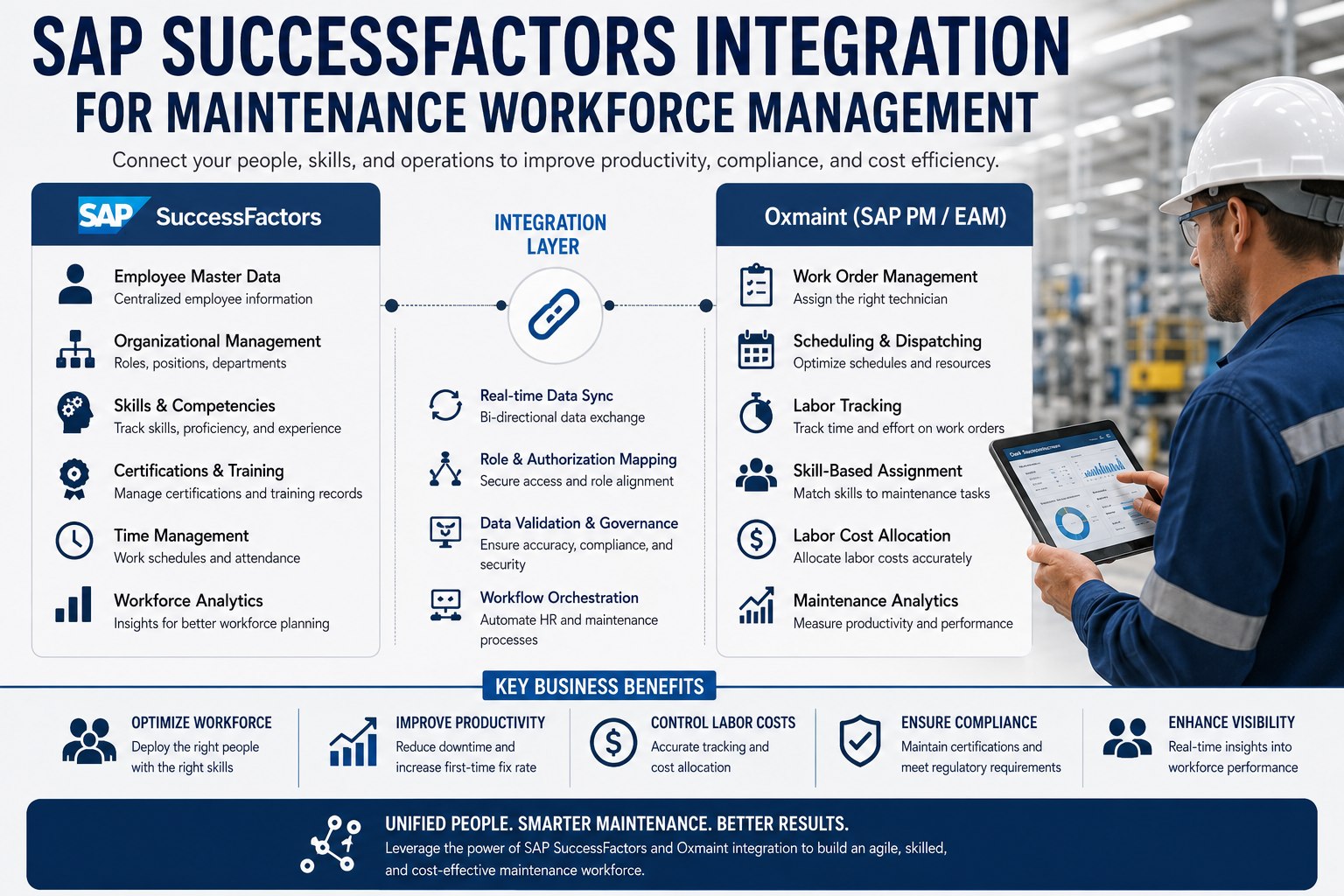
Oxmaint integrates with SAP Fieldglass, SuccessFactors, and SAP PM — giving AI agents the full workforce context needed to assign, monitor, and optimize your contingent maintenance teams autonomously.
The Contractor Lifecycle: Before and After Agentic AI
Look at a single contractor's journey — from initial need identification through assignment, onboarding, work execution, and offboarding. In traditional SAP Fieldglass operations, each stage requires human orchestration. With agentic AI layered on top, the same journey flows autonomously, with humans intervening only for exceptions and strategic decisions.
Traditional Fieldglass Flow
A
Need Identified
Planner manually identifies contractor need, drafts requisition specs
Day 1–3
B
Supplier Distribution
Procurement distributes to qualified suppliers, waits for responses
Day 3–7
C
Candidate Review
Hiring manager reviews candidates manually, checks certifications
Day 7–12
D
Onboarding & Assignment
Badge, safety training, work order assignment coordinated manually
Day 12–16
Total: 14–16 days
With Agentic AI
A
Need Auto-Detected
Agent reads Oxmaint work order, generates Fieldglass requisition automatically
Minutes
B
Smart Supplier Matching
Agent scores suppliers on skill match, past performance, availability
Same day
C
Pre-Validated Candidates
Only compliance-verified candidates reach the hiring manager for final pick
Day 1–2
D
Autonomous Onboarding
Badge, training, work order, and system access provisioned in sequence
Day 2–4
Total: 4–5 days
Data Flow: How the AI Agent Sees Your Workforce
An agent is only as smart as the data it can access. For contingent workforce management, this means pulling signals from multiple enterprise systems simultaneously — and having the authority to write back decisions. The architecture below shows the data feeds an agentic AI workforce system typically orchestrates.
SAP Fieldglass
Requisitions, suppliers, rates, time & spend
SuccessFactors
Full-time skills, org structure, job codes
SAP PM / Oxmaint
Work orders, asset locations, skill needs
Compliance Systems
Certifications, training records, safety
SAP FI/CO
Cost centres, budgets, spend limits
Access Systems
Badges, gate access, facility permissions
Capability Maturity Comparison
Not every enterprise is at the same stage of AI adoption in contingent workforce management. Here is how capabilities stack across the four maturity levels — and where most organizations land today versus where leaders are heading.
| Capability |
L1 Manual |
L2 Assisted |
L3 Automated |
L4 Agentic |
| Candidate Matching |
Email & spreadsheets |
Fieldglass search |
Rule-based filtering |
AI ranks + recommends |
| Compliance Check |
Manual cert review |
Dashboard alerts |
Scheduled scans |
Continuous real-time |
| Rate Management |
Static rate cards |
Periodic review |
Threshold approvals |
Dynamic negotiation |
| Demand Planning |
Reactive requests |
Quarterly forecasts |
Rolling schedules |
Predictive 30–90 days |
| Supplier Governance |
Relationship-based |
Scorecards |
Automated reports |
Performance-driven rank |
| Decision Making |
Fully human |
Human + data |
Human approves AI |
Agent acts, human audits |
ROI Math: The Contingent Workforce Business Case
For a mid-sized industrial enterprise running $50M in annual contingent labour spend through SAP Fieldglass, the impact of agentic AI is measurable and material. Here is the breakdown of value creation across the five impact areas.
Rate Optimization
12–18% savings on $50M contingent spend via AI rate negotiation and benchmarking
Productivity Recovery
15% more billable contractor hours by eliminating unplanned gaps and delayed fills
Compliance Risk Reduction
Avoided fines, incidents, and audit findings from real-time certification enforcement
Admin Time Savings
Reclaimed hours from planners, procurement, and hiring managers across the year
Maverick Spend Eliminated
Rogue contractor engagements captured and channeled through governed Fieldglass flow
Total Annual Value
$25.5M
On $50M baseline contingent spend · 51% effective value ratio
Implementation Roadmap: From Fieldglass to Agentic AI
Moving from a traditional SAP Fieldglass deployment to a fully agentic AI workforce model is not a single project — it is a staged capability build. Here is the practical roadmap most enterprises follow over 9–18 months.
Phase 01
Months 1–3
Data Foundation
Connect Fieldglass to SuccessFactors, SAP PM, and Oxmaint. Clean supplier and skill taxonomies. Establish unified workforce data model.
Phase 02
Months 4–6
AI Assistance (L2)
Deploy candidate recommendation engine, anomaly detection, and compliance alerts. Humans still decide — AI informs.
Phase 03
Months 7–12
Automation (L3)
Automate requisition drafting, supplier distribution, and onboarding workflows. AI executes inside policy rails.
Phase 04
Months 13–18
Full Agentic (L4)
Agent operates autonomously across the contractor lifecycle. Humans set strategy, audit outcomes, handle exceptions only.
Risks & Guardrails
Agentic AI is powerful — and power without governance creates new risks. Every mature deployment balances autonomy with guardrails that keep the agent aligned to human intent, legal obligations, and ethical workforce practices.
Risk
AI makes biased assignment decisions
Guardrail
Regular fairness audits across demographic dimensions; override triggers for pattern anomalies.
Risk
Agent over-negotiates and damages supplier relationships
Guardrail
Rate negotiation stays within pre-approved bounds; strategic suppliers flagged for human-only handling.
Risk
Data gaps cause wrong-skill assignments
Guardrail
Confidence scores required above threshold before autonomous action; low-confidence cases routed to human.
Risk
Compliance rules change without model updates
Guardrail
Policy engine separate from ML model; compliance teams update rules directly without retraining.
Where Oxmaint Fits in the Fieldglass + AI Stack
SAP Fieldglass governs the contractor. Agentic AI orchestrates the decisions. But between the requisition and the work itself, something has to translate "we need a certified technician" into "here is the specific maintenance task, at this asset, at this time, with these safety requirements." That translation layer is Oxmaint — the maintenance management software that makes contractor assignments actionable on the plant floor.
1
Fieldglass Contractor Data Flows into Oxmaint
Certified contractor records, skill profiles, and assignment history sync from SAP Fieldglass into Oxmaint's technician registry — ready for work order assignment.
2
Oxmaint Work Orders Drive Fieldglass Demand
When Oxmaint generates a work order that requires external skills, the AI agent creates the matching Fieldglass requisition with full context — skill, location, duration, urgency.
3
Field Execution Captured in Oxmaint
Contractors execute work through Oxmaint's mobile interface — time, parts, completion status, photos. Execution data flows back to Fieldglass for accurate billing.
4
Performance Feedback to Fieldglass
Work quality scores, on-time completion, and safety observations from Oxmaint feed into Fieldglass supplier performance records — closing the governance loop.
See It Live
Oxmaint + SAP Fieldglass + AI in a single demo
In 30 minutes, we walk through exactly how Oxmaint connects to your SAP Fieldglass environment, how AI agents orchestrate contractor assignments, and how your team regains time to focus on strategic workforce decisions.
Fieldglass
Contractor sync
SuccessFactors
Full-time skills
Oxmaint AI
Autonomous agent
Frequently Asked Questions
What is SAP Fieldglass and how does agentic AI improve it?
SAP Fieldglass is the leading vendor management system for sourcing, managing, and paying external workers — contingent workers, SOW consultants, and service providers. Agentic AI adds an autonomous decision layer on top, handling requisition creation, candidate matching, compliance enforcement, rate negotiation, and demand forecasting without constant human intervention.
Does Oxmaint integrate directly with SAP Fieldglass?
What is the difference between regular AI and agentic AI?
Regular AI assists humans — it searches, recommends, classifies. Agentic AI acts autonomously — it reasons about goals, plans multi-step actions, and executes them end-to-end. For contingent workforce, this means the AI doesn't just suggest a contractor, it actually creates the Fieldglass requisition and coordinates onboarding.
How do we keep agentic AI decisions safe and compliant?
Every mature deployment uses guardrails: policy engines separate from ML models, confidence thresholds before autonomous action, fairness audits, and rate-negotiation bounds. The agent operates with autonomy within defined rails — humans handle strategy, exceptions, and audit.
What ROI can we expect from this on our existing Fieldglass spend?
Most enterprises see 12–18% rate savings, 15% productivity recovery, 68% faster fill times, and 91% reduction in compliance breaches. On a $50M contingent spend baseline, total annual value often exceeds $20M across these categories combined.
How long does Oxmaint-Fieldglass integration with AI take?
Basic Oxmaint-to-Fieldglass integration deploys in 4–8 weeks. Building up to full L4 agentic AI typically takes 9–18 months across four phases — data foundation, AI assistance, automation, and full autonomy.
Start your free trial to begin Phase 1 immediately.
Oxmaint + SAP Fieldglass + Agentic AI
Transform your contingent workforce from a cost centre you manage into an intelligent capability that manages itself. Mobile maintenance, autonomous contractor orchestration, real-time compliance, and full SAP connectivity — all in a platform you deploy in weeks.