Mining Safety and AI: Real-Time PPE Detection and Hazard Monitoring
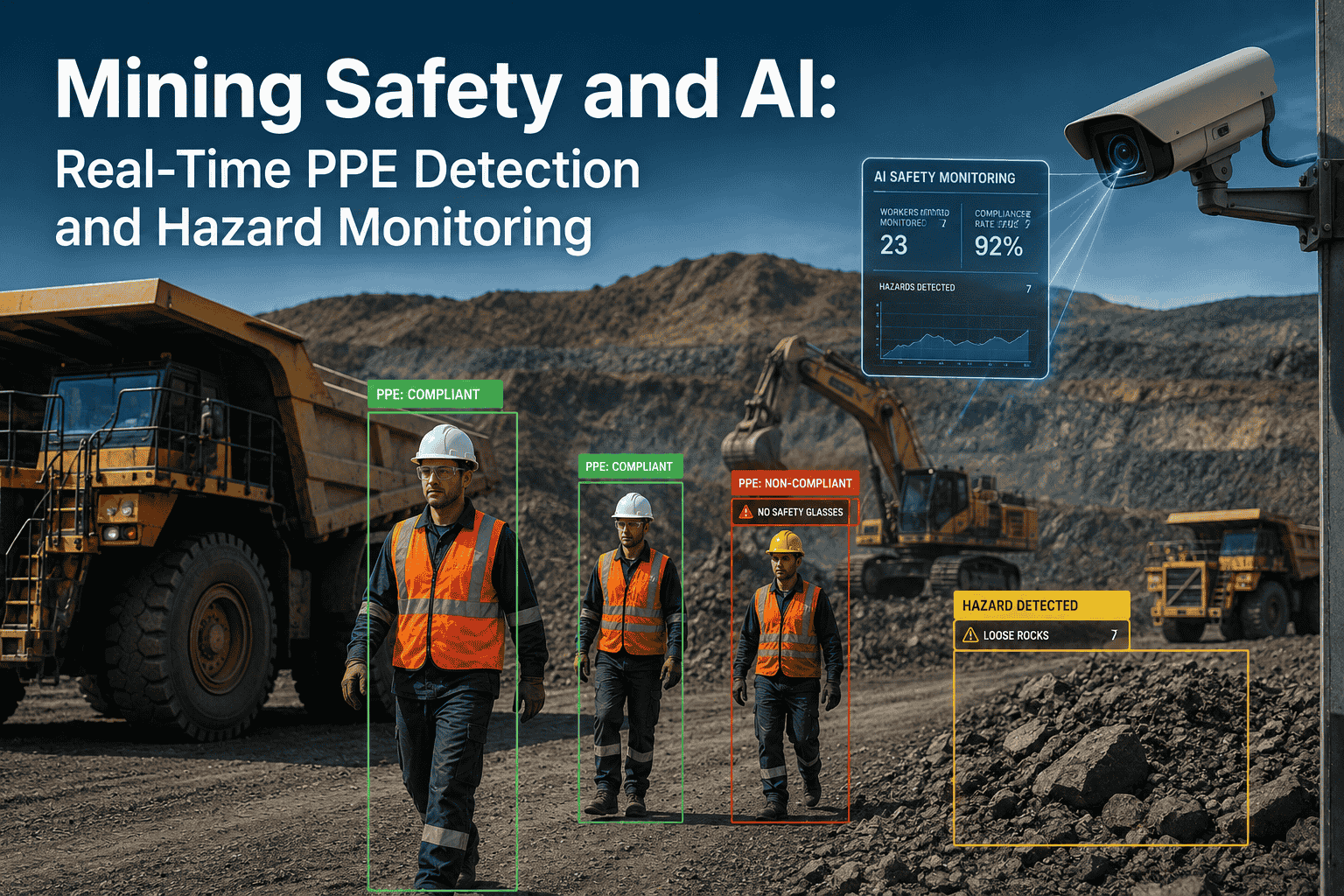
Mining's fatal injury rate stands at 14.2 per 100,000 workers — nearly four times the private industry average. Vehicle-pedestrian collisions in blind spots, missing hard hats in falling-rock zones, workers lingering too long in gas-accumulation areas, unauthorized entry into blast zones — these are not rare edge cases. They are the daily reality on every open-pit and underground site in the world. The safety manager cannot watch every camera feed, every zone boundary, every PPE compliance point simultaneously. AI can. Computer vision systems processing existing CCTV feeds detect PPE violations in under 200ms, flag proximity breaches before collisions happen, and enforce restricted-zone boundaries without physical barriers. Mining companies deploying these systems report incident-rate reductions of 40-50% within the first operating year. Sign up free to evaluate AI safety monitoring for your mine site.
PPE DETECTION · PROXIMITY · ZONE ENFORCEMENT · EDGE AI
14.2 Fatalities per 100K Workers. AI Vision Catches What Safety Managers Cannot See — in Under 200ms.
Computer vision analyzes existing CCTV feeds in real time — detecting missing hard hats, missing hi-vis vests, workers too close to moving equipment, unauthorized entry into blast zones, and prolonged dwell time in gas-accumulation areas. Alerts fire in under 200ms to the control room, the shift supervisor's mobile, and the on-site PA system. All processed on edge AI hardware at the mine site — no cloud dependency, no connectivity requirement for underground operations. Perpetual license. Source code included.
Six AI Safety Layers · What the System Watches For
Each layer adds another ring of protection around every worker on the mine site. Existing CCTV cameras become intelligent safety monitors. No new camera infrastructure required in most deployments — the AI runs on the edge box connected to the feeds you already have. Sign up free to map your site's camera coverage to the six safety layers.
01PPE COMPLIANCE DETECTION<200ms
Hard hat, hi-vis vest, safety glasses, respirator/mask, gloves, steel-toe boots — detected per worker per frame. Violations flagged with worker location, camera ID, and timestamp. Alert to shift supervisor mobile + control room + on-site PA.
MINING CONTEXT Crusher area, conveyor corridor, shaft entry, processing plant — each zone has its own required PPE profile. The AI applies zone-specific rules automatically.
02VEHICLE-PEDESTRIAN PROXIMITY<150ms
Haul trucks, loaders, excavators approaching pedestrians. Distance calculated in real time from camera + LiDAR fusion. Graduated alerts: warning at 15m, critical at 8m, emergency stop at 4m. Horn activation and operator cabin alert simultaneously.
MINING CONTEXT Haul road bends, dump points, loading zones, workshop entrances — the areas where miners often cannot hear approaching equipment due to ear protection and ambient noise.
03RESTRICTED ZONE ENFORCEMENT<200ms
Virtual boundaries around blast zones, unstable ground, crane radii, and high-voltage areas. AI detects any person crossing the boundary — no physical barriers needed. Immediate alert to safety officer + automatic logging for compliance audit.
MINING CONTEXT Blast zones must be 100% clear before detonation. AI confirms zero-occupancy with visual evidence — replacing the radio call-and-confirm process that fails when someone's radio is off.
04DWELL TIME MONITORINGContinuous
Tracks how long each worker remains in hazardous zones — gas accumulation areas, radiation zones, high-temperature enclosures, confined spaces. Alerts when approaching the exposure limit. Auto-logs for MSHA/OSHA compliance records.
MINING CONTEXT Underground headings with gas accumulation, high-dust zones near crushers, confined spaces inside mills during shutdown. Rotation alerts fire 3 minutes before the exposure limit.
05ENVIRONMENTAL HAZARD ALERTING<500ms
Gas sensor fusion (methane, CO, H2S, O2 depletion), dust concentration, ground vibration for slope stability, and water level in sumps. AI correlates multiple sensor streams to detect compound hazards that single-sensor monitoring misses.
Wearable biometrics for heart rate variability, skin temperature, and movement patterns that signal fatigue. Haul-truck operator drowsiness detection via in-cab camera. Shift scheduling adjusted based on fatigue risk scoring.
MINING CONTEXT 12-hour shifts, extreme heat/cold, altitude effects. A fatigued haul-truck operator on a 15% grade is the highest single-event risk on any mine site. AI catches it before the operator does.
40-50%
Incident rate reduction · first year
24/7
Every camera · every zone · every shift
MSHA
OSHA · ISO 45001 · compliance audit trail
Edge
Works underground · zero connectivity needed
The six layers run simultaneously on the same edge hardware. A single Jetson box at a portal entrance handles PPE detection, proximity monitoring, and zone enforcement for that area. The RTX Safety Brain at the control room aggregates alerts from all Jetson boxes across the site and runs the compound-hazard logic that requires multi-sensor fusion. Book a free demo to see the six safety layers running against your site's camera feeds.
"A worker removed his hard hat to wipe sweat inside the crusher building. Eight seconds later, a rock fragment dislodged from the secondary crusher discharge chute. The AI alert reached the supervisor in 140ms. The old system? Nobody was watching that camera feed."
THE PROBLEM
Open-pit gold mine. Crusher building has 14 CCTV cameras. Safety control room monitors 86 cameras total across the entire site. Two safety officers watch the feeds on rotating 8-second cycles — meaning any single camera is actively watched for about 1.5 seconds per minute. A maintenance worker removed his hard hat for 12 seconds inside the secondary crusher discharge area. No human observer caught it. The hat was off during the highest-risk window in the highest-risk zone on site.
HOW AI SAFETY MONITORING SOLVES IT
Camera Edge (Jetson)
Jetson box at the crusher building processes all 14 camera feeds simultaneously at 15 fps each. PPE detection model evaluates every person in every frame. Hard-hat absence detected within 140ms of removal — while the worker is still reaching for his brow.
Safety Brain (RTX)
Alert fired to shift supervisor mobile, control room dashboard, and the PA speaker in the crusher building. Zone-specific rule applied: crusher discharge area = hard hat mandatory, zero tolerance. Alert classified as "critical PPE violation · falling-object zone."
Compliance Record
Violation logged with timestamp, camera ID, worker identification, zone classification, and 5-second video clip. MSHA-audit-ready record created automatically. Supervisor confirmed corrective action within 30 seconds of the alert.
THE RESULT
Hard hat back on within 8 seconds of removal. Rock fragment dislodged 4 seconds later. Worker protected. Incident prevented. Zero human observation required.
SCENARIO 02
"A pedestrian walked around a haul-road bend at the same moment a loaded CAT 793 was approaching from the blind side. Neither the driver nor the pedestrian could see each other. The AI saw both."
THE PROBLEM
Surface copper mine. Haul road with a blind bend at the ramp-to-pit transition. A maintenance technician walking to a pump station crossed the haul road at the bend. A loaded CAT 793 (220-tonne payload) was climbing the ramp on the other side. Closing speed: 15 km/h. Neither party had line of sight. The technician was wearing ear protection and could not hear the truck. The truck operator's blind spot extended 12 meters ahead of the front bumper. Estimated time to collision: 9 seconds.
HOW AI SAFETY MONITORING SOLVES IT
Camera Edge (Jetson)
Two cameras cover the blind bend from elevated positions. Jetson fuses both feeds and tracks the pedestrian (walking east) and the truck (climbing west). Closing trajectory calculated: collision in 9 seconds at current vectors.
Safety Brain (RTX)
Proximity alert triggered at T-9 seconds: "VEHICLE-PEDESTRIAN CONVERGENCE · Ramp R7 · CAT-12 + Worker M-1923 · collision in 9 sec." Truck horn activated automatically via radio relay. Strobe light at bend activated. Control room alert with live camera feed displayed.
Outcome
Truck operator heard the horn, applied brakes. Pedestrian saw the strobe and stopped. Separation at closest point: 22 meters. Without the AI system, this encounter would have been a near-miss at best and a fatality at worst.
THE RESULT
Collision prevented 9 seconds before impact. Both parties alerted simultaneously. Zero-harm outcome. The system saw what neither human could.
Usually not. The AI runs on existing CCTV feeds — IP cameras outputting H.264 or H.265 video at 720p or higher. Most mine sites already have 50-200+ cameras installed for security and operational monitoring. The Jetson Camera Edge box connects to these feeds via RTSP and processes them locally. If coverage gaps exist (a blind bend with no camera, an underground heading with no feed), targeted cameras can be added incrementally. The typical deployment uses 85-90% existing cameras and adds 10-15% new cameras to close specific safety gaps.
Does it work underground with no internet?
Yes — that is exactly why edge AI matters for mining. The Jetson Camera Edge box processes video locally at the portal or underground staging area. No cloud dependency. No internet required. Alerts route over the mine's internal network (Wi-Fi mesh, leaky feeder, fiber backbone) to the underground control point and the surface control room. If the internal network goes down, the Jetson box continues processing and stores alerts locally until connectivity restores. Designed for the worst-connectivity environment in industry.
How does PPE detection work in dusty, low-light conditions?
The AI models are trained on mining-specific image datasets — including dust-heavy, low-light, and headlamp-lit conditions that standard industrial vision models fail on. Night-shift underground footage, crusher-area dust clouds, rain-soaked surface conditions — all part of the training corpus. For extreme low-light, thermal cameras complement visible-light cameras. For heavy dust, the AI uses silhouette and motion patterns alongside color detection. Detection accuracy exceeds 96% in mine-specific conditions after the 4-week site-tuning period.
How does the system handle false positives?
False positives erode trust faster than anything else in safety monitoring. The RTX Safety Brain applies three filters: confidence threshold (alerts fire only above 92% model confidence), temporal persistence (a single-frame detection does not trigger an alert — the violation must persist for 3+ frames = 200ms), and zone context (a hard-hat violation in a parking area is a warning, not a critical alert; the same violation in a falling-rock zone is critical). After the 4-week tuning period, false-positive rates typically drop below 2%.
How fast can we deploy?
Six to eight weeks for a single-zone pilot (typically the highest-risk area — crusher building, haul-road intersection, or underground portal). Weeks 1-2 — site survey, camera inventory, zone mapping, PPE rule definition. Weeks 3-4 — Jetson boxes deployed, connected to existing camera feeds, baseline detection calibrated. Weeks 5-6 — RTX Safety Brain live at control room, alert workflows configured, shift supervisors trained. Weeks 7-8 — site-specific model tuning, false-positive rate verified below 2%, MSHA compliance pack validated. Expansion: 2-3 weeks per additional zone.
Mining Edition · 6 Safety Layers · 6-Week Pilot
Every Camera on Your Site Just Became an AI Safety Officer. One That Never Blinks.
Book a 30-minute call with our mining safety deployment engineers. Walk through your site map, your camera coverage, and your highest-risk zones. See PPE detection, proximity alerting, and zone enforcement running live against your own camera feeds. Perpetual license, source code included, $0/mo.