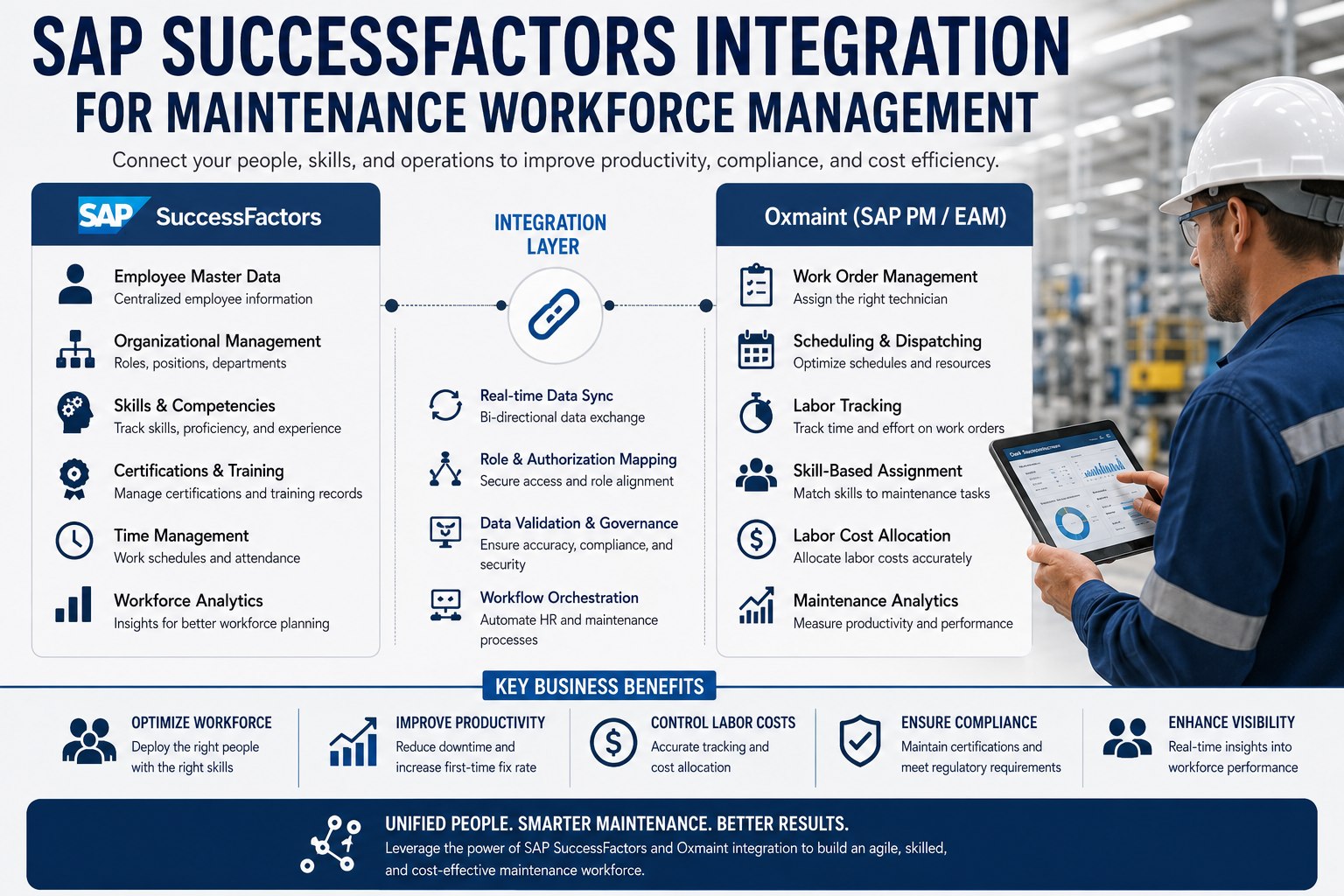
The maintenance workforce crisis is not coming — it is here. The average industrial maintenance technician is 48 years old. Thirty percent of the skilled trades workforce will retire within seven years. And the replacements are not showing up because traditional hiring practices screen for job titles and years of experience instead of the specific skills that keep assets running. SAP SuccessFactors with AI rewrites the recruitment equation by matching candidates to asset needs, not job descriptions — identifying the exact welding certifications, PLC programming competencies, and vibration analysis skills your equipment requires, then finding the people who have them. When connected to Oxmaint's maintenance platform, the entire loop closes: the assets tell you what skills they need, SuccessFactors finds the people, and Oxmaint puts them to work. Start your free Oxmaint trial and connect your workforce skills data to your asset needs. Or book a demo to see how Oxmaint and SAP SuccessFactors AI build an asset-driven workforce together.
Workforce Intelligence
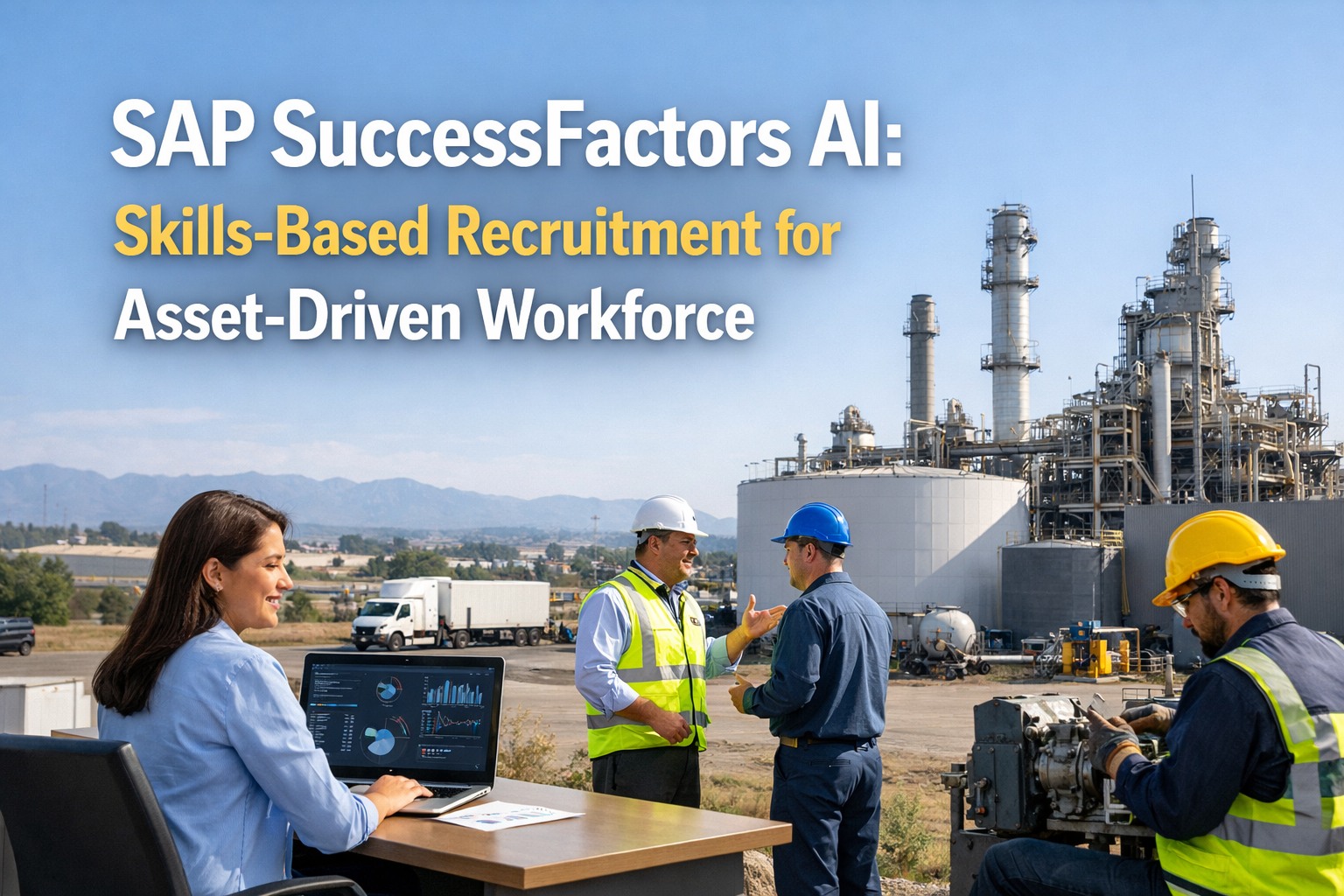
SAP SuccessFactors AI: Skills-Based Recruitment for the Asset-Driven Workforce
48
Avg technician age in industrial maintenance
30%
Of skilled trades retiring within 7 years
72
Avg days to fill a specialist maintenance role
2.4x
Cost of a bad hire vs waiting for the right one
Job Titles Are Broken — Skills Are What Assets Need
A "Maintenance Technician III" at one company means something completely different at another. Job-title-based hiring produces candidates who look right on paper but lack the specific competencies your assets demand. A pharmaceutical clean-room HVAC system requires different skills than a steel mill cooling tower, even though both might fall under "HVAC Technician." Skills-based recruitment ignores the title entirely and asks: does this person possess the specific certifications, hands-on competencies, and equipment experience that our actual maintenance backlog requires?
Title-Based Hiring
Screen by job title match
Filter by years of experience
Require specific degree
Assess based on interview answers
Hope the hire fits the asset
Result
42% of hires leave within 18 months
Skills-Based Hiring
Match to asset skill requirements
Score by demonstrated competency
Value certifications over degrees
Validate with practical assessment
Assign to the asset from day one
Result
78% still productive after 24 months
How SAP SuccessFactors AI Powers Skills-Based Recruitment
SAP SuccessFactors has evolved from a traditional HRIS into an AI-powered talent intelligence platform. For maintenance-heavy enterprises, the AI layer does five things that manual HR processes simply cannot — matching at a scale, speed, and granularity that transforms how organizations find, assess, and develop their maintenance workforce.
Skills Ontology Engine
AI maintains a living taxonomy of 250,000+ skills, auto-mapping synonyms and equivalencies. "PLC Programming" and "Allen-Bradley ControlLogix" and "Rockwell Automation Certified" all connect to the same underlying competency node.
Coverage250K+ skills mapped
Candidate-to-Asset Matching
When connected to Oxmaint, SuccessFactors knows which assets need which skills. A pump station posting requiring vibration analysis Level II certification only surfaces candidates who hold that exact credential — or a validated equivalent.
Time to shortlistReduced 68%
Internal Mobility Discovery
Before posting externally, AI scans the existing workforce for employees whose adjacent skills make them ideal internal candidates — a motor rewind technician who is one certification away from transformer maintenance qualifications.
Internal fill rateUp 35%
Skills Gap Forecasting
AI models retirement timelines, attrition patterns, and equipment commissioning schedules to predict exactly which skills the organization will lack 6–24 months from now — before the gap becomes an emergency.
Forecast window6–24 months ahead
Bias-Reduced Screening
Skills-first AI removes name, school, employer prestige, and demographic signals from the initial screening pass. The first filter is purely: does this person's verified skill profile match the asset requirement?
Screening equityMeasurably improved
The Asset-Driven Workforce Loop
In traditional organizations, HR and maintenance operate in parallel silos. HR hires people; maintenance assigns them. The connection between what assets actually need and who HR is recruiting is indirect at best, broken at worst. The asset-driven workforce loop closes this gap by making the asset's skill requirements the starting point for every hiring, training, and development decision.
A
Assets Signal Skill Needs
Oxmaint work order history, backlog analysis, and AI predictions identify which skills are undersupplied relative to maintenance demand
B
SuccessFactors Matches Talent
AI recruits against the specific skill profile — not a generic job description — sourcing from internal mobility, external candidates, and contractor pools
C
Oxmaint Assigns & Validates
New hires deploy to Oxmaint work orders immediately; performance data and competence observations flow back for quality-of-hire tracking
D
Data Refines Future Hiring
Actual on-asset performance feeds the AI model, improving prediction of which skill profiles succeed on which asset types in future hires
Close the Loop
Connect Oxmaint asset intelligence to SuccessFactors talent intelligence
When your assets tell your HR system exactly what skills they need, every hire becomes a targeted investment instead of a hopeful guess. See it running in a live demo with your asset data.
The Skills Gap Dashboard: What Leaders Need to See
When SuccessFactors AI and Oxmaint are connected, a new class of workforce intelligence becomes visible — the skills gap dashboard. This is the single view that lets maintenance directors and HR leaders see exactly where the workforce is strong, where it is thin, and where retirements or new equipment are about to create critical shortfalls.
Critical Skills Coverage
74%
Share of critical asset skills with 2+ qualified technicians available
Skills At Risk (Retirement)
18
Skills where the only qualified holders retire within 24 months
Open Skill Requisitions
23
Active SuccessFactors requisitions driven by Oxmaint skill gap data
Avg Time to Qualified Hire
34 days
Down from 72 days with skills-based matching
Internal Mobility Fills
41%
Share of maintenance roles filled from existing workforce
Quality of Hire Score
8.4/10
Based on Oxmaint work order completion quality at 90 days
Industry Skills Profiles: What Each Sector Needs
Every industry runs different assets, which means every industry needs a different skills profile in its maintenance workforce. SuccessFactors AI, when fed by Oxmaint's asset data, builds sector-specific skill demand models. Here is what the top five industrial sectors are actually recruiting for — not by job title, but by the skills their assets demand.
Manufacturing
PLC Programming
Hydraulic Systems
CNC Maintenance
Pneumatics
Conveyor Alignment
Top gap: PLC programming — 3.2x more demand than supply
Oil & Gas
Rotating Equipment
Corrosion Analysis
HAZOP Training
Pressure Vessel
Pipeline Integrity
Top gap: Corrosion engineers — 68% at retirement age within 5 years
Utilities & Power
Substation Ops
Protection Relays
Transformer Oil
SCADA Systems
Arc Flash Safety
Top gap: Protection relay technicians — 2.8x unfilled demand
Pharmaceutical
Clean Room HVAC
Calibration Metrology
GMP Compliance
Bioreactor Systems
CIP/SIP Systems
Top gap: GMP-qualified calibration techs — 45-day avg fill time
The ROI of Getting Hiring Right
Bad maintenance hires are not just an HR problem. Every mis-hire ripples into higher overtime for existing staff, increased contractor spend, delayed work orders, asset reliability dips, and ultimately, production losses. The financial impact of skills-based hiring powered by SuccessFactors AI and Oxmaint is measurable across five cost lines.
Time-to-Fill
72 days to 34 days
Each unfilled day costs $1,200–$3,500 in overtime, contractors, and deferred work
Quality of Hire
42% to 78% retention at 24mo
Every avoided turnover saves $28K–$65K in rehiring and retraining costs
Contractor Spend
Reduced 25–40%
Internal skills coverage reduces dependency on premium external contractors
Asset Reliability
MTBF improved 18%
Better-skilled technicians complete work right the first time, extending asset life
Implementation Path: Connecting the Systems
Integrating SAP SuccessFactors, Oxmaint, and SAP PM into a single skills-based workforce management flow follows a staged approach. Most enterprises have the core integration live within 8–12 weeks, with AI matching capabilities maturing over the following 6 months as the skills data enriches.
Phase 1
Weeks 1–4
Skills Taxonomy Alignment
Map Oxmaint asset skill requirements to the SuccessFactors skills ontology. Define competency levels, certification equivalencies, and critical vs desirable skill classifications.
Phase 2
Weeks 4–8
Integration & Data Flow
Connect Oxmaint skill demand signals to SuccessFactors requisition engine. Wire SAP PM work order data into the matching algorithm. Enable bidirectional profile sync.
Phase 3
Weeks 8–12
AI Matching Activation
Turn on skills-based candidate scoring, internal mobility discovery, and gap forecasting. Begin measuring time-to-fill, quality-of-hire, and skills coverage against baseline.
Phase 4
Months 3–9
Continuous Learning
AI model improves as Oxmaint performance data feeds back into SuccessFactors. Hiring recommendations sharpen. Gap forecasts extend. Internal mobility pathways become visible.
Common Mistakes in Maintenance Workforce Planning
!
Hiring for Headcount, Not Skills
Filling seats without matching to asset requirements means having the wrong people in the building. Three generalists cannot replace one specialist when a turbine trips.
!
Ignoring Retirement Cliff Data
Most organizations know their workforce is aging but do not model which specific skills leave with each retiree. When the only transformer oil analyst retires, the gap is not "one person" — it is a critical capability gone.
!
No Feedback Loop from Field to HR
HR never learns which hires actually succeed on the floor. Without Oxmaint performance data flowing back into SuccessFactors, the AI cannot learn what makes a good maintenance hire.
!
Over-Reliance on External Recruiting
The best candidate might already work for you. Without internal mobility discovery, organizations pay external agency fees for roles their own employees could fill with one additional certification.
Build the Workforce Your Assets Need
See Oxmaint + SuccessFactors AI working together in 30 minutes
Bring your maintenance backlog, your retirement projections, and your hardest-to-fill role. We will show exactly how the systems work together to find, match, and develop the skills your assets are demanding.
Frequently Asked Questions
How does Oxmaint tell SuccessFactors what skills assets need?
Oxmaint analyses work order history, backlog composition, and AI-predicted future maintenance demand to generate a skills demand profile per asset class. This profile syncs to SuccessFactors through the integration layer, automatically informing requisition templates and candidate matching criteria.
What AI features does SAP SuccessFactors include for recruitment?
SuccessFactors includes a skills ontology engine mapping 250K+ skills, AI-powered candidate scoring, internal mobility matching, skills gap forecasting, and bias-reduced screening. When connected to Oxmaint, these features become asset-aware — matching against real maintenance needs, not generic job descriptions.
Book a demo to see this in action.
Can this approach work for contingent and contractor maintenance workers?
Yes. SuccessFactors connects to SAP Fieldglass for contingent workforce management. Skills-based matching applies equally to permanent hires, staff augmentation contractors, and SOW service providers — ensuring every person on your plant floor meets the asset's skill requirements.
How long does skills-based matching take to start producing better hires?
Most organizations see measurable improvements in time-to-fill within 60 days of activation. Quality-of-hire improvements (measured by 90-day Oxmaint performance data) typically become statistically significant by month 4–6 as the AI model accumulates feedback.
Start a free trial to begin building your skills baseline.
Does Oxmaint track technician competencies and certifications?
Yes. Oxmaint maintains a competence matrix per technician — certifications, training records, qualification expiry dates, and competency assessments. This data syncs with SuccessFactors and feeds into work order assignment rules, ensuring only qualified technicians are dispatched to specific asset types.
Is skills-based recruitment relevant for smaller maintenance teams?
Especially so. In smaller teams, every hire has outsized impact. One wrong hire in a 12-person maintenance team is an 8% productivity hit. Skills-based matching ensures that your limited headcount covers the skills your specific equipment demands — no gaps, no redundancy.
The Workforce Your Assets Deserve
SAP SuccessFactors AI finds the skills. Oxmaint puts them to work. Together, they build the maintenance workforce your assets actually need — recruited by competency, validated by performance, and continuously refined by AI that learns what works on your plant floor.