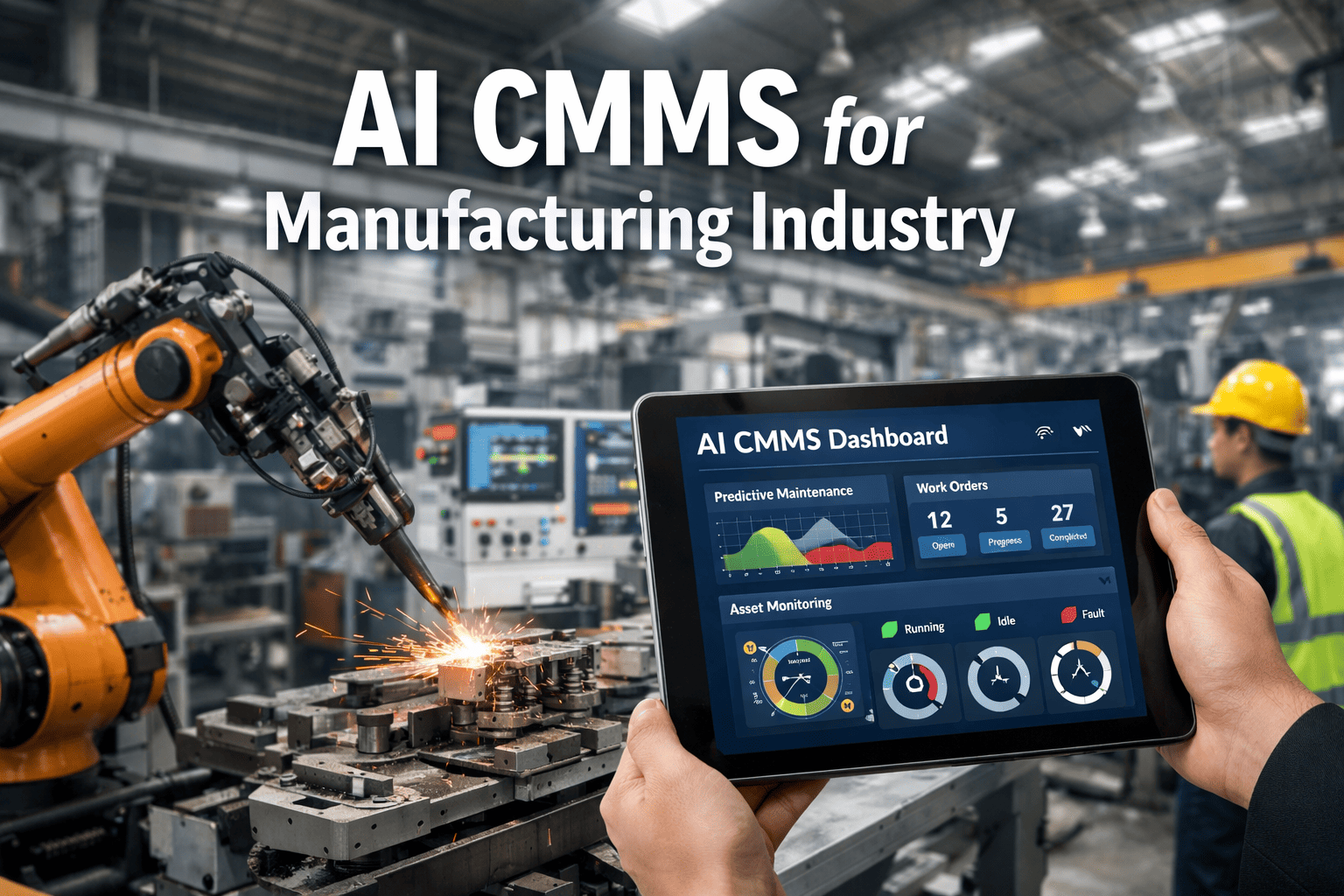
The manufacturing plant running on a reactive maintenance strategy in 2026 is not making a neutral operational choice. It is paying an invisible tax — on every emergency repair billed at 3–5x planned rate, on every production hour lost to an unplanned shutdown that a predictive system would have prevented three weeks earlier, on every expedited parts order placed at premium pricing for a failure that a managed inventory system would have pre-staged, and on every technician hour spent filling out paper forms instead of performing repairs. The US Department of Energy has documented 10x returns on predictive maintenance investments. McKinsey has documented 40% lower maintenance spend at facilities that have made the shift from reactive to AI-driven programmes. The manufacturing plants capturing these savings are not larger, better-funded, or more technically sophisticated than the ones still running on reactive strategy. They made a different software decision. Sign up for Oxmaint to make that decision today.
Struggling Plants vs. Profitable Plants — What AI CMMS Changes
Every manufacturing facility sits somewhere on the spectrum between reactive and AI-driven maintenance. The difference between the two extremes is not a question of equipment quality or workforce skill — it is a question of information infrastructure. Sign up for Oxmaint to start moving your operation toward the right column.
What Oxmaint AI CMMS Delivers for Manufacturing Operations
Oxmaint is built for the operational reality of manufacturing maintenance — mobile-first for technicians on the factory floor, AI-powered for the maintenance engineers analysing asset performance, and integrated for the operations leaders who need live KPI visibility without waiting for the monthly paper report. Book a demo to see all six capabilities configured for your operation.
IoT sensor data (vibration, temperature, current, pressure) feeds Oxmaint's AI anomaly detection engine. When a bearing, motor, or pump begins deviating from its normal operating signature, Oxmaint generates a predictive work order 14–42 days before failure — with enough lead time to plan the repair, source the parts, and schedule the window. Emergency repairs become scheduled events.
Work orders are created, assigned, and completed on mobile — no paper, no desktop, no administration building trip. The technician receives a push notification on their phone or rugged device, sees the asset history and parts availability before they walk to the machine, and closes the work order with a digital signature at the point of repair. The maintenance record is complete when the repair is complete. Sign up to activate mobile work orders.
Every asset in your factory is registered in Oxmaint with its full maintenance history, parts consumption record, failure pattern data, and condition trend. When a technician opens a corrective work order, they see every previous repair on that machine — what was found, what was replaced, and what the current AI health score is. Root cause identification accelerates. Recurring failures stop recurring. Book a demo to see the asset register.
Oxmaint links every spare part to the assets that consume it, tracks actual consumption rates against AI failure forecasts, and auto-generates purchase orders at optimised reorder points before stockouts occur. When an AI prediction identifies an imminent bearing failure, Oxmaint checks parts availability and generates a procurement alert if the required part is not in stock — converting potential emergency orders into planned standard purchases at standard pricing.
Equipment running outside its design operating condition consumes 10–30% more energy than specification. Oxmaint tracks energy consumption per asset against baseline, identifies equipment showing efficiency degradation from IoT energy meter data, and generates PM work orders for the maintenance tasks (filter cleaning, combustion tuning, bearing lubrication) that recover the lost efficiency. The CMMS shows which work order produced which energy improvement. Sign up to activate energy monitoring.
The maintenance director's monthly report — which traditionally requires two days of manual compilation — is a live Oxmaint dashboard updated continuously from closed work orders. PM completion rate by asset area, corrective vs. planned maintenance ratio, mean time between failures by equipment class, and cost per work order are visible in real time. Management can act on this week's data, not last month's summary. Book a demo to see the dashboard live.
Eight Manufacturing Maintenance Challenges — and How Oxmaint Resolves Each
Manufacturing operations face a consistent set of maintenance challenges regardless of sector. Each one has a specific Oxmaint solution — not a general capability, but a configured operational workflow that addresses the challenge directly. Sign up for Oxmaint to address all eight at your facility.
Unplanned breakdowns halt production with no warning, creating cascading delays across the line and triggering expensive emergency repair response at overtime rates.
AI-driven predictive maintenance detects equipment degradation from IoT sensor data 14–42 days before failure, automatically generating scheduled maintenance work orders with the correct parts pre-staged — converting unplanned events into planned ones.
Equipment operating outside optimal condition consumes 10–30% excess energy. Without visibility into per-asset energy performance, the source of the waste is invisible until the utility bill arrives.
AI-driven energy optimisation analyses usage patterns per asset, flags equipment showing efficiency degradation, and generates the specific PM work orders — combustion tuning, filter replacement, bearing lubrication — that recover the lost efficiency.
Equipment that drifts out of calibration or condition produces defective output before anyone detects the quality change — often discovered at end-of-line inspection or, worse, by the customer.
Real-time monitoring of production parameters links equipment condition to output quality. Condition-based maintenance keeps machines in spec, reducing scrap rates by 15–25% and improving first-pass yield. Book a demo to see quality monitoring.
Overstocked spare parts rooms tie up capital. Stockouts at the moment of failure trigger $2,000+ emergency procurement runs. Neither problem is visible until it is already costing money.
AI-based inventory management forecasts demand from failure predictions, sets optimised reorder points per part per asset, and auto-generates purchase orders before stockouts occur — cutting carrying costs 20–30% while eliminating emergency orders. Sign up to activate.
High safety risks in manufacturing environments and difficulty tracking compliance with regulatory safety standards — inspections, permits, and incident records scattered across paper systems.
Real-time hazard detection alerts and integrated permit-to-work management ensure safety compliance is enforced at the work order level — not just at the paper sign-off stage. Digital inspection records are audit-ready and searchable instantly.
High capital costs and inefficiency from aging equipment — reactive maintenance accelerates degradation, and without condition data there is no basis for defend-or-replace capital decisions.
Digital twin technology and predictive analytics continuously monitor infrastructure health, extend asset life by 25% on average through condition-based rather than calendar-based maintenance, and provide the quantified condition data needed for capital planning decisions. Sign up to start tracking.
Pressure to comply with health, safety, and environmental standards — manual monitoring and paper-based reporting create compliance gaps and consume 40–60 hours per reporting cycle in manual compilation.
Automated monitoring and reporting streamlines compliance by generating inspection records, safety permit logs, and audit trails automatically from work order completion — reducing reporting effort by 88% and producing audit-ready documentation on demand. Book a demo to see compliance automation.
Managing carbon emissions and complying with environmental regulations — without per-equipment energy and emissions tracking, sustainability targets remain aspirational rather than operationally managed.
Real-time emissions tracking and optimisation links equipment condition to environmental performance — maintenance work orders for combustion tuning and efficiency restoration are tied directly to emissions reduction targets, with automated sustainability reporting for regulatory submissions. Sign up for sustainability tracking.
Documented Outcomes from Real Manufacturing Deployments
These results are drawn from verified case studies and industry research published by Deloitte, the US Department of Energy, McKinsey, and documented CMMS deployments across manufacturing sectors. Sign up for Oxmaint to start building your own results record.
Reduction in maintenance costs with AI-driven predictive strategy
Decrease in unplanned downtime incidents across AI maintenance deployments
Return on investment from predictive maintenance programme deployment
Lower total maintenance spend vs. reactive-only approaches
Annual verified savings at a CPG plant through sensor-based analytics
Of organisations achieve full CMMS payback within 12 months
The Dollar-by-Dollar Savings at a $10M Annual Operating Budget Manufacturing Plant
What does a 35% operating cost reduction actually look like in financial terms for a mid-sized manufacturing plant? This breakdown is drawn from documented outcomes across multiple CMMS deployments — not projections. Book a demo to model the numbers for your specific facility.
| Cost Category | Annual Spend | Reduction Range | Annual Savings |
|---|---|---|---|
| Maintenance & Repairs | $2,500,000 | 25–40% | $625K – $1M |
| Unplanned Downtime | $1,500,000 | 50–70% | $750K – $1.05M |
| Energy & Utilities | $3,000,000 | 15–20% | $450K – $600K |
| Labour Inefficiency | $1,200,000 | 25–30% | $300K – $360K |
| Spare Parts Inventory | $800,000 | 20–30% | $160K – $240K |
| Scrap & Rework | $1,000,000 | 15–25% | $150K – $250K |
| Total | $10,000,000 | 24–35% | $2.43M – $3.5M |
Swipe to view full table
The biggest myth in manufacturing is that you need massive capital investment to cut costs significantly. The truth is, most of your waste is invisible — hidden in reactive maintenance, excess inventory, and manual processes. A good CMMS makes it visible, and once you can see it, you can eliminate it.
Your Plant's 35% Savings Are Already There — Waiting to Be Found
Every week without an AI CMMS is another week of preventable downtime, emergency procurement premiums, energy waste, and maintenance hours lost to paperwork. Oxmaint makes the waste visible — and once visible, eliminates it.
AI CMMS for Manufacturing — Common Questions
Yes, though timeline and composition vary by starting point. Plants with minimal digital infrastructure typically see 15–20% savings in the first year from eliminating reactive maintenance — emergency procurement reduction and PM completion rate improvement account for most of the initial gain. The full 35% is usually achieved within 18–24 months as predictive analytics mature, inventory optimisation compounds, and energy management layers in. Book a demo to get a realistic projection built for your specific plant profile.
Most Oxmaint customers report full payback within 3–6 months. The US Department of Energy has documented 10x returns on predictive maintenance investments. When you add inventory carrying cost reduction, labour productivity gains from eliminating administrative waste, and downtime cost reduction from higher PM completion rates, the payback accelerates rapidly. The first emergency procurement order that Oxmaint prevents — because the correct part was already in stock at the reorder point the system set — often represents more value than the first month's subscription cost. Sign up for a free account to see results immediately.
No. IoT sensors unlock the full power of AI predictive maintenance, but significant savings are achievable with Oxmaint alone from day one — through digitalised work orders, preventive scheduling with real-time completion visibility, parts inventory optimisation, and cost analytics that identify where reactive maintenance spend is concentrated. Most facilities start with the CMMS software and add IoT sensors incrementally to their highest-value assets based on the work order data that shows which equipment is consuming the most corrective maintenance hours. Sign up for Oxmaint to start with software and expand to sensors at your own pace.
The sweet spot is facilities with 50 or more assets and annual maintenance budgets above $500K. At this scale, the compounding effects of the five levers create dramatic visible reductions — the emergency procurement savings alone typically cover the CMMS subscription cost within 60–90 days. Smaller facilities benefit proportionally but see less dramatic absolute dollar savings. Very large facilities benefit significantly from the AI anomaly detection capability that monitors thousands of assets continuously — a task impossible to replicate with manual inspection at the required frequency and consistency.
Every Week Without Oxmaint Is a Week of Preventable Waste. It Ends When You Decide It Does.
Oxmaint gives manufacturing teams the AI predictive maintenance, mobile work orders, inventory optimisation, and live KPI dashboards that convert the invisible waste embedded in reactive strategy into documented, measurable savings — starting in the first 30 days, compounding over 18–24 months to deliver the full 35% operating cost reduction that leading manufacturers are already capturing.


.png)


