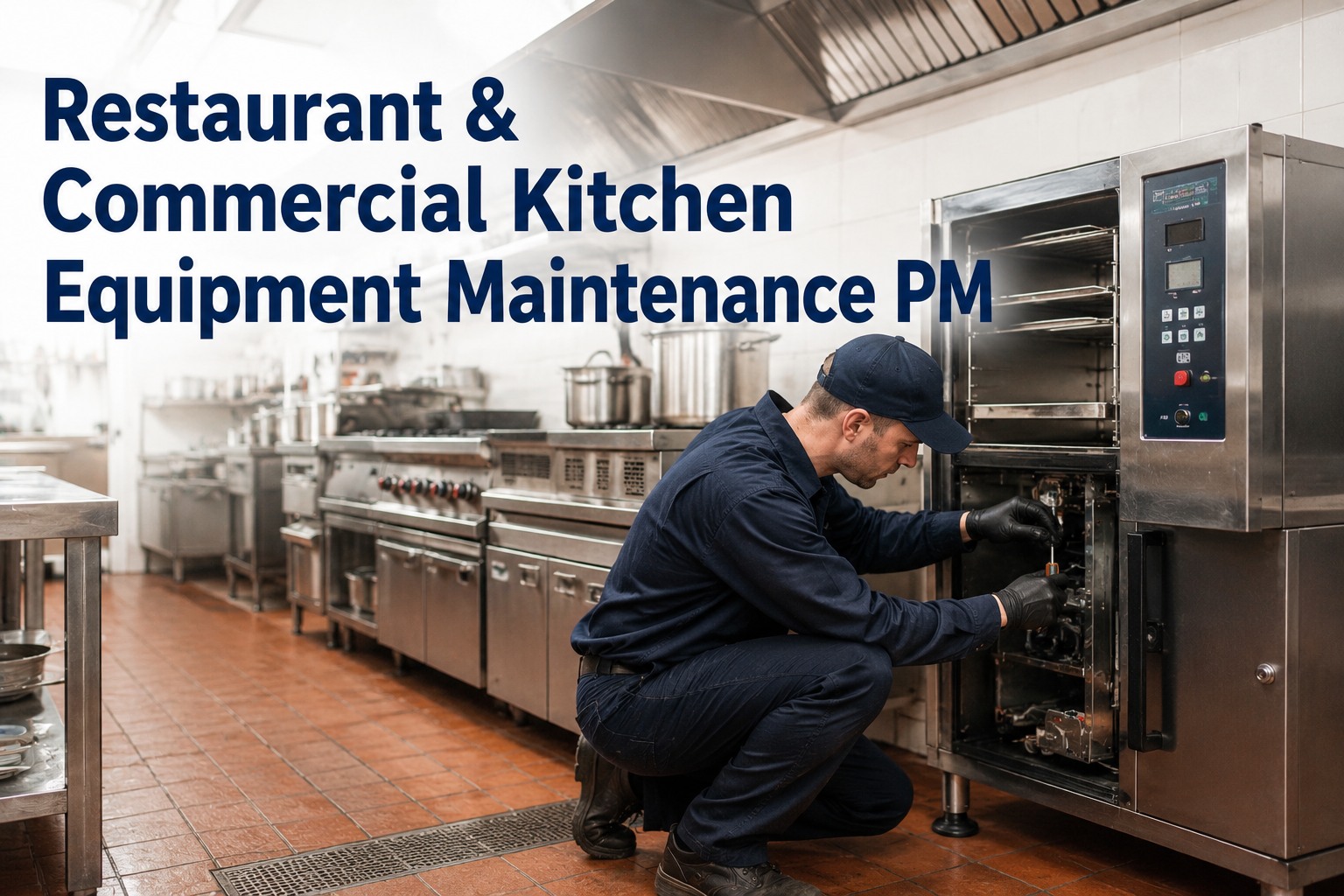
Restaurant maintenance is not office building maintenance scaled down — it is a revenue-protection discipline where a broken refrigerator at 5 PM Friday costs thousands in spoiled inventory and lost covers, where a grease trap backup shuts down the kitchen mid-service, and where the maintenance team must keep 200+ pieces of cooking and food storage equipment, point-of-sale systems, HVAC, plumbing, and health-code infrastructure running flawlessly while remaining invisible to customers. A 20-location QSR chain manages 4,000+ maintainable assets across kitchens, dining areas, storage, back-of-house systems, and utility infrastructure — each with different PM frequencies, vendor relationships, and revenue impact profiles. Restaurant chains using structured CMMS platforms report 41% reduction in unplanned equipment downtime, 58% fewer health code violations through preventive sanitation and equipment PM tracking, and a measurable improvement in food cost ratios tied to refrigeration and storage equipment uptime. The platforms ranked here are evaluated on quick-service restaurant and franchise operator criteria — kitchen equipment PM automation, multi-location rollout speed, health department compliance documentation, and whether a shift manager can actually request maintenance from the POS or a mobile app without calling corporate.
Best CMMS for Restaurants and QSR Chains 2026
Top restaurant and franchise maintenance platforms ranked on kitchen equipment management, multi-location deployment, health code compliance, and real-world adoption by QSR operators managing equipment uptime as a direct profit center.
See How OxMaint Handles Multi-Location Restaurant Maintenance
Kitchen equipment PM, franchise rollout templates, health compliance tracking, and location-level dashboards — deployed across your QSR chain in days.
Why Restaurant Maintenance Is Different From Other Operations
Restaurant and QSR maintenance operates under uniquely tight financial constraints. A broken walk-in cooler at a 100-seat restaurant costs $2,000+ in spoiled inventory plus lost covers during repair time. A grease trap backup shuts down the kitchen — not just a work area, but a revenue-generating asset. Equipment failures in food service are not inconveniences; they are immediate profit threats that ripple across inventory loss, labor inefficiency, customer experience damage, and potential health code violations. The maintenance team must execute preventive programs across fryers, grills, coolers, freezers, hood systems, plumbing, HVAC, and POS infrastructure while keeping repair response times under 2-4 hours — not the 24-hour windows that office environments tolerate.
Multi-location QSR chains compound this complexity exponentially. A regional operations director needs portfolio-level visibility into equipment failure trends, PM compliance rates, and food cost impact across 20-50 locations while each location's shift manager needs immediate maintenance request capability from the kitchen or POS system. A restaurant CMMS must bridge both realities from a single platform without requiring IT expertise at each location. Discover how OxMaint handles this for QSR chains — start a free trial or book a demo to see franchise deployment in action.
The Real Pain Points of Multi-Location Restaurant Operations
These are not theoretical operational inefficiencies — they are the daily failures that cost restaurant operators thousands in lost revenue, health code citations, and emergency repair fees.
Without PM schedules automated across 20 locations, preventive work gets deferred during high-volume periods. 71% of restaurant equipment failures could be prevented with structured PM — yet they happen because nobody is tracking maintenance completion across the chain.
Health inspectors document maintenance compliance as a scoring factor — equipment condition, sanitation records, grease trap service documentation. Restaurants without CMMS-based compliance tracking face violations and points deductions 3x more frequently.
A walk-in cooler failure during a Saturday dinner service can spoil $3,000-$8,000 in inventory within hours. Multi-location operators report 2-3 major inventory losses annually per location due to unexpected equipment failures.
Regional directors cannot compare equipment failure rates, PM compliance, or repair costs across 30 locations when each location runs disconnected spreadsheets or calls corporate about problems after they occur.
Unplanned equipment failures force emergency service calls at 3-5x the cost of scheduled maintenance. A restaurant chain can save 35-45% on annual maintenance spend by shifting from reactive to preventive — but without a CMMS enforcing PM discipline, reactive culture dominates.
Opening a new franchise location means building a maintenance program from scratch at each location — no standardized asset lists, no consistent PM templates, no shared vendor relationships. Each location becomes an isolated operational problem.
Evaluation Criteria for Restaurant and QSR CMMS
These six weighted criteria reflect the operational realities that determine whether a CMMS drives restaurant profit protection or simply becomes an unused tool filling a server.
Pre-configured PM schedules for every commercial kitchen appliance — fryers, grills, coolers, freezers, hood systems, grease traps — across all locations simultaneously?
Can brand-standard PM templates, asset lists, and vendor relationships deploy instantly to new franchise locations without manual configuration at each site?
Built-in documentation for health inspection preparation — equipment maintenance records, sanitizer concentration logs, grease trap service, and pest control schedules?
Can a shift manager initiate maintenance requests from the POS register or a mobile app without calling corporate or searching for a computer?
Can the platform show maintenance spend per location, equipment failure trends, and PM compliance — so corporate can identify underperforming locations quickly?
Can you deploy the platform at the first location in 2 weeks and scale to 50 locations within 4 months without per-location setup complexity?
Top Restaurant and QSR CMMS Platforms — 2026 Rankings
Ranked specifically for restaurant and QSR franchise operations — kitchen equipment management, multi-location deployment, health code compliance, and the operational reality of keeping food-service equipment running 365 days per year.
OxMaint leads the 2026 QSR CMMS ranking because it combines pre-configured kitchen equipment PM templates with franchise deployment architecture that actually works across 5-100 locations. The platform comes with industry-standard PM schedules for every commercial food service asset — walk-in coolers, fryers, grills, ovens, hood systems, dishwashers, grease traps, and plumbing infrastructure — deployable instantly to new franchise locations without manual setup. A regional operations director sees location-level dashboards showing equipment failure trends, PM compliance rates, and maintenance spend per location — enabling rapid identification of underperforming sites. Shift managers request maintenance from POS systems or mobile apps without requiring IT knowledge or corporate phone calls. Health code compliance is built-in — the platform tracks equipment maintenance records, sanitizer documentation, grease trap service, and pest control schedules in formats health inspectors recognize and accept. Unlimited user pricing means every shift manager, head chef, maintenance tech, and regional director has access without per-location user fees that scale with restaurant count. Deployment at the first location takes 2-3 weeks, and franchise rollout to subsequent locations accelerates dramatically because brand-standard configurations push automatically — most 20-location chains go live completely within 8-10 weeks.
Toast serves as both a restaurant POS and operations platform with maintenance request capability built directly into the register interface. Shift managers submit maintenance requests from the POS without leaving their workflow. Kitchen equipment PM is handled through the Toast operations dashboard with reasonable pre-configured templates. The advantage is POS integration — maintenance requests flow naturally into Toast's operational backbone where restaurant teams already live. The limitation is that Toast's CMMS depth is lighter than maintenance-heritage platforms — it excels as a POS-integrated operations tool but lacks the asset lifecycle tracking, CapEx forecasting, and franchise-wide compliance dashboards that dedicated CMMS platforms provide. Per-location licensing also becomes expensive for large chains.
Square offers POS capabilities with basic operations management features including maintenance task creation. Independent restaurants and small 3-5 location chains find Square's integrated approach valuable because maintenance lives alongside inventory, staff scheduling, and payments in a unified dashboard. Kitchen equipment PM support is less detailed than restaurant-specific CMMS platforms, and multi-location chain capabilities are minimal. Per-location pricing and limited health code compliance documentation make Square better suited for independent establishments than multi-unit QSR operations.
Limble provides solid work order management and PM scheduling for restaurant teams without requiring extensive technical expertise. The mobile app is strong, and technician adoption is typically high. Kitchen equipment templates are available but less comprehensive than restaurant-specific platforms. Multi-location features are limited, making Limble better suited to single-location restaurants or small independent chains where corporate overhead is minimal.
UpKeep's mobile-first design suits restaurant teams working on the floor with work order creation and photo documentation strong on mobile devices. General PM and work order capabilities handle basic restaurant maintenance needs. The platform was not purpose-built for QSR operations — kitchen equipment specialization, health code compliance, franchise deployment, and multi-location dashboards require custom configuration. Per-user pricing becomes costly at multi-location scales.
Platforms 6-8: Additional QSR Options
iPad-based POS with operations management features. Maintenance task creation is available but minimal. Best for independent restaurants and casual dining with simple operational needs. Limited multi-location chain support and no dedicated kitchen equipment PM templates.
Solid general-purpose CMMS with strong asset management and work order capabilities. Some restaurant groups adopt Fiix for maintenance depth. Kitchen equipment specialization requires configuration. Better for property maintenance than food service operations.
Mobile-friendly with strong procedure and checklist features useful for kitchen standardization. Simple multi-location capability exists. Health compliance documentation and kitchen equipment specialization not built-in. Better for operational task tracking than asset maintenance management.
Good general-purpose CMMS for PM and work order management. Food service equipment PM templates require customization. Multi-location features exist but restaurant-specific chain management not developed. Stronger in education and government than hospitality.
Feature Comparison: Top 5 Restaurant CMMS Platforms
This comparison focuses on the QSR-specific capabilities that determine whether a CMMS protects food cost and equipment uptime or just digitizes paperwork.
| QSR Capability | OxMaint | Toast | Square | Limble | UpKeep |
|---|---|---|---|---|---|
| Kitchen Equipment PM Templates | Comprehensive pre-configured | Good coverage | Basic templates | Limited | Limited |
| Multi-Location Franchise Rollout | Instant template deployment | Multi-location capable | Basic multi-site | Not designed | Limited |
| Health Code Compliance Docs | Built-in inspection prep | Not included | Not included | Not included | Not included |
| POS Integration | API-based for major systems | Native Toast integration | Native Square integration | Not integrated | Not integrated |
| Location-Level Dashboards | Full cost and compliance | Multi-location view | Limited | Not available | Limited |
| Mobile Maintenance Request | Offline-capable app | POS-integrated mobile | POS-integrated | Strong mobile | Excellent mobile |
| Pricing Model | Unlimited users | Per-location | Per-location | Per-user | Per-user |
Reactive vs. Preventive: Restaurant Equipment Economics
The financial impact of shifting restaurant operations from reactive break-fix maintenance to preventive PM is measurable in daily operations — food cost, labor efficiency, and emergency repair spend.
| Metric | Reactive / No CMMS | CMMS-Driven Preventive |
|---|---|---|
| Equipment Downtime Per Year | 8-15 unplanned incidents per location | 2-4 incidents with planned maintenance |
| Emergency Repair Vendor Costs | $1,200-$2,000+ per incident | $300-$600 scheduled maintenance cost |
| Inventory Loss From Cooler Failure | 2-3 major losses per location annually | Prevented with PM-driven monitoring |
| Health Code Violations | Equipment condition cited in 45% of inspections | Under 8% with documented PM history |
| PM Completion Tracking | No accountability, improves during inspections | 90%+ completion rate with CMMS |
| Annual Maintenance Spend Per Location | $8,000-$12,000 uncontrolled emergency costs | $4,500-$6,500 with preventive structure |
Multi-location restaurant chains consistently report 35-45% reduction in annual maintenance spend when they shift from reactive to structured CMMS-driven preventive programs. The data is clear across every restaurant segment from QSR to casual dining to fine dining. See how OxMaint delivers these results for restaurant chains — start a free trial or book a demo to see kitchen equipment PM in action across multiple locations.
How OxMaint Solves Multi-Location Restaurant Maintenance
Six capabilities designed for the way QSR chains actually operate — not adapted from industrial maintenance, but built for the 365-day equipment uptime demand of food service.
Pre-configured PM schedules for fryers, grills, coolers, freezers, hood systems, grease traps. Deploy across all locations simultaneously. No manual setup per location, no missed equipment categories.
Brand-standard asset lists, PM templates, and vendor relationships deploy automatically to new franchise locations. No configuration, no duplication of setup effort. Scale from 5 to 50 locations without infrastructure headaches.
Equipment maintenance records, sanitation logs, grease trap service, pest control documentation — all tracked and reportable in formats health inspectors recognize. Zero scramble before inspections.
Broken equipment is reported instantly from the POS without searching for a phone or computer. Work orders route automatically to maintenance. No lost communication, no delayed response.
Equipment failure trends, PM completion rates, maintenance spend per location. Identify underperforming sites fast. Compare locations and enforce maintenance discipline across the chain.
Offline-capable mobile app for kitchen staff and maintenance teams. Complete work orders, capture photos of equipment condition, update PM status — no connectivity excuses.
Matching CMMS to Your Restaurant Type
The right restaurant CMMS depends on your operation type, chain size, and whether your primary challenge is daily equipment uptime, health compliance, or franchise scalability.
Large franchise networks need franchise-ready templates that deploy instantly to new locations, location-level dashboards for corporate oversight, and unlimited user pricing that doesn't escalate with restaurant count. OxMaint is purpose-built for this complexity.
Casual dining operations with varied menu complexity and diverse equipment needs benefit from comprehensive kitchen PM templates and multi-location visibility. OxMaint scales seamlessly. Toast adds value if POS integration is critical to your workflow.
Smaller operations need simple setup without expensive consultants. OxMaint deploys in 2 weeks even for independent restaurants with its unlimited user model. Square and Toast offer POS integration. Limble provides low-friction work order management.
Fine dining establishments with specialized equipment — sous vide systems, precision fryers, wine coolers, sophisticated HVAC for dining room control — need platform flexibility and deep asset tracking. OxMaint handles custom asset libraries and specialized PM schedules seamlessly.
Frequently Asked Questions
How does kitchen equipment PM actually prevent failures?
Can we really deploy OxMaint at 20 locations simultaneously?
How does a health inspector view the maintenance records we're collecting?
What happens when a piece of equipment fails unexpectedly despite PM?
Stop Losing Revenue to Equipment Failures
Every broken cooler, every grease trap backup, every equipment failure during service is money lost directly off the bottom line. OxMaint gives restaurant and QSR chains the kitchen equipment PM automation, franchise deployment speed, and health compliance documentation that transforms maintenance from a cost center into a profit protection system. Most 20-location chains are running preventive PM across all locations and meeting health compliance standards within 8-10 weeks — with shift managers requesting maintenance from the register and regional directors monitoring equipment uptime from the dashboard.