
Property managers overseeing multiple buildings know the pain — tenant requests flooding in through emails and phone calls, vendor invoices with no work verification, and maintenance budgets that feel like guesswork because there is no single system connecting every property, every asset, and every dollar spent. A property management CMMS is not a luxury tool for large REITs; it is the operational backbone that separates reactive chaos from controlled, profitable building operations. Organizations using structured multi-property CMMS platforms report 38% lower emergency repair costs, 52% faster tenant request resolution, and a 27% improvement in vendor accountability through digital work verification. Whether you manage 5 residential buildings or a 200-property commercial portfolio, this guide ranks the platforms that actually work for property managers — not facilities engineers, not plant operators, but the people juggling tenants, vendors, budgets, and building inspections simultaneously across multiple addresses.
Best CMMS for Property Management 2026
Multi-property maintenance platforms ranked on tenant request handling, vendor coordination, portfolio-level reporting, and real-world adoption by property management teams managing commercial, residential, and mixed-use portfolios.
See How OxMaint Handles Multi-Property Maintenance
Built-in tenant request portal, vendor tracking, and portfolio dashboards — deployed across your properties in days, not months.
What Is a Property Management CMMS?
A property management CMMS is a centralized maintenance platform designed for organizations managing multiple buildings — commercial offices, residential complexes, retail centers, HOAs, or mixed-use portfolios. Unlike generic maintenance software built for factories, a property management CMMS handles the unique operational reality of building portfolios: tenant-facing service requests, third-party vendor coordination, lease-driven maintenance obligations, building inspection compliance, and CapEx planning across dozens or hundreds of addresses from a single dashboard.
The critical difference is hierarchy. A property CMMS organizes assets as Portfolio, Property, System, Asset, and Component — so a single login gives a regional manager visibility into HVAC performance across 40 buildings while the on-site super sees only their building's open work orders. 73% of property management firms that adopt structured CMMS platforms report measurable NOI improvement within the first year. Want to explore how this works for your portfolio — start a free trial or book a demo to see it in action.
Why Property Managers Need a Purpose-Built CMMS
Generic maintenance tools break under the weight of multi-property operations. These are the real pain points property teams face daily.
Without a digital intake portal, 34% of tenant maintenance requests are delayed or lost entirely — leading to dissatisfaction, lease non-renewals, and legal exposure for habitability issues.
Regional managers making budget decisions cannot see which buildings are consuming 3x the maintenance spend without property-level dashboards. Spreadsheets are always outdated.
68% of property managers report paying vendor invoices without verified work completion. No photos, no digital sign-off, no way to dispute charges after the fact.
Roof replacements, boiler upgrades, elevator modernizations — these six-figure decisions are made without asset condition data or remaining useful life projections in most portfolios.
Fire safety, elevator, backflow, and building code inspections require documented maintenance histories. Without a CMMS, preparation consumes 15-25 staff hours per property per inspection cycle.
Properties operating in break-fix mode spend 4.8x more per repair event than those with preventive programs — and emergency repairs are the single largest controllable operating expense.
Evaluation Criteria for Property Management CMMS
These six criteria reflect what actually matters when selecting a CMMS for property management — not feature checklists from vendor marketing, but the capabilities that determine whether a platform survives contact with real portfolio operations.
Can you manage 10, 50, or 200 properties from one login with roll-up reporting and property-level drill-down?
Built-in tenant portal for service requests with status tracking, communication logs, and satisfaction scoring?
Vendor assignment, work verification with photos, digital sign-off, insurance tracking, and invoice reconciliation?
Rolling 5-10 year capital expenditure forecasting tied to actual asset condition scores and remaining useful life data?
Can supers and technicians complete inspections, log work, and capture photos from mobile devices across all properties?
Can the platform deploy across a portfolio in weeks — not months — without dedicated IT resources or heavy consulting fees?
Top Property Management CMMS Platforms — 2026 Rankings
Ranked specifically for property management operations — multi-site portfolios, tenant-facing workflows, vendor coordination, and the operational reality of teams managing buildings, not factories.
OxMaint leads the 2026 property management CMMS ranking because it was architectured from day one for multi-property operations. The platform's Portfolio, Property, System, Asset, Component hierarchy means a regional director sees roll-up metrics across 80 buildings while each property manager sees only their site — all from the same system, no custom configuration required. The built-in tenant request portal eliminates the email-and-spreadsheet intake process that costs most property teams 8-12 hours per week in administrative overhead. Tenants submit requests through a branded portal, requests auto-route to the assigned vendor or in-house tech, and status updates flow back to tenants automatically. Vendor management goes beyond simple assignment — OxMaint tracks insurance certificates, captures photo verification of completed work, collects digital signatures, and links every invoice to documented work completion. CapEx forecasting ties directly to asset condition scoring, producing investor-grade 5-10 year capital plans that ownership groups and lenders actually trust. Unlimited user pricing means every super, porter, property manager, and regional director has full access without per-seat cost escalation — critical for portfolios where user counts can reach 100+.
Building Engines is a strong fit for Class A commercial office portfolios where tenant experience scoring and lobby-level service management are competitive differentiators. The tenant portal is polished and the preventive maintenance module handles building system PMs competently. The limitation is pricing — per-property licensing becomes expensive for large portfolios, and residential or mixed-use properties find the commercial-office-centric workflows less natural. Implementation typically requires 2-3 months for mid-size portfolios.
Facilio combines CMMS functionality with building automation and IoT data aggregation — making it a strong choice for portfolios with smart building infrastructure already in place. The platform excels at pulling BMS data into maintenance triggers, enabling condition-based maintenance on HVAC, elevators, and electrical systems. The trade-off is complexity — Facilio requires more technical setup than simpler platforms, and properties without BAS or IoT infrastructure get less value from the platform's core differentiator. Best for technology-forward portfolios in UAE Vision 2030 or US Class A markets.
Limble delivers clean, intuitive PM and work order management that small property management companies — 5 to 20 properties — can adopt quickly without IT support. The mobile app is strong, and technician adoption rates are among the highest in the category. The platform handles core maintenance workflows well but lacks the portfolio-level reporting, tenant portal, and CapEx forecasting capabilities that larger operations require. Per-user pricing also becomes a concern as team sizes grow beyond 15-20 users.
UpKeep's mobile-first design makes it a practical choice for property maintenance teams that operate primarily from the field rather than a desktop. Work order creation, photo documentation, and parts tracking work well on mobile. However, the platform was designed for general maintenance — not property management specifically — so tenant communication, vendor insurance tracking, and investor-grade reporting require workarounds or third-party integrations. Per-user pricing at higher tiers limits scalability for larger property operations.
Platforms 6-8: Additional Options
Enterprise-grade platform for institutional commercial real estate portfolios. Strong tenant experience tools but requires significant implementation investment. Best for portfolios managed by major CRE firms with dedicated IT support. 4-6 month implementation timeline.
Solid general-purpose CMMS that some property teams adopt for core PM and work order needs. Industrial heritage means building system maintenance is handled well, but tenant-facing features and multi-property architecture require custom configuration that property-specific platforms provide natively.
Strong presence in education and government property portfolios. Handles campus-style multi-building environments well. Commercial and residential property management workflows are less developed than platforms targeting those verticals specifically. Good for HOA and municipal property management.
Mobile-friendly with strong communication features between teams. Works for small property management operations with simple PM needs. Multi-property portfolio architecture, CapEx forecasting, and tenant portal capabilities are not yet developed to the level property-specific platforms deliver.
Feature Comparison: Top 5 Property Management CMMS
This comparison focuses on the capabilities that separate a property management CMMS from a generic maintenance tool — the features your tenants, vendors, and investors actually interact with.
| Capability | OxMaint | Building Engines | Facilio | Limble | UpKeep |
|---|---|---|---|---|---|
| Multi-Property Portfolio Dashboard | Full roll-up | Good | Good | Basic | Limited |
| Tenant Request Portal | Built-in | Built-in | Available | Not included | Not included |
| Vendor Work Verification | Photo + digital sign-off | Photo + sign-off | Basic | Photo only | Photo only |
| CapEx Forecasting | 5-10 year models | Basic budgeting | Analytics-based | Not included | Not included |
| Asset Condition Scoring | Built-in lifecycle | Moderate | IoT-driven | Manual | Manual |
| Mobile App for Field Teams | Offline-capable | Good | Functional | Excellent | Excellent |
| Pricing Model | Unlimited users | Per property | Per property | Per user | Per user |
Reactive vs. CMMS-Driven Property Maintenance
The difference between properties that protect NOI and properties that bleed money comes down to operational structure. Here is what changes when a portfolio moves from reactive maintenance to a structured CMMS approach.
| Metric | Reactive / No CMMS | CMMS-Driven Portfolio |
|---|---|---|
| Emergency Repair Ratio | 65-80% of all work orders | Under 20% of work orders |
| Tenant Request Response | 24-72 hours average | Under 4 hours average |
| Vendor Invoice Disputes | No verification data | Photo + digital sign-off on 100% |
| CapEx Planning Accuracy | Gut feel and spreadsheets | Condition-based 5-10 year models |
| Inspection Prep Time | 15-25 hours per property | Reports generated on demand |
| Asset Lifecycle Visibility | Unknown until failure | Remaining useful life tracked per asset |
Property portfolios using structured CMMS operations consistently outperform reactive portfolios on NOI, tenant retention, and capital planning accuracy. The data is clear — the only question is how fast you can get there. Explore OxMaint for your portfolio — start a free trial or book a demo to see portfolio-level dashboards in action.
How OxMaint Solves Multi-Property Maintenance
Six capabilities built specifically for property management teams managing buildings — not adapted from industrial software, but designed for the way property operations actually work.
Portfolio, Property, System, Asset, Component hierarchy. Regional managers see roll-up KPIs. Site teams see their building. No duplicate logins, no data silos across properties.
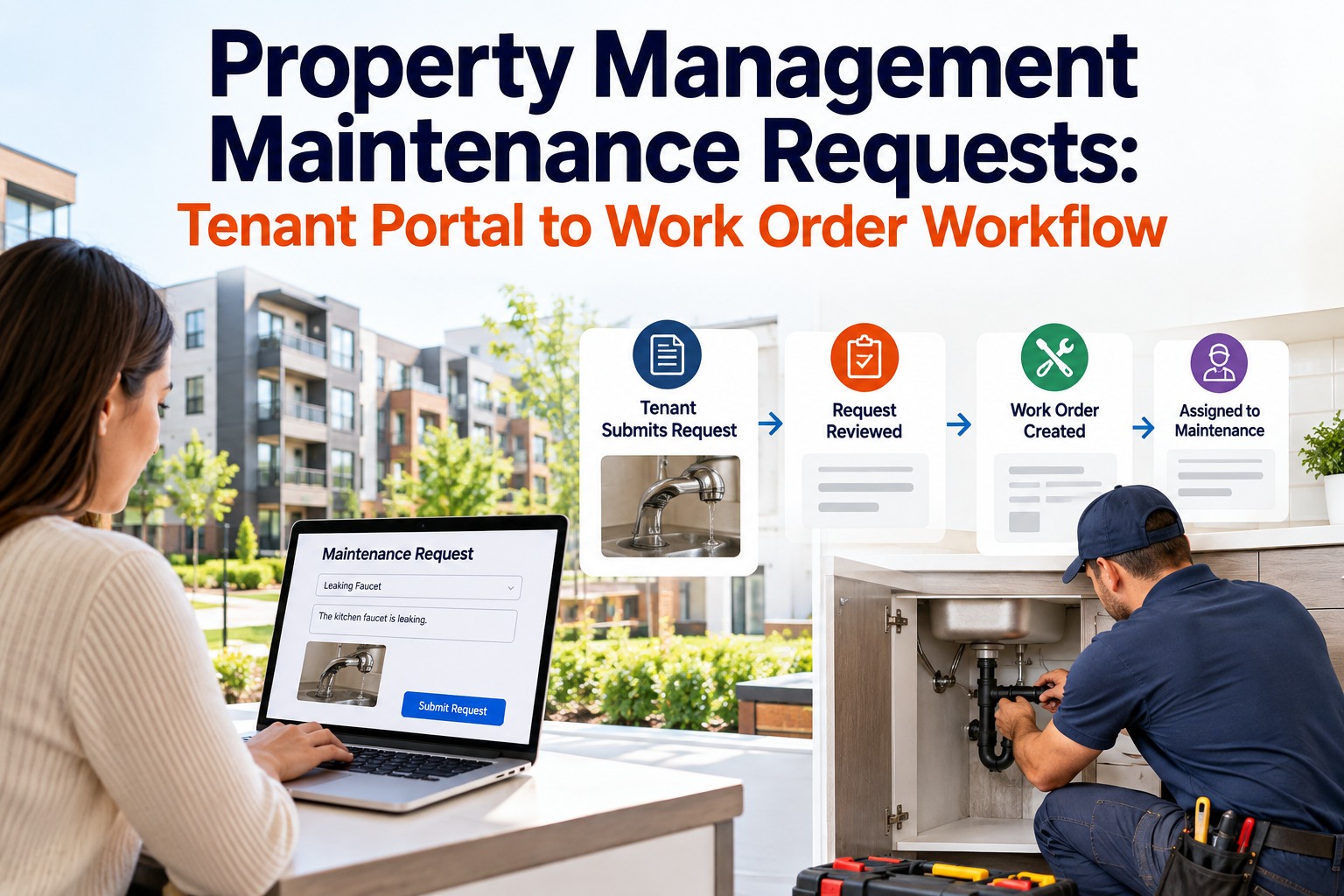
Branded tenant intake portal. Requests auto-route to assigned vendors or in-house techs. Tenants track status in real time. 52% faster resolution replaces the email chaos.
Photo documentation, digital sign-off, insurance certificate tracking, and SLA monitoring. Every vendor invoice links to documented work completion with timestamps.
Asset condition scoring drives rolling CapEx models. Roof, HVAC, elevator, and MEP replacement timelines based on actual condition — not age alone. Investor-grade outputs.
Automated PM scheduling with full technician history per asset. Building system PMs, fire safety inspections, and seasonal maintenance all structured and tracked.
Offline-capable mobile app for supers and technicians. Complete inspections, log work orders, capture photos — no laptop required, no connectivity excuses.
Matching CMMS to Your Property Type
The right platform depends on your portfolio composition. This framework maps property types to the platforms best equipped to handle their specific operational requirements.
Tenant experience, common area maintenance, and building system PM programs are primary drivers. OxMaint delivers this with unlimited user pricing. Building Engines adds premium tenant experience features at higher per-property cost.
High work order volume from tenant requests, unit turnover maintenance, and common area upkeep. OxMaint's tenant portal and unlimited users serve high-volume residential operations. Limble works for smaller portfolios under 15 properties.
Mixed tenant types with different SLA requirements, CAM reconciliation complexity, and diverse building systems. OxMaint handles multi-tenant diversity natively. Facilio adds value when smart building infrastructure exists.
Homeowner request management, common element maintenance, reserve fund planning, and vendor coordination for landscaping, pool, and shared systems. OxMaint's tenant portal adapts to homeowner request workflows seamlessly.
Frequently Asked Questions
How is a property management CMMS different from property management software like Yardi or AppFolio?
Can OxMaint handle both in-house maintenance teams and third-party vendors?
What does the CapEx forecasting feature actually produce?
How quickly can we deploy OxMaint across a 20-property portfolio?
Your Properties Deserve Better Than Spreadsheets and Email
Every day without a structured CMMS is another day of lost vendor accountability, missed preventive maintenance, reactive emergency costs, and CapEx decisions made on guesswork. OxMaint deploys across your portfolio in weeks — not months — with tenant portals, vendor tracking, asset lifecycle scoring, and investor-grade reporting from day one. Most property teams are running live operations within 14 days of signup.


.png)