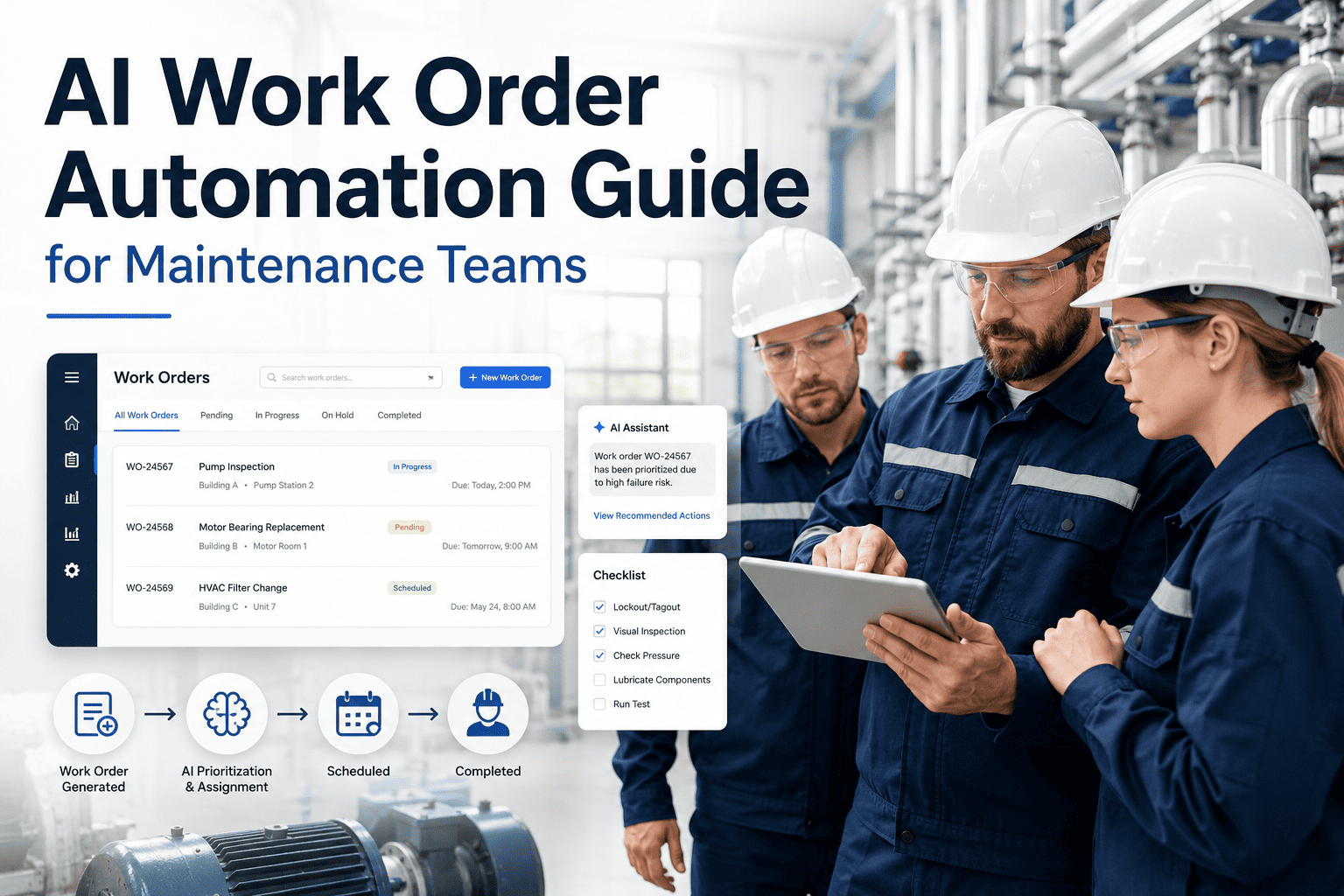
Maintenance teams that still route work orders through email, whiteboards, and radio calls are running a process designed for the 1980s on a plant floor that demands 2020s response times. The gap between work order creation and closure is where costs accumulate, assets deteriorate further, and technician time disappears into scheduling friction. This guide covers how AI work order automation closes that gap — with specific examples of how OxMaint's work order management reduces mean time to close (MTTC) by 40–60%, eliminates manual assignment bottlenecks, and builds the maintenance record quality that supports audits, warranty claims, and reliability analysis.
Work Order Automation Guide
AI Work Order Automation: From Backlog to Closed — Faster
The complete guide for maintenance teams replacing manual routing, assignment delays, and paper trails with an AI-powered workflow that runs itself.
Where Manual Work Order Processes Break Down
42%
of work orders closed more than 2x longer than the planned duration
31%
of technician time spent on non-wrench activities in manual systems
$47K
average annual cost of work order backlog per maintenance team
58%
of reactive work orders lacked a root cause record at closure
The Seven Stages of AI Work Order Automation
1
Trigger Detection
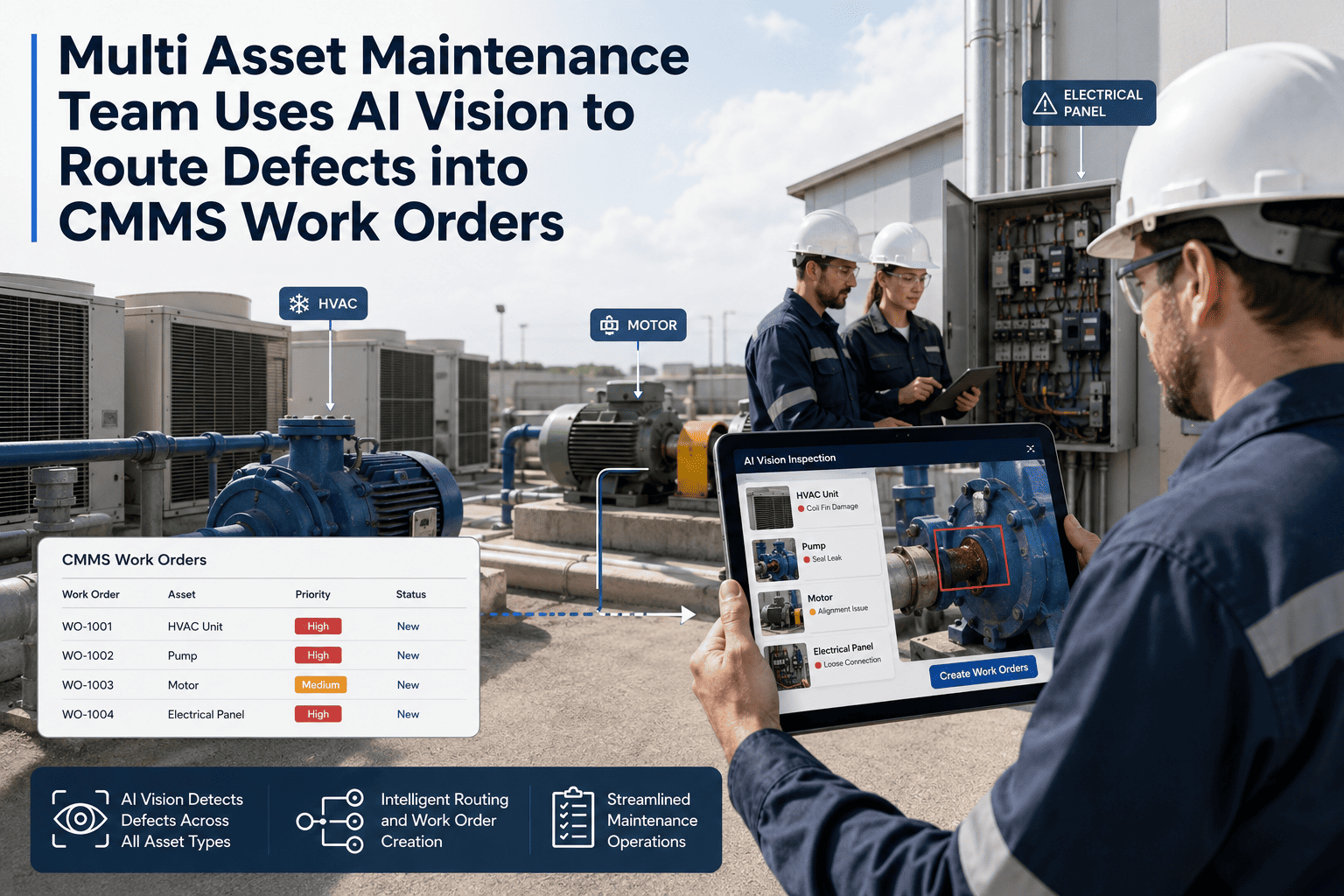
Work order initiated automatically from sensor alert, PM schedule, inspection finding, or operator request — without manual entry duplication.
2
Priority Scoring
AI scores urgency based on asset criticality, failure mode, production impact, and safety risk. No more tribal knowledge priority decisions.
3
Smart Assignment
System matches work order to available technician with right certifications, tools, and proximity. Shift schedule and current workload factored in automatically.
4
Parts and Tools Check
Required parts inventory checked before dispatch. If stock is short, purchase request auto-generated. No technician arrives empty-handed.
5
Mobile Execution
Technician receives full work order on mobile: checklist, manuals, safety permits, and asset history. Completes offline in field and syncs on reconnect.
6
Closure with RCA
Mobile closure requires root cause selection from structured taxonomy. No more blank cause fields. AI suggests likely RCA based on symptom pattern history.
7
Analytics Feed
Every closed work order feeds reliability metrics, cost-per-asset tracking, and PM effectiveness dashboards — automatically, without manual data entry.
Manual vs AI-Automated Work Order: Time Comparison
| Process Stage | Manual Process | AI-Automated (OxMaint) | Time Saved |
|---|---|---|---|
| Work order creation | 8–20 min (phone + entry) | 0–2 min (auto or 1-tap) | ~15 min/WO |
| Priority assessment | 15–30 min (planner review) | Instant (AI scoring) | ~20 min/WO |
| Technician assignment | 10–25 min (schedule check) | Instant (auto-match) | ~18 min/WO |
| Parts verification | 20–45 min (manual check) | 2 min (auto inventory check) | ~35 min/WO |
| Closure documentation | 15–30 min (paper or back-entry) | 5 min (mobile guided) | ~18 min/WO |
| Total per work order | 68–150 min | 7–14 min | ~1.7 hrs/WO |
See OxMaint Work Order Automation Live
From trigger to closure — a complete work order cycle in OxMaint takes under 10 minutes. Book a 30-minute demo and watch the full workflow run on a real plant use case.
Four Metrics That Change After AI Work Order Automation
Mean Time to Close (MTTC)
Before: 4.2 days average
After: 1.9 days average
55% reduction
Backlog Size (Open WOs)
Before: 280 open work orders
After: 107 open work orders
62% reduction
RCA Completion Rate
Before: 42% with root cause
After: 94% with root cause
124% improvement
Wrench Time Ratio
Before: 28% wrench time
After: 52% wrench time
86% improvement
Expert Review
"
The single biggest lever in maintenance productivity is not hiring more technicians — it is reducing the overhead that keeps them from doing maintenance work. Work order administration in a manual system consumes 30–40% of a planner's day and a meaningful fraction of every technician's shift. AI automation reclaims that time without adding headcount. The teams that implement it well typically see wrench time ratios improve from under 30% to above 50% within six months, which is the equivalent of adding 60% more productive capacity to an existing crew.
Marcus Chen, CMRP
Reliability Engineering Director — 20 years maintenance optimization, discrete and process manufacturing
Frequently Asked Questions
How does AI work order automation handle emergency or breakdown maintenance that cannot be pre-planned?
AI automation handles reactive work orders by enabling one-tap or voice-initiated creation from mobile devices — including pre-populated fields from asset QR codes and symptom selection from a structured library. The priority scoring algorithm deprioritizes non-critical backlog automatically when a breakdown work order is created, so the planner's attention is directed to the right place. OxMaint's reactive work order flow is designed specifically for speed in breakdown scenarios without sacrificing documentation quality.
What happens to existing work order history when migrating to OxMaint?
OxMaint's migration tooling imports historical work order records from common CMMS formats, preserving asset linkage, dates, and closure codes. Historical data becomes immediately searchable and feeds reliability analytics from day one — teams do not lose the insights embedded in years of maintenance history. The migration scope and process are reviewed as part of the onboarding demo session.
Can technicians complete work orders on mobile without internet access?
OxMaint is built with offline-first mobile architecture. Technicians download their assigned work orders to their device before entering low-connectivity areas — including confined spaces, remote field locations, and RF-shielded rooms. All updates sync automatically when connectivity is restored, with no data loss and full timestamp integrity preserved. Start a free trial to test the mobile experience on your own device.
Your Work Order Backlog Has a Fix — See It in 30 Minutes
OxMaint's AI work order automation replaces manual routing, assignment guesswork, and paper closure records with a workflow that runs from trigger to analytics automatically. Book a demo built around your team's specific pain point.


.png)
