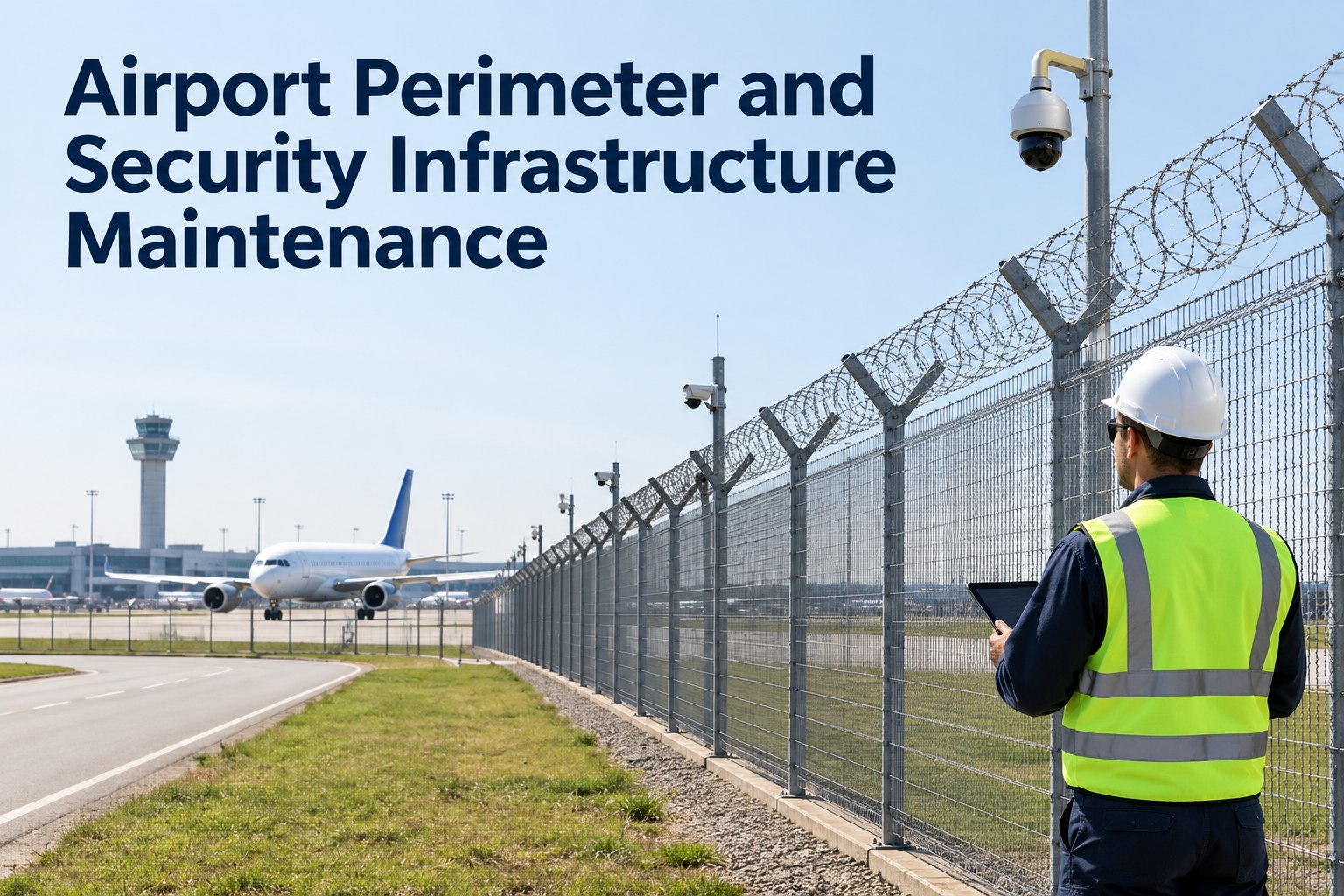
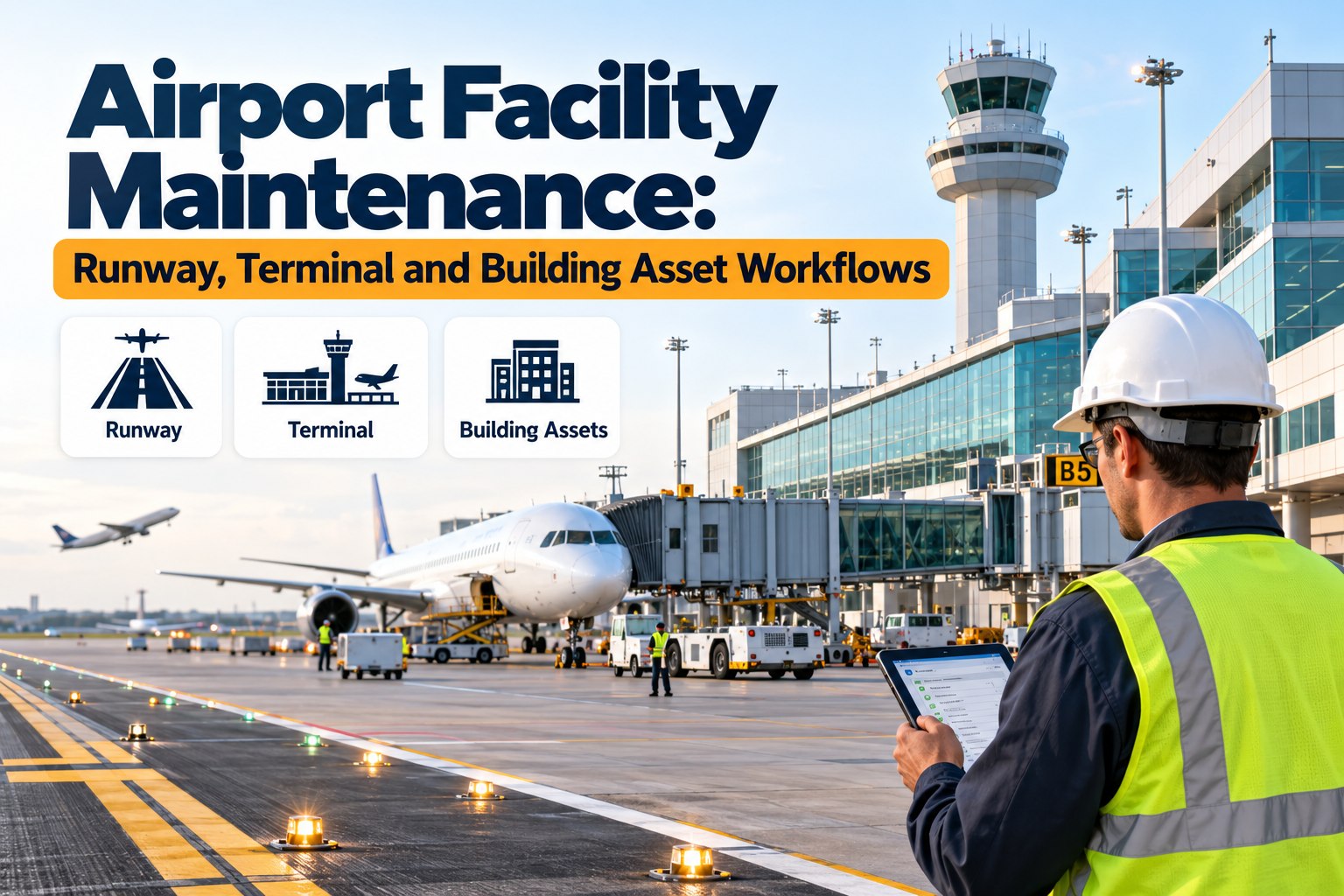
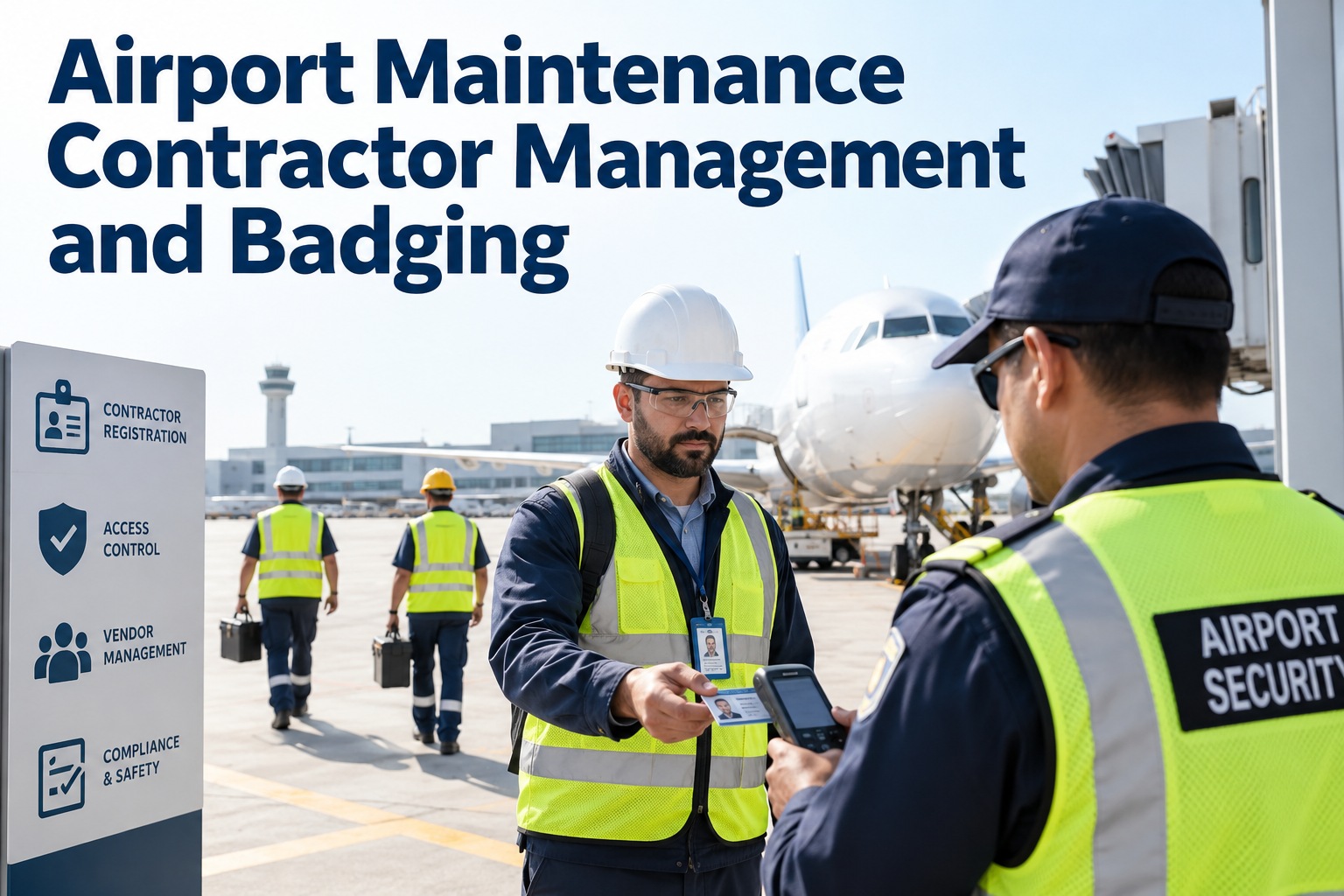
An airport perimeter is not a fence — it is a layered security system of barrier, detection, access control, surveillance, and lighting, and a gap in any one layer is a gap in all of them. This guide covers airport perimeter and security infrastructure maintenance for operations and security coordinators: how to structure inspection routes, the PM that keeps gate operators and access control alive, camera and sensor upkeep, and the 49 CFR Part 1542 documentation trail that turns a breach into a defensible record instead of a civil penalty. Start free on OxMaint to build your perimeter program, or book a demo.
49 CFR Part 1542 · AOA · SIDA · Secured Area
Airport Perimeter & Security Infrastructure Maintenance
A breached perimeter is a security event and a regulatory event in the same instant. Keep every layer operational — and provable.
Daily
Inspection frequency expected for security-critical perimeter zones at commercial airports
12 mo
Minimum retention for perimeter inspection records under the Airport Security Program
5
Security layers — barrier, detection, access control, surveillance, lighting — that must all stay live
Same-day
Corrective-action window expected on a documented perimeter deficiency
The Perimeter Is Five Layers, Not One Fence
Operations directors who run a resilient perimeter stop thinking about "the fence" and start thinking about five interlocking layers. The barrier slows an intruder; detection notices the attempt; access control governs the legitimate openings; surveillance sees it; lighting makes all of that possible after dark. A maintenance program that services the fence but lets a camera blind-spot or a dead gate loop sit unrepaired has not maintained the perimeter — it has maintained one layer of it.
Layer 1
Barrier
Fence fabric, posts, tension, bottom rail, anti-climb and outriggers. Vegetation and berms that create a climbing aid or reduce effective height.
Layer 2
Detection
Fence-mounted and buried intrusion sensors, taut-wire, fiber, and their alarm paths. A sensor that no longer reports is worse than none — it implies coverage that isn't there.
Layer 3
Access Control
Vehicle gates, gate operators, badge readers, and door alarms at every AOA / SIDA / Secured Area opening. The most mechanically failure-prone layer.
Layer 4
Surveillance
CCTV coverage, image quality, recording function, and field-of-view. Coverage drifts as cameras age, mounts sag, and foliage grows into the frame.
Layer 5
Lighting
Perimeter and gate lighting levels, fixture function, and dark zones. Every other layer's effectiveness collapses in an unlit gap after sunset.
The Regulatory Backbone · 49 CFR Part 1542
TSA's airport security regulation governs commercial-service airports through a written Airport Security Program (ASP), and it defines the security areas your perimeter protects. The key idea for a maintenance team: the obligation is continuous, not event-driven — and the work is only compliant if it's documented. Verbal assurance that a gate was checked does not satisfy the standard; the record does.
Secured Area
The most tightly controlled area, covering the portions of the airfield where the highest access-control and identification measures apply.
AOA
Air Operations Area — the airfield movement and non-movement zones. Entry control must prevent and detect unauthorized people and ground vehicles.
SIDA
Security Identification Display Area — where displayed identification media is mandatory. Access points require functioning, maintained control.
Sterile Area
Post-screening passenger area. Its boundary integrity and access points fall inside the same documented-maintenance discipline.
A perimeter breach into any of these areas — via fence damage, gate malfunction, or sensor failure — is a reportable security event. The physical infrastructure failure that created the access condition must be documented and its corrective action recorded. That record is your primary evidence of a proactive program in any TSA enforcement proceeding.
Build a TSA-Aligned Perimeter Inspection Program — Free Forever
Sign up on OxMaint's free plan and deploy daily perimeter inspection routes with inspector ID, timestamp, zone coverage, and deficiency capture built in. Records retain automatically, corrective actions open same-day, and the audit trail is retrievable on demand. No card, no time limit.
The Inspection Route · What a Compliant Walk Captures
A perimeter inspection is a route, not a glance. The value is in consistent coverage of every layer at every segment, captured the same way each time so a deficiency shows up as a deviation from a known-good baseline. Below is the field-standard capture set — the data points a defensible inspection records at each stop.
Fence Line Integrity
Fabric cuts, dig-unders, loose fabric, damaged posts, compromised outriggers, and tension across each segment.
Vegetation & Clear Zone
Growth, berms, debris, or stored equipment on either side that reduces effective height or offers a climbing aid — a standard TSA walkthrough item.
Gate Status & Operation
Each vehicle and pedestrian gate cycles fully, latches and locks, and the operator holds position. No forced-open or held-open condition.
Sensor & Alarm Function
Intrusion sensors report, alarm paths reach the monitoring point, and no zone sits in a masked or bypassed state.
Camera Coverage
Field of view intact, image quality usable, recording confirmed. No new blind spot from a shifted mount or grown foliage.
Lighting & Signage
Fixtures functioning, no dark gaps, and unauthorized-entry warning signs present and legible at access points and along the perimeter.
The PM Layer · Keeping Access Control Alive
Inspection finds the deficiency; preventive maintenance stops it from happening. Access control is the most mechanically stressed layer of the perimeter — gate operators cycle thousands of times, and a failed operator is both a security gap and a traffic bottleneck. These are the PM anchors that keep the electromechanical layers reliable.
Gate Operators
Lubrication, chain / belt tension, limit-switch calibration, safety-loop and photo-eye function, battery backup, and manual-release test. The highest-duty-cycle asset on the perimeter.
Badge Readers & Door Alarms
Reader response, contact and alarm function, tamper detection, and firmware currency at every controlled opening. Every malfunction requires a logged fix.
Cameras & Recorders
Lens cleaning, focus and aim verification, housing and mount integrity, recorder health, and retention-window confirmation.
Sensors & Power
Sensitivity calibration, alarm-path end-to-end test, and UPS / backup power verification so detection survives a power event.
From Deficiency to Closed Record · The Corrective Loop
The moment an inspection finds a fault, a clock starts — and the difference between a proactive program and a citation is whether that clock is documented. The loop below is what turns a perimeter deficiency into a closed, defensible record.
01
Detect & Log
Deficiency captured on the route with location, layer, severity, inspector ID, and timestamp — the moment it's seen.
02
Mitigate
Interim measure where the gap is security-critical — patrol, temporary barrier, or manned post — logged against the deficiency.
03
Corrective WO
Work order to the right craft, initiated same-day for a security deficiency, with the layer and area classification attached.
04
Verify & Close
Repair confirmed, layer back to baseline, record closed and retained. The evidence trail a TSA inspector can pull on demand.
How OxMaint Runs the Perimeter Program
Routes, PM schedules, deficiency capture, corrective work orders, and the retained record all live on one platform — every gate, camera, sensor, and fence segment carried as an asset, so an inspection deviation becomes a work order and a work order becomes an audit-ready record without a binder in sight.
Map
Perimeter as Asset Segments
Fence segments, gates, cameras, and sensors registered by location and security zone — the perimeter as a live asset register, not a drawing.
Route
Daily Inspection Schedules
Repeatable routes with inspector ID, timestamp, zone coverage, and per-layer capture — deployed on mobile, done the same way every shift.
Schedule
PM by Asset Class
Gate-operator, reader, camera, and sensor PM on their own cadence — the electromechanical layers serviced before they fail.
Capture
Deficiency → Corrective WO
A flagged deficiency auto-opens a same-day corrective work order with location, layer, and severity carried through.
Retain
Audit-Ready Records
Inspection logs and corrective actions retained on the required window and retrievable on demand — the proactive-program evidence.
Report
Perimeter Status Rollup
Open deficiencies, overdue PM, and layer health across the whole perimeter in one view for the security coordinator.
Make Your Next TSA Inspection a Records Pull, Not a Scramble
Free forever plan — no card, no time limit. Register your perimeter assets, deploy daily routes, and let every deficiency trace to a same-day corrective work order and a retained record. Or book 30 minutes and we'll map your fence line, gates, and access points onto the platform end to end.
Frequently Asked Questions
How often must airport perimeter security be inspected?
Under 49 CFR Part 1542, commercial airports are expected to inspect security-critical perimeter zones daily, and every inspection must be documented with inspector identification, time, areas covered, and any deficiencies. Records are retained for a minimum of 12 months. The obligation is continuous — the ability to prove the work matters as much as the work itself.
What counts as a reportable perimeter security event?
Unauthorized access or entry into a SIDA, sterile area, or AOA must be reported to TSA. When the access condition was created by physical infrastructure — fence damage, a gate malfunction, a lighting or sensor failure — that failure must be documented and its corrective action recorded. The infrastructure record is part of the incident record.
Why treat the perimeter as five layers instead of just the fence?
Because an intruder only needs one failed layer. The barrier slows entry, detection notices it, access control governs the openings, surveillance sees it, and lighting enables the rest after dark. A program that maintains the fence but leaves a camera blind spot or a dead gate loop has left the perimeter breachable — the layers only work as a set.
What's the most failure-prone part of the perimeter?
Access control — specifically gate operators. They cycle thousands of times and carry the highest mechanical duty on the perimeter, so lubrication, limit-switch calibration, safety-loop testing, and battery-backup checks are the PM anchors that prevent both a security gap and a traffic bottleneck.
Book a demo to see gate-operator PM in the platform.
Why run perimeter compliance in a CMMS instead of spreadsheets?
Because airports fail audits not for skipping the work but for being unable to prove it. A CMMS captures each inspection with ID and timestamp, opens corrective work orders same-day, retains records automatically, and makes the whole trail retrievable in the moment an inspector asks.
Start free to build the audit trail from day one.