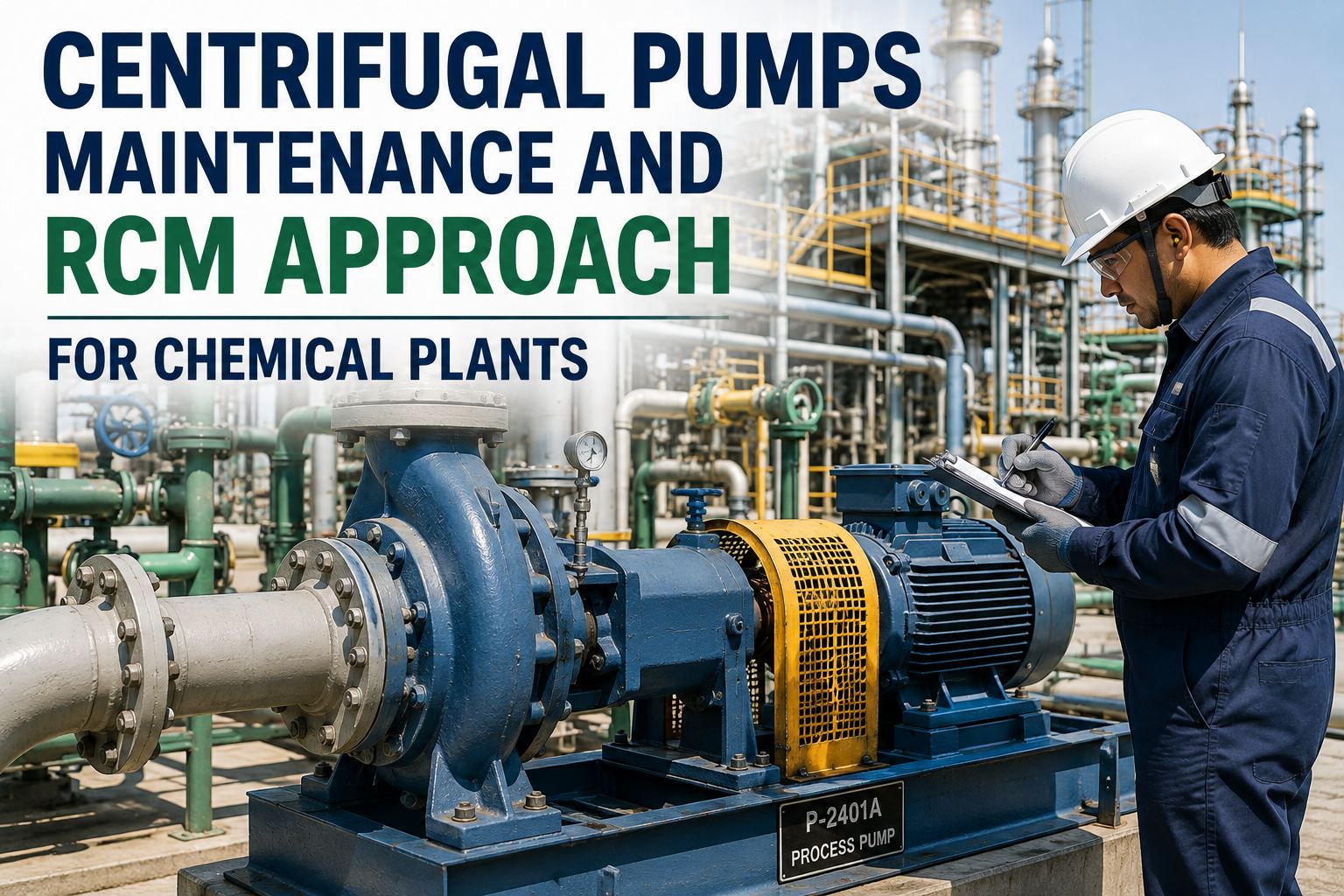
Centrifugal pumps handle the majority of fluid transfer duties in chemical processing plants, making their reliability a direct driver of production throughput, safety, and regulatory compliance. Applying Reliability-Centered Maintenance (RCM) to these critical assets shifts operations from costly reactive firefighting to predictable, condition-based interventions. This guide covers industry-specific failure modes, condition monitoring best practices, and proven RCM maintenance strategies for centrifugal pumps in chemical processing. To implement these workflows seamlessly, you can Start Free Trial of our AI-powered platform and transition your maintenance data into actionable decisions today.
CHEMICAL PROCESSING RELIABILITY
Is Reactive Pump Maintenance Draining Your Chemical Plant's Margin?
Unplanned centrifugal pump failures cost chemical processors up to $50B annually. An RCM-driven approach cuts downtime by up to 50% and extends mean time between failures (MTBF) across your most critical assets. OxMaint operationalizes your RCM strategy from day one.
FAILURE MODES & MECHANISMS
Centrifugal Pumps Failure Modes in Chemical Processing
Up to 70% of centrifugal pump failures in chemical environments stem from just four operational mechanisms. Identifying which failure mode is driving your bad actors is the first step in building a defensible RCM strategy.
Erosion & Cavitation
High-velocity corrosive slurries and sudden pressure drops rapidly degrade impeller vanes and volute casings. Cavitation destroys internal geometry, leading to catastrophic vibration and shaft deflection.
Corrosion & Chemical Attack
Handling aggressive acids and bases degrades mechanical seals and O-rings. Even highly alloyed duplex stainless steel suffers localized pitting when process chemistry deviates outside design limits.
Mechanical Seal Failure
Dry running, misalignment, and thermal shock cause elastomer degradation and face cracking. Seal failure is the leading cause of hazardous chemical leakage in centrifugal pumping systems.
| Failure Mode | Primary Root Cause | RCM Consequence Category |
|---|---|---|
| Bearing Degradation | Poor lubrication, misalignment, vibration | Hidden & Operational |
| Impeller Wear | Erosion from particulates, cavitation | Evident & Environmental |
| Shaft Fracture | Cyclic fatigue, torsional stress | Safety & Critical |
| Casing Perforation | Localized chemical corrosion | Safety & Environmental |
RCM STRATEGY
How to Build a Centrifugal Pumps RCM Strategy for Chemical Processing
A structured RCM checklist tailored for chemical centrifugal pumps ensures that maintenance tasks are both technically feasible and worth doing. Here is the proven 4-step execution path to move from reactive to predictive reliability.
Asset Hierarchy & FMEA Setup
Map your pumps within a structured asset hierarchy. Conduct a Failure Mode and Effects Analysis (FMEA) to identify which pumps handling hazardous or high-temperature chemicals pose the greatest safety, environmental, and production risks. Assign criticality tiers (A, B, C) to determine where full RCM analysis is justified.
Condition-Based vs. Preventive Tasks
For critical A-tier pumps, specify condition-based monitoring (vibration, ultrasound, tribology). For B-tier assets, apply time-based preventive maintenance (PM) schedules like bearing re-greasing and seal flush inspections. Use run-to-failure only for redundant, low-criticality C-tier pumps.
Automate PM Schedules & Workflows
Translate your RCM tasks into automated PM triggers. A centrifugal pumps PM schedule for chemical processing might trigger a vibration analysis every 30 days, a seal inspection every 90 days, and a full teardown at 18,000 run-hours—managed entirely within a digital CMMS.
Continuous Improvement Loop
Feed failure data back into the system to refine task intervals. If condition monitoring detects cavitation before a scheduled inspection, adjust the PM frequency and update the RCM checklist. This continuous feedback loop can improve MTBF by 30-40% within the first year.
INSPECTION & TASKS
Centrifugal Pumps RCM Checklist for Chemical Processing
Use this tiered RCM checklist to standardize inspections across your pump population. Each task directly mitigates a specific failure mode identified during FMEA, ensuring compliance with ISO 55000 asset management standards.
Daily Operator Rounds
- Inspect for visible leaks at mechanical seals and flanges
- Verify discharge and suction pressures match baseline DCS trends
- Listen for abnormal cavitation or bearing acoustic signatures
- Check bearing housing temperature manually or via IR thermography
Monthly Condition Monitoring
- Collect full vibration spectrum data (velocity & acceleration)
- Perform oil analysis for wear metals, viscosity, and water content
- Verify alignment using laser alignment tools (coupling target specs)
- Inspect baseplate grouting for cracks and structural integrity
Quarterly PM & Overhaul Prep
- Perform internal impeller and wear ring clearance measurements
- Re-grease bearings with specified lubricant volume and grade
- Test mechanical seal flush plan (API Plan 53A/53B) pressures
- Audit spare parts inventory for critical seals and bearings
CONDITION MONITORING ROI
The Cost of Reactivity vs. RCM for Chemical Pumps
A chemical plant operating 180 critical centrifugal pumps typically loses $42,000 annually per pump to unplanned downtime, seal replacement, and hazardous spill cleanup. Shifting to an RCM-driven, condition-based approach pays for itself in under 9 months.
RCM Payback Formula for Centrifugal Pumps
Total ROI = (Avoided Downtime Cost + Reduced Spare Parts Spend) - (CMMS Software Cost + Monitoring Sensor Setup)
Worked Example: For a 50-pump fleet, avoiding just 2 catastrophic failures per year ($85K each) saves $170,000. Deducting $36,000 for annual software and sensors yields a net positive ROI of $134,000 in Year 1.
| Maintenance Approach | Annual Pump Downtime | MTBF (Months) | Estimated Cost per Asset |
|---|---|---|---|
| Reactive / Run-to-Failure | 48 - 72 Hours | 8 Months | $42,000 |
| Time-Based PM Only | 24 - 36 Hours | 14 Months | $28,000 |
| RCM & Condition-Based (OxMaint) | 6 - 12 Hours | 28+ Months | $11,500 |
SOLUTION
How OxMaint Powers Your Centrifugal Pumps RCM Strategy
OxMaint is an AI-powered CMMS and Enterprise Asset Management platform built to execute complex RCM strategies without the friction of spreadsheets or paper work orders. Here is how OxMaint specifically transforms centrifugal pump reliability in chemical processing.
Predictive Failure Alerts
OxMaint's AI engine analyzes vibration and temperature data streams from your pumps, automatically generating work orders when anomalies are detected. Outcome: Catch cavitation and bearing wear weeks before catastrophic failure, cutting unplanned downtime by 30-50%.
Automated PM Scheduling
Trigger inspections based on run-hours, calendar intervals, or API flush plan requirements. Outcome: Eliminate missed lubrication routes and ensure your centrifugal pumps PM schedule for chemical processing is executed exactly to spec, every time.
Mobile Work Order Execution
Equip technicians with the OxMaint mobile app to receive digital RCM checklists, log seal readings, and upload thermal images directly from the field. Outcome: Eradicate paper work orders and achieve 100% maintenance data compliance for OSHA and ISO audits.
Spare Parts & Seal Tracking
Link specific mechanical seals, impellers, and bearings directly to the asset hierarchy. Outcome: Maintain optimal safety stock for A-tier critical pumps, reducing emergency procurement spend by up to 25% and accelerating mean time to repair (MTTR).
Stop Firefighting Pump Failures. Start Driving Reliability.
See how OxMaint operationalizes your RCM strategy, automates condition-based work orders, and protects your chemical processing uptime. Book a 30-minute demo with a reliability expert today.
FREQUENTLY ASKED QUESTIONS
Chemical Processing Centrifugal Pumps Maintenance FAQs
What is the best maintenance strategy for centrifugal pumps in chemical processing?
The best strategy is Reliability-Centered Maintenance (RCM) combined with condition-based monitoring. Unlike pure preventive maintenance, RCM identifies the specific failure modes of chemical pumps (like cavitation or seal degradation) and applies targeted predictive tasks—such as vibration analysis and oil monitoring—to prevent failures before they impact production or safety.
How often should chemical centrifugal pumps be inspected?
Daily visual inspections by operators are recommended to check for leaks, noises, and temperature changes. For more detailed RCM tasks, monthly condition monitoring (vibration and oil analysis) and quarterly internal inspections (seal flush plans, alignment checks) are industry best practices. You can automate these varying frequencies easily within a CMMS like OxMaint.
What are the most common failure modes for centrifugal pumps handling chemicals?
The most common failure modes include mechanical seal failure (due to dry running or chemical corrosion), bearing degradation (from misalignment or poor lubrication), impeller erosion (from cavitation or abrasive slurries), and casing perforation. An RCM checklist specifically targets these vulnerabilities with defined inspection thresholds.
How does a CMMS improve centrifugal pump reliability?
A CMMS improves reliability by automating PM schedules based on run-hours, centralizing asset history, and triggering work orders automatically when condition monitoring data breaches safe thresholds. To see how OxMaint digitizes RCM workflows and eliminates paper work orders, Book a Demo with our team.
Can I switch from spreadsheet-based maintenance to an RCM CMMS easily?
Yes. Transitioning from spreadsheets to an AI-powered CMMS like OxMaint is designed to be seamless. You can import your existing asset hierarchy, PM frequencies, and spare parts lists directly into the platform. Teams typically see full adoption and a reduction in reactive maintenance within the first 30-60 days of implementation.
READY TO TRANSFORM YOUR MAINTENANCE?
Implement Your RCM Strategy with OxMaint Today
Join the chemical processing plants that have eliminated unplanned pump downtime, optimized their spare parts inventory, and achieved full regulatory compliance with OxMaint's AI-powered EAM platform.
Free 14-day trial · No credit card required


-optimizing-your-maintenance-strategy.png)