A centrifugal pump does not fail because it is old. It fails because it ran 800 hours a month at 40% of its Best Efficiency Point, or because the suction level dropped and NPSH available slipped 0.4 metres below NPSH required, or because a wear ring opened 0.015 inch and the recirculation cooked the mechanical seal. Bearing failures alone account for approximately 40% of all pump breakdowns in water utilities, and cavitation ranks as the leading cause of centrifugal pump damage in water systems. Every one of these events is preceded by a hydraulic or mechanical signal that a properly-scoped RCM programme catches weeks before the pump goes down. Oxmaint is the maintenance management software water and wastewater utilities use to run that programme — FMEA per pump asset, condition-based triggers on vibration, NPSH margin and seal-pot level, and a full audit trail against every impeller and bearing in the system. Start free and stand up an RCM programme on your critical pumps this week, or book a demo mapped to your raw water intakes, high-service pumps, and lift stations.
Water & Wastewater · Centrifugal Pump · FMEA · RCM
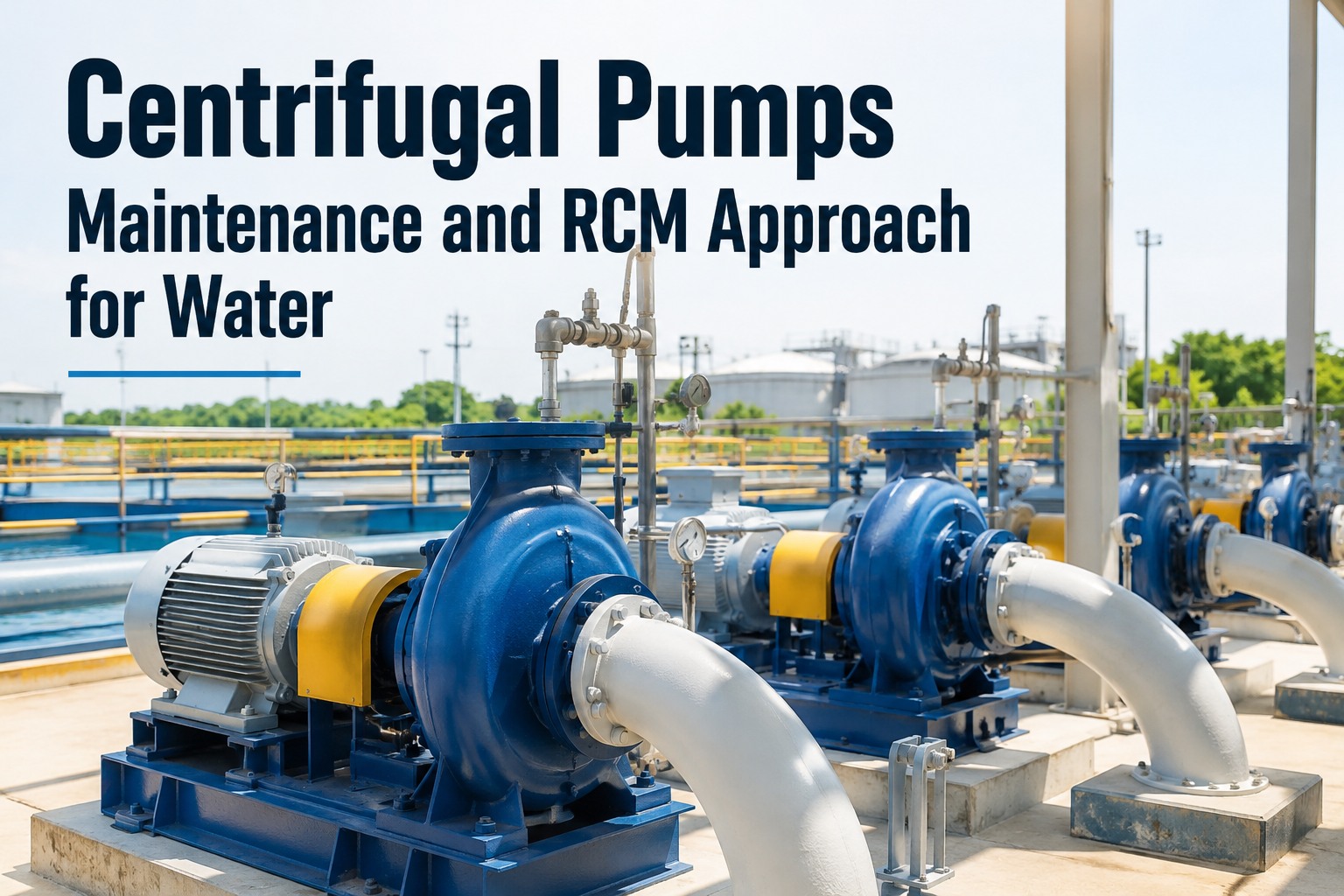
Centrifugal Pumps Maintenance and RCM Approach for Water
Every failure mode, every detection technique, every RCM strategy — organized against the 13 major failure modes documented for water and sewerage centrifugal pumps, the hydraulic vs mechanical split, and the NPSH, BEP and wear-ring thresholds that actually govern pump life.
-
40%
of pump breakdowns in water utilities begin with bearing failure
-
#1
cavitation ranks as the leading cause of pump damage in water systems
-
13
major failure modes identified across water & sewerage centrifugal pumps
-
30–50%
energy saving from VFD control that prevents cavitation at low flow
The Two Failure Families
Hydraulic vs Mechanical — Every Failure Falls Into One
Every centrifugal pump failure sits in one of two families, and the two families need different monitoring techniques. Mechanical faults surface in vibration and temperature; hydraulic degradation surfaces in flow, pressure, and efficiency. Treating them as one hides the actual defect. This split is the working foundation of every RCM programme Oxmaint runs on a pump fleet.
What the Fluid Does to the Pump
- Cavitation (NPSH violation)
- Pressure pulsations
- Suction & discharge recirculation
- Radial & axial thrust imbalance
- Air entrainment / vortex
- Wear ring clearance drift
Detected by: flow, suction pressure, efficiency trending, acoustic monitoring, vibration in the 1–10 kHz band
What the Pump Does to Itself
- Bearing wear / deterioration
- Mechanical seal failure
- Shaft imbalance
- Coupling misalignment
- Impeller wear / erosion
- Fatigue and shaft fracture
Detected by: vibration spectrum, bearing metal temperature, oil analysis, alignment survey, thermography
FMEA Risk Ranking
The Six Components That Drive Pump RPN
Peer-reviewed FMEA of water centrifugal pumps ranked the shaft as the highest Risk Priority Number component (RPN 294) and the wearing ring as the lowest (RPN 54). The Pareto ranking below is the working priority order — load these into Oxmaint as the first set of asset records to receive full RCM analysis, and the low-RPN components stay on standard PM until the programme expands.
-
1
Shaft
RPN 294Fatigue fracture from thrust imbalance, misalignment, or repeated dry-start events. Preventive strategy: alignment discipline, vibration trending, dry-run interlock.
-
2
Coupling
HighElement wear, misalignment-driven degradation. Preventive: alignment after every uncoupling, coupling inspection at PM interval.
-
3
Stuffing Box / Seal
HighFace wear, dry-running, abrasive damage. Preventive: seal pot level and pressure trending, flush plan per API 682.
-
4
Motor
Medium-HighWinding insulation, bearing failure. Preventive: motor current signature analysis, thermography, insulation resistance testing.
-
5
Impeller
MediumCavitation pitting, erosion, clogging. Preventive: NPSH margin discipline, performance trending, borescope at outage.
-
6
Wear Ring
RPN 54Clearance growth. Preventive: measure at outage — replace when clearance exceeds 0.010 inch per inch of shaft diameter.
The Cavitation Gauge
NPSH Margin — The Single Most Important Number in Pump Health
Cavitation begins the moment NPSH available falls below NPSH required — even by small margins. The published rule of thumb is that NPSH margin should exceed 0.5× NPSHr with a safety buffer. Below that, the pump is self-destructing through vapour-bubble collapse on the impeller vanes. Oxmaint tracks NPSH margin as a first-class KPI on every asset, and any drift below the alert threshold auto-generates a condition-based work order.
Detection: sharp rattling / gravel-like noise at the suction eye, unstable discharge pressure, broadband vibration energy in the 1–10 kHz band, pitting damage on impeller vanes at borescope. Correcting NPSH deficiency (raise suction level, reduce fluid temperature, throttle discharge) resolves the root cause.
The BEP Envelope
Where a Centrifugal Pump Wants to Live
The Best Efficiency Point is the flow rate at which hydraulic forces on the impeller are most balanced. Operating away from BEP — either too low or too high — increases radial and axial forces on the impeller and shaft, accelerating bearing and mechanical seal wear. Most centrifugal pumps require continuous flow of at least 30–40% of design capacity to avoid deadheading damage.
- Below 30% of design capacity: deadhead risk, temperature rise, seal failure. Recirculation line or automatic recirculation valve required.
- 30% to 80% of BEP: radial thrust rising, bearing L10 life reducing, seal wear accelerated.
- Around BEP: hydraulic forces balanced, bearing and seal life maximised. Design the duty point here whenever possible.
- Above 120% of BEP: runout, motor overload risk, NPSHr climbs — cavitation risk if NPSHa does not follow.
A Small Number That Costs a Big One
2 to 3 Mils of Offset Misalignment Cuts Bearing L10 Life by 50%+
Misalignment is one of the leading contributors to premature bearing failure in centrifugal pumps. Even 2–3 mils of offset misalignment can reduce bearing L10 life by 50% or more due to increased radial loading. Oxmaint schedules alignment surveys after every uncoupling as a mandatory work-order step — no coupling is closed out without alignment values in the record.
Water-Industry Service Duties
Same Pump, Different Failure Story by Service
A high-service pump moving finished water and a submersible in a lift station wet well are the same type of machine failing on different mechanisms. Scoping RCM per service type — rather than per model — puts the right monitoring against the right dominant failure. Oxmaint tags each pump asset with its service class and drives failure-mode scope from that tag.
-
A
Raw Water Intake
Debris and sediment ingress dominant. Wear ring and impeller erosion accelerated. Strainer ΔP and shaft vibration lead the monitoring set.
-
B
High-Service (Potable)
Long runtime near-BEP, seal reliability drives life. Motor current, seal pot level, and NPSH margin the key indicators.
-
C
Booster & Pressure Zone
Cycling and pressure surge dominant. Bearing wear from start-count and pressure transient are the killers; VFD control extends life.
-
D
Lift Station Submersible
Rag build-up and float switch reliability dominant. Volute clog check, seal chamber leak sensor, and float function test.
-
E
RAS / WAS Sludge
Abrasive solids, high wear rate. Impeller erosion trending and mechanical seal flush plan per API 682 lead the strategy.
-
F
Chemical Feed / Dosing
Setpoint calibration and diaphragm wear dominant. Weekly calibration check to hold within the SDWA 3% treatment-technique deviation.
Signal-to-Mode Matrix
Which Sensor Actually Catches Which Failure
A common trap is instrumenting a pump with vibration and assuming that covers everything. Different failure modes light up different sensors. This matrix maps signal to mode so the monitoring investment lands where it earns its detection. Oxmaint uses this map to configure the condition triggers automatically.
| Signal | Primary Failure Mode Detected | Threshold Behaviour | PF Interval |
|---|---|---|---|
| Vibration overall (mm/s RMS) | Unbalance, misalignment, bearing wear | Rising trend against baseline, ISO 10816 limits | Weeks |
| Vibration spectrum (1–10 kHz) | Cavitation, bearing defect frequencies | Broadband energy rise, defect-frequency peaks | Weeks |
| Bearing metal temperature | Bearing wear, lube starvation | Rise > 5–8°F above baseline sustained | Days to weeks |
| Suction pressure / NPSHa | Cavitation onset, strainer clog, air ingress | NPSH margin drops below 0.5× NPSHr | Immediate |
| Motor current / VFD load | Impeller wear, deadhead, blockage | Drop indicates worn impeller, spike indicates block | Weeks |
| Seal pot pressure / level | Seal face wear, primary seal leak | Level drop or pressure loss beyond envelope | Days |
| Flow vs pump curve | Wear ring clearance growth, impeller erosion | Actual flow below curve at rated head | Months |
Built for Water Utilities
How Oxmaint Runs Pump RCM Across a Utility Fleet
-
Per-Pump FMEA
Failure Modes and RPN Stored as Structured Fields
Every pump asset carries its own FMEA — modes, causes, effects, detection technique, and RCM strategy — retrievable by any engineer, not stored in a retiring technician's head.
-
NPSH Guardrail
Margin Below 0.5× NPSHr Auto-Escalates
Suction pressure and calculated NPSH margin tracked as a first-class KPI. Any drift below the alert threshold generates a condition-based corrective work order immediately.
-
Alignment Discipline
No Coupling Closed Without Alignment Values
Alignment survey is a mandatory work-order step after every uncoupling. The record is the countermeasure to the 2–3 mils that halves bearing L10 life.
-
Wear Ring Tracking
Clearance Threshold Fires the Replacement WO
Measured wear-ring clearance stored against the asset. Exceedance of 0.010 inch per inch of shaft diameter fires the parts and labour work package for the next outage.
-
Service Tagging
Raw Water, Potable, Lift Station Scoped Separately
Each pump tagged with its service class so the right dominant failure mode set is applied — impeller erosion for raw water, seal reliability for high-service, rag build-up for lift-station.
-
Closed-Loop Feedback
Findings Refine the FMEA Over Every Cycle
Every closed work order — measured vibration, parts replaced, condition observed — feeds back into asset history. Inspections that consistently find nothing get relaxed; modes occurring early get tightened.
Measured Outcomes
What Water Utilities Gain When RCM Runs in the CMMS
-
40%
Bearing Failures Caught Early
The share of pump breakdowns that begin at the bearing is caught in the vibration and temperature trend before it takes down the seal, the impeller, and the outage schedule.
-
Zero
Unmeasured Alignments
Every uncoupling generates a mandatory alignment record. The 2–3 mils that halves L10 life stops being invisible.
-
30–50%
Energy Saved on Low-Flow VFDs
VFD control shifts the pump curve to match system demand — eliminates throttling losses and prevents low-flow cavitation on the same asset.
-
$0
Free Forever Plan to Start
Reliability teams load an initial FMEA against the highest-consequence pump on the free plan and scale into the full platform as the programme matures.
Frequently Asked
Centrifugal Pump RCM Questions
Where should a water utility start applying RCM to its pump fleet?
Start with the highest-consequence pumps — high-service potable, main intake, and critical lift stations — and load full FMEA against them first. Lower-consequence pumps (booster on redundant zones, non-critical process) stay on standard PM until the programme expands. Start free and load your first pump FMEA today.
What is the earliest sign of cavitation in a water pump?
A sharp gravel-rattling noise at the suction eye, unstable discharge pressure readings, and broadband vibration energy in the 1–10 kHz band. NPSH margin below 0.5× NPSHr is the numeric threshold. Correcting NPSH deficiency by raising the suction level or reducing fluid temperature resolves the root cause.
When should a wear ring be replaced?
When measured clearance exceeds 0.010 inch per inch of shaft diameter. A worn wear ring increases internal recirculation, reduces efficiency, and overheats the mechanical seal — so the ring often takes the seal with it if replacement is deferred. Book a demo to see wear-ring clearance tracking on your pumps.
Does BEP operation really matter that much for pump life?
Yes. Operating significantly away from BEP increases radial and axial forces on the impeller and shaft, accelerating bearing and mechanical seal wear. Design the duty point at or near BEP; use VFD control to shift the curve rather than throttling; keep continuous flow at least 30–40% of design capacity.
Is there a free plan for smaller utilities?
Yes. Oxmaint offers a free forever plan — enough to load a first FMEA against the highest-consequence pump, configure condition triggers, and prove RCM value against a real event before scaling to the full fleet. Sign up for the free plan and stand up your first pump FMEA today.
FMEA · Monitor · Extend
Every Pump Failure Was in the Vibration, the NPSH, or the BEP Deviation
The FMEA above is the framework. Oxmaint is the maintenance management software that turns it into scheduled, mobile-first, condition-triggered work — every bearing, every seal, every impeller — for every raw-water intake, high-service pump, and lift-station submersible in the utility. Stop maintaining pumps by calendar and start maintaining them by failure mode and consequence.